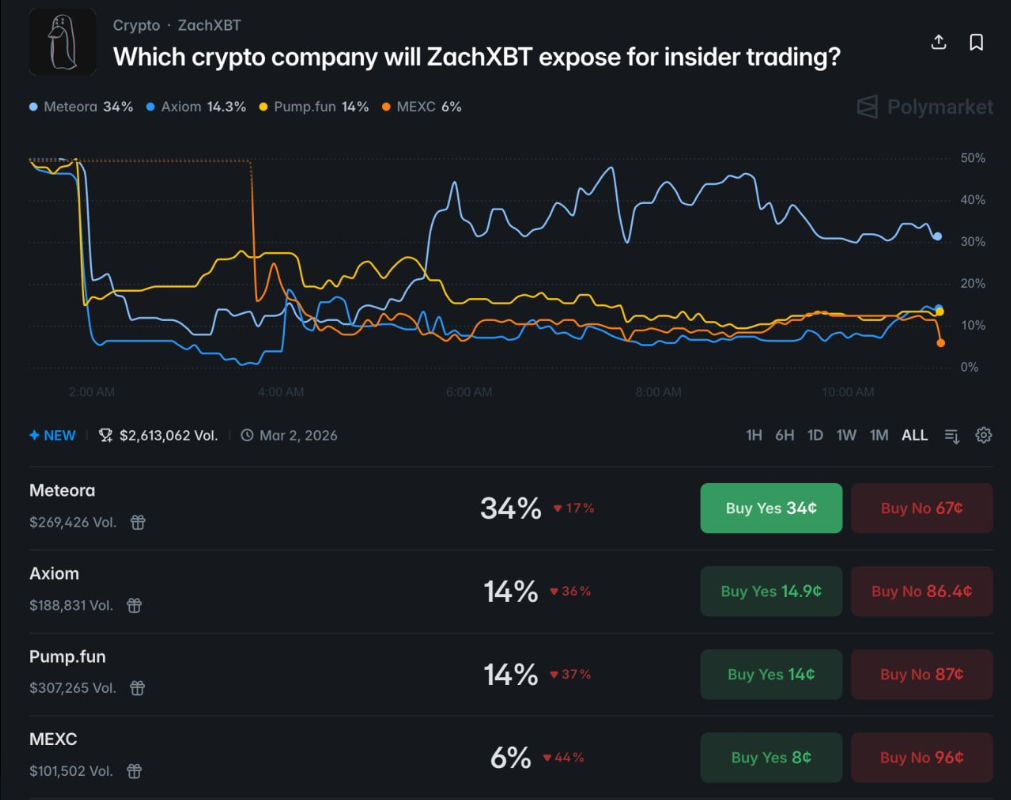
ZachXBT’s Teaser Sparks $2M in Prediction Market Bets

TheNewsCryptoPublished on 2026-02-24Last updated on 2026-02-24

Abstract

Crypto researcher ZachXBT sparked significant speculation and market activity with a cryptic tweet, leading to over $2 million in prediction market bets. While the tweet lacked specific details, it raised concerns due to ZachXBT's history of exposing fraud and tracking illicit funds in DeFi. The crypto market reacted with slight price volatility as traders and analysts attempted to gauge potential implications for major exchanges or enforcement actions. Risk management was tightened amid the uncertainty. The community awaits further clarification, expecting ZachXBT to provide evidence such as documentation or transaction hashes, as he has done in past investigations. Despite the speculation, derivatives funding rates remained stable, and no defensive actions have been announced by exchanges or projects.

Crypto researcher ZachXBT ignited massive speculations on social media platforms with a cryptic tweet posted late last night. Market observers immediately dissected the cryptic message and speculated on the possible market implications of the developments for current blockchain research in the crypto market. The tweet did not include specific information on the projects involved. So, this lighted concerns for its followers worldwide. However, observers have noted that ZachXBT has a history of exposing fraud schemes. And also for tracing the movement of illicit funds in decentralized finance markets.

The prices of the cryptocurrencies reacted with a slight variation here. The market attempted to understand whether the warning was an indication of enforcement actions or revelations for the major exchanges. Some analysts noted that the lack of details made it difficult to have any definitive opinions on the entities and the levels of transactions at this stage. Trading floors did, however, tighten risk management tools pending more information from the blockchain researcher on the suspected problem. On-chain analysts reviewed transactions associated with dormant accounts for any significant relationships in the wake of the publication yesterday.
Community Awaits Clarification

ZachXBT has, in the past, created in-depth threads that traced the wallets. He named the culprits based on evidence for every claim. The community, therefore, expects a subsequent breakdown that may list the findings or debunk the theories on it. The overall market environment is still sensitive to investigative findings that tend to affect the value of tokens in global exchanges.

Investors are still following official channels to distinguish between verified reports and mere speculations that tend to spread quickly on the internet. The overall regulatory environment this year has made traders more vigilant in response to investigative findings that tend to affect the overall digital asset market. Experts indicate that evidence tends to determine the effect of allegations on the market.

Until new updates come out, the exchanges and project teams perform normal operations without making any announcements regarding defensive actions related to the message itself. Market data providers observed that the derivatives funding rates were stable despite the heightened discussion about the statement made by the investigator today. The market players look forward to having more direction after ZachXBT shares evidence in the form of documentation, timestamps, or transaction hashes related to the initial message posted on social media platforms.

Highlighted Crypto News:

Crypto Funds Shed $4B as Outflows Hit Five-Week Streak

Tagsprediction marketzachbxtZachXBT

Related Questions

QWhat was the immediate market reaction to ZachXBT's cryptic tweet?

AThe prices of cryptocurrencies reacted with slight variations, and trading floors tightened risk management tools while awaiting more information.

QWhat is ZachXBT known for in the crypto community?

AZachXBT is known for exposing fraud schemes and tracing the movement of illicit funds in decentralized finance markets.

QHow did the community expect ZachXBT to follow up on the initial tweet?

AThe community expected a subsequent breakdown with findings, likely in the form of documentation, timestamps, or transaction hashes, as he has done in the past.

QWhat was the observed impact on derivatives funding rates despite the speculation?

AMarket data providers observed that derivatives funding rates remained stable despite the heightened discussion about ZachXBT's statement.

QWhat are investors doing to distinguish between fact and speculation regarding ZachXBT's tweet?

AInvestors are following official channels to distinguish between verified reports and mere speculations that spread quickly online.

Related Reads

OpenAI Post-Training Engineer Weng Jiayi Proposes a New Paradigm Hypothesis for Agentic AI

OpenAI engineer Weng Jiayi's "Heuristic Learning" experiments propose a new paradigm for Agentic AI, suggesting that intelligent agents can improve not just by training neural networks, but also by autonomously writing and refining code based on environmental feedback. In the experiment, a coding agent (powered by Codex) was tasked with developing and maintaining a programmatic strategy for the Atari game Breakout. Starting from a basic prompt, the agent iteratively wrote code, ran the game, analyzed logs and video replays to identify failures, and then modified the code. Through this engineering loop of "code-run-debug-update," it evolved a pure Python heuristic strategy that achieved a perfect score of 864 in Breakout and performed competitively with deep reinforcement learning (RL) algorithms in MuJoCo control tasks like Ant and HalfCheetah. This approach, termed Heuristic Learning (HL), contrasts with Deep RL. In HL, experience is captured in readable, modifiable code, tests, logs, and configurations—a software system—rather than being encoded solely into opaque neural network weights. This offers potential advantages in explainability, auditability for safety-critical applications, easier integration of regression tests to combat catastrophic forgetting, and more efficient sample use in early learning stages, as demonstrated in broader tests on 57 Atari games. However, the blog acknowledges clear limitations. Programmatic strategies struggle with tasks requiring long-horizon planning or complex perception (e.g., Montezuma's Revenge), areas where neural networks excel. The future vision is a hybrid architecture: specialized neural networks for fast perception (System 1), HL systems for rules, safety, and local recovery (also System 1), and LLM agents providing high-level feedback and learning from the HL system's data (System 2). The core proposition is that in the era of capable coding agents, a significant portion of an AI's learned experience could be maintained as an auditable, evolving software system.

marsbit30m ago

OpenAI Post-Training Engineer Weng Jiayi Proposes a New Paradigm Hypothesis for Agentic AI

marsbit30m ago

Your Claude Will Dream Tonight, Don't Disturb It

This article explores the recent phenomenon of AI companies increasingly using anthropomorphic language—like "thinking," "memory," "hallucination," and now "dreaming"—to describe machine learning processes. Focusing on Anthropic's newly announced "Dreaming" feature for its Claude Agent platform, the piece explains that this function is essentially an automated, offline batch processing of an agent's operational logs. It analyzes past task sessions to identify patterns, optimize future actions, and consolidate learnings into a persistent memory system, akin to a form of reinforcement learning and self-correction. The article draws parallels to similar features in other AI agent systems like Hermes Agent and OpenClaw, which also implement mechanisms for reviewing historical data, extracting reusable "skills," and strengthening long-term memory. It notes a key difference from human dreaming: these AI "dreams" still consume computational resources and user tokens. Further context is provided by discussing the technical challenges of managing AI "memory" or context, highlighting the computational expense of large context windows and innovations like Subquadratic's new model claiming drastically longer contexts. The core critique argues that this strategic use of human-centric vocabulary does more than market products; it subtly reshapes user perception. By framing algorithms with terms associated with consciousness, companies blur the line between tool and autonomous entity. This linguistic shift can influence user expectations, tolerance for errors, and even perceptions of responsibility when systems fail, potentially diverting scrutiny from the companies and engineers behind the technology. The article concludes by speculating that terms like "daydreaming" for predictive task simulation might be next, continuing this trend of embedding the idea of an "inner life" into computational processes.

marsbit32m ago

Your Claude Will Dream Tonight, Don't Disturb It

marsbit32m ago

Trading

Spot
Futures
活动图片

