XRP Velocity Rallies Back To Yearly Highs After Months Of Cooling – What This Means

bitcoinistPublished on 2026-02-05Last updated on 2026-02-05

Abstract

XRP Ledger transaction velocity has surged to a yearly high of 0.013, matching previous peaks from 2025, indicating heightened network activity and usage despite a recent price decline to $1.43. This increased velocity suggests growing economic engagement, such as trading, payments, or DeFi activity, rather than dormant holding. Analyst Xaif Crypto notes this level often signals critical market turning points and potential redistribution. Concurrently, large holders (whales with至少1 million XRP) are accumulating again, adding over 42 addresses since January 2026, bringing the count to 2,016. This whale activity, holding over $2 million in XRP, reflects underlying confidence not yet mirrored in price action, with trading volume rising 30% amid the downturn.

The XRP Ledger is currently operating at a rapid level as transactions and usage continue to climb, pointing to growing demand for block space and network utility beneath the surface. With this significant usage, the Ledger’s transaction velocity has spiked to record levels.

Transaction Velocity On The XRP Ledger climbs

While prices are trending downward due to the current volatile state of the cryptocurrency market, XRP’s on-chain momentum is steadily picking up pace. Currently, XRP Ledger transaction velocity is rising again after months of a slowdown.

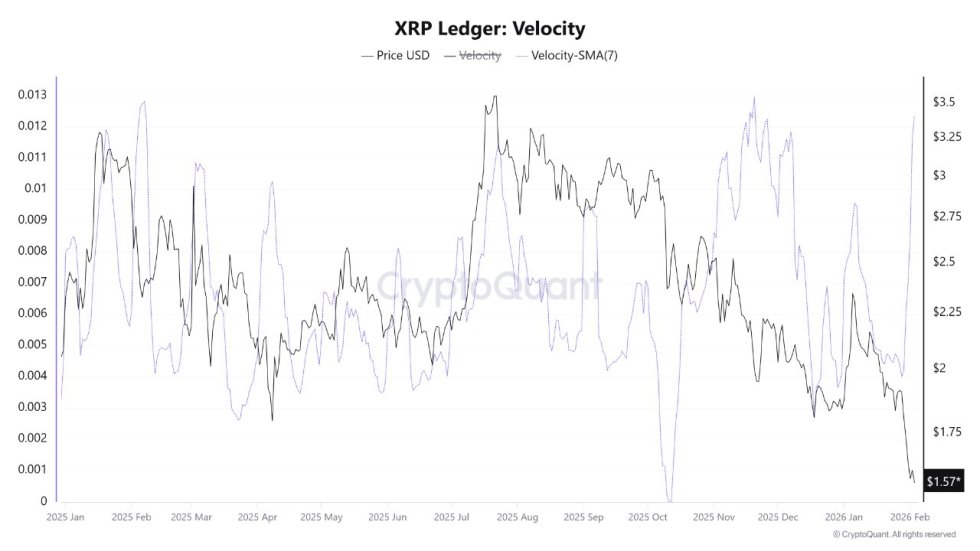
Following an analysis of the chart, Xaif Crypto, a market expert and investor, has found that the XRP velocity has risen to 0.013, which matches the yearly highs last seen in 2025. The rise indicates that the token is moving more actively around the network, which is indicative of increased engagement and usage rather than dormant holding behavior.

Increased velocity steadily indicates growing economic activity, whether it is fueled by trade, payments, or Decentralized Finance (DeFi) involvement. Even if price action has not yet completely reflected the shift, this metric’s return to high territory indicates that interest in using XRP on-chain is growing.
Source: Chart from Xaif Crypto on X

A major insight from the increased velocity is that the network turnover is at its peak with price sitting at $1.57, suggesting high on-chain circulation during a decline. Xaif Crypto highlighted that the development, which the analyst flagged as a high-friction event, suggests an impending major redistribution phase.

In the past, the current 0.013 level often denotes critical turning points for the market. As a result, the expert believes that it is worth monitoring the trend for potential capitulation signals.

Large Holders Are Returning, And Are Steadily Buying

Despite the ongoing pullback in price, a crucial shift in sentiment is being observed among XRP investors, especially the large holders. From the data shared by Xaif Crypto, whales are showing renewed conviction in the altcoin as they start to accumulate once again.

This renewed buying activity is being conducted by wallet addresses holding at least 1 million XRP. After a period of relative inactivity, the number of these key investors is growing for the first time since September 2025. Such a trend implies that these investors might be preparing themselves ahead of possible market shifts in the future.

Data shows that more than 42 whale wallet addresses have been added since January 1, 2026, which brings the total number of whale addresses to about 2,016. Interestingly, these wallet addresses now contain over $2 million in XRP. This fresh buying activity, which is reshaping the token’s supply dynamics, frequently appears at subtle phases when underlying confidence is not reflected in price behavior.

At the time of writing, the altcoin’s price was trading at $1.43 after dropping by more than 10% in the last 24 hours. Despite declining price action, its trading volume has risen by over 30% in the past day.

XRP trading at $1.43 on the 1D chart | Source: XRPUSDT on Tradingview.com

Related Questions

QWhat has the XRP Ledger's transaction velocity risen to, according to market expert Xaif Crypto?

AThe XRP Ledger's velocity has risen to 0.013, which matches the yearly highs last seen in 2025.

QWhat does an increase in XRP's velocity typically indicate about network activity?

AAn increase in velocity indicates that the token is moving more actively around the network, which is indicative of increased engagement, usage, and growing economic activity rather than dormant holding behavior.

QWhat critical shift in sentiment is being observed among XRP investors, specifically large holders?

ADespite the price pullback, large holders (whales) are showing renewed conviction and have started to accumulate XRP again after a period of inactivity.

QHow many new whale wallet addresses (holding at least 1 million XRP) have been added since January 1, 2026?

AMore than 42 whale wallet addresses have been added since January 1, 2026, bringing the total to about 2,016.

QWhat was the price of XRP and its 24-hour trading volume change at the time of writing?

AAt the time of writing, XRP's price was $1.43 after dropping by more than 10% in the last 24 hours, while its trading volume had increased by over 30% in the same period.

Related Reads

Gensyn AI: Don't Let AI Repeat the Mistakes of the Internet

In recent months, the rapid growth of the AI industry has attracted significant talent from the crypto sector. A persistent question among researchers intersecting both fields is whether blockchain can become a foundational part of AI infrastructure. While many previous AI and Crypto projects focused on application layers (like AI Agents, on-chain reasoning, data markets, and compute rentals), few achieved viable commercial models. Gensyn differentiates itself by targeting the most critical and expensive layer of AI: model training. Gensyn aims to organize globally distributed GPU resources into an open AI training network. Developers can submit training tasks, nodes provide computational power, and the network verifies results while distributing incentives. The core issue addressed is not decentralization for its own sake, but the increasing centralization of compute power among tech giants. In the era of large models, access to GPUs (like the H100) has become a decisive bottleneck, dictating the pace of AI development. Major AI companies are heavily dependent on large cloud providers for compute resources. Gensyn's approach is significant for several reasons: 1) It operates at the core infrastructure layer (model training), the most resource-intensive and technically demanding part of the AI value chain. 2) It proposes a more open, collaborative model for compute, potentially increasing resource utilization by dynamically pooling idle GPUs, similar to early cloud computing logic. 3) Its technical moat lies in solving complex challenges like verifying training results, ensuring node honesty, and maintaining reliability in a distributed environment—making it more of a deep-tech infrastructure company. 4) It targets a validated, high-growth market with genuine demand, rather than pursuing blockchain integration without purpose. Ultimately, the boundaries between Crypto and AI are blurring. AI requires global resource coordination, incentive mechanisms, and collaborative systems—areas where crypto-native solutions excel. Gensyn represents a step toward making advanced training capabilities more accessible and collaborative, moving beyond a niche controlled by a few giants. If successful, it could evolve into a fundamental piece of AI infrastructure, where the most enduring value in the AI era is often created.

marsbit9h ago

Gensyn AI: Don't Let AI Repeat the Mistakes of the Internet

marsbit9h ago

Why is China's AI Developing So Fast? The Answer Lies Inside the Labs

A US researcher's visit to China's top AI labs reveals distinct cultural and organizational factors driving China's rapid AI development. While talent, data, and compute are similar to the West, Chinese labs excel through a pragmatic, execution-focused culture: less emphasis on individual stardom and conceptual debate, and more on teamwork, engineering optimization, and mastering the full tech stack. A key advantage is the integration of young students and researchers who approach model-building with fresh perspectives and low ego, prioritizing collective progress over personal credit. This contrasts with the US culture of self-promotion and "star scientist" narratives. Chinese labs also exhibit a strong "build, don't buy" mentality, preferring to develop core capabilities—like data pipelines and environments—in-house rather than relying on external services. The ecosystem feels more collaborative than tribal, with mutual respect among labs. While government support exists, its scale is unclear, and technical decisions appear driven by labs, not state mandates. Chinese companies across sectors, from platforms to consumer tech, are building their own foundational models to control their tech destiny, reflecting a broader cultural drive for technological sovereignty. Demand for AI is emerging, with spending patterns potentially mirroring cloud infrastructure more than traditional SaaS. Despite challenges like a less mature data industry and GPU shortages, Chinese labs are propelled by vast talent, rapid iteration, and deep integration with the open-source community. The competition is evolving beyond a pure model race into a contest of organizational execution, developer ecosystems, and industrial pragmatism.

marsbit11h ago

Why is China's AI Developing So Fast? The Answer Lies Inside the Labs

marsbit11h ago

3 Years, 5 Times: The Rebirth of a Century-Old Glass Factory

Corning, a 175-year-old glass company, is experiencing a dramatic revival as a key player in AI infrastructure, driven by surging demand for high-performance optical fiber in data centers. AI data centers require vastly more fiber than traditional ones—5 to 10 times as much per rack—to handle high-speed data transmission between GPUs. This structural demand shift, coupled with supply constraints from the lengthy expansion cycle for fiber preforms, has created a significant supply-demand gap. Nvidia has invested in Corning, along with Lumentum and Coherent, in a $4.5 billion total commitment to secure the optical supply chain for AI. Corning's competitive edge lies in its expertise in producing ultra-low-loss, high-density, and bend-resistant specialty fiber, which is critical for 800G+ and future 1.6T data rates. Its deep involvement in co-packaged optics (CPO) with partners like Nvidia further solidifies its position. While not the largest fiber manufacturer globally, Corning's revenue from enterprise/data center clients now exceeds 40% of its optical communications sales, and it has secured multi-year supply agreements with major hyperscalers including Meta and Nvidia. Financially, Corning's optical communications revenue has surged, doubling from $1.3 billion in 2023 to over $3 billion in 2025. Its stock price has risen nearly 6-fold since late 2023. Key future catalysts include the rollout of Nvidia's CPO products and the scale of undisclosed customer agreements. However, risks include high current valuations and potential disruption from next-generation technologies like hollow-core fiber. The company's long-term bet on light over electricity, maintained even through the telecom bubble crash, is now being validated by the AI boom.

marsbit11h ago

3 Years, 5 Times: The Rebirth of a Century-Old Glass Factory

marsbit11h ago

Trading

Spot
Futures

Hot Articles

What is XRP 2.0

XRP 2.0: A New Frontier in the Cryptocurrency Landscape Introduction to XRP 2.0 In the ever-evolving realm of cryptocurrency, new projects continuously emerge, vying for attention and adoption. One such promising initiative is XRP 2.0, a novel cryptocurrency project designed to leverage advanced blockchain technology and robust encryption methodologies. While the name draws parallels with Ripple’s XRP, it’s crucial to note that XRP 2.0 operates independently, focusing on enhancing transaction security, privacy, and scalability. As the digital financial landscape increasingly embraces decentralized solutions, XRP 2.0 aims to contribute meaningfully to web3 and the overall expansion of crypto projects. What is XRP 2.0? At its core, XRP 2.0 is a cryptocurrency project that aims to create a secure and decentralized digital currency ecosystem. Its foundational technology integrates sophisticated blockchain principles with cutting-edge encryption techniques. The overarching goal of XRP 2.0 is to establish itself as a reliable and efficient platform enabling swift transaction execution while prioritizing enhanced privacy protections for its users. The project is promoted as a solution to many limitations faced by existing cryptocurrencies, proposing a system that can handle a higher volume of transactions with improved speed and privacy. This versatility positions XRP 2.0 as a significant contender in a marketplace riddled with various digital currencies. Who is the Creator of XRP 2.0? The identity of the creator behind XRP 2.0 has been flagged as ‘Wilbur.’ However, comprehensive details regarding Wilbur or their associated entity remain elusive. The anonymity of many cryptocurrency creators is not an uncommon phenomenon in the industry, often designed to maintain a degree of privacy and security. Who are the Investors of XRP 2.0? As of now, specific information related to the investment foundations or organizations supporting XRP 2.0 is not publicly available. In the cryptocurrency sector, the backing by reputed investors can significantly influence a project's credibility and success, yet the transparency regarding the financial supporters of XRP 2.0 has not been established. How Does XRP 2.0 Work? XRP 2.0 stands out by employing a combination of blockchain technology and advanced encryption algorithms that ensures secure and decentralized transactions. Its innovative structure includes unique features designed to foster user engagement and broaden functionalities beyond conventional cryptocurrency transactions. Among these features, XRP 2.0 incorporates AI-powered capabilities, such as text-to-image and text-to-speech functionalities. These additions are designed to enhance the interactive experience for users, promoting broader applicability across various sectors. By bridging technological advancements with user-centered design, XRP 2.0 aims to capture the attention of a diverse range of individuals and enterprises looking to integrate cryptocurrency solutions into their operational frameworks. Timeline of XRP 2.0 Understanding XRP 2.0 requires examining the milestones that have defined its journey thus far: July 23, 2023: XRP 2.0 is introduced as a novel cryptocurrency project, aiming to revolutionize secure and decentralized transaction capabilities in the blockchain domain. September 8, 2023: The launching of another project, XRP20, occurs, marking the emergence of an ERC-20 token on the Ethereum blockchain that remains unrelated to XRP 2.0. November 13, 2023: The XRP Ledger undergoes a significant update with the release of rippled server software version 2.0.0. It is essential to note that this development is disconnected from the XRP 2.0 cryptocurrency project. Key Points About XRP 2.0 To distill the essence of XRP 2.0, several critical factors emerge: Unique Features: The inclusion of features like AI-powered text-to-image and text-to-speech further diversifies the potential applications of XRP 2.0. Blockchain Technology: The framework utilizes advanced blockchain mechanisms and encryption protocols, ensuring a secure and decentralized environment for transactions. Scalability and Privacy: XRP 2.0 prioritizes enhanced privacy protections in transaction processes and the scalability necessary to accommodate a growing user base. No Affiliation with Ripple: Importantly, despite its name, XRP 2.0 does not have any allegiance or collaboration with Ripple’s XRP, distinguishing its operational framework and objectives within the cryptocurrency ecosystem. Conclusion XRP 2.0 represents an ambitious venture into the cryptocurrency sphere, aiming to offer a combination of security, privacy, and efficiency in digital transactions. By integrating sophisticated technologies and user-friendly features, the project sets out to broaden the horizons of what cryptocurrency can achieve in today's digital economy. While the anonymity of its creator and lack of disclosed investors might raise questions for some, XRP 2.0's focus on advanced functionalities and decentralisation enhances its appeal amidst an increasingly crowded crypto market. As the cryptocurrency landscape continues to evolve, XRP 2.0 may yet emerge as a pivotal player in the expansion of secure and scalable blockchain solutions.

941 Total ViewsPublished 2024.04.01Updated 2024.12.03

What is XRP 2.0

Discussions

Welcome to the HTX Community. Here, you can stay informed about the latest platform developments and gain access to professional market insights. Users' opinions on the price of XRP (XRP) are presented below.

活动图片