XRP Ledger Hard Fork In 8 Days? Upgrade Deadline Sparks Network Split Debate

bitcoinistPublished on 2026-05-19Last updated on 2026-05-19

Abstract

The XRP Ledger community is debating whether the mandatory v3.1.3 software upgrade constitutes a hard fork, with critics warning that nodes not updated before the May 27 deadline will be cut off from the network. The update includes a critical fix amendment, which, according to network rules, will automatically activate after a set period. Early data showed a majority of nodes had not upgraded, sparking concerns about a potential network split. Proponents argue the process is not a contentious fork but a standard "amendment blocking" security feature designed to protect network integrity by isolating outdated software. They emphasize that responsible node maintenance is required, and the mechanism ensures all participants correctly interpret transaction rules. Infrastructure experts also note that raw node counts may overstate the risk, as many inactive or non-critical nodes could update last-minute. The debate centers on governance and the operational health of the decentralized network.

The XRP Ledger community is debating whether an approaching v3.1.3 upgrade amounts to a hard fork after infrastructure operators warned that nodes failing to update before the fix amendment activates will no longer be able to communicate with the network.

The dispute erupted after XRPL validator operator Vet said version 3.1.3 of rippled had been available for more than a week, with 40% of the network upgraded at the time of his post (May 18). He warned that the fix amendment included in the release would become active in nine days and that “every node that hasn’t been updated to 3.1.3 will be unable to communicate to the network.”

In a later update, RippleX head of engineering J. Ayo Akinyele said 44% of the XRPL network had upgraded and urged node operators to move quickly, adding: “Only 8 days left before the fix amendment activates — don’t be left out!”

XRPL Hard Fork Debate Heats Up

According to XRPL.org, rippled is the reference server implementation of the XRP Ledger protocol. The 3.1.3 release introduces the fixCleanup3_1_3 amendment, a package of fixes for NFTs, Permissioned Domains, Vaults and the Lending Protocol. Because of the importance of those fixes, XRPL.org said the amendment’s default vote is set to “Yes.”

The “hard fork” framing came from critics who argued that, as of the early upgrade figures, a majority of network nodes were still on the path to being cut off. X user ScamDaddy wrote: “The XRPL will hard fork in 9 days. As of this moment, 60% of the network will be forked off.” The post then turned the argument into a governance challenge: “But who’s to say 3.1.3 should be XRP mainnet, Ripple? Vet? 60% is the majority after all!”

That framing drew pushback from XRPL community members who argued the mechanism is better understood as amendment blocking, not an accidental or contentious chain split. XRPL’s amendment system uses validator voting to approve protocol changes that affect transaction processing. According to XRPL.org, an amendment passes if it receives more than 80% support from trusted validators for two weeks, after which the change applies permanently to future ledger versions.

The technical consequence for outdated servers is still material. XRPL.org says amendment blocking is a security feature intended to protect data accuracy when old software no longer understands the active rules of the network. Servers running earlier versions without the amendment code cannot determine ledger validity, submit or process transactions, participate in consensus, or vote on future amendments; upgrading to a newer rippled version unblocks them.

Daniel Keller, Chief Technology Officer (CTO) for Eminence, a blockchain infrastructure company that runs a Full History Node for the XRP Ledger, argued that raw node counts may overstate the operational risk. “The only question is: how many of them actually matter to XRPL operations?” he wrote. “How many are abandoned? How many would just update a few hours late? How many are actually relevant infrastructure?”

Keller framed the cutoff as maintenance discipline rather than a decentralization failure: “Decentralisation does not mean dead weight gets carried. Running a node is a responsibility, not a participation trophy. If you can’t maintain infrastructure, you should get filtered out. That is network hygiene.”

Krippenreiter made a similar case, saying the negative connotation around “forking” can obscure XRPL’s design. “Forking has a negative connotation because it sounds like the network is less secure because of it, when in reality, at least on the XRP Ledger, the amendment block mechanism itself, ironically, is a security feature,” he wrote. “It is a security mechanism so that no transaction data or rules on XRPL are interpreted wrongly by any node that didn’t already update.”

At press time, XRP traded at $1.38.
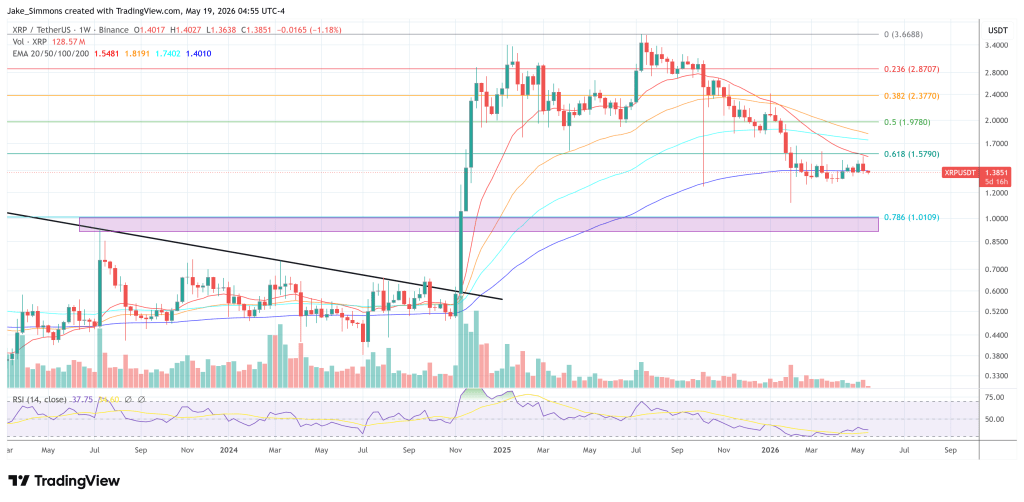
XRP bulls must break the 0.618 Fib, 1-week chart | Source: XRPUSDT on TradingView.com

Related Questions

QWhat is the main debate in the XRP Ledger community regarding the v3.1.3 upgrade?

AThe debate is over whether the approaching v3.1.3 upgrade constitutes a hard fork that could split the network, or if it is better understood as a standard amendment blocking process, which is a security feature to protect data accuracy.

QWhat happens to nodes that fail to update to rippled version 3.1.3 before the fix amendment activates?

ANodes that have not been updated to version 3.1.3 will be unable to communicate with the network. They cannot determine ledger validity, submit or process transactions, participate in consensus, or vote on future amendments.

QWhat is the purpose of the fixCleanup3_1_3 amendment included in the rippled 3.1.3 release?

AThe fixCleanup3_1_3 amendment is a package of fixes for NFTs, Permissioned Domains, Vaults, and the Lending Protocol on the XRP Ledger.

QAccording to critics, why was the situation framed as a 'hard fork'?

ACritics framed it as a 'hard fork' because, based on early upgrade figures, a majority (60%) of network nodes were on a path to being cut off, which they argued could create a governance challenge about which chain should be considered the mainnet.

QHow do defenders of the process, like Daniel Keller, view the potential cutoff of outdated nodes?

ADefenders like Daniel Keller view the cutoff as necessary maintenance discipline and 'network hygiene,' arguing that decentralization does not mean carrying 'dead weight.' Running a node is a responsibility, and outdated infrastructure that cannot be maintained should be filtered out.

Related Reads

Eight Global Central Banks Enter the Fray, Aiming to Claim a Piece of the Stablecoin Pie?

The article discusses the Agorá project, a global cross-border payment system initiative led by the Bank for International Settlements (BIS) with participation from eight major central banks (including the Federal Reserve Bank of New York, Bank of England, and Bank of Japan) and over 40 private financial institutions like JPMorgan and SWIFT. Agorá aims to create a unified platform for the instant settlement of cross-border transactions using tokenized commercial bank deposits. A key feature is its strict "permissioned" design, where funds are pre-labeled by country and smart contracts enforce AML and sanctions checks. This contrasts with the "permissionless" ideal suggested by its ancient Greek namesake. The system employs a two-tier architecture: central banks retain full control over sovereign reserves on separate ledgers, while private entities manage a shared ledger for multi-currency clearing. The project, which completed a prototype in May 2026, seeks to streamline the slow, multi-step process of traditional cross-border payments. It is positioned as a centralized, regulatory-compliant alternative to decentralized stablecoins like Tether, targeting large-scale institutional transfers. The analysis highlights a potential future market split: projects like Agorá could dominate wholesale institutional payments, while public blockchain-based stablecoins retain their role in retail, remittance, and emerging market use cases. This represents an effort by traditional finance to establish boundaries for decentralized networks. The upcoming integration of the EU's Pontes framework with its core settlement system will test this dynamic.

marsbit2m ago

Eight Global Central Banks Enter the Fray, Aiming to Claim a Piece of the Stablecoin Pie?

marsbit2m ago

BitMart Research Institute Weekly Highlights: ETF Continued Outflows + AI Drain, Crypto Market Seeks Bottom Amid Volatility

**BitMart Research Weekly Highlights: ETF Outflows and AI Demand Weigh on Crypto Market** The crypto market saw a correction this past week, diverging from the all-time highs in U.S. equity markets. Bitcoin (BTC) fell roughly 6%, while Ethereum (ETH) declined about 4.5%. The primary pressure point was significant and sustained outflows from U.S. spot Bitcoin ETFs, which experienced a record nine consecutive days of net redemptions totaling approximately $2.8 billion. Spot Ethereum ETFs also faced continuous outflows. This weakness in digital assets contrasted with the continued surge in traditional markets, particularly AI-related stocks. The news of Anthropic's secret IPO filing, targeting a potential $750B IPO, and Alphabet's major new AI infrastructure funding further fueled the tech rally. The analysis suggests a potential "liquidity siphon" effect, where capital is being diverted from crypto into the dominant AI investment narrative. Other notable developments include DTCC's DTC announcing plans to integrate Stellar for tokenized asset services, signaling a major step for tokenized equities. Meanwhile, MicroStrategy paused its primary mechanism for funding Bitcoin purchases to focus on debt management, removing a key institutional buyer from the market. The report concludes that the crypto market remains under pressure from the competing AI narrative and major upcoming IPOs, with a potential for a broader market bottom if an AI-driven correction occurs later this cycle.

marsbit18m ago

BitMart Research Institute Weekly Highlights: ETF Continued Outflows + AI Drain, Crypto Market Seeks Bottom Amid Volatility

marsbit18m ago

The Death of the Three-Act Play: AI Ushers Enterprise Software Startups into the ‘Speedrun Era’

The Death of the Three-Act Play: How AI is Ushering in a 'Speedrun Era' for Enterprise Software Startups The traditional three-act play for building an enterprise software company—first, a niche wedge product; second, an expanded suite; third, a dominant platform—is becoming obsolete in the AI era. Previously, startups would spend 3-5 years perfecting a single-point solution to reach tens of millions in ARR (Act 1: The Wedge). Then, over another few years, they'd build adjacent products to form a suite and cross the $100M ARR threshold (Act 2: The Suite). Finally, with scale and user engagement, they could aim to become a foundational platform themselves (Act 3: The Platform). This model assumed a timeline measured in years. However, AI-driven tools have dramatically compressed software development costs and timelines. Companies like Cursor, Clay, and Harvey have scaled from near zero to approaching or surpassing $100M ARR in remarkably short periods, demonstrating a new competitive pace. The core argument is that in this rapidly changing market, relying on a small, "safe" wedge as a protective harbor may now be a conservative, even risky, strategy. The plummeting cost of building software means the time required for Acts 1 and 2 is approaching zero. Consequently, rational strategy now favors planning to build the entire vision from the outset. This shift changes the calculus for early-stage investment. The emphasis is moving from finding a defensible niche to backing founders with "unreasonable, relentless ambition" to reimagine entire workflows or replace incumbent platforms from day one. The age of gradual expansion is giving way to an era of immediate, full-scale ambition.

marsbit37m ago

The Death of the Three-Act Play: AI Ushers Enterprise Software Startups into the ‘Speedrun Era’

marsbit37m ago

After the 'Golden Finger' Points to IBM, the Stock God Trump's Next Target Emerges

The White House occupant is being called a "stock god." Financial disclosures show former President Trump executed 3,642 stock trades in Q1 2026, averaging 58 per trading day. More significantly, a pattern has emerged where companies he publicly praises often see their stock prices rise and frequently overlap with his personal portfolio holdings, government industrial policy, and federal funding. Since a high-profile Tesla event in March 2025, Trump has publicly endorsed at least nine companies, including Intel, Dell, Micron, Palantir, IBM, Apple, Thermo Fisher, Nvidia, and AMD. These "Trump concept stocks" share key traits: they are tied to AI, semiconductors, quantum computing, or "Made in America" narratives; they often receive government contracts, subsidies (like CHIPS Act funding), or regulatory favors; and their CEOs typically have strong personal or political ties to Trump. Timing raises questions. In several instances, such as with Palantir and Dell, Trump's personal account established or increased positions weeks before his public endorsements, which were followed by significant stock price jumps. While his assets are reportedly held in a blind trust managed by his children, the correlation is notable. Based on this pattern, analysis suggests the next companies likely to be endorsed are those where the US government has already taken a strategic equity stake but which haven't yet received a high-profile "call-out." Prime candidates include MP Materials (rare earths, 15% DoD interest), Lithium Americas (lithium, DoE-backed), and quantum computing firms like IonQ, Rigetti, and D-Wave, which are reportedly in talks for government equity-for-funding deals. Other potential names are Oracle (deep political ties) and GlobalFoundries (semiconductors and quantum funding). These stocks carry high political premium, meaning their valuations are highly sensitive to political favor, which can be volatile.

marsbit1h ago

After the 'Golden Finger' Points to IBM, the Stock God Trump's Next Target Emerges

marsbit1h ago

Trading

Spot
Futures
活动图片





