XRP Gets A Wall Street Wrapper: Evernorth CEO Teases Q1 2026 Nasdaq IPO

bitcoinistPublished on 2026-01-16Last updated on 2026-01-16

Abstract

Evernorth CEO Ashish Birla announced the company is preparing for a Q1 2026 IPO on Nasdaq, positioning it as a simplified way for institutions to gain exposure to XRP without handling custody, compliance, or security directly. Birla cited favorable regulation and growing institutional demand as key reasons for the timing. The firm’s equity will serve as a proxy for XRP investment, allowing investors to buy public stock instead of holding the digital asset. Evernorth plans to actively manage its XRP treasury, generate yield, and support ecosystem development. At the time of reporting, XRP was trading at $2.07.

Evernorth CEO Ashish Birla said the firm is preparing for a Q1 2026 IPO on Nasdaq, pitching the listing as a simplified, public-markets route for institutions to gain exposure to XRP without building the custody, compliance, and security stack themselves.

Speaking on Nasdaq’s Live from MarketSite on Jan. 15 with host Kristina Ayanian, Birla framed the planned offering as a response to what he described as growing institutional readiness and a shifting regulatory backdrop. Ayanian said: “Evernorth is gearing up for a Q1 2026 IPO.”

Birla responded: “I’ve been waiting for this moment for a long time. I’ve been in blockchain since 2013,” Birla said. “The timing couldn’t be more perfect. We have the right kind of regulation. We have the right kind of administration and institutions are ready to adopt.”

XRP Gets A Wall Street Wrapper

At the center of Evernorth’s pitch is the XRP treasury strategy, which Birla described as “the digital asset underpinning Evernorth’s digital asset treasury.” In Birla’s telling, Evernorth’s equity is meant to function as an exposure vehicle for investors who prefer traditional market rails over direct token custody.

“Prior to Evernorth ... you would have to go in, you know, custody digital assets on your own. You would have to worry about compliance. You’d have to worry about security,” he said. “But a large lion’s share just wants to buy a public stock. So we made it as easy as buying a public stock. And we’ll figure that stuff out for you.”

Birla also suggested Evernorth intends to brand that exposure explicitly through its stock identity, referring to “XRPN as the Evernorth stock,” and repeating that the proposition is to “just buy the stock ... and we’ll take care of all that heavy lifting for you.” For investors, the value proposition is less about novel financial engineering than operational outsourcing: Evernorth claims it can package custody, compliance, and blockchain participation behind a public equity wrapper.

The executive tied the timing of Evernorth’s public-market push to what he described as rising demand for regulated exposure. Asked about “XRP ETFs ... making a big splash,” Birla said the category had seen “a record breaking last few weeks,” arguing that it signaled appetite from traditional investors. “That shows that there is the demand from the public markets to gain exposure to XRP,” he said, adding that Evernorth intends to go beyond simple spot exposure by supporting the broader ecosystem.

That “beyond” hinges on yield generation and active treasury management. Birla said Evernorth expects to “be generating yield as well on the XRP asset,” and that the proceeds would be recycled into the treasury: “We’ll use [it] to go and buy more of the digital asset for the treasury. So we’ll be actively out there.” He positioned the company as an active participant in product development on-chain, saying Evernorth will “help develop that XRP ecosystem, help bring financial products to the blockchain.”

Pressed on what separates durable “digital asset treasury” strategies from the rest, Birla emphasized scale and activity. “One, you have to have scale. And Evernorth as of today is by far the largest XRP digital asset treasury out there,” he said. The second criterion, he argued, is avoiding a purely passive posture. “They can’t be passive. They have to be active stewards of helping the ecosystem flourish and develop,” Birla said, adding that he plans to continue “helping the XRP ecosystem develop” and that Evernorth could “generate yield for the for the treasury as well.”

For prospective institutional buyers and public-market investors, the message was blunt: the company sees the last missing piece as capital access, and it is building a listed vehicle around it. “You’ve got regulation, you’ve got the products, and now you’ve got institutional capital,” Birla said. “I think timing is right to adopt blockchain for financial products.”

At press time, XRP traded at $2.07.
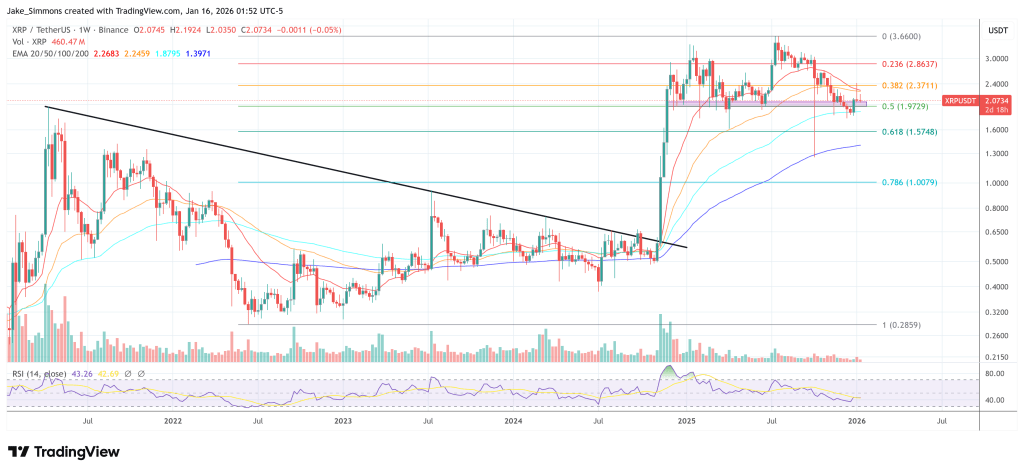
Bulls needs to reclaim the 0.382 Fib, 1-week chart | Source: XRPUSDT on TradingView.com

Related Questions

QWhat is the planned timeline for Evernorth's IPO on Nasdaq, and what is the core value proposition for investors?

AEvernorth is planning its IPO for Q1 2026. The core value proposition is to provide institutional investors with a simplified, public-markets route to gain exposure to XRP without having to manage the complexities of direct custody, compliance, and security themselves.

QAccording to CEO Ashish Birla, what are the two key factors that make the timing perfect for Evernorth's public-market push?

ABirla stated that the timing is perfect due to the 'right kind of regulation,' the 'right kind of administration,' and that 'institutions are ready to adopt' blockchain-based financial products.

QHow does Evernorth intend to go beyond simple spot exposure to XRP for its investors?

AEvernorth plans to go beyond simple spot exposure by actively generating yield on its XRP assets and recycling the proceeds to buy more for its treasury. The company also aims to be an active participant in developing the XRP ecosystem and bringing financial products to the blockchain.

QWhat two criteria did Birla emphasize as essential for a durable 'digital asset treasury' strategy?

ABirla emphasized that a durable strategy requires scale, noting Evernorth is the largest XRP treasury, and that the treasury cannot be passive; it must be an active steward that helps the ecosystem flourish and develop.

QWhat specific stock ticker did Birla refer to when describing Evernorth's equity as an exposure vehicle for XRP?

ABirla referred to the Evernorth stock as 'XRPN' and pitched it as a way for investors to gain exposure to XRP by simply buying the public stock.

Related Reads

OpenAI Post-Training Engineer Weng Jiayi Proposes a New Paradigm Hypothesis for Agentic AI

OpenAI engineer Weng Jiayi's "Heuristic Learning" experiments propose a new paradigm for Agentic AI, suggesting that intelligent agents can improve not just by training neural networks, but also by autonomously writing and refining code based on environmental feedback. In the experiment, a coding agent (powered by Codex) was tasked with developing and maintaining a programmatic strategy for the Atari game Breakout. Starting from a basic prompt, the agent iteratively wrote code, ran the game, analyzed logs and video replays to identify failures, and then modified the code. Through this engineering loop of "code-run-debug-update," it evolved a pure Python heuristic strategy that achieved a perfect score of 864 in Breakout and performed competitively with deep reinforcement learning (RL) algorithms in MuJoCo control tasks like Ant and HalfCheetah. This approach, termed Heuristic Learning (HL), contrasts with Deep RL. In HL, experience is captured in readable, modifiable code, tests, logs, and configurations—a software system—rather than being encoded solely into opaque neural network weights. This offers potential advantages in explainability, auditability for safety-critical applications, easier integration of regression tests to combat catastrophic forgetting, and more efficient sample use in early learning stages, as demonstrated in broader tests on 57 Atari games. However, the blog acknowledges clear limitations. Programmatic strategies struggle with tasks requiring long-horizon planning or complex perception (e.g., Montezuma's Revenge), areas where neural networks excel. The future vision is a hybrid architecture: specialized neural networks for fast perception (System 1), HL systems for rules, safety, and local recovery (also System 1), and LLM agents providing high-level feedback and learning from the HL system's data (System 2). The core proposition is that in the era of capable coding agents, a significant portion of an AI's learned experience could be maintained as an auditable, evolving software system.

marsbit31m ago

OpenAI Post-Training Engineer Weng Jiayi Proposes a New Paradigm Hypothesis for Agentic AI

marsbit31m ago

Your Claude Will Dream Tonight, Don't Disturb It

This article explores the recent phenomenon of AI companies increasingly using anthropomorphic language—like "thinking," "memory," "hallucination," and now "dreaming"—to describe machine learning processes. Focusing on Anthropic's newly announced "Dreaming" feature for its Claude Agent platform, the piece explains that this function is essentially an automated, offline batch processing of an agent's operational logs. It analyzes past task sessions to identify patterns, optimize future actions, and consolidate learnings into a persistent memory system, akin to a form of reinforcement learning and self-correction. The article draws parallels to similar features in other AI agent systems like Hermes Agent and OpenClaw, which also implement mechanisms for reviewing historical data, extracting reusable "skills," and strengthening long-term memory. It notes a key difference from human dreaming: these AI "dreams" still consume computational resources and user tokens. Further context is provided by discussing the technical challenges of managing AI "memory" or context, highlighting the computational expense of large context windows and innovations like Subquadratic's new model claiming drastically longer contexts. The core critique argues that this strategic use of human-centric vocabulary does more than market products; it subtly reshapes user perception. By framing algorithms with terms associated with consciousness, companies blur the line between tool and autonomous entity. This linguistic shift can influence user expectations, tolerance for errors, and even perceptions of responsibility when systems fail, potentially diverting scrutiny from the companies and engineers behind the technology. The article concludes by speculating that terms like "daydreaming" for predictive task simulation might be next, continuing this trend of embedding the idea of an "inner life" into computational processes.

marsbit33m ago

Your Claude Will Dream Tonight, Don't Disturb It

marsbit33m ago

Trading

Spot
Futures
活动图片