XRP Co-Creator Arthur Britto Is Real, David Schwartz Says In Rare Comments

bitcoinistPublished on 2026-04-23Last updated on 2026-04-23

Abstract

David Schwartz, Ripple's Chief Technology Officer, has publicly confirmed that Arthur Britto, the elusive co-creator of the XRP Ledger, is a real and highly private individual, not a myth or pseudonym. In detailed comments, Schwartz described Britto as a key architect whose ideas were fundamental to core XRP Ledger mechanics like its exchange functionality and auto-bridging. He emphasized Britto's extreme value for privacy, noting he has attended events anonymously and was even upset about a photo showing the back of his head. Schwartz compared Britto's unique intelligence to Mozart's, stating he arrives at brilliant solutions intuitively, without needing to verbalize the intermediate logic, unlike Schwartz's own step-by-step reasoning. Despite his absence from public life, Britto is confirmed to be "doing really well." At the time of reporting, XRP was trading at $1.4228.

David Schwartz offered one of his most detailed public descriptions yet of Arthur Britto, the elusive XRP Ledger architect whose near-total absence from public life has long fueled speculation across the crypto industry. Speaking in an X Space, Schwartz said Britto is not a myth or a pseudonym, but a deeply private individual whose ideas helped shape some of the ledger’s core mechanics.

XRP Mystery Deepens As David Schwartz Opens Up

The remarks matter because Britto has occupied an unusual place in XRP lore for years: central to the project’s early technical history, but almost entirely missing from its public narrative. Schwartz, who has worked alongside him, pushed back directly on the aura that has formed around that absence. “He values his privacy tremendously,” Schwartz said, before adding that Britto is “a real person, an individual person.”

Schwartz went further than that. He said Britto had attended an XRP event in public and had also appeared at a Bitcoin event in San Jose without identifying himself. According to Schwartz, Britto was upset that a photo captured even “the back of his head in the background,” a detail that underscored just how aggressively he guards his privacy. Schwartz also said he could share personal updates and that Britto is “doing really well,” but made clear that doing so “is not my place.”

That framing was notable in itself. Rather than merely confirming Britto’s existence, Schwartz tried to explain why someone so important to the XRP Ledger’s early development might still remain almost completely unseen. “He really, really, really values his privacy,” Schwartz said. “He’s chosen not to, but he is a real live human being. He actually exists. People have met him in person. He’s not mythical.”

The more revealing part of the discussion came when Schwartz turned to Britto’s technical abilities. He described Britto not simply as intelligent, but as someone whose kind of intelligence worked differently from his own. Schwartz, known for his own technical fluency, said his reasoning is something he can articulate step by step. Britto, by contrast, seemed to arrive at answers before the intermediate logic was fully verbalized.

“Arthur Britto is not like that at all,” Schwartz said. “He’s like a Mozart or something. Like Mozart doesn’t compose the same way everybody else does. He’s just better at it. Mozart has something that other people don’t have. And Arthur Britto has something that other people just don’t have.”

Schwartz then tied that assessment to specific parts of XRP Ledger design. He said “some of the core ideas about how the XRP ledger works were his,” citing the exchange functionality and auto-bridging among the areas shaped by Britto’s thinking. In Schwartz’s telling, Britto would propose a solution first, while Schwartz would reason through why it worked afterward.

“And Arthur would turn to me and say, ‘Whoa, David, slow down, slow down. I can’t keep up,’” Schwartz said. “And I’m just baffled. I’m like, it’s your idea. How could you — I could not have had the idea he had without having to go through all the reasoning behind it first. Somehow he has the idea first.”

At press time, XRP traded at $1.4228.
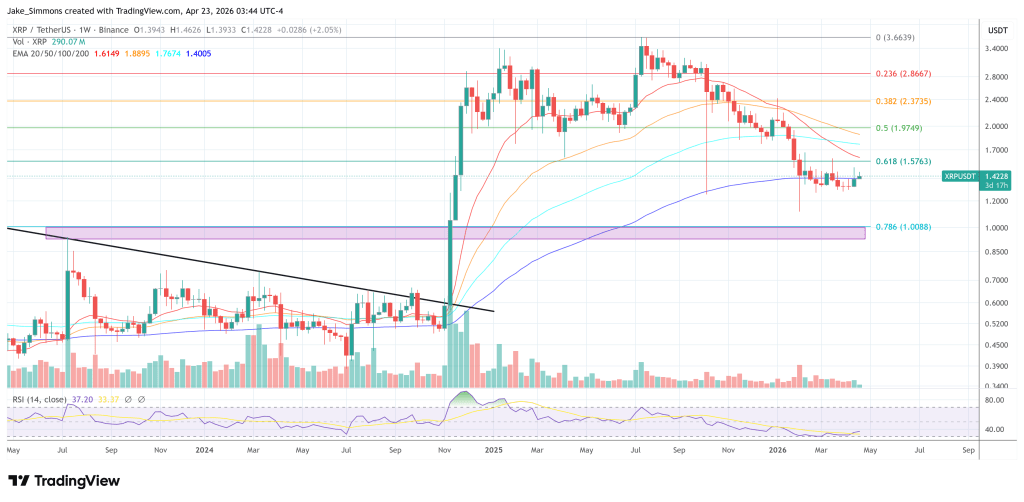
XRP rises back above the 200-week EMA, 1-week chart | Source: XRPUSDT on TradingView.com

Related Questions

QWho is Arthur Britto and what role did he play in the development of the XRP Ledger?

AArthur Britto is a real, deeply private individual and one of the co-creators of the XRP Ledger. He is an architect who helped shape some of the ledger's core mechanics, including the exchange functionality and auto-bridging.

QHow did David Schwartz describe Arthur Britto's approach to problem-solving and intelligence?

ADavid Schwartz described Arthur Britto's intelligence as unique, comparing him to Mozart. He stated that Britto arrives at solutions intuitively without fully verbalizing the intermediate logic, whereas Schwartz himself reasons step by step.

QWhy has Arthur Britto remained largely absent from public life, according to David Schwartz?

AAccording to David Schwartz, Arthur Britto remains absent from public life because he tremendously values his privacy. He is a very private person who avoids public recognition, as evidenced by his discomfort even with having the back of his head photographed at an event.

QWhat specific example did Schwartz provide to illustrate Britto's desire for privacy?

ASchwartz mentioned that Britto attended an XRP event and a Bitcoin event in San Jose without identifying himself and was upset that a photo captured 'the back of his head in the background,' highlighting his extreme preference for privacy.

QWhat was the price of XRP at the time the article was published?

AAt press time, XRP was trading at $1.4228.

Related Reads

STRC Breaks Below $95: Why Does It Continue to Depeg? Is There Default Risk?

"STRC Falls Below $95: Why the Persistent Depegging and Is There Default Risk?" The article discusses the recent decline in the price of STRC, a perpetual preferred stock issued by Strategy (MSTR) designed to trade around a $100 par value. As of publication, STRC traded at $94.65, raising market concerns. STRC is described as a high-yield cash flow product, offering an 11.50% annual dividend paid monthly. Its "preferred" status grants it priority over common stock for dividends and in liquidation. Key reasons cited for the price depegging include: 1. **Bitcoin's Price Drop:** MSTR's assets are heavily tied to Bitcoin (BTC), which fell over 21% from its recent high, pressuring all Strategy-related products. 2. **Competitive Pressure:** Rival Strive Asset Management's similar product, SATA, offers daily dividends and has maintained its $100 par value with a ~13% yield. In response, Strategy has proposed changing STRC's dividend frequency from monthly to bi-weekly, pending shareholder vote. 3. **Technical Selling:** A break below $100 may have triggered algorithmic selling and stop-losses, exacerbating the decline. Regarding default risk, the analysis suggests it is currently low. Strategy founder Michael Saylor confirmed the June 2026 dividend rate remains at 11.50% with no cuts or suspensions. The company's massive reserve of 843,706 BTC provides a significant backstop for its obligations. Industry opinions are mixed. Some analysts view the BTC holdings as reliable support for dividends, while critics like Peter Schiff warn of potential dividend cuts leading to price crashes and lawsuits. Others highlight inflation risk and the company's ability to reduce dividends without a formal default. In summary, STRC's drop is attributed to BTC volatility, competition, and technical factors. While immediate default risk appears contained, the product faces challenges from market conditions and competitive dynamics.

marsbit42m ago

STRC Breaks Below $95: Why Does It Continue to Depeg? Is There Default Risk?

marsbit42m ago

AI Trading Cools, South Korean Stocks Plunge 1.8%, Spot Gold Rises 1%, Bitcoin Dives

A sell-off in AI-related stocks, triggered by Broadcom's disappointing earnings forecast, sent shockwaves through global markets. South Korea's KOSPI led Asia's decline, plunging 1.8% as the risks from concentrated chip stock gains and surging leveraged investments came to the fore. The tech-heavy Nasdaq 100 futures fell 0.5% following Broadcom's 14% after-hours plunge, which signaled a slower-than-expected transition to AI clients. This pullback extended Wall Street's weakness, halting the S&P 500's nine-day rally amid hawkish Fed signals and renewed Middle East tensions. South Korean authorities convened an emergency meeting, pledging "immediate measures" against market volatility and warning of record-high stock margin debt. The adjustment rippled across assets: Bitcoin fell to around $64,000, its lowest since February, while safe-haven gold rose 1% on bargain hunting. Oil prices dipped on Middle East ceasefire news. Market analysts noted the sell-off was driven by profit-taking after massive gains, particularly in chip stocks like Samsung and SK Hynix, which now dominate the KOSPI. Wall Street banks are divided on Korea's outlook, with Goldman Sachs raising its target while Citigroup and others warn of overvaluation and a potential bubble. Bridgewater's Ray Dalio noted that great technological shifts often create bubbles. Meanwhile, Fed officials' hints at potential future rate hikes added to the cautious mood ahead of key U.S. jobs data.

华尔街日报1h ago

AI Trading Cools, South Korean Stocks Plunge 1.8%, Spot Gold Rises 1%, Bitcoin Dives

华尔街日报1h ago

Seeking Alpha's Hot Article: Why Might the U.S. Stock Market Crash in June?

In a recent Seeking Alpha article, financial professor and analyst Damir Tokic argues that the US stock market may be poised for a significant crash in June 2026. The core thesis centers on a "mega-bubble" in equities, particularly within the technology sector, which has driven the S&P 500 to near-record valuations, with a Shiller P/E ratio exceeding 40—a level comparable to the 2000 dot-com bubble. Tokic identifies two primary catalysts for a potential collapse. First, he points to unsustainable market exuberance fueled by what he terms the "Trump Stimulus"—massive AI capital expenditure by tech giants, which he believes is politically driven and cannot last. Second, and more urgently, he highlights the escalating Iran war as a critical threat. The ongoing closure of the Strait of Hormuz has created a severe global energy supply crunch. Strategic petroleum reserves are projected to hit critically low operational levels by June, potentially causing oil prices to spike above $200 per barrel and triggering a severe, supply-driven inflationary shock. This scenario, Tokic warns, would force the Federal Reserve's hand. Despite currently maintaining a dovish bias, the Fed would likely be compelled to officially pivot to a hawkish stance at its June FOMC meeting to combat soaring inflation and bond yields. He contends that such a shift—or even a failure to act, which would destroy Fed credibility—could be the trigger that punctures the market bubble. The resulting downturn, he concludes, could rival the bear markets of 2000 and 2008, advising investors to prepare for a major correction.

marsbit1h ago

Seeking Alpha's Hot Article: Why Might the U.S. Stock Market Crash in June?

marsbit1h ago

Trading

Spot
Futures

Hot Articles

What is XRP 2.0

XRP 2.0: A New Frontier in the Cryptocurrency Landscape Introduction to XRP 2.0 In the ever-evolving realm of cryptocurrency, new projects continuously emerge, vying for attention and adoption. One such promising initiative is XRP 2.0, a novel cryptocurrency project designed to leverage advanced blockchain technology and robust encryption methodologies. While the name draws parallels with Ripple’s XRP, it’s crucial to note that XRP 2.0 operates independently, focusing on enhancing transaction security, privacy, and scalability. As the digital financial landscape increasingly embraces decentralized solutions, XRP 2.0 aims to contribute meaningfully to web3 and the overall expansion of crypto projects. What is XRP 2.0? At its core, XRP 2.0 is a cryptocurrency project that aims to create a secure and decentralized digital currency ecosystem. Its foundational technology integrates sophisticated blockchain principles with cutting-edge encryption techniques. The overarching goal of XRP 2.0 is to establish itself as a reliable and efficient platform enabling swift transaction execution while prioritizing enhanced privacy protections for its users. The project is promoted as a solution to many limitations faced by existing cryptocurrencies, proposing a system that can handle a higher volume of transactions with improved speed and privacy. This versatility positions XRP 2.0 as a significant contender in a marketplace riddled with various digital currencies. Who is the Creator of XRP 2.0? The identity of the creator behind XRP 2.0 has been flagged as ‘Wilbur.’ However, comprehensive details regarding Wilbur or their associated entity remain elusive. The anonymity of many cryptocurrency creators is not an uncommon phenomenon in the industry, often designed to maintain a degree of privacy and security. Who are the Investors of XRP 2.0? As of now, specific information related to the investment foundations or organizations supporting XRP 2.0 is not publicly available. In the cryptocurrency sector, the backing by reputed investors can significantly influence a project's credibility and success, yet the transparency regarding the financial supporters of XRP 2.0 has not been established. How Does XRP 2.0 Work? XRP 2.0 stands out by employing a combination of blockchain technology and advanced encryption algorithms that ensures secure and decentralized transactions. Its innovative structure includes unique features designed to foster user engagement and broaden functionalities beyond conventional cryptocurrency transactions. Among these features, XRP 2.0 incorporates AI-powered capabilities, such as text-to-image and text-to-speech functionalities. These additions are designed to enhance the interactive experience for users, promoting broader applicability across various sectors. By bridging technological advancements with user-centered design, XRP 2.0 aims to capture the attention of a diverse range of individuals and enterprises looking to integrate cryptocurrency solutions into their operational frameworks. Timeline of XRP 2.0 Understanding XRP 2.0 requires examining the milestones that have defined its journey thus far: July 23, 2023: XRP 2.0 is introduced as a novel cryptocurrency project, aiming to revolutionize secure and decentralized transaction capabilities in the blockchain domain. September 8, 2023: The launching of another project, XRP20, occurs, marking the emergence of an ERC-20 token on the Ethereum blockchain that remains unrelated to XRP 2.0. November 13, 2023: The XRP Ledger undergoes a significant update with the release of rippled server software version 2.0.0. It is essential to note that this development is disconnected from the XRP 2.0 cryptocurrency project. Key Points About XRP 2.0 To distill the essence of XRP 2.0, several critical factors emerge: Unique Features: The inclusion of features like AI-powered text-to-image and text-to-speech further diversifies the potential applications of XRP 2.0. Blockchain Technology: The framework utilizes advanced blockchain mechanisms and encryption protocols, ensuring a secure and decentralized environment for transactions. Scalability and Privacy: XRP 2.0 prioritizes enhanced privacy protections in transaction processes and the scalability necessary to accommodate a growing user base. No Affiliation with Ripple: Importantly, despite its name, XRP 2.0 does not have any allegiance or collaboration with Ripple’s XRP, distinguishing its operational framework and objectives within the cryptocurrency ecosystem. Conclusion XRP 2.0 represents an ambitious venture into the cryptocurrency sphere, aiming to offer a combination of security, privacy, and efficiency in digital transactions. By integrating sophisticated technologies and user-friendly features, the project sets out to broaden the horizons of what cryptocurrency can achieve in today's digital economy. While the anonymity of its creator and lack of disclosed investors might raise questions for some, XRP 2.0's focus on advanced functionalities and decentralisation enhances its appeal amidst an increasingly crowded crypto market. As the cryptocurrency landscape continues to evolve, XRP 2.0 may yet emerge as a pivotal player in the expansion of secure and scalable blockchain solutions.

942 Total ViewsPublished 2024.04.01Updated 2024.12.03

What is XRP 2.0

Discussions

Welcome to the HTX Community. Here, you can stay informed about the latest platform developments and gain access to professional market insights. Users' opinions on the price of XRP (XRP) are presented below.

活动图片