xAI's Trump Card: Why Grok 5 Could Become the Strongest Model in 2026?

marsbitPublished on 2026-01-19Last updated on 2026-01-19

Abstract

xAI's Grok 5, a 7-trillion-parameter model set for release in 2026, is positioned to become the most powerful AI model due to four key advantages. First, xAI has a massive compute advantage, with plans to deploy 1 million GPUs across multiple data centers, including custom power solutions like airlifted gas turbines and Tesla Megapacks to bypass grid limitations. Second, it leverages real-time data from X (Twitter), processing over 100 million posts daily for training, enabling superior cultural and trend awareness. Third, X’s distribution network—700 million DAU and 6 billion MAU—provides a built-in user base and integration potential for an "everything app." Finally, xAI benefits from physical AI integration through Tesla’s autonomous vehicles and Optimus robots, which supply real-world data and act as deployment platforms. Despite risks like Musk’s controversies, execution challenges, and potential shifts in scaling laws, xAI’s ecosystem strategy may secure its lead.

Author: Ejaaz

Compiled by: Deep Tide TechFlow

Deep Tide Guide: This article is a direct counterattack against recent pessimistic voices about xAI. The author systematically argues, from four dimensions—computing power, data, distribution channels, and physical AI—why xAI might surpass all competitors by 2026.

The core point is straightforward: While others are still discussing model architecture, Musk is already building his own power grid, airlifting gas turbines, and feeding data with Tesla robots. This is an analysis with a clear stance, worth reading.

Main text follows:

Lately, I've seen too much criticism of xAI. This article aims to set the record straight.

I will systematically break down a judgment: the upcoming Grok 5 from xAI isn't just about catching up with competitors; it's about directly surpassing them.

Don't forget, we're talking about a company that's only two years old. Yet, they built the world's largest supercomputer in 122 days (normally taking four years), achieved 600 million monthly active users, and possess something no other AI lab has—a physical carrier (yes, autonomous robots).

Enough talk, let's get straight to the point.

Musk is Building His Own Power Grid

Entering 2026, xAI's advantage in computing power is overwhelmingly dominant. Their current real-time computing power (approximately 500,000 GPUs) is greater than that of Anthropic and Meta combined.

And it doesn't stop there. Including Colossus I and II, they plan to deploy 900,000 GPUs by the second quarter of 2026. With the recently announced Colossus III (yes, another new data center already under construction) operational, it is expected to reach 1 million GPUs, with a total investment of $35 billion.

How can others catch up with this scale?

But the issue isn't just how much money was spent or how much hardware was stacked; it's how they did it. Look at this tweet:
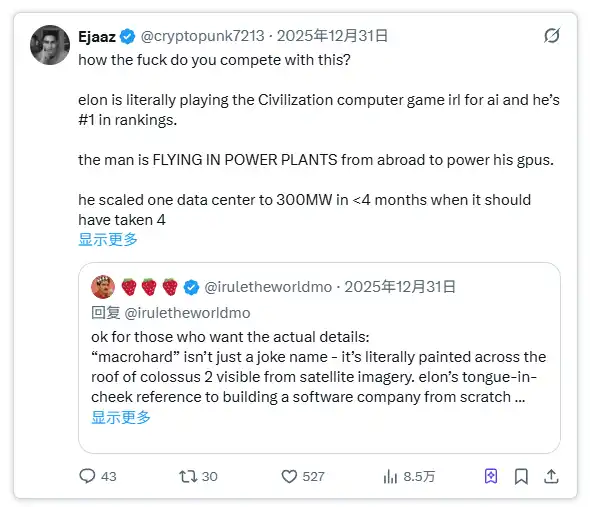
Elon directly airlifted gas turbines to power the data centers because the grids in Tennessee and Memphis simply couldn't handle it. These turbines alone can support an additional 600,000 GPUs.

He chose to completely bypass the entire state's power grid (conventional expansion would take years) just to speed up model training. In addition, he deployed about 250MW of Tesla Megapack energy storage batteries to handle situations where the grid can't supply enough during peak usage.

This forward-thinking combined with extremely fast execution is giving xAI a huge computing power advantage over competitors.

You have to understand, the regulatory approvals, talent recruitment, and operational logistics involved in this have never been done on this scale before. xAI not only did it but made it look easy.

If the hypothesis that "more computing power = stronger model" holds true (and it currently seems to), then the rumored 7 trillion parameter Grok 5 will be a monster upon release. For comparison: Grok 4 has 3 trillion parameters—this is more than double.
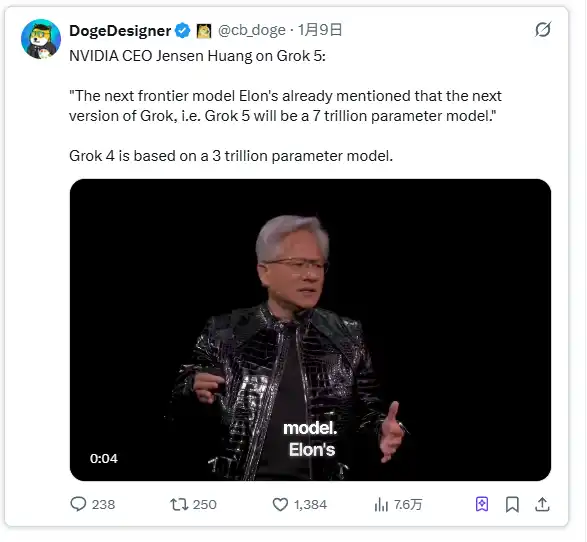
NVIDIA CEO Jensen Huang on Grok 5:

"Elon has mentioned that the next frontier model, the next version of Grok, namely Grok 5, will be a 7 trillion parameter model."

The infrastructure race is no longer in doubt.

There is no infrastructure expansion war right now because xAI has already won. Their strategy is "build first, talk later." Unless other labs catch up, xAI's models will remain ahead.

X's "X-Factor": Unlocking Personal AI

xAI has stronger computing power than anyone, but top-tier models also require massive amounts of data.

And not just any data. AI labs are increasingly realizing that real-time data is the key to unlocking personalized AI—an AI that deeply understands your desires and goals and helps you execute them before you even think of it.

Google's latest "Personal Intelligence" product is the clearest signal that models are ultimately heading in this direction. But xAI has a unique advantage here that Google doesn't:

A social media platform that feeds them over 100 million posts daily.

This means over 100 million pieces of text, images, and videos can be used to train Grok, enabling:

  • Real-time trends and breaking news
  • Large-scale understanding of virality, trends, and human behavior
  • Real-time sensing of the global cultural zeitgeist

Other models can only tell you what's happening; Grok can simultaneously tell you what's happening and how people feel about it—and faster than anyone else.

This capability is valuable.

If we assume the value users get from a tailored AI model is 10 times that of a general-purpose large model, then X's moat is very difficult to breach.

It's not just the data; X's distribution capability is also insane:

  • 70 million daily active users
  • 600 million monthly active users
  • An "Ask Grok" button next to every post

It's not hard to imagine xAI integrating real-time prediction markets, shopping, banking, dating, and more into the same App in the future, all powered by Grok.

Currently, most model lab valuations are based on GPU count, intelligence benchmarks, and reputation. xAI has all of these, plus the opportunity to penetrate multiple internet monopoly areas—don't forget their goal is to become an "Everything App."

Today, X's recommendation algorithm is powered by Grok, which analyzes every post to make recommendations. Tomorrow, it will provide personal intelligence services for each user.

Grok is clearly not just a standard large language model; its valuation should reflect that.

Physical AI Advantage: xAI is the Most Forward-Looking Lab

It's no secret that robots will have a huge impact on the world in the next five years. The technology has finally matured.

From factory manual labor to "last-mile" delivery, from fast-food chains to top surgeons, all will be assisted or entirely replaced by robots.

The viral videos from Boston Dynamics over a decade ago have now snowballed into autonomous vehicle fleets and (surprisingly impressively) humanoid robots. Honestly, when it comes to these two things, only one company comes to mind: Tesla.

A car that drives better than a human is no longer a fantasy. The latest v14.2.2.3 update is technically already a better driver than you. Once regulations pass, you'll see autonomous Teslas transporting people everywhere.

Similarly, a humanoid robot that can carry your shopping bags and carefully wipe your mother's fine china is becoming a reality. Optimus will begin mass shipments into homes and factories by the end of this year.

What does this have to do with xAI?

Two things:

  1. Machines need a brain to drive them, and Tesla uses Grok.
  2. Grok needs diverse data sources to understand the world around it, and this data comes from Tesla's robots.

This symbiotic relationship gives xAI an almost unfair advantage over competitors. I think Google is the only company that can compete at this level, but they are still behind.

Today, Grok is already powering Tesla vehicles—the latest update lets you to simply tell Grok to drive you somewhere while playing music and telling you about Roman history.

Similarly, Grok is now receiving video data from Tesla cameras, distance data from Tesla sensors, etc., helping it understand real-world physics, visual perception, and navigation.

All this data now helps it become stronger in other capabilities, such as generating more physically accurate video content.

You have to admit Musk is playing 5D chess. He's not just building a large language model; he's building the entire ecosystem for AI to live and operate in.

Writing this, I admit it all sounds fantastic, but also incredibly ambitious......which leads to the final part of the article:

Yes, There Are Risks Here

There are risks in everything. Maybe managing 5 companies is Elon's limit, and 6 is too many......but I doubt it. If there's anyone in this world who has repeatedly proven able to prove doubters wrong time and again, it's him.

Call me crazy, I don't care—what he has already achieved is itself extremely improbable.

I think there are three key risks:

The King of Controversy — Elon and headlines are old friends. He is currently involved in a $130 billion lawsuit with OpenAI and is under investigation by EU and Indian regulators. Who knows, this guy might do something outrageous that messes up the entire vision.

Execution Risk — xAI burns about $1 billion per month; that's a huge bill. And Elon alone manages 5 companies (not including Starlink).

Scaling Laws — xAI is betting everything on "more computing power = stronger model," but if a new, better training architecture is discovered, this hypothesis could be overturned. Andrej Karpathy has stated multiple times that he doesn't believe large language models are the final form.

That's it! I think people have been unfairly critical of xAI's efforts to push the frontiers of intelligence lately and seem to forget they are still a force to be reckoned with.

I hope this article changes your perspective. Thanks for reading.

Related Questions

QWhat are the key advantages that xAI has over its competitors according to the article?

AThe article highlights four key advantages: massive computing power (with plans for 1 million GPUs by 2026), access to a vast, real-time data stream from the X platform, a powerful distribution channel with 600M monthly active users, and a unique 'physical AI' advantage through integration with Tesla's autonomous driving and Optimus robotics.

QHow is Elon Musk ensuring sufficient power for xAI's massive data centers?

AHe is bypassing the local power grid by airlifting gas turbine generators to power the data centers directly. He is also deploying Tesla Megapack battery storage systems to handle peak demand, allowing for a rapid expansion that the conventional grid could not support.

QWhat is the significance of the X platform's data for training Grok?

AThe X platform provides Grok with over 100 million posts daily, offering a massive, real-time dataset. This allows Grok to understand current trends, breaking news, viral content, and human behavior on a global scale, giving it a significant edge in personalization and cultural awareness over models trained on static datasets.

QWhat is the 'physical AI' advantage that xAI possesses?

AxAI's 'physical AI' advantage comes from its symbiotic relationship with Tesla. Grok is the AI brain for Tesla's autonomous vehicles and Optimus robots. In return, these physical systems provide Grok with vast amounts of real-world data on visual perception, navigation, and physics, which helps improve its overall capabilities.

QWhat are the main risks to xAI's ambitious plans as mentioned in the article?

AThe article identifies three main risks: 1) Reputational and regulatory risk due to Elon Musk's controversies and ongoing legal battles. 2) Execution risk from managing multiple companies and a high monthly burn rate of ~$1 billion. 3) The risk that the 'scaling laws' (more compute = better model) assumption could be invalidated by a breakthrough in a new, more efficient AI architecture.

Related Reads

KOL's Perspective: Why Is SOL Set to Rise from This Point?

**Summary: Why SOL is Positioned for Growth at This Level** The article argues that SOL is poised for an upward move from its current price point, citing several key factors. Primarily, SOL has just broken out of a 4-month consolidation phase. This breakout signals a return of risk appetite to the broader crypto market, as SOL is seen as a key indicator of overall crypto health. The token's ownership has reportedly shifted from short-term traders and tourists to long-term accumulators, leading to low volume. Any meaningful increase in trading activity could thus trigger significant upward momentum. Fundamental strengths include strong institutional adoption, integration with DeFi and RWAs (Real-World Assets), and the potential benefits from the Clarity Act. Despite its high volatility—having dropped 70% from its all-time high but still up 12x from its bear market low—SOL is highlighted as one of the few tokens from the last cycle to reach new highs. It boasts a robust ecosystem of applications, users, and protocols. Future catalysts include the expected influx of AI developers following the Miami Accelerate conference, which focused on AI on Solana. Furthermore, Solana is positioned as the premier chain for memecoin activity, a trend expected to continue and drive network usage and fees. The article concludes that recent price action reflects a healthy transfer to long-term holders, setting the stage for growth.

marsbit13m ago

KOL's Perspective: Why Is SOL Set to Rise from This Point?

marsbit13m ago

Those Pre-Bitcoin PoW Protocols Have Recently Been Reimplemented

This article details a recent surge in replicating pre-Bitcoin Proof-of-Work (PoW) protocols, specifically focusing on Hal Finney's 2004 RPOW (Reusable Proofs of Work). Within five days in May 2026, multiple independent builders in the Bitcoin/cypherpunk community launched projects inspired by this early electronic cash proposal. The initiative began with Fred Krueger's `rpow2.com`, a centralized but auditable system that replaced RPOW's original IBM 4758 hardware with Ed25519 signatures. Initially a faithful replica, it later adopted Bitcoin-like features (21M supply cap, difficulty adjustment) and a controversial 5.24% founder allocation. This sparked rapid forks, including `rpow4.com` which incorporated full Bitcoin parameters, a prediction market (`rpowmarket.com`), and a DEX (`rpow2swap.com`). Concurrently, Mike In Space created a prototype of Wei Dai's 1998 b-money proposal (`b-money.replit.app`), pushing the historical exploration even further back. The article contrasts these centralized, server-dependent experiments with Bitcoin's core innovation of decentralized, trustless consensus. It also highlights a parallel development: the `HASH` project on Ethereum, which uses smart contract hooks to enable a purely fair-launch, browser-mineable PoW token with 0% allocations to team or VCs. The collective activity is framed as a meme-driven, educational exploration of cypherpunk history rather than a serious financial movement, with all projects heavily disclaiming any investment value.

marsbit18m ago

Those Pre-Bitcoin PoW Protocols Have Recently Been Reimplemented

marsbit18m ago

South Korean Exchanges 'Battle' Regulators, Challenging the Boundaries of Enforcement and Legislation

South Korea's cryptocurrency industry is engaged in a rare, direct confrontation with regulators. The Financial Intelligence Unit (FIU), the primary anti-money laundering (AML) watchdog, has recently imposed heavy penalties on major exchanges like Upbit and Bithumb for alleged violations involving unregistered overseas VASPs and AML procedures. However, exchanges are now actively challenging these actions in court and through industry associations. In a significant shift, the Seoul Administrative Court ruled in favor of Upbit's operator, Dunamu, overturning part of an FIU-ordered business suspension. The court found the FIU's penalty criteria and justification insufficiently clear. Similarly, the court suspended the enforcement of a six-month business suspension against Bithumb pending a final ruling, citing potential irreversible harm to the exchange. Beyond legal battles, the industry is contesting proposed legislative amendments. The Digital Asset eXchange Alliance (DAXA) strongly opposes a draft rule that would mandate Suspicious Transaction Reports (STRs) for all crypto transfers over 10 million KRW (~$6,800). DAXA argues this "poison pill" clause violates legal principles and would overwhelm the STR system, increasing reports from 63,000 to an estimated 5.45 million annually for major exchanges, thereby crippling effective AML monitoring. This conflict highlights a structural tension in South Korea's crypto governance: comprehensive digital asset laws are still developing, while regulators rely heavily on AML enforcement. The industry's move from passive compliance to active legal and legislative challenges signifies a new phase, pressing for clearer rules and more proportionate enforcement. While short-term disputes may intensify, this clash could ultimately lead to a more mature and sustainable regulatory framework for South Korea's vibrant crypto market.

marsbit1h ago

South Korean Exchanges 'Battle' Regulators, Challenging the Boundaries of Enforcement and Legislation

marsbit1h ago

After 50x Storage Surge, Justin Sun Always Looks to the Next Decade

Sun Yuchen, known for his controversial stunts like a $30 million lunch with Warren Buffett (canceled due to a kidney stone) and eating a $6.2 million duct-taped banana, is often overshadowed by a significant fact: his decade-long track record of spotting major investment trends. In 2016, he famously advised young people to invest in Bitcoin, Nvidia, Tesla, and Tencent instead of buying property. A hypothetical $20,000 investment in Nvidia and Tesla from that list would now be worth over 50 million RMB. His latest major call was on November 6, 2025, predicting a "50x storage opportunity" tied to the AI boom, which materialized with Sandisk's stock surging nearly 50-fold by 2026. Looking ahead, Sun now focuses on the next frontier: Physical AI. He identifies four key areas: 1. **Embodied AI/Robotics**: He sees this reaching its "iPhone moment," with companies like UBTech and Galaxy General leading in commercialization. 2. **Drones**: Viewed as the first commercially viable form of Physical AI, revolutionizing sectors from warfare (e.g., AeroVironment's Switchblade) to logistics. 3. **Spatial Computing**: Beyond VR, it's about AI understanding physical space, a foundational technology for robotics and autonomous systems, exemplified by Apple's Vision Pro. 4. **Space Exploration**: After a 2025 suborbital flight with Blue Origin, Sun advocates for space as the ultimate frontier, discussing blockchain's potential role in space asset management and data transactions. His investment philosophy involves betting on entire, inevitable trends rather than single companies. For robotics, he sees Tesla (the body/manufacturer) and Nvidia (the brain/AI platform) as complementary plays. In defense drones, he highlights companies making tanks obsolete (AeroVironment) and those augmenting fighter jets (Kratos). For space, he participated in Blue Origin's flight and anticipates SpaceX's potential IPO to redefine the sector's valuation. Sun Yuchen's vision frames the next two decades not as a revolution in information flow (like the internet), but in the fundamental operation of the physical world through AI-powered robots, autonomous systems, and spatial intelligence, ultimately extending human and AI activity into space. While many still focus on conventional assets, he continues to look toward the next technological horizon.

marsbit2h ago

After 50x Storage Surge, Justin Sun Always Looks to the Next Decade

marsbit2h ago

Trading

Spot
Futures
活动图片





