xAI's Trump Card: Why Grok 5 Could Become the Strongest Model in 2026?

marsbitPublished on 2026-01-19Last updated on 2026-01-19

Abstract

xAI's Grok 5, a 7-trillion-parameter model set for release in 2026, is positioned to become the most powerful AI model due to four key advantages. First, xAI has a massive compute advantage, with plans to deploy 1 million GPUs across multiple data centers, including custom power solutions like airlifted gas turbines and Tesla Megapacks to bypass grid limitations. Second, it leverages real-time data from X (Twitter), processing over 100 million posts daily for training, enabling superior cultural and trend awareness. Third, X’s distribution network—700 million DAU and 6 billion MAU—provides a built-in user base and integration potential for an "everything app." Finally, xAI benefits from physical AI integration through Tesla’s autonomous vehicles and Optimus robots, which supply real-world data and act as deployment platforms. Despite risks like Musk’s controversies, execution challenges, and potential shifts in scaling laws, xAI’s ecosystem strategy may secure its lead.

Author: Ejaaz

Compiled by: Deep Tide TechFlow

Deep Tide Guide: This article is a direct counterattack against recent pessimistic voices about xAI. The author systematically argues, from four dimensions—computing power, data, distribution channels, and physical AI—why xAI might surpass all competitors by 2026.

The core point is straightforward: While others are still discussing model architecture, Musk is already building his own power grid, airlifting gas turbines, and feeding data with Tesla robots. This is an analysis with a clear stance, worth reading.

Main text follows:

Lately, I've seen too much criticism of xAI. This article aims to set the record straight.

I will systematically break down a judgment: the upcoming Grok 5 from xAI isn't just about catching up with competitors; it's about directly surpassing them.

Don't forget, we're talking about a company that's only two years old. Yet, they built the world's largest supercomputer in 122 days (normally taking four years), achieved 600 million monthly active users, and possess something no other AI lab has—a physical carrier (yes, autonomous robots).

Enough talk, let's get straight to the point.

Musk is Building His Own Power Grid

Entering 2026, xAI's advantage in computing power is overwhelmingly dominant. Their current real-time computing power (approximately 500,000 GPUs) is greater than that of Anthropic and Meta combined.

And it doesn't stop there. Including Colossus I and II, they plan to deploy 900,000 GPUs by the second quarter of 2026. With the recently announced Colossus III (yes, another new data center already under construction) operational, it is expected to reach 1 million GPUs, with a total investment of $35 billion.

How can others catch up with this scale?

But the issue isn't just how much money was spent or how much hardware was stacked; it's how they did it. Look at this tweet:
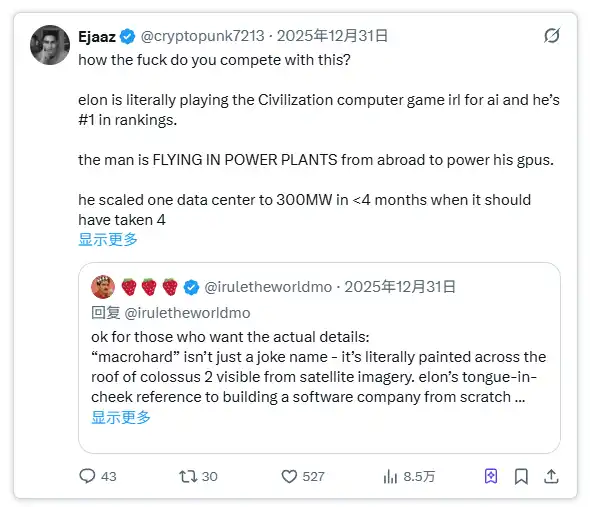
Elon directly airlifted gas turbines to power the data centers because the grids in Tennessee and Memphis simply couldn't handle it. These turbines alone can support an additional 600,000 GPUs.

He chose to completely bypass the entire state's power grid (conventional expansion would take years) just to speed up model training. In addition, he deployed about 250MW of Tesla Megapack energy storage batteries to handle situations where the grid can't supply enough during peak usage.

This forward-thinking combined with extremely fast execution is giving xAI a huge computing power advantage over competitors.

You have to understand, the regulatory approvals, talent recruitment, and operational logistics involved in this have never been done on this scale before. xAI not only did it but made it look easy.

If the hypothesis that "more computing power = stronger model" holds true (and it currently seems to), then the rumored 7 trillion parameter Grok 5 will be a monster upon release. For comparison: Grok 4 has 3 trillion parameters—this is more than double.
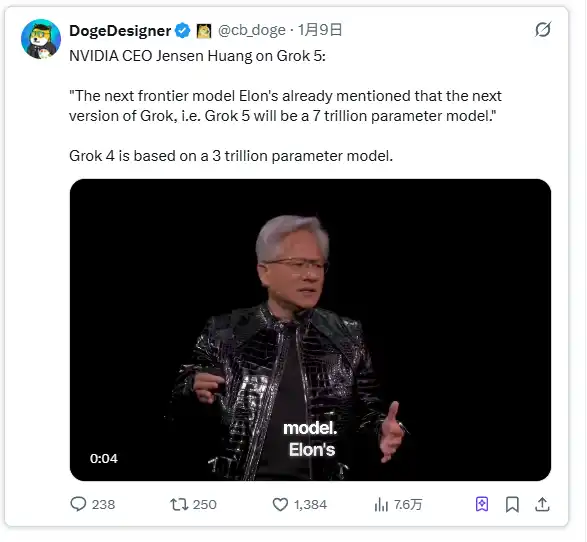
NVIDIA CEO Jensen Huang on Grok 5:

"Elon has mentioned that the next frontier model, the next version of Grok, namely Grok 5, will be a 7 trillion parameter model."

The infrastructure race is no longer in doubt.

There is no infrastructure expansion war right now because xAI has already won. Their strategy is "build first, talk later." Unless other labs catch up, xAI's models will remain ahead.

X's "X-Factor": Unlocking Personal AI

xAI has stronger computing power than anyone, but top-tier models also require massive amounts of data.

And not just any data. AI labs are increasingly realizing that real-time data is the key to unlocking personalized AI—an AI that deeply understands your desires and goals and helps you execute them before you even think of it.

Google's latest "Personal Intelligence" product is the clearest signal that models are ultimately heading in this direction. But xAI has a unique advantage here that Google doesn't:

A social media platform that feeds them over 100 million posts daily.

This means over 100 million pieces of text, images, and videos can be used to train Grok, enabling:

  • Real-time trends and breaking news
  • Large-scale understanding of virality, trends, and human behavior
  • Real-time sensing of the global cultural zeitgeist

Other models can only tell you what's happening; Grok can simultaneously tell you what's happening and how people feel about it—and faster than anyone else.

This capability is valuable.

If we assume the value users get from a tailored AI model is 10 times that of a general-purpose large model, then X's moat is very difficult to breach.

It's not just the data; X's distribution capability is also insane:

  • 70 million daily active users
  • 600 million monthly active users
  • An "Ask Grok" button next to every post

It's not hard to imagine xAI integrating real-time prediction markets, shopping, banking, dating, and more into the same App in the future, all powered by Grok.

Currently, most model lab valuations are based on GPU count, intelligence benchmarks, and reputation. xAI has all of these, plus the opportunity to penetrate multiple internet monopoly areas—don't forget their goal is to become an "Everything App."

Today, X's recommendation algorithm is powered by Grok, which analyzes every post to make recommendations. Tomorrow, it will provide personal intelligence services for each user.

Grok is clearly not just a standard large language model; its valuation should reflect that.

Physical AI Advantage: xAI is the Most Forward-Looking Lab

It's no secret that robots will have a huge impact on the world in the next five years. The technology has finally matured.

From factory manual labor to "last-mile" delivery, from fast-food chains to top surgeons, all will be assisted or entirely replaced by robots.

The viral videos from Boston Dynamics over a decade ago have now snowballed into autonomous vehicle fleets and (surprisingly impressively) humanoid robots. Honestly, when it comes to these two things, only one company comes to mind: Tesla.

A car that drives better than a human is no longer a fantasy. The latest v14.2.2.3 update is technically already a better driver than you. Once regulations pass, you'll see autonomous Teslas transporting people everywhere.

Similarly, a humanoid robot that can carry your shopping bags and carefully wipe your mother's fine china is becoming a reality. Optimus will begin mass shipments into homes and factories by the end of this year.

What does this have to do with xAI?

Two things:

  1. Machines need a brain to drive them, and Tesla uses Grok.
  2. Grok needs diverse data sources to understand the world around it, and this data comes from Tesla's robots.

This symbiotic relationship gives xAI an almost unfair advantage over competitors. I think Google is the only company that can compete at this level, but they are still behind.

Today, Grok is already powering Tesla vehicles—the latest update lets you to simply tell Grok to drive you somewhere while playing music and telling you about Roman history.

Similarly, Grok is now receiving video data from Tesla cameras, distance data from Tesla sensors, etc., helping it understand real-world physics, visual perception, and navigation.

All this data now helps it become stronger in other capabilities, such as generating more physically accurate video content.

You have to admit Musk is playing 5D chess. He's not just building a large language model; he's building the entire ecosystem for AI to live and operate in.

Writing this, I admit it all sounds fantastic, but also incredibly ambitious......which leads to the final part of the article:

Yes, There Are Risks Here

There are risks in everything. Maybe managing 5 companies is Elon's limit, and 6 is too many......but I doubt it. If there's anyone in this world who has repeatedly proven able to prove doubters wrong time and again, it's him.

Call me crazy, I don't care—what he has already achieved is itself extremely improbable.

I think there are three key risks:

The King of Controversy — Elon and headlines are old friends. He is currently involved in a $130 billion lawsuit with OpenAI and is under investigation by EU and Indian regulators. Who knows, this guy might do something outrageous that messes up the entire vision.

Execution Risk — xAI burns about $1 billion per month; that's a huge bill. And Elon alone manages 5 companies (not including Starlink).

Scaling Laws — xAI is betting everything on "more computing power = stronger model," but if a new, better training architecture is discovered, this hypothesis could be overturned. Andrej Karpathy has stated multiple times that he doesn't believe large language models are the final form.

That's it! I think people have been unfairly critical of xAI's efforts to push the frontiers of intelligence lately and seem to forget they are still a force to be reckoned with.

I hope this article changes your perspective. Thanks for reading.

Related Questions

QWhat are the key advantages that xAI has over its competitors according to the article?

AThe article highlights four key advantages: massive computing power (with plans for 1 million GPUs by 2026), access to a vast, real-time data stream from the X platform, a powerful distribution channel with 600M monthly active users, and a unique 'physical AI' advantage through integration with Tesla's autonomous driving and Optimus robotics.

QHow is Elon Musk ensuring sufficient power for xAI's massive data centers?

AHe is bypassing the local power grid by airlifting gas turbine generators to power the data centers directly. He is also deploying Tesla Megapack battery storage systems to handle peak demand, allowing for a rapid expansion that the conventional grid could not support.

QWhat is the significance of the X platform's data for training Grok?

AThe X platform provides Grok with over 100 million posts daily, offering a massive, real-time dataset. This allows Grok to understand current trends, breaking news, viral content, and human behavior on a global scale, giving it a significant edge in personalization and cultural awareness over models trained on static datasets.

QWhat is the 'physical AI' advantage that xAI possesses?

AxAI's 'physical AI' advantage comes from its symbiotic relationship with Tesla. Grok is the AI brain for Tesla's autonomous vehicles and Optimus robots. In return, these physical systems provide Grok with vast amounts of real-world data on visual perception, navigation, and physics, which helps improve its overall capabilities.

QWhat are the main risks to xAI's ambitious plans as mentioned in the article?

AThe article identifies three main risks: 1) Reputational and regulatory risk due to Elon Musk's controversies and ongoing legal battles. 2) Execution risk from managing multiple companies and a high monthly burn rate of ~$1 billion. 3) The risk that the 'scaling laws' (more compute = better model) assumption could be invalidated by a breakthrough in a new, more efficient AI architecture.

Related Reads

Must-Watch Events Next Week|CLARITY Act Could Face Senate Vote; SpaceX, Circle to Report Earnings (8.3-8.9)

**Summary: Key Events and Developments to Watch (August 3-9)** The upcoming week is marked by significant financial disclosures, key legislative deadlines, and notable product updates. **Major Financial Events:** Several companies are scheduled to release their Q2 2026 earnings. American Bitcoin (ABTC) will report on August 3, followed by SpaceX and Hut 8 Mining Corp. on August 4, and Circle on August 5. Notably, a significant portion of SpaceX shares (up to 12% of total shares) will be unlocked on August 6 following their earnings release. **Key Legislative Deadline:** The U.S. Senate faces an August 7 deadline to secure 60 votes for the CLARITY Act, a bipartisan bill aiming to establish a federal regulatory framework for cryptocurrencies. The Senate may hold a full vote on the bill during the week. **Economic Data:** The U.S. July Non-Farm Payrolls report will be released on August 7, providing crucial labor market data. **Technology & Product Updates:** * **Shutdowns:** DeFi portfolio tracker Zapper and wallet app Ctrl Wallet will cease operations on August 3. * **Upgrades:** LayerZero will deprecate its v1 relayers on August 3. XRP Ledger's new version 3.3.0, featuring five new functions, is expected next week. * **AI:** Elon Musk announced that the advanced Grok 4.6 AI model is set for release around August 7. * **Bitcoin:** The BIP-110 forced signaling for a potential Bitcoin network change is scheduled to begin around August 8. **Other Notable Events:** Chinese robotics firm Unitree Tech has set its preliminary price inquiry for its IPO for August 5. South Korean exchange Upbit will delist AQT and AERGO tokens on August 3.

marsbit24m ago

Must-Watch Events Next Week|CLARITY Act Could Face Senate Vote; SpaceX, Circle to Report Earnings (8.3-8.9)

marsbit24m ago

Stocks Are Plummeting More Sharply Than Cryptocurrencies. Where Has the Money Gone?

Stock Markets Plunge Deeper Than Cryptocurrencies: Where Did the Money Go? In late July, Seoul's Kospi index triggered circuit breakers for two consecutive days, plummeting over 40% from its June high. The collapse was led by heavyweight stocks like SK Hynix, whose record profits still disappointed investors, and devastating leveraged ETFs, with one major product losing over 83% of its value. This signaled a global, forced deleveraging targeting the most crowded trades. Interestingly, while stocks exhibited extreme volatility akin to crypto markets, Bitcoin rose nearly 15% in July after a prior steep drop. Analysis shows the money fleeing equities did not flow into Bitcoin. Instead, Bitcoin had already absorbed its sell-off in May-June, when U.S. spot Bitcoin ETFs saw historic outflows. The true safe-haven beneficiary was gold, whose price rose over 20% year-on-year, highlighting a decoupling between Bitcoin and gold as "digital gold." The sell-off was a targeted unwinding of leveraged positions in tech and semiconductors, accelerated by broker-dealer risk management and shifts in the AI narrative, including new competition from Chinese memory chipmakers. The retreat path was clear: from high-valuation tech stocks to cash and U.S. Treasuries, then to gold. For Bitcoin to attract sustained institutional inflows, conditions like eased global liquidity pressure, a "soft-landing" Fed rate cut, and U.S. regulatory clarity via legislation like the stalled CLARITY Act are needed. Currently, Bitcoin is not a safe haven but an already-cleared asset. Its low correlation with tech stocks, however, makes it a potential diversification play for institutional portfolios once the storm passes. The money isn't here yet, but the positioning is underway.

marsbit24m ago

Stocks Are Plummeting More Sharply Than Cryptocurrencies. Where Has the Money Gone?

marsbit24m ago

In Conversation with Ray Dalio: We Are Currently in an AI Bubble, with 1% of My Portfolio in Bitcoin

Ray Dalio, founder of Bridgewater Associates, warns in an interview that the current AI boom shows classic bubble characteristics, which could lead to significant economic downturns as seen in past cycles like 1929 or 2000. He explains that speculative enthusiasm, fueled by debt and overvaluation, often precedes a crash when rising rates or taxation force asset sales, causing widespread losses and recession. Dalio also outlines his "Big Cycle" theory, describing an approximate 80-year pattern where widening wealth gaps, massive government deficits, and shifting geopolitical power (like China's rise) create internal conflict and global instability. He emphasizes that we are in a late-cycle, transitional phase where traditional powers like the US and UK face decline. For personal wealth protection, Dalio advises diversification beyond cash into assets like stocks, bonds, real estate, and particularly gold, which he prefers over Bitcoin. While he holds about 1% of his portfolio in Bitcoin as a non-printable hard asset, he views gold as more secure from technological or governmental threats. Regarding AI's impact, Dalio believes it will disproportionately benefit capital owners, worsening inequality by replacing both physical and cognitive labor. He suggests that human intuition and emotional intelligence, combined with AI, will be key for future workers. On taxation, Dalio argues that wealth taxes are impractical and risk triggering asset sell-offs, reducing productive investment. He points to the UK as a cautionary example of debt, low productivity, and political strife. Geopolitically, Dalio foresees a more regionalized world, with the US showing weakness in prolonged conflicts like with Iran, akin to past imperial declines. The ideal outcome, he suggests, is coexisting powerful blocs (e.g., Americas, China-Asia Pacific) without major war.

marsbit4h ago

In Conversation with Ray Dalio: We Are Currently in an AI Bubble, with 1% of My Portfolio in Bitcoin

marsbit4h ago

Daily 7.2 Trillion KRW: Foreign Capital's Record Net Buying on Friday! Wall Street Says Headwinds for Korean Stock Fund Flows Have Subsided

South Korean stock market sees a dramatic shift in fund flows. On July 31, foreign investors made a record net purchase of approximately KRW 7.2 trillion in KOSPI stocks, marking a fundamental reversal from the persistent large-scale net outflows seen in previous months. This contributed to a significant narrowing of foreign net selling in July to KRW 9.8 trillion, down sharply from KRW 48.4 trillion in June and KRW 44.5 trillion in May. Simultaneously, domestic institutional pressure eased. South Korean pension funds and asset managers turned to a net buying position in July, purchasing KRW 1.0 trillion worth of KOSPI shares, contrasting with net sales in May and June. Market volatility is expected to be dampened by new financial regulations. Effective July 31, the Financial Services Commission tightened access for retail investors to single-stock leveraged ETFs by raising the minimum cash deposit requirement. Trading volumes for these products subsequently dropped to about 50% of their monthly average. Citigroup Research maintains its year-end KOSPI target of 10,000 points. The firm cites several supportive factors: the substantial easing of headwinds from capital outflows, a robust fundamental outlook for the semiconductor sector, historically low market valuations, strong economic fundamentals, and the potential for policy support from financial authorities if needed.

marsbit4h ago

Daily 7.2 Trillion KRW: Foreign Capital's Record Net Buying on Friday! Wall Street Says Headwinds for Korean Stock Fund Flows Have Subsided

marsbit4h ago

Trading

Spot
活动图片





