World Models Shift from Prediction to Planning: HWM and the Challenge of Long-Horizon Control

marsbitPublished on 2026-04-17Last updated on 2026-04-17

Abstract

World models have evolved from focusing on representation learning and future prediction to addressing long-horizon planning challenges. While models like V-JEPA 2 demonstrate strong predictive capabilities using large-scale video pre-training, they struggle with multi-stage control tasks due to error accumulation and exponential growth in action search space. HWM (Hierarchical World Model) introduces a two-level planning structure: a high-level planner outlines coarse subgoals over longer time horizons, while a low-level executor handles short-term actions. This decomposition reduces planning complexity and error propagation. In experiments, HWM achieved 70% success in real-world robotic tasks where flat models failed entirely. Complementary efforts include V-JEPA (focused on representation), HWM (on hierarchical planning), and WAV (World Action Verifier, on self-correction). Together, they mark a shift from pure world modeling to integrated systems capable of prediction, planning, and verification—key to deploying world models in real-world agents and long-term tasks.

Over the past year, the research focus of world models has initially centered on representation learning and future prediction. Models first understand the world and then internally simulate future states. This approach has already produced a number of representative results. V-JEPA 2 (Video Joint Embedding Predictive Architecture 2—a video world model suite released by Meta in 2025) used over 1 million hours of internet video for pre-training, combined with a small amount of robot interaction data, demonstrating the potential of world models in understanding, prediction, and zero-shot robot planning.

However, a model's ability to predict does not equate to its ability to handle long-horizon tasks. When faced with multi-stage control, systems typically encounter two challenges. One is that prediction errors accumulate over long rollouts (multi-step simulations), causing the entire path to increasingly deviate from the goal. The other is that the action search space expands rapidly as the planning horizon increases, leading to continuously rising planning costs. HWM does not rewrite the underlying learning approach of world models but instead adds a hierarchical planning structure on top of existing action-conditioned world models, enabling the system to first organize stage paths and then handle local actions.

From a technical perspective, V-JEPA 2 (https://ai.meta.com/research/vjepa/) leans more toward world representation and basic prediction, HWM leans more toward long-horizon planning, and WAV (World Action Verifier: Self-Improving World Models via Forward-Inverse Asymmetry, https://arxiv.org/abs/2604.01985) leans more toward the model's ability to identify and correct its own prediction distortions. These three lines of research are gradually converging. The focus of world model research has shifted from merely predicting the future to transforming predictive capabilities into executable, correctable, and verifiable system capabilities.

I. Why Long-Horizon Control Remains a Bottleneck for World Models

The difficulties of long-horizon control become clearer when applied to robotic tasks. Take robotic arm manipulation as an example: picking up a cup and placing it in a drawer is not a single action but a sequence of continuous steps. The system must approach the object, adjust its posture, complete the grasp, move to the target location, and then handle the drawer and placement. As the chain lengthens, two problems arise simultaneously. One is that prediction errors accumulate along the rollout, and the other is that the action search space expands rapidly.
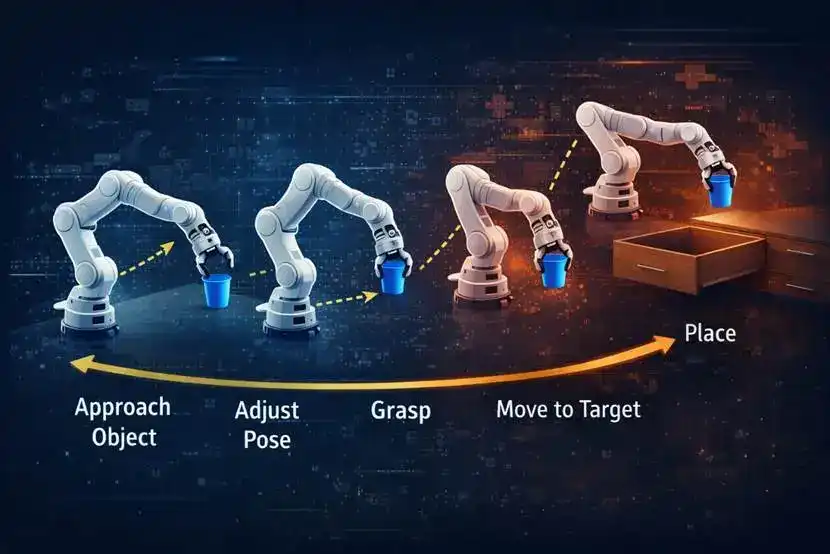
What the system often lacks is not local predictive ability but the capacity to organize distant goals into stage paths. Many actions may appear to deviate from the goal locally but are actually intermediate steps required to achieve it. For example, raising the arm before grasping or moving back slightly and adjusting the angle before opening a drawer.

In demonstration tasks, world models can already provide coherent predictions. However, when entering real control scenarios, performance begins to decline, and problems emerge. The pressure comes not only from the representation itself but also from the immaturity of the planning layer.

II. How HWM Restructures the Planning Process

HWM splits the originally single-layer planning process into two layers. The upper layer is responsible for stage direction at a longer time scale, while the lower layer handles local execution at a shorter time scale. The model plans at two different temporal rhythms simultaneously, rather than at a single pace.

When handling long tasks, single-layer methods typically need to search the entire action chain directly in the underlying action space. The longer the task, the higher the search cost, and the more likely prediction errors are to diffuse along multi-step rollouts. After HWM's decomposition, the high layer only handles route selection at a longer time scale, and the low layer only handles the execution of the current segment. The entire long task is broken into multiple shorter segments, reducing planning complexity.

Another key design is that high-level actions are not simply the difference between two states but use an encoder to compress a sequence of low-level actions into a higher-level action representation. For long tasks, the key is not just the difference between the start and end points but also how the intermediate steps are organized. If the high layer only looks at displacement differences, it may lose path information in the action chain.

HWM embodies a hierarchical task organization approach. Faced with a multi-stage task, the system no longer unfolds all actions at once but first forms a coarse stage path and then executes and corrects it segment by segment. Once this hierarchical relationship is incorporated into the world model, predictive capabilities begin to transform more stably into planning capabilities.

III. From 0% to 70%: What the Experimental Results Indicate

In the real-world grasp-and-place task set up in the paper, the system was given only the final goal condition without manually decomposed intermediate goals. Under these conditions, HWM achieved a success rate of 70%, while the single-layer world model had a 0% success rate. A long task that was nearly impossible to complete originally became highly achievable after introducing hierarchical planning.
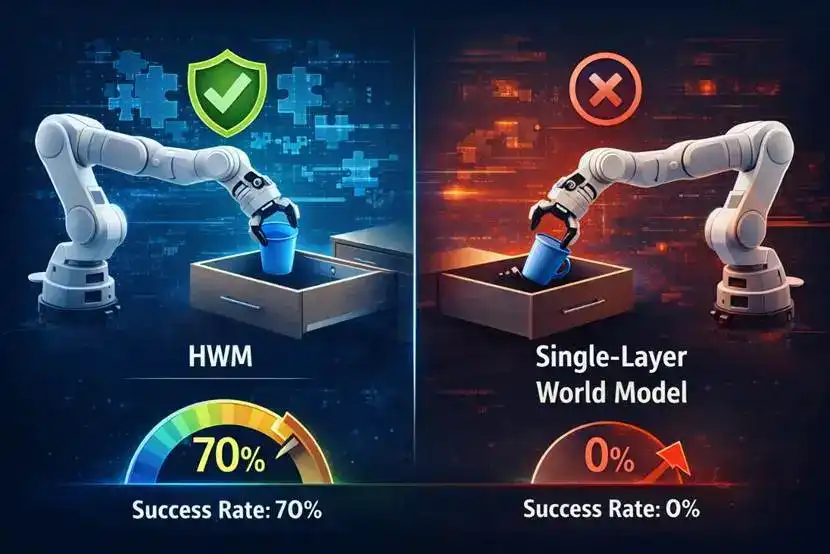
The paper also tested simulation tasks such as object pushing and maze navigation. The results showed that hierarchical planning not only improved success rates but also reduced the computational cost of the planning phase. In some environments, the computational cost of the planning phase could be reduced to about a quarter of the original while maintaining higher or comparable success rates.

IV. From V-JEPA to HWM to WAV

V-JEPA 2 represents the world representation approach. V-JEPA 2 used over 1 million hours of internet video for pre-training, combined with less than 62 hours of robot video for post-training (targeted training after pre-training), resulting in a latent action-conditioned world model (a world model that predicts in an abstract representation space incorporating action information) usable for understanding, predicting, and planning in the physical world. It demonstrates that models can acquire world representations through large-scale observation and transfer these representations to robot planning.

HWM is the next step. The model already possesses world representation and basic predictive capabilities, but once multi-stage control is involved, the problems of error accumulation and search space expansion erupt. HWM does not change the underlying representation learning approach but adds a multi-timescale planning structure on top of existing action-conditioned world models. It addresses how the model organizes distant goals into a set of intermediate steps and then advances segment by segment.

WAV further focuses on verification capabilities. For world models to enter policy optimization and deployment scenarios, they cannot just predict; they must also identify areas where they are prone to distortion and make corrections accordingly. It focuses on how the model checks itself.

V-JEPA leans toward world representation, HWM toward task planning, and WAV toward result verification. Although their focuses differ, their overall direction is consistent. The next phase of world models is no longer just internal prediction but the gradual integration of prediction, planning, and verification into a system capability.
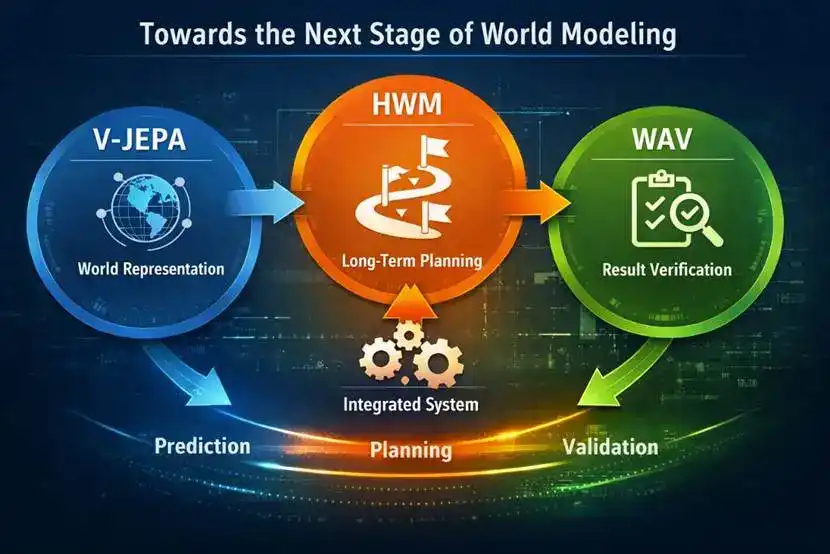
V. From Internal Prediction to Executable Systems

Many past world model efforts were closer to improving the continuity of future state predictions or the stability of internal world representations. However, the current research focus is beginning to change. Systems must not only form judgments about the environment but also translate those judgments into actions and continue to adjust the next steps after results are obtained. To get closer to real deployment, it is necessary to control error propagation in long-horizon tasks, compress the search space, and reduce inference costs.

Such changes will also affect AI agents. Many agent systems can already handle short-chain tasks, such as calling tools, reading files, and executing multi-step commands. However, once tasks become long-chain, multi-stage, and require mid-course re-planning, performance declines. This is not fundamentally different from the difficulties in robotic control; both stem from insufficient high-level path organization capabilities, leading to a disconnect between local execution and overall goals.

The hierarchical approach provided by HWM—where the high level is responsible for paths and stage goals, the low level handles local actions and feedback processing, and result verification is layered on top—will continue to appear in more systems in the future. The next phase of world models will focus not only on predicting the future but on organizing prediction, execution, and correction into a viable path.


Related Questions

QWhat are the main challenges in long-horizon control for world models, as discussed in the article?

AThe main challenges are the accumulation of prediction errors during long rollout sequences, which causes the system to increasingly deviate from the goal, and the exponential expansion of the action search space as the planning horizon grows, leading to rising computational costs.

QHow does HWM (Hierarchical World Model) address the problem of long-term task planning?

AHWM restructures the planning process into two layers: a high-level layer that plans stage directions over longer time scales, and a low-level layer that handles local execution over shorter time scales. This hierarchical approach breaks long tasks into shorter segments, reducing planning complexity and error propagation.

QWhat key improvement did HWM demonstrate in experimental results for real-world tasks?

AIn a real-world grasping and placement task where only the final target was provided without intermediate goals, HWM achieved a 70% success rate, compared to a 0% success rate for a single-layer world model. It also reduced computational costs by up to a quarter in some environments while maintaining high success rates.

QWhat are the distinct focuses of V-JEPA 2, HWM, and WAV in world model research?

AV-JEPA 2 focuses on world representation and foundational prediction using large-scale video pre-training. HWM emphasizes hierarchical task planning for long-horizon control. WAV (World Action Verifier) concentrates on self-verification, identifying and correcting prediction distortions to improve model reliability.

QHow is the research focus of world models evolving beyond mere prediction?

AThe research is shifting from internal future prediction to building executable systems that integrate prediction, planning, and verification. This involves controlling error propagation, compressing search spaces, reducing inference costs, and organizing hierarchical structures for reliable long-term task execution.

Related Reads

DAT Failure? Listed Companies Betting on HYPE Floating Profit of $12.5 Billion

Several public companies that adopted a "HYPE Treasury" strategy—holding significant reserves of the HYPE token from the Hyperliquid ecosystem—have achieved substantial paper gains, collectively exceeding $1.25 billion. This contrasts with the reported struggles of MicroStrategy's flagship BTC treasury strategy. The article profiles three such HYPE-focused treasury companies: 1. **Hyperliquid Strategies Inc. (PURR):** The largest holder, with approximately 22.3 million HYPE tokens valued at ~$1.636 billion, resulting in an unrealized gain of ~$1.22 billion. It has fully transitioned from a biotech firm to a dedicated crypto treasury, adding staking and validator operations to enhance returns. 2. **Hyperion DeFi (HYPD):** Holds around 2 million HYPE tokens (~$147 million value) with a gain of ~$49.4 million. It is deeply integrated into the Hyperliquid ecosystem, running a major validator node and building DeFi products for additional yield. 3. **Lion Group Holding (LGHL):** A smaller holder with ~194,000 HYPE tokens (~$14.14 million value), maintaining a long-term commitment to the token. The success of these HYPE treasuries is attributed not only to the token's significant price appreciation but also to active on-chain participation through staking, validation, and ecosystem integrations, creating a compounding "flywheel" effect. The article posits that while MicroStrategy's BTC strategy faces challenges, HYPE treasuries may offer a more sustainable model through deeper protocol engagement, with potential for further growth if HYPE's price rises as predicted by some analysts.

marsbit3m ago

DAT Failure? Listed Companies Betting on HYPE Floating Profit of $12.5 Billion

marsbit3m ago

DAT Failing? Listed Companies Betting on HYPE Have Floating Profits of $12.5 Billion

Facing a potential need to sell Bitcoin to pay dividends amid a $12.5B quarterly net loss, the crypto treasury strategy pioneered by Strategy appears strained. In contrast, public companies that adopted a similar strategy by betting on the HYPE token are seeing massive gains, with collective unrealized profits exceeding $1.25 billion. Three key HYPE treasury companies are highlighted: 1. **Hyperliquid Strategies Inc. (PURR):** The largest holder, with approximately 22.3 million HYPE tokens valued at ~$1.636 billion, resulting in ~$1.22 billion in unrealized gains. It has fully transitioned from a biotech firm to a native crypto treasury, focusing on staking and ecosystem participation via validator operations. 2. **Hyperion DeFi (HYPD):** Holds about 2 million HYPE tokens (~$147M value) with ~$49.4M in gains. It is deeply integrated into the Hyperliquid ecosystem, running a top validator node and building DeFi products to generate additional yield. 3. **Lion Group Holding (LGHL):** A smaller player holding ~193,775 HYPE tokens (~$14.14M value), maintaining a long-term holding strategy alongside other crypto assets. The article argues that HYPE treasuries have an advantage over Bitcoin-based ones like Strategy's. Their success stems not just from price appreciation but from active on-chain participation—staking, earning validator rewards, and engaging with ecosystem protocols—creating a compounding "flywheel" effect. With Hyperliquid dominating the on-chain perpetuals market and HYPE's tokenomics encouraging buys and burns, these treasuries are positioned to benefit further if HYPE's price rises as some predict. While the original Bitcoin treasury strategy isn't declared a failure, the current narrative highlights the outsized success of early movers into the HYPE ecosystem.

Odaily星球日报7m ago

DAT Failing? Listed Companies Betting on HYPE Have Floating Profits of $12.5 Billion

Odaily星球日报7m ago

Comics Illustration: Helping You Understand China's New Regulations on Outbound Investment

Summary: Understanding China's New Regulations on Overseas Investment The State Council has announced new regulations on overseas investment, effective July 1, 2026. The core message is not a prohibition on international investment, but a call for both companies and individuals to operate with strong regulatory awareness. Here are the key points: 1. **Scope is Broad:** The rules apply not only to companies but also to other organizations and individual residents. 2. **Definition of Investment is Wide:** It encompasses not just capital transfers but also asset contributions, obtaining equity or rights, financing, providing guarantees, and direct or indirect acquisition of rights related to overseas entities or assets. 3. **Companies Must Plan Comprehensively:** Beyond simple ownership charts, firms need clear plans covering the investing entity, required approvals or filings, fund transfer paths, and compliance with technology, data, and security reviews. 4. **Individuals Should Prioritize Compliance:** Before focusing on returns, individuals must first assess their eligibility, understand legal channels for capital outflow, know what they are acquiring, and identify responsible parties in case of issues. 5. **Penalties are Significant:** Violations can result in fines and potentially restrictions on future overseas investment activities. In essence, overseas investment remains possible, but it must be approached with regulatory compliance as a fundamental priority, not solely based on commercial opportunity. *Note: This is a general informational summary and does not constitute legal advice or investment recommendations.*

marsbit22m ago

Comics Illustration: Helping You Understand China's New Regulations on Outbound Investment

marsbit22m ago

Nvidia Rack Disassembly Reveals New Growth Opportunity, MLCC Value Surges 182%

Supply bottlenecks in AI infrastructure have expanded to fundamental hardware components like multilayer ceramic capacitors (MLCCs), crucial for stabilizing power and filtering noise in AI servers. Both Goldman Sachs and Morgan Stanley highlight MLCCs as entering a historic "volume-price dual increase" supercycle driven by AI. Goldman forecasts the AI server MLCC market to surge over fourfold from ~$1.4B in FY2025 to ~$5.8B in FY2030, a 34% CAGR. The core driver is a structural supply-demand imbalance. While AI server demand is projected to grow ~4.3x by 2030, industry capacity expands at only ~10% annually, constrained by internal production of equipment and materials. This is compounded by strong demand from electric vehicles. The shortage is evident, with lead times for high-end MLCCs exceeding 20 weeks. The price cycle has officially begun. Japanese leaders Murata and Taiyo Yuden have raised prices by 15-35% for AI server and automotive MLCCs since April, citing material costs. Japan's April export data confirms the trend, with MLCC export value up 28% year-over-year. Profit leverage is significant: Goldman estimates a mere 5% price increase could boost Murata's FY2027 operating profit by ~13% and Taiyo Yuden's by up to 37%. Morgan Stanley's teardown of Nvidia's upcoming Vera Rubin AI rack reveals another catalyst: the MLCC value per rack has skyrocketed 182% from the previous generation to ~$4,320, highlighting the component's growing importance. With demand set to massively outstrip constrained supply, and price increases just starting, analysts position MLCCs at the beginning of a major, prolonged upcycle.

marsbit22m ago

Nvidia Rack Disassembly Reveals New Growth Opportunity, MLCC Value Surges 182%

marsbit22m ago

A 134% Surge, 75 P/E Ratio: Why Is the Market Paying Up for Murata's 'Zero Growth'?

Murata Manufacturing, the world's largest passive components maker, saw its stock price surge 134% over the past year and hit a record high on May 28th, despite reporting nearly zero growth in operating profit for its latest fiscal year. This has pushed its valuation to a P/E ratio of approximately 75x. The disconnect is driven by a fundamental market re-rating. The catalyst was a late-May meeting where management upgraded the AI investment cycle outlook to "lasting until around 2030" and noted that demand for its components is roughly double its supply capacity, with customers prioritizing securing volume over price. While Murata's revenue grew only 5.0% and operating profit stagnated at ¥281.8 billion for the fiscal year ending March 2026, its guidance for the current fiscal year projects a 34.8% jump in operating profit to ¥380 billion. This sharp growth is underpinned by expectations that its AI/data center-related revenue will nearly double from ¥170 billion to ¥325 billion, becoming a key pillar of its business. Analysts highlight that this growth stems not from broad price hikes but from a shift towards higher-value, cutting-edge MLCCs for AI servers, where Murata holds over 70% market share. The market is now pricing Murata not as a cyclical component maker but as a critical "AI pick-and-shovel" supplier with structural pricing power. However, the high valuation also carries risk if future AI demand or quarterly guidance falls short of the elevated expectations.

marsbit45m ago

A 134% Surge, 75 P/E Ratio: Why Is the Market Paying Up for Murata's 'Zero Growth'?

marsbit45m ago

Trading

Spot
Futures
活动图片




