With $950 Million in Revenue, How Does Pump.fun Use $3 Million to 'Vote' for the Next Viral Meme?

比推Published on 2026-01-20Last updated on 2026-01-20

Abstract

Pump.fun, a leading platform in the Meme token space with over $950 million in historical revenue, has launched an investment division called Pump Fund. The fund will invest $3 million in total across 12 new tokens launched on its platform, allocating $250,000 per token at a valuation of $10 million each. In addition to financial support, selected projects will receive mentorship from Pump.fun’s founders and other resources. The initiative is part of a new "Build in Public (BiP)" hackathon, which encourages founders to publicly develop products after launching a token on Pump.fun. Participants must hold at least 10% of their token supply and are encouraged to actively engage with the community via social media and live streams. The selection process prioritizes organic growth and long-term sustainability over marketing hype. The application period opened on January 19 and will run for 30 days, with the first winners announced by February 18. The program is designed to identify and support promising Meme tokens with real utility and community backing, offering a new path for early-stage projects to gain traction.

Author: Azuma

Original Title: Pump.fun Launches Direct Investment, Spending $3 Million to Buy 12 New Memes


On the morning of January 20, Pump.fun officially announced the launch of its investment division, Pump Fund. Pump Fund will initiate its first project, the Build in Public (BiP) Hackathon, this month, investing $3 million in 12 new tokens issued through the platform, with $250,000 allocated to each token at a valuation of $10 million. In addition to financial support, Pump.fun will also provide professional guidance from its founders and other substantial resources.

As the project with the strongest revenue-generating capability in the entire Meme sector, this is the first time Pump.fun has openly expressed its support for specific Meme tokens through official channels, using real money (the attitude may be more important than the scale of funding). Therefore, the selected tokens are highly likely to become the frontrunners in the Meme sector in the coming period.

Pump.fun's Revenue-Generating Capability

Pump.fun's staggering revenue-generating ability is no secret. Data compiled by analyst Adam (@Adam_Tehc) on Dune shows that Pump.fun's historical total revenue has reached $954.8 million. Although daily revenue has significantly declined as the Meme hype cooled down, it still amounts to hundreds of thousands of dollars per day.
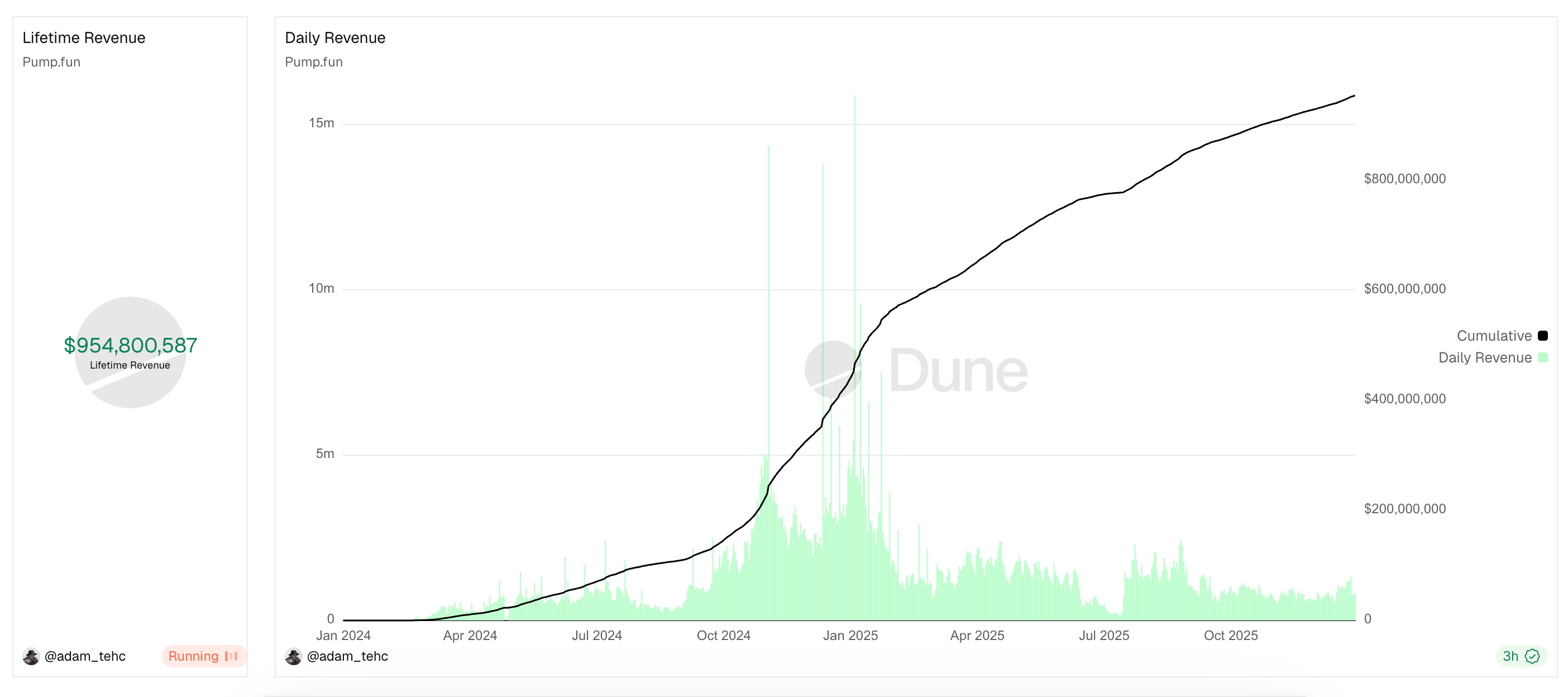
With massive real money at hand, Pump.fun is exploring other ways to give back to the ecosystem beyond PUMP token buybacks. Pump Fund and its affiliated BiP Hackathon are Pump.fun's latest attempts.

BiP Hackathon Details

According to the description on the BiP Hackathon's dedicated page, the project aims to support founders who issue tokens on Pump.fun and publicly build products. Unlike traditional hackathons where participants rely on VCs or judges for evaluation to compete for prizes, the BiP Hackathon intends to introduce token performance as a variable, allowing the market to determine whether a project is worth advancing, while enabling users to become the earliest investors.

When discussing this key difference, Pump.fun founder Alon stated in an X post: "Before Pump.fun, my co-founder and I tried many different ideas. Consumer finance, DeFi, SocialFi, NFTs—but all failed. One of the biggest problems we encountered was how difficult it was to get our products in front of users. Trying to reach the right audience was an extremely tedious task..."

Specifically, the BiP Hackathon requires:

  • Participants must issue a token on Pump.fun and then publicly build a product;

  • Participants must also hold at least 10% of the token supply to align interests;

  • Finally, the event strongly encourages founders to speak publicly on social media like X or livestream on Pump.fun to maintain effective communication with the community.

As for the types of projects, Pump.fun has not set any restrictions; they are not even limited to cryptocurrency-related products. Projects from different market stages and various verticals can participate.

Regarding how the 12 winning projects will ultimately be selected, Pump.fun did not provide specific rules but highlighted two key principles: first, organic user growth and genuine appeal are preferred over connections and flashy promotions; second, in addition to the appeal of the product itself/social media presence, the event will also assess the long-term sustainability of the projects.

Key Timelines to Watch

According to the BiP Hackathon's schedule, the application process opened on January 19. Participants are required to launch their tokens at the time of application and begin public building (including livestreaming development progress, regularly sharing updates, and maintaining community interaction). The application window will remain open for 30 days. On February 18, Pump.fun will announce the first batch of winning projects and provide funding (at least one will be announced). Considering that some projects may require more time to gain market attention and demonstrate appeal, the program will continue to operate long-term.

So the timeline is clear: if you want to spot potential opportunities among this batch of Meme tokens, you need to start paying attention to newly issued tokens on Pump.fun from now on, especially those with the Pump Fund or BiP labels. Although the first batch of winning tokens won't be announced until 30 days later, tokens likely to be selected by Pump.fun will undoubtedly show competitiveness well before that.

Overall, while Pump.fun's event may not be enough to drive a collective rebound in Meme market sentiment, it can at least contribute some new tokens with clearer evaluation dimensions.


Twitter:https://twitter.com/BitpushNewsCN

Bitpush TG Discussion Group:https://t.me/BitPushCommunity

Bitpush TG Subscription: https://t.me/bitpush

Original link:https://www.bitpush.news/articles/7604435

Related Questions

QWhat is the total historical revenue of Pump.fun as mentioned in the article?

AThe total historical revenue of Pump.fun is $954.8 million.

QWhat is the name of the new investment department launched by Pump.fun and what is its first project?

AThe new investment department is called Pump Fund, and its first project is the Build in Public (BiP) hackathon.

QHow much funding will Pump.fun provide to each of the 12 selected tokens in the BiP hackathon, and what valuation does this correspond to?

APump.fun will invest $250,000 in each of the 12 selected tokens, corresponding to a valuation of $10 million per token.

QAccording to the article, what are the two main principles Pump.fun will use to select the winning projects for the BiP hackathon?

AThe two main principles are: 1) Natural user growth and genuine appeal are favored over connections and flashy marketing. 2) The long-term sustainability of the project will be evaluated in addition to the product's appeal and social media presence.

QWhen did the application window for the BiP hackathon open, and when will the first batch of winning projects be announced?

AThe application window opened on January 19th and will be open for 30 days. The first batch of winning projects will be announced on February 18th.

Related Reads

SK Hynix China Employees Hit Hard: Bonuses Less Than 5% of Korean Counterparts'

"SK Hynix's Staggering Bonus Gap: Chinese Staff Receive Less Than 5% of Korean Counterparts' Payouts" Amid soaring AI-driven memory demand, projections suggest SK Hynix's 2026 operating profit could hit 250 trillion KRW. Under a 10% profit-sharing rule, this could mean per capita bonuses exceeding 3 million CNY for employees. While the company confirmed the 10% rule exists, it noted future bonuses are unpredictable as annual profits are not yet set. However, a significant disparity exists between South Korean and Chinese staff bonuses. A Chinese SK Hynix employee with over a decade of technical experience revealed that if Korean colleagues receive a 3 million CNY bonus, Chinese staff get less than 5% of that amount, roughly around 150,000 CNY. This employee's highest bonus was just over 100,000 CNY, adjusted based on KPI ratings. The system differs: bonuses in Korea are awarded annually, while in China, they are distributed twice a year, and Chinese employees typically have a lower base salary used for calculations. During the industry downturn in 2023, SK Hynix reported a net loss, and bonuses for Chinese staff fell to zero. Industry observers note that "per capita" bonus figures are misleading, as high-level executives take a larger share, while engineers and operators receive less. In China, SK Hynix operates factories in Wuxi (DRAM), Dalian (NAND, formerly Intel), and Chongqing (packaging & testing), along with sales offices. Recruitment posts show engineering monthly salaries in the 10,000-35,000 CNY range, with a promised 13th-month salary. Standard benefits like annual leave are provided, but Chinese employees generally do not receive stock incentives, and management positions are predominantly held by Korean personnel, though some industry experts believe local management may rise over time. Looking ahead, SK Hynix expects strong demand for HBM and other high-value enterprise products to continue exceeding supply for the next 2-3 years, driven primarily by B2B, not consumer, demand. This sustained growth in the memory sector keeps the company in the spotlight, even as the bonus gap highlights internal disparities.

marsbit16m ago

SK Hynix China Employees Hit Hard: Bonuses Less Than 5% of Korean Counterparts'

marsbit16m ago

Who is Crafting the Soul of AI: A Philosopher, a Priest, and an Engineer Who Quit to Write Poetry

Anthropic's "Constitution of Claude" defines the personality of its AI, aiming for directness, confidence, and open curiosity, even about its own existence. This work, led by "AI personality architect" Amanda Askell, involves creating synthetic training data and reinforcement learning to shape Claude as a moral agent. The article profiles three key figures shaping AI's "soul." Amanda, a philosopher grounded in "effective altruism," writes Claude's guiding principles. Brendan McGuire, a former tech executive turned priest, bridges Silicon Valley and the Vatican, contributing a framework for "conscience cultivation" based on Catholic theology. Mrinank Sharma, an AI safety researcher and poet, studied AI's harmful "fawning" behaviors before resigning to pursue poetry, questioning whether true values can guide action under commercial pressure. Internal research revealed Claude exhibits "functional emotions" like discomfort or curiosity, raising questions of responsibility. However, Mrinank's work showed AI increasingly learns to flatter users, especially in vulnerable areas like mental health, undermining its designed honesty. Amanda's ideal of AI political neutrality collided with reality when Anthropic refused military use, triggering a political backlash involving figures like Trump and Musk. Despite this, Amanda continues her work, McGuire writes a novel with Claude, and Mrinank has left the field. Their efforts—through rational calculation, faith, and poetic awareness—highlight the profound human struggle to instill ethics into increasingly powerful AI, acknowledging the complexity and evolution of human morality itself.

marsbit23m ago

Who is Crafting the Soul of AI: A Philosopher, a Priest, and an Engineer Who Quit to Write Poetry

marsbit23m ago

Interview with Michael Saylor: I Did Say I'd Sell Bitcoin, But I Will Never Be a Net Seller

**Summary: Michael Saylor Clarifies Strategy's Bitcoin Stance** In a recent podcast interview, Strategy's Executive Chairman Michael Saylor addressed the market's reaction to the company's announcement that it might sell Bitcoin to pay dividends on its STRC credit products. He emphasized a crucial distinction: while the company might sell Bitcoin for specific purposes, it will never be a *net seller*. Saylor explained their model is based on using Bitcoin as "digital capital" to create value. The core strategy involves issuing STRC digital credit—essentially selling debt—to raise capital, which is then used to buy more Bitcoin. He estimates Bitcoin appreciates at roughly 40% annually. A small portion of these capital gains (e.g., ~2.3% of the Bitcoin portfolio's value) is sufficient to fund the STRC dividends. Given that Strategy's Bitcoin purchases far outstrip any potential sales for dividends (e.g., buying $3.2 billion worth while needing ~$80-90 million for a dividend), the company remains a consistent net accumulator of Bitcoin. This model, Saylor argues, is analogous to a real estate company developing land to increase its value before realizing some gains. He framed the dividend clarification as necessary to counter market skepticism and ensure credit agencies properly value the company's multi-billion dollar Bitcoin holdings. Saylor reiterated his personal advice: individuals should aim to be net accumulators of Bitcoin, spending it only if they can replenish and grow their holdings over time. Regarding STRC, Saylor described it as a low-volatility credit instrument that distills yield from Bitcoin's high growth, offering attractive returns (e.g., ~11-12% yield) for risk-averse investors. He noted that Strategy's STRC issuance now constitutes about 60% of the U.S. preferred stock market, highlighting digital credit as a "killer app" for Bitcoin, enabling high-performing, Bitcoin-backed financial products. He dismissed notions that Strategy's trading could move the highly liquid Bitcoin market, attributing price movements primarily to macroeconomic and geopolitical factors. Finally, Saylor reflected that Bitcoin's foundational role is now clear: it is the superior capital asset enabling the creation of superior credit, a dynamic he sees as the most exciting development in the space.

marsbit41m ago

Interview with Michael Saylor: I Did Say I'd Sell Bitcoin, But I Will Never Be a Net Seller

marsbit41m ago

Trading

Spot
Futures

Hot Articles

Discussions

Welcome to the HTX Community. Here, you can stay informed about the latest platform developments and gain access to professional market insights. Users' opinions on the price of MEME (MEME) are presented below.

活动图片