Will Warsh Compromise with Trump? A Look at the 70-Year Power Struggle Between the President and the Fed

marsbitPublished on 2026-05-22Last updated on 2026-05-22

Abstract

Will the Fed's new chair, Kevin Warsh, yield to pressure from President Trump? A White House-administered oath ceremony for Warsh breaks recent precedent, spotlighting a seven-decade power struggle between the presidency and the Federal Reserve. Historically, each Fed chair has balanced political pressure with policy independence. Warsh's situation, however, is uniquely complex, inheriting a divided Federal Open Market Committee (FOMC) with some members opposing even hints of rate cuts, while Trump expects easing. The report from Caitong Securities reviews this history: from William Martin establishing independence, to Arthur Burns compromising under Nixon, Paul Volcker building institutional credibility, Alan Greenspan navigating political waters, and Jerome Powell facing severe pressure from Trump, ultimately hardening the Fed's defensive stance. Warsh, a former Fed governor known for questioning quantitative easing, is not a traditional dove. His recent statements emphasize a nuanced view of Fed independence, skepticism of forward guidance, serious concern over inflation (contradicting Trump's "fake inflation" claims), and the potential for AI-driven productivity gains to allow rate cuts. The analysis concludes Warsh's policy will likely feature a clear direction but cautious pace. Rate cuts are probable but constrained by persistent inflation above target; if Trump pressures heavily, Warsh may delay cuts to defend Fed independence. Balance sheet reduction is seen as nec...

Author: Zhao Ying

Source: Wall Street News

Trump will personally preside over the swearing-in ceremony of the new Fed Chairman, Kevin Warsh. This arrangement, which breaks recent conventions, once again thrusts the decades-long power game between the White House and the Federal Reserve into the spotlight. History shows that every Fed Chair has had to seek a balance between political pressure and policy independence, and Warsh is no exception—but the situation he faces is far more complex than outsiders imagine.

According to the Wall Street Journal, citing White House officials, Trump will preside over Warsh's swearing-in ceremony at the White House this Friday. This move breaks with recent practice—inauguration ceremonies are typically held internally at the Fed, with the president rarely attending in person. The last time a Fed Chair's swearing-in ceremony was held at the White House dates back nearly forty years to Alan Greenspan's inauguration in 1987.

The Fixed Income team at Caitong Securities (Sun Binbin, Sui Xiuping, Lu Xingchen) pointed out in their latest research report that although Warsh is not a "dovish chair," it cannot be ruled out that there will be no rate cuts this year—the relationship between the Fed Chair and the U.S. President is not static but evolves over time.

However, Warsh is not inheriting a unified and ready Federal Reserve. At the late April FOMC meeting, Governors Hammack (Cleveland), Kashkari (Minneapolis), and Logan (Dallas) cast the most unusual dissenting votes since October 1992—they did not oppose the idea of rate cuts themselves but argued against even hinting at them. This means Warsh inherits a central bank already showing internal fractures, precisely as Trump expects him to deliver rate cuts.

White House Inauguration: An Arrangement Full of Political Signals

The arrangement of the inauguration ceremony itself sends a strong signal. When Jerome Powell was inaugurated in 2018, the ceremony was held internally at the Fed, and Trump did not attend. The most recent sitting president to attend an inauguration was George W. Bush, who attended Ben Bernanke's swearing-in in 2006. Trump's personal hosting this time directly underscores his close attention to this Fed appointment.

At the procedural level, this transition process has also been unusually lengthy. Warsh was confirmed by the Senate last week, receiving a four-year term. Powell's term as Chair ended last weekend, but he stated he would remain on the Fed Board as a Governor, a term that lasts until January 2028. Warsh also agreed to divest some personal investments before formally taking office, which delayed the transition to some extent. During the interim, Fed Vice Chair Philip Jefferson represented the central bank at the G7 finance ministers and central bank governors meeting in Paris this Monday.

70 Years of Rivalry: From Martin to Powell

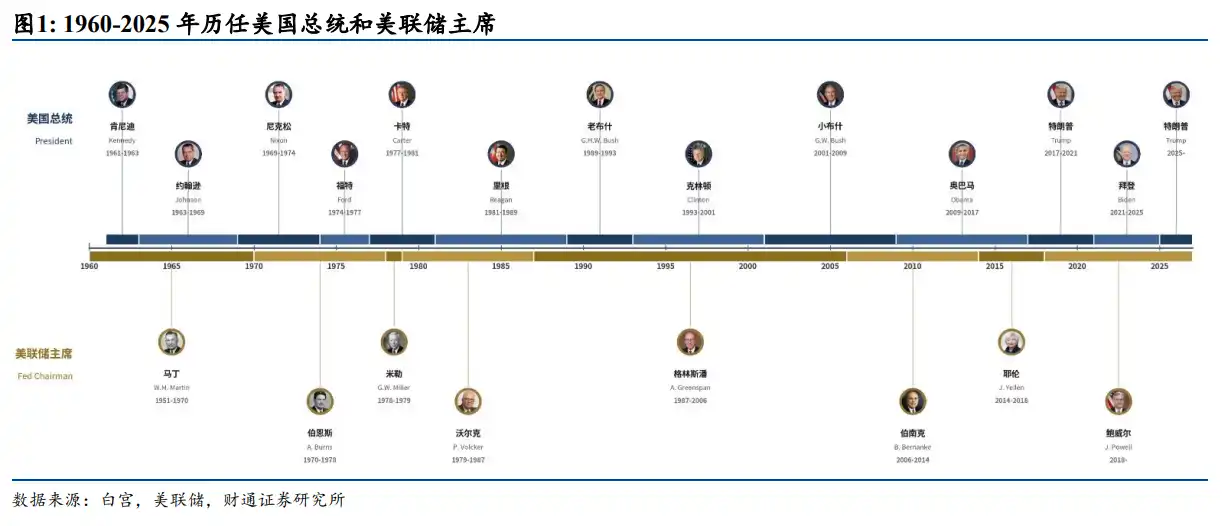
Caitong Securities' report systematically reviews the history of the relationships between each Fed Chair and the President since 1960, outlining a clear evolutionary path.

William Martin, facing a lack of institutional moats, could only rely on personal credibility to guard independence. After taking office, he refused to act as the Treasury's agent, shifted the Fed's decision-making center from New York to Washington, and expanded decision-making authority to the entire FOMC. When Truman saw him on a New York street, he just threw out the word "Traitor" and walked away.

Arthur Burns's failure stemmed from his own disbelief that monetary policy could end inflation, which opened the door to Nixon's political pressure. Nixon applied pressure through private letters, intervened in Board personnel composition, and even sent senior advisors to directly lecture Fed staff. Burns preserved institutional independence in form but made significant compromises on substantive policy direction, ultimately destroying the Fed's credibility.

William Miller represents the most direct political coordination model—deliberately chosen to align with Carter's political goals, but backfired in the face of external crises. By the summer of 1979, inflation had become Carter's biggest political crisis. Miller was moved to Treasury Secretary, making way for appointing a true inflation hawk.

Paul Volcker elevated independence from "personal credibility defense" to a triple moat of "personal credibility + institutional framework + market credibility." Carter, knowing appointing Volcker would come at a political cost, still made the choice—as his policy advisor Eizenstat said, it "ultimately squeezed him out of a second term, at the cost of high unemployment, while squeezing out inflation." Though Reagan "ordered" Volcker not to raise rates before the 1984 election and launched an "FOMC ambush" through appointed governors in 1986, he ultimately failed to substantively change policy direction.

Alan Greenspan used technocratic rhetoric to push the struggle below the surface, clashing fiercely with George H. W. Bush, reaching a "Washington-style peace" with Clinton, but overstepping to support tax cuts under George W. Bush, becoming the first Fed Chair in history to actively "invade" the realm of fiscal policy.

Ben Bernanke embodied a model of natural convergence between the White House and the Fed under crisis conditions, with his main pressures coming from Congress and within the Fed, not the White House. Janet Yellen countered Trump's attacks with "non-political language + strict self-restraint," becoming the first Fed Chair to be replaced by an incoming president since Carter did not reappoint Burns.

Jerome Powell faced presidential pressure more severe than any Chair since Burns. During Trump's first term, under combined external political pressure and internal economic judgment, Powell cut rates three times consecutively in 2019 and stopped balance sheet reduction. In Trump's second term, facing investigations launched by Trump over cost overruns in the Fed's Washington headquarters renovation and hints of dismissal, Powell's response significantly hardened, elevating the defense of Fed independence to a historically new level of legalization, documentation, and publicity. In his final meeting as Chair, the FOMC held rates steady with an unusually split 8-4 vote.
Warsh's Dilemma: A New Chair Caught in Internal and External Troubles

The situation Warsh inherits is quite rare in history—he simultaneously faces rate cut pressure from the White House and hawkish resistance from within the FOMC.

Warsh is not a traditional dove. Appointed as a Fed Governor by George W. Bush in 2006 at age 35, he was one of the youngest governors in Fed history. After QE2 was formally launched in 2010, he became the only Governor in the FOMC to publicly question its expansionary direction and resigned early in 2011, widely interpreted by the market as a silent protest against the Fed's excessive easing. His background as a Morgan Stanley investment banker, Executive Secretary of the White House NEC, and close ties to Republican core circles suggest his policy independence expectations are no lower than those of historically similar chairs.

Caitong Securities' report outlines four key points from Warsh's recent speeches and Q&A sessions:

  • First, his definition of Fed independence is more nuanced than his predecessors'. He believes politicians' comments on monetary policy do not affect Fed independence. This is both a desensitization tactic towards Trump's pressure and leaves room to maintain policy independence in the future without open conflict.
  • Second, he holds a negative view of forward guidance. Markets may need to adapt to a more "silent" Fed.
  • Third, he takes inflation very seriously, directly refuting Trump's view that rising oil prices represent "fake inflation."
  • Fourth, he believes productivity gains from artificial intelligence will make rate cuts possible, sharing a similar logical structure to Greenspan's insights during the late 1990s productivity boom.

Rate Cuts and Balance Sheet Reduction: Direction Certain, Pace Cautious

Caitong Securities believes that monetary policy under Warsh will likely feature "certain direction but cautious pace."

Regarding the pace of rate cuts, with inflation exceeding the target for five consecutive years, the priority of stabilizing inflation expectations is higher. Warsh's serious attitude towards inflation, especially his denial of "fake inflation," indicates he will not easily cut rates before inflation clearly returns to the target range. In the short term, demand growth driven by data center investment may further offset room for rate cuts, causing the pace of cuts to be constrained by data and slow down. The report notes that if Trump shows Warsh more respect, rate cuts may come earlier; if Trump continues high-intensity pressure, to defend Fed independence, Warsh would instead lean towards cutting later.

Regarding the pace of balance sheet reduction, Warsh believes the expanded balance sheet has effectively extended the Fed's monetary policy boundary into the fiscal domain, making reduction logically necessary. But he also acknowledges that it took the Fed 18 years to accumulate the balance sheet to this extent, and reducing it is not an overnight task; it's expected to proceed slowly and methodically. Furthermore, starting balance sheet reduction without having cut rates could almost be seen as proactively picking a fight with the White House—this also dictates that reduction will proceed at a pace that avoids a direct confrontation before the rate-cutting cycle begins.

Caitong Securities' core conclusion is: Recreating Greenspan-style management and returning to a scarce reserve model first require winning support within the Fed itself; moving too hastily will only backfire. Judging Warsh's future policy path should not rely solely on his personal stance or his current relationship with the White House but should return to macro trends—the position of inflation, growth elasticity, oil price direction, financial condition tightness—to deduce his most likely choices under different scenarios.


Related Questions

QWhat is the significance of Trump personally presiding over the swearing-in ceremony of the new Federal Reserve Chair, Kevin Warsh?

ATrump's personal presiding of Kevin Warsh's swearing-in ceremony at the White House, a departure from recent convention, sends a strong political signal of the administration's close attention to this Fed appointment. It underscores the ongoing power dynamics between the White House and the Federal Reserve, reminiscent of ceremonies from decades ago, such as Alan Greenspan's in 1987, and highlights the exceptional nature of this leadership transition under political scrutiny.

QAccording to the Caitong Securities report, what are the key characteristics of the relationship between the Fed Chair and the President?

AAccording to the Caitong Securities report, the relationship between the Federal Reserve Chair and the President is not static but evolves and changes with time. Each Fed Chair has had to navigate the delicate balance between political pressure and policy independence differently, shaped by their personal beliefs, the institutional framework of their time, and the specific economic and political circumstances they faced.

QWhat historical case illustrates a Fed Chair's failure to maintain policy independence due to personal belief, and what was the consequence?

AThe historical case of Arthur Burns illustrates this failure. Burns himself did not believe monetary policy could end inflation, which opened the door to political pressure from President Nixon. While he formally preserved the Fed's institutional independence, he made substantial compromises on the direction of policy, ultimately destroying the Fed's credibility.

QHow does the situation faced by Kevin Warsh differ from that of his predecessors?

AKevin Warsh faces a historically rare and complex situation. He is caught between opposing pressures: on one side, he faces explicit interest rate cut demands from the White House (President Trump), and on the other side, he encounters resistance from hawkish dissenting votes within his own Federal Open Market Committee (FOMC). This puts him in a position where he must navigate external political pressure while managing internal policy disagreements.

QWhat is Caitong Securities' prediction for the likely monetary policy approach under Kevin Warsh?

ACaitong Securities predicts that monetary policy under Kevin Warsh will likely be characterized by 'a clear direction but a cautious pace.' Regarding interest rates, while a rate-cutting cycle is the probable direction, the pace will be data-dependent and cautious due to high inflation priority. Regarding balance sheet reduction (QT), it is considered logically necessary but will proceed slowly and methodically to avoid direct conflict with the White House, especially before rate cuts begin. The report concludes that the policy path will ultimately be shaped by macro trends like inflation, growth, and financial conditions.

Related Reads

Base Under Pressure

**Title: The Pressure Mounts for Base** Base, the Ethereum Layer 2 scaling solution backed by Coinbase, is facing significant pressure and public scrutiny from its leadership following the launch of Robinhood Chain. Base co-founder Jesse Pollak recently acknowledged strategic missteps, admitting that the chain's past focus on social and creator tokens (e.g., through Farcaster, Zora) failed to deliver sustainable adoption. He has refocused on core infrastructure, handing leadership of the Base App back to Coinbase's Cobie. While Base remains a top L2 contender alongside OP Mainnet and Arbitrum, and boasts the highest TVL (nearly $12B), its weaknesses are being highlighted by the new competitor. Key criticisms include its slow progress on decentralization. Base has faced issues with its single sequencer causing block production halts, and L2BEAT is reportedly considering downgrading its decentralization rating from Stage 1 to Stage 0. This contrasts sharply with the rapid initial success of Robinhood Chain, whose DEX quickly entered the top five by volume. The leadership styles of the parent companies are also being compared: Robinhood's CEO actively engages with new projects, while a recent incident where Coinbase's Brian Armstrong briefly changed his profile picture—sparking and then crashing a related meme token—drew community ire and mockery. Pollak stated Base is working with Coinbase on tokenized stocks backed 1:1 by real equity, differentiating it from Robinhood's derivatives model. However, the article argues that Base's most urgent task is to address its long-standing technical and trust issues. With more traditional finance players likely to emulate Robinhood's path, Base must use this competitive pressure to solidify its position as long-term financial infrastructure.

Foresight News14m ago

Base Under Pressure

Foresight News14m ago

White House Concession Removes Ethical Hurdle, Clarity Act Races Against Final Window Before Recess?

On July 21st, industry sources reported that the Trump administration has agreed to include an ethics provision in the "Clarity Act" (Digital Asset Market Clarity Act of 2025). This concession addresses the long-standing conflict-of-interest concerns regarding government officials and the crypto industry, potentially removing the final major obstacle to the bill's progress. Additionally, Patrick Witt, the executive director of the White House's Digital Asset Advisory Committee, confirmed he will remain in his role to help finalize the bill, alleviating previous concerns about his potential departure. The Clarity Act aims to establish a unified federal regulatory framework for the U.S. digital asset market. Its core objective is to resolve regulatory ambiguity by defining different types of digital assets (digital commodities, investment contract assets, and permitted payment stablecoins) and clarifying the respective oversight roles of the SEC and CFTC. This would end the long-running jurisdictional dispute between the two agencies and provide clearer compliance paths for the industry. With the ethics issue moving toward resolution, the most urgent challenge now is time. The U.S. Congress is set to begin its August recess in mid-August, leaving only a few working weeks to finalize the text and advance the bill through the Senate. Industry advocates, like the Blockchain Association's Kristin Smith, stress that this is a critical moment. If negotiations conclude successfully in the coming weeks, the Clarity Act could pass a key hurdle before the recess; otherwise, it may face significant delays. If enacted, the Clarity Act could mark a historic turning point in crypto regulation. By providing a clearer and more predictable legal framework, it aims to reduce uncertainty for businesses, developers, and traditional financial institutions looking to enter the digital asset space, potentially setting a global benchmark for market structure regulation.

Odaily星球日报19m ago

White House Concession Removes Ethical Hurdle, Clarity Act Races Against Final Window Before Recess?

Odaily星球日报19m ago

AI Era, Industrial Revolution, and Future Civilization Interview — Zhang Dingwen: The Future Does Not Belong to Chasers

"AI Era, Industrial Revolution and Future Civilization: An Interview with Zhang Dingwen – The Future Does Not Belong to Those Who Chase" In this interview, entrepreneur Zhang Dingwen reflects on his entrepreneurial journey and philosophy, moving beyond discussions of financing or success to emphasize understanding the "era" itself. He argues that true entrepreneurs should not chase short-term trends ("winds"), but position themselves in the direction of long-term technological and societal evolution. Zhang shares key lessons from his early days, including the realization that user value does not automatically translate to commercial value. For him, the core of entrepreneurship is not building a company but constantly upgrading one's own "cognition" – the ability to interpret information, ask the right questions, and understand the underlying "causes" behind business outcomes, not just the effects. His thinking has evolved from a focus on creating good products to a strategic focus on building "entrances" – platforms that naturally connect users to digital services. He sees smart wearables, like watches, not merely as hardware but as potential future gateways combining technological, financial, social, and even fashion attributes to create sustained user relationships and ecosystems. Ultimately, Zhang's vision transcends individual products or companies. He discusses business competition in three stages: product, platform, and finally, "civilization" – where the greatest companies influence how society operates by defining new rules and ways of life. He believes the mission of a truly great enterprise is to solve problems of its time, build enduring trust, and contribute lasting value, leaving behind not just wealth but a positive impact on how the world works. The future, he concludes, belongs not to the fastest, but to those with the correct long-term direction and a commitment to continuous learning and evolution.

marsbit31m ago

AI Era, Industrial Revolution, and Future Civilization Interview — Zhang Dingwen: The Future Does Not Belong to Chasers

marsbit31m ago

Cryptocurrency & Stock Market Barometer丨Strategy Cash Reserves Increase to $3.23 Billion, Halting BTC Purchases; Vanguard and Other Asset Managers Increase Holdings in Strategy Stock (July 21)

Market Overview & Warnings: The article warns of high volatility in South Korean stocks and continued dependence on U.S. stocks on geopolitics. Chinese A-shares remain under pressure. It advises against using leverage in current equity markets. For crypto-linked stocks, most have limited growth except Robinhood, with caution advised. U.S. Stock Market: Bearish bets on U.S. stocks, particularly targeting AI-related companies, have reached record highs since 2010, signaling deep skepticism about the sustainability of the AI-driven rally. Tech and chip stocks led a market decline, with the Philadelphia Semiconductor Index potentially entering a bear market. Increased expectations for Federal Reserve interest rate hikes and geopolitical tensions contributed to the negative sentiment. Bitcoin Treasury Company Updates: * Strategy: Increased its cash reserves to $3.23 billion and paused Bitcoin purchases. Several major asset managers, including Vanguard Group and Capital Group, increased their holdings of Strategy (MSTR) stock. * Global corporate Bitcoin buying slowed significantly to just $1.33 million last week. * Other notable activity: Strive purchased 21 BTC; ORANGE JUICE raised $40 million for Bitcoin acquisitions; Bitcoin Japan Corp. raised $60 million, allocating $4.08 million for its first BTC purchase. Other Crypto Treasury Holdings: * Ethereum: BitMine increased its ETH holdings to 5.78 million, nearing its 5% of supply goal. Its total crypto assets, cash, and securities are valued at $11.5 billion. * Solana: No significant corporate treasury activity reported. * Altcoins: HypeStrat made no adjustments to its treasury; its mNAV ratio fell to a long-term low. (Note: This summary is for informational purposes only and does not constitute investment advice.)

marsbit31m ago

Cryptocurrency & Stock Market Barometer丨Strategy Cash Reserves Increase to $3.23 Billion, Halting BTC Purchases; Vanguard and Other Asset Managers Increase Holdings in Strategy Stock (July 21)

marsbit31m ago

Trading

Spot
活动图片