Will Warsh Compromise with Trump? A Look at the 70-Year Power Struggle Between the President and the Fed

marsbitPublished on 2026-05-22Last updated on 2026-05-22

Abstract

Will the Fed's new chair, Kevin Warsh, yield to pressure from President Trump? A White House-administered oath ceremony for Warsh breaks recent precedent, spotlighting a seven-decade power struggle between the presidency and the Federal Reserve. Historically, each Fed chair has balanced political pressure with policy independence. Warsh's situation, however, is uniquely complex, inheriting a divided Federal Open Market Committee (FOMC) with some members opposing even hints of rate cuts, while Trump expects easing. The report from Caitong Securities reviews this history: from William Martin establishing independence, to Arthur Burns compromising under Nixon, Paul Volcker building institutional credibility, Alan Greenspan navigating political waters, and Jerome Powell facing severe pressure from Trump, ultimately hardening the Fed's defensive stance. Warsh, a former Fed governor known for questioning quantitative easing, is not a traditional dove. His recent statements emphasize a nuanced view of Fed independence, skepticism of forward guidance, serious concern over inflation (contradicting Trump's "fake inflation" claims), and the potential for AI-driven productivity gains to allow rate cuts. The analysis concludes Warsh's policy will likely feature a clear direction but cautious pace. Rate cuts are probable but constrained by persistent inflation above target; if Trump pressures heavily, Warsh may delay cuts to defend Fed independence. Balance sheet reduction is seen as nec...

Author: Zhao Ying

Source: Wall Street News

Trump will personally preside over the swearing-in ceremony of the new Fed Chairman, Kevin Warsh. This arrangement, which breaks recent conventions, once again thrusts the decades-long power game between the White House and the Federal Reserve into the spotlight. History shows that every Fed Chair has had to seek a balance between political pressure and policy independence, and Warsh is no exception—but the situation he faces is far more complex than outsiders imagine.

According to the Wall Street Journal, citing White House officials, Trump will preside over Warsh's swearing-in ceremony at the White House this Friday. This move breaks with recent practice—inauguration ceremonies are typically held internally at the Fed, with the president rarely attending in person. The last time a Fed Chair's swearing-in ceremony was held at the White House dates back nearly forty years to Alan Greenspan's inauguration in 1987.

The Fixed Income team at Caitong Securities (Sun Binbin, Sui Xiuping, Lu Xingchen) pointed out in their latest research report that although Warsh is not a "dovish chair," it cannot be ruled out that there will be no rate cuts this year—the relationship between the Fed Chair and the U.S. President is not static but evolves over time.

However, Warsh is not inheriting a unified and ready Federal Reserve. At the late April FOMC meeting, Governors Hammack (Cleveland), Kashkari (Minneapolis), and Logan (Dallas) cast the most unusual dissenting votes since October 1992—they did not oppose the idea of rate cuts themselves but argued against even hinting at them. This means Warsh inherits a central bank already showing internal fractures, precisely as Trump expects him to deliver rate cuts.

White House Inauguration: An Arrangement Full of Political Signals

The arrangement of the inauguration ceremony itself sends a strong signal. When Jerome Powell was inaugurated in 2018, the ceremony was held internally at the Fed, and Trump did not attend. The most recent sitting president to attend an inauguration was George W. Bush, who attended Ben Bernanke's swearing-in in 2006. Trump's personal hosting this time directly underscores his close attention to this Fed appointment.

At the procedural level, this transition process has also been unusually lengthy. Warsh was confirmed by the Senate last week, receiving a four-year term. Powell's term as Chair ended last weekend, but he stated he would remain on the Fed Board as a Governor, a term that lasts until January 2028. Warsh also agreed to divest some personal investments before formally taking office, which delayed the transition to some extent. During the interim, Fed Vice Chair Philip Jefferson represented the central bank at the G7 finance ministers and central bank governors meeting in Paris this Monday.

70 Years of Rivalry: From Martin to Powell

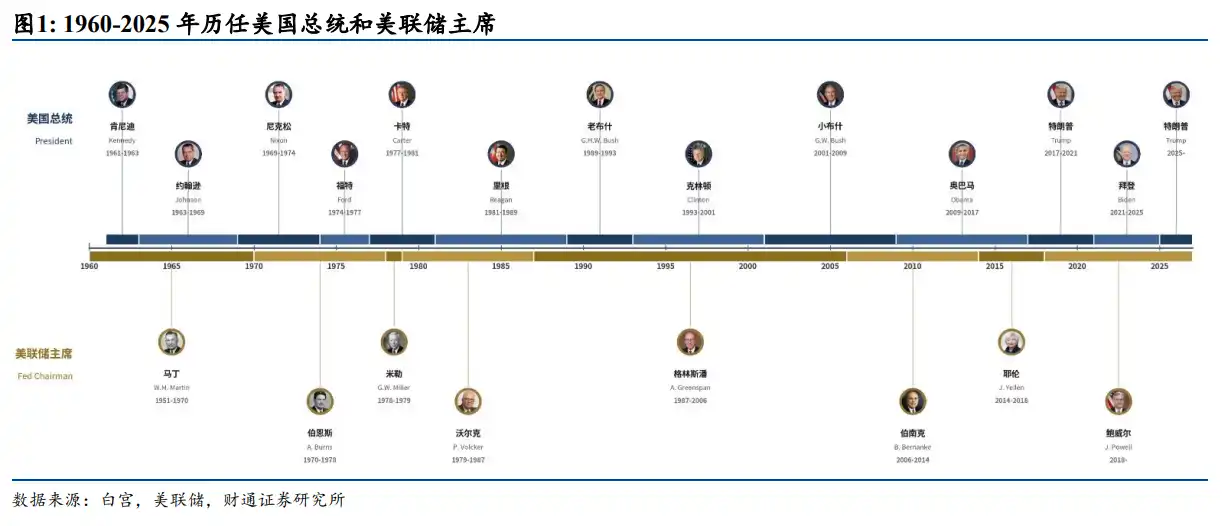
Caitong Securities' report systematically reviews the history of the relationships between each Fed Chair and the President since 1960, outlining a clear evolutionary path.

William Martin, facing a lack of institutional moats, could only rely on personal credibility to guard independence. After taking office, he refused to act as the Treasury's agent, shifted the Fed's decision-making center from New York to Washington, and expanded decision-making authority to the entire FOMC. When Truman saw him on a New York street, he just threw out the word "Traitor" and walked away.

Arthur Burns's failure stemmed from his own disbelief that monetary policy could end inflation, which opened the door to Nixon's political pressure. Nixon applied pressure through private letters, intervened in Board personnel composition, and even sent senior advisors to directly lecture Fed staff. Burns preserved institutional independence in form but made significant compromises on substantive policy direction, ultimately destroying the Fed's credibility.

William Miller represents the most direct political coordination model—deliberately chosen to align with Carter's political goals, but backfired in the face of external crises. By the summer of 1979, inflation had become Carter's biggest political crisis. Miller was moved to Treasury Secretary, making way for appointing a true inflation hawk.

Paul Volcker elevated independence from "personal credibility defense" to a triple moat of "personal credibility + institutional framework + market credibility." Carter, knowing appointing Volcker would come at a political cost, still made the choice—as his policy advisor Eizenstat said, it "ultimately squeezed him out of a second term, at the cost of high unemployment, while squeezing out inflation." Though Reagan "ordered" Volcker not to raise rates before the 1984 election and launched an "FOMC ambush" through appointed governors in 1986, he ultimately failed to substantively change policy direction.

Alan Greenspan used technocratic rhetoric to push the struggle below the surface, clashing fiercely with George H. W. Bush, reaching a "Washington-style peace" with Clinton, but overstepping to support tax cuts under George W. Bush, becoming the first Fed Chair in history to actively "invade" the realm of fiscal policy.

Ben Bernanke embodied a model of natural convergence between the White House and the Fed under crisis conditions, with his main pressures coming from Congress and within the Fed, not the White House. Janet Yellen countered Trump's attacks with "non-political language + strict self-restraint," becoming the first Fed Chair to be replaced by an incoming president since Carter did not reappoint Burns.

Jerome Powell faced presidential pressure more severe than any Chair since Burns. During Trump's first term, under combined external political pressure and internal economic judgment, Powell cut rates three times consecutively in 2019 and stopped balance sheet reduction. In Trump's second term, facing investigations launched by Trump over cost overruns in the Fed's Washington headquarters renovation and hints of dismissal, Powell's response significantly hardened, elevating the defense of Fed independence to a historically new level of legalization, documentation, and publicity. In his final meeting as Chair, the FOMC held rates steady with an unusually split 8-4 vote.
Warsh's Dilemma: A New Chair Caught in Internal and External Troubles

The situation Warsh inherits is quite rare in history—he simultaneously faces rate cut pressure from the White House and hawkish resistance from within the FOMC.

Warsh is not a traditional dove. Appointed as a Fed Governor by George W. Bush in 2006 at age 35, he was one of the youngest governors in Fed history. After QE2 was formally launched in 2010, he became the only Governor in the FOMC to publicly question its expansionary direction and resigned early in 2011, widely interpreted by the market as a silent protest against the Fed's excessive easing. His background as a Morgan Stanley investment banker, Executive Secretary of the White House NEC, and close ties to Republican core circles suggest his policy independence expectations are no lower than those of historically similar chairs.

Caitong Securities' report outlines four key points from Warsh's recent speeches and Q&A sessions:

  • First, his definition of Fed independence is more nuanced than his predecessors'. He believes politicians' comments on monetary policy do not affect Fed independence. This is both a desensitization tactic towards Trump's pressure and leaves room to maintain policy independence in the future without open conflict.
  • Second, he holds a negative view of forward guidance. Markets may need to adapt to a more "silent" Fed.
  • Third, he takes inflation very seriously, directly refuting Trump's view that rising oil prices represent "fake inflation."
  • Fourth, he believes productivity gains from artificial intelligence will make rate cuts possible, sharing a similar logical structure to Greenspan's insights during the late 1990s productivity boom.

Rate Cuts and Balance Sheet Reduction: Direction Certain, Pace Cautious

Caitong Securities believes that monetary policy under Warsh will likely feature "certain direction but cautious pace."

Regarding the pace of rate cuts, with inflation exceeding the target for five consecutive years, the priority of stabilizing inflation expectations is higher. Warsh's serious attitude towards inflation, especially his denial of "fake inflation," indicates he will not easily cut rates before inflation clearly returns to the target range. In the short term, demand growth driven by data center investment may further offset room for rate cuts, causing the pace of cuts to be constrained by data and slow down. The report notes that if Trump shows Warsh more respect, rate cuts may come earlier; if Trump continues high-intensity pressure, to defend Fed independence, Warsh would instead lean towards cutting later.

Regarding the pace of balance sheet reduction, Warsh believes the expanded balance sheet has effectively extended the Fed's monetary policy boundary into the fiscal domain, making reduction logically necessary. But he also acknowledges that it took the Fed 18 years to accumulate the balance sheet to this extent, and reducing it is not an overnight task; it's expected to proceed slowly and methodically. Furthermore, starting balance sheet reduction without having cut rates could almost be seen as proactively picking a fight with the White House—this also dictates that reduction will proceed at a pace that avoids a direct confrontation before the rate-cutting cycle begins.

Caitong Securities' core conclusion is: Recreating Greenspan-style management and returning to a scarce reserve model first require winning support within the Fed itself; moving too hastily will only backfire. Judging Warsh's future policy path should not rely solely on his personal stance or his current relationship with the White House but should return to macro trends—the position of inflation, growth elasticity, oil price direction, financial condition tightness—to deduce his most likely choices under different scenarios.

Related Questions

QWhat is the significance of Trump personally presiding over the swearing-in ceremony of the new Federal Reserve Chair, Kevin Warsh?

ATrump's personal presiding of Kevin Warsh's swearing-in ceremony at the White House, a departure from recent convention, sends a strong political signal of the administration's close attention to this Fed appointment. It underscores the ongoing power dynamics between the White House and the Federal Reserve, reminiscent of ceremonies from decades ago, such as Alan Greenspan's in 1987, and highlights the exceptional nature of this leadership transition under political scrutiny.

QAccording to the Caitong Securities report, what are the key characteristics of the relationship between the Fed Chair and the President?

AAccording to the Caitong Securities report, the relationship between the Federal Reserve Chair and the President is not static but evolves and changes with time. Each Fed Chair has had to navigate the delicate balance between political pressure and policy independence differently, shaped by their personal beliefs, the institutional framework of their time, and the specific economic and political circumstances they faced.

QWhat historical case illustrates a Fed Chair's failure to maintain policy independence due to personal belief, and what was the consequence?

AThe historical case of Arthur Burns illustrates this failure. Burns himself did not believe monetary policy could end inflation, which opened the door to political pressure from President Nixon. While he formally preserved the Fed's institutional independence, he made substantial compromises on the direction of policy, ultimately destroying the Fed's credibility.

QHow does the situation faced by Kevin Warsh differ from that of his predecessors?

AKevin Warsh faces a historically rare and complex situation. He is caught between opposing pressures: on one side, he faces explicit interest rate cut demands from the White House (President Trump), and on the other side, he encounters resistance from hawkish dissenting votes within his own Federal Open Market Committee (FOMC). This puts him in a position where he must navigate external political pressure while managing internal policy disagreements.

QWhat is Caitong Securities' prediction for the likely monetary policy approach under Kevin Warsh?

ACaitong Securities predicts that monetary policy under Kevin Warsh will likely be characterized by 'a clear direction but a cautious pace.' Regarding interest rates, while a rate-cutting cycle is the probable direction, the pace will be data-dependent and cautious due to high inflation priority. Regarding balance sheet reduction (QT), it is considered logically necessary but will proceed slowly and methodically to avoid direct conflict with the White House, especially before rate cuts begin. The report concludes that the policy path will ultimately be shaped by macro trends like inflation, growth, and financial conditions.

Related Reads

AI Relay Stations Spark Heated Debate on Zhihu: Behind Cheap Tokens, What Are Users Really Worried About?

A discussion on Zhihu about "AI relay stations" shifted the niche developer topic of "cheap tokens" into broader user awareness. Users moved beyond simply questioning the legitimacy of these services to focus on practical concerns: Where do cheap tokens truly come from? Is the model being accessed the real one? Can relay stations see prompts, code, and API keys? For occasional users, are the risks worth it? The core debate centered less on price and more on trust. A primary worry is model authenticity—the risk of "model swapping," where users paying for a premium model might be routed to a cheaper one, creating an information asymmetry. Others argued that cost comparisons matter; while cheaper than official pay-as-you-go APIs, relay stations may not be the lowest-cost option versus subscriptions, domestic models, or free tiers, making user needs assessment crucial. Speculation about token sources ranged from legitimate bulk discounts to gray-area methods like account sharing or exploiting regional pricing. This opacity makes risk assessment difficult for users. Data security emerged as a critical concern, especially for enterprise use. When processing sensitive information like code, contracts, or client data, the inability to verify a relay station's data handling, retention, or access policies poses significant compliance and confidentiality risks. The evolving consensus suggests relay stations can be used cautiously for low-sensitivity, disposable tasks (e.g., summarizing public info, simple translation). However, they should not be the default for sensitive, professional, or production workflows involving proprietary data, Agents, or automated systems. Recommendations include avoiding large prepayments, not relying on a single service, using test prompts to monitor quality, anonymizing data where possible, and keeping official channels as backups. Ultimately, the discussion framed tokens not just as a billing unit but as a measure of real cost encompassing price, model integrity, data security, and service stability. The popularity of relay stations highlights user demand for affordable access, but the debate underscores a key trade-off: the savings from cheap tokens may come at the price of trust, transparency, and control over one's data and AI experience.

marsbit11m ago

AI Relay Stations Spark Heated Debate on Zhihu: Behind Cheap Tokens, What Are Users Really Worried About?

marsbit11m ago

In-Depth Research Report on TradFi: The Convergence Wave of Crypto and Traditional Finance

In 2026, the crypto industry is undergoing a profound infrastructure-level transformation—TradFi assets are migrating on-chain at an unprecedented pace. According to CoinGecko's Q1 2026 report, the total value locked (TVL) of tokenized real-world assets (RWA) has surpassed $31 billion, a nearly 4x increase from $7.8 billion at the beginning of 2025, with the sector’s aggregate market capitalization reaching $19.3 billion. Among these, the market cap of tokenized stocks surged from $2 million to $486 million, with Q1 spot trading volume reaching $15.1 billion—a single quarter already surpassing the entire second half of 2025. RWA perpetual contract Q1 trading volume reached a staggering $524.8 billion, far exceeding the $313 billion for all of 2025. Meanwhile, BlackRock's BUIDL fund has reached $2.3 billion in scale and has filed for two new tokenized funds, signaling that the world's largest asset manager's tokenization strategy is evolving from pilot to product suite expansion. HTX, as a core participant in the crypto exchange sector, officially launched TradFi perpetual futures products including NVDA, AAPL, MSFT, META, and SPY in 2026, enabling crypto users to gain 24/7 trading access to core U.S. equities. Boston Consulting Group predicts that global tokenized asset scale could reach $16 trillion by 2030, while McKinsey offers a conservative estimate of approximately $2 trillion. The on-chain migration of TradFi assets is no longer a "future narrative" but a structural transformation unfolding in real time, as crypto exchanges evolve from single crypto asset trading platforms toward "multi-asset-class trading infrastructure."

HTX Learn14m ago

In-Depth Research Report on TradFi: The Convergence Wave of Crypto and Traditional Finance

HTX Learn14m ago

Blocked Its Own Treasure, WeChat AI Steps Up

Tencent's stock surged over 10% on June 2nd amid reports that WeChat, with 1.43 billion monthly users, is finalizing tests for a native AI Agent. The reported feature, accessible by swiping right from the main interface, allows users to issue commands in natural language. The AI then decomposes tasks and automatically calls upon relevant Mini Programs within WeChat to complete actions like ordering food, booking tickets, or making payments, creating a closed-loop service execution system. This strategic shift follows the internal conflict and subsequent "blocking" of Tencent's standalone AI app, Yuanbao, by WeChat for violating sharing rules during a 2026 Spring Festival promotion. The incident highlighted a lack of internal consensus and exposed the weakness of competing in the standalone AI assistant arena against rivals like ByteDance's Doubao (345M MAU) and Alibaba's Qianwen. The new WeChat AI Agent aims to leverage WeChat's unique assets—its massive user base, standardized Mini Program APIs, WeChat Pay, and identity system—to move from simple content generation to actual task execution. Analysts note this changes the competitive landscape from model benchmarks to which AI can connect to more real-world services. However, success depends on key variables: the capability of Tencent's underlying Hunyuan model, managing massive inference costs, and redesigning incentives for Mini Program developers whose traffic might be bypassed. The move is seen as an attempt to keep user service intent within WeChat's ecosystem as AI begins to redefine how users access services.

marsbit1h ago

Blocked Its Own Treasure, WeChat AI Steps Up

marsbit1h ago

ByteDance Adopts Arm CPUs, Jensen Huang: So Sad I Didn't Buy Arm

**Summary:** At Computex 2026, Arm CEO Rene Haas announced that ByteDance and Oracle have adopted Arm's self-designed Arm AGI data center CPU. The company expects significant revenue growth from this product, projecting $20 billion in demand for the 2027/2028 fiscal years. Haas noted that restricting AI-capable CPUs from the US to China is nearly impossible due to their widespread applications. Arm's stock has surged dramatically this year, notably rising 16% after NVIDIA's Arm-based Vera CPU and RTX Spark announcements. A highlight was the informal, humorous on-stage conversation between Haas and NVIDIA CEO Jensen Huang. Huang joked about NVIDIA's failed attempt to acquire Arm and playfully lamented selling his Arm shares. Both executives showed a clear sense of camaraderie and shared regret over the missed merger. Key technical topics were discussed: 1. **AI PC Design:** Huang explained NVIDIA's RTX Spark superchip (with a 20-core Arm CPU) is designed for future AI agents that will autonomously run and use tools on PCs, blending local and cloud processing. 2. **Agent vs. OS:** Huang emphasized the operating system remains crucial, as AI agents rely on its APIs and tools to function. 3. **Growth Constraints:** He identified the shift to "useful AI" that generates profitable tokens as a primary driver for immense, almost limitless, computational demand. Haas outlined Arm's strategy across PC and data centers. For PCs, Arm collaborates with partners like NVIDIA and MediaTek, offering its compute subsystem (CSS) for custom SoCs. In data centers, its Arm AGI CPU (built on TSMC's 3nm process) has gained major partners including OpenAI, Meta, and now ByteDance and Oracle. Arm presented a multi-year roadmap for its in-house CPU line. The article concludes that while GPUs dominated the AI training race, the explosion of AI agents is shifting significant focus to CPUs for inference, state management, and tool orchestration. The industry is trending towards vertical integration, with companies like cloud providers designing chips and chip/IP firms offering full solutions, all competing to deliver more efficient computing per watt.

marsbit1h ago

ByteDance Adopts Arm CPUs, Jensen Huang: So Sad I Didn't Buy Arm

marsbit1h ago

Trading

Spot
Futures
活动图片




