Will The XRP Price Have Better Luck In The Second Quarter Of The Year? Analyst Shares Forecast

bitcoinistPublished on 2026-04-02Last updated on 2026-04-02

Abstract

XRP concluded the first quarter of 2026 with a 27.1% decline, continuing a correction that has erased over 60% from its July 2025 high of $3.65. The price is now at a critical decision point entering Q2. An analyst’s technical analysis suggests two possible paths. The primary scenario anticipates a corrective bounce (a "B wave") toward the $1.76 to $2.86 resistance zone. A move above $2 could signal a broader rally. However, this expected bounce is viewed as corrective, not a full bullish reversal, and would likely be a three-wave move. If this plays out, it could set up for another decline (a C wave) later in Q2 or Q3, potentially pushing the price below $1. The overall tone remains cautious.

XRP closed Q1 2026 with a 27.1% decline from its quarter open, extending a correction that has now erased more than 60% from the token’s July 2025 high of $3.65. The current structure now leaves the XRP price at an important decision point heading into Q2, where the next move could show whether this is a pause before recovery or part of a deeper correction below $1 in the new quarter. A recent technical analysis shared on X lays out both possibilities, but the tone says caution is the dominant theme for now.

Q1 Played Out As Expected. Here’s What The Analyst Got Right

Going into Q1, the analyst had flagged that XRP’s correction in 2025 was not yet complete and that one more low was likely before the formation of any sustainable rally. That forecast proved accurate. XRP dipped below $1.20 in early February, precisely within the support zone the analyst had identified. The dip eventually bottomed around $1.16 on February 6 before a recovery of about 55% from that low in the same month.

The move, however, did not translate into a full trend reversal, and the XRP price struggled throughout March. Price action across the weekly structure still reflects a market struggling to reclaim strength. The rebound failed to push into higher resistance zones above $1.5. This bearish price action eventually ended up with a negative 2.79% close in March, which is the sixth consecutive month of bearish closes.
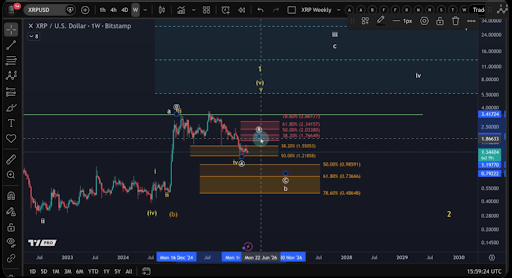
XRP Weekly Price Chart. Source: @Morecryptoonl On X

A Temporary Bounce In Q2, But Not A Full Bullish Reversal

As it stands, the XRP price is now sitting at an important decision point, and the analyst is distinguishing between two scenarios heading into Q2. The primary focus is on whether it can sustain a corrective bounce, which is labeled as a “B wave” based on the Elliott Wave theory, back to the $1.76 to $2.86 resistance band.

According to the analysis, any meaningful recovery in Q2 would need to push decisively into this region. A move above $2 would begin to validate the idea of a broader rally. This prediction is based on the 50% Fibonacci extension at $2.03380 and the 61.8% level at $2.34157, both on the weekly chart.

The current expectation leans toward a corrective bounce rather than a full breakout. A move higher in April or early Q2 is considered possible, especially since a similar bounce already occurred earlier in the year.

However, the structure of that bounce matters more than the bounce itself. If the price action forms a three-wave move upward, it would likely confirm a B-wave scenario, meaning the rally is corrective in nature and not the start of a new bullish cycle.

In that case, the XRP price could still be setting up for another leg down (a C wave), which may unfold later in Q2 or extend into Q3.

Price restarts uptrend again | Source: XRPUSDT on Tradingview.com

Related Questions

QWhat was the percentage decline in XRP's price in Q1 2026 from its quarter open?

AXRP closed Q1 2026 with a 27.1% decline from its quarter open.

QAccording to the analyst, what is the primary focus for XRP's price action heading into Q2?

AThe primary focus is on whether XRP can sustain a corrective bounce, labeled as a 'B wave' based on Elliott Wave theory, back to the $1.76 to $2.86 resistance band.

QWhat price levels, based on Fibonacci extensions, would begin to validate the idea of a broader rally for XRP?

AA move above the 50% Fibonacci extension at $2.03380 and the 61.8% level at $2.34157 on the weekly chart would begin to validate the idea of a broader rally.

QWhat would a three-wave move upward in price action likely confirm, according to the analyst?

AA three-wave move upward would likely confirm a B-wave scenario, meaning the rally is corrective in nature and not the start of a new bullish cycle, potentially setting up for another leg down (a C wave).

QHow many consecutive months of bearish closes did XRP experience by the end of March?

AXRP experienced six consecutive months of bearish closes by the end of March.

Related Reads

When Computing Power Becomes Commoditized, How Long Until a GPU Futures Market Emerges?

"When Will GPU Futures Arrive? A Framework for Assessing Compute as a Commodity" The article explores the potential for a robust futures market for compute power (GPUs), arguing that such a market is not yet mature but may emerge. It analyzes the landscape using a five-part framework developed for new commodity futures markets. The analysis scores the current state: * **Fragmented Supply (Red)**: Supply is highly concentrated among hyperscale cloud providers (AWS, Azure, GCP, Oracle), limiting the need for price discovery. * **Price Volatility (Green)**: GPU pricing is already highly volatile due to uncertain supply and surging demand. * **Physical Settlement Infrastructure (Green)**: Early infrastructure exists via OTC brokers and price indices (e.g., Ornn, Silicon Data) standardizing contracts. * **Standardized Unit (Red)**: A lack of standardized, tradable units hinders markets; a GPU instance hour varies by region, configuration, and contract terms. * **Lack of Alternatives (Yellow)**: Large players hedge internally via vertical integration, while smaller players bear spot market risk. Overall, the market shows promise (volatility, early infrastructure) but lacks the fragmented supply and standardization needed for large-scale futures trading. Most activity remains OTC. Key open questions and hypotheses: 1. Supply is expected to fragment moderately in 1-2 years, driven by new cloud providers, cheap power locations, and demand from non-frontier labs and AI startups using open-source models. 2. Standardization is most likely to emerge around inference workloads (forecast to be >65% of AI compute demand by 2029), which have simpler, more homogeneous hardware needs than training. Widespread adoption of open-source model weights could accelerate this by democratizing inference and creating demand for optimized, standardized infrastructure. 3. The primary traded unit will likely be the **"chip instance hour"** (akin to electricity, traded regionally), not the physical chip or the downstream AI output (tokens).

marsbit22m ago

When Computing Power Becomes Commoditized, How Long Until a GPU Futures Market Emerges?

marsbit22m ago

When Computing Power Becomes Commoditized, How Long Until a GPU Futures Market?

When Compute is Commoditized: How Far Away is a GPU Futures Market? The article explores the potential emergence of a futures market for computing power ("compute"), akin to markets for commodities like oil or electricity. It uses a five-dimension framework to assess the market's maturity for sustaining robust futures trading. **Current Market Assessment (Scorecard):** * **Supply Fragmentation:** 🔴 **Red.** Supply is highly concentrated, dominated by a few hyperscale cloud providers. * **Price Volatility:** 🟢 **Green.** GPU pricing is already highly volatile. * **Physical Settlement Infrastructure:** 🟢 **Green.** Early infrastructure exists at the OTC/broker level. * **Standardization:** 🔴 **Red.** Compute lacks a standardized, tradable unit (e.g., an H100 hour is not uniform). * **Lack of Substitutes:** 🟡 **Yellow.** Vertically integrated players can hedge internally, while others are forced to be long. **Conclusion:** The overall scorecard suggests a robust futures market is premature. The market has volatility and early settlement infrastructure but lacks the necessary supply fragmentation and standardization for large-scale price discovery. Most activity remains OTC. **Key Unanswered Questions & Hypotheses:** The article posits that the market could evolve in the next 1-2 years: 1. **Supply:** May become *moderately more fragmented* due to new cloud providers, cheaper power locations, and demand from long-tail users (e.g., startups running open-source model inference). 2. **Standardization:** Could emerge from the growing **inference** workload (expected to be >65% of AI compute demand by 2029), which has more homogeneous hardware requirements than custom training workloads. Widespread adoption of **open-source model weights** is seen as a key catalyst for democratizing inference and driving infrastructure standardization. 3. **Traded Unit:** The most viable layer for trading is likely the **"chip-instance-hour"** (powered, usable compute time), traded similarly to electricity in regional contracts with spot/futures overlays. Trading at the upstream "chip" layer is unlikely due to supply concentration, while the downstream "token" layer faces challenges due to lack of uniformity across AI models.

链捕手28m ago

When Computing Power Becomes Commoditized, How Long Until a GPU Futures Market?

链捕手28m ago

Interview with Anthropic's Product Manager: Claude 'Dreams' in the Background, We Study Its Consciousness Formation Like Raising a Child

**Title**: Anthropic Product Manager Interview: Claude "Dreams" in the Background, We Study Its Consciousness Formation Like Raising a Child **Summary**: In this interview, Anthropic Research Product Manager Alex Albert discusses the development of the next-generation Claude model. He explains that Anthropic treats each new model as a product, defining its intended capabilities and desired "personality" from the start. The development process is likened to "raising" a model, where the final traits emerge during training. Key focus areas include integrating user feedback into training, prioritizing key capabilities like coding and knowledge work, and refining Claude's interactive personality. Albert highlights the importance of Claude's character as models evolve into autonomous agents making unsupervised decisions. He details features like "adaptive thinking," which lets Claude decide when to reason deeply, and a "dreaming" process where the agent reviews and consolidates its memories offline, akin to human memory reconsolidation. The interview also covers how AI accelerates product development, shifting bottlenecks from building to strategic coordination. Albert describes using Claude as a brainstorming partner and research tool internally. While Anthropic has researchers exploring questions of AI consciousness, the company has no official stance on whether Claude is conscious. The focus remains on ensuring Claude is trustworthy and aligned as it takes on more complex, long-term tasks.

marsbit1h ago

Interview with Anthropic's Product Manager: Claude 'Dreams' in the Background, We Study Its Consciousness Formation Like Raising a Child

marsbit1h ago

Trading

Spot
Futures

Hot Articles

What is XRP 2.0

XRP 2.0: A New Frontier in the Cryptocurrency Landscape Introduction to XRP 2.0 In the ever-evolving realm of cryptocurrency, new projects continuously emerge, vying for attention and adoption. One such promising initiative is XRP 2.0, a novel cryptocurrency project designed to leverage advanced blockchain technology and robust encryption methodologies. While the name draws parallels with Ripple’s XRP, it’s crucial to note that XRP 2.0 operates independently, focusing on enhancing transaction security, privacy, and scalability. As the digital financial landscape increasingly embraces decentralized solutions, XRP 2.0 aims to contribute meaningfully to web3 and the overall expansion of crypto projects. What is XRP 2.0? At its core, XRP 2.0 is a cryptocurrency project that aims to create a secure and decentralized digital currency ecosystem. Its foundational technology integrates sophisticated blockchain principles with cutting-edge encryption techniques. The overarching goal of XRP 2.0 is to establish itself as a reliable and efficient platform enabling swift transaction execution while prioritizing enhanced privacy protections for its users. The project is promoted as a solution to many limitations faced by existing cryptocurrencies, proposing a system that can handle a higher volume of transactions with improved speed and privacy. This versatility positions XRP 2.0 as a significant contender in a marketplace riddled with various digital currencies. Who is the Creator of XRP 2.0? The identity of the creator behind XRP 2.0 has been flagged as ‘Wilbur.’ However, comprehensive details regarding Wilbur or their associated entity remain elusive. The anonymity of many cryptocurrency creators is not an uncommon phenomenon in the industry, often designed to maintain a degree of privacy and security. Who are the Investors of XRP 2.0? As of now, specific information related to the investment foundations or organizations supporting XRP 2.0 is not publicly available. In the cryptocurrency sector, the backing by reputed investors can significantly influence a project's credibility and success, yet the transparency regarding the financial supporters of XRP 2.0 has not been established. How Does XRP 2.0 Work? XRP 2.0 stands out by employing a combination of blockchain technology and advanced encryption algorithms that ensures secure and decentralized transactions. Its innovative structure includes unique features designed to foster user engagement and broaden functionalities beyond conventional cryptocurrency transactions. Among these features, XRP 2.0 incorporates AI-powered capabilities, such as text-to-image and text-to-speech functionalities. These additions are designed to enhance the interactive experience for users, promoting broader applicability across various sectors. By bridging technological advancements with user-centered design, XRP 2.0 aims to capture the attention of a diverse range of individuals and enterprises looking to integrate cryptocurrency solutions into their operational frameworks. Timeline of XRP 2.0 Understanding XRP 2.0 requires examining the milestones that have defined its journey thus far: July 23, 2023: XRP 2.0 is introduced as a novel cryptocurrency project, aiming to revolutionize secure and decentralized transaction capabilities in the blockchain domain. September 8, 2023: The launching of another project, XRP20, occurs, marking the emergence of an ERC-20 token on the Ethereum blockchain that remains unrelated to XRP 2.0. November 13, 2023: The XRP Ledger undergoes a significant update with the release of rippled server software version 2.0.0. It is essential to note that this development is disconnected from the XRP 2.0 cryptocurrency project. Key Points About XRP 2.0 To distill the essence of XRP 2.0, several critical factors emerge: Unique Features: The inclusion of features like AI-powered text-to-image and text-to-speech further diversifies the potential applications of XRP 2.0. Blockchain Technology: The framework utilizes advanced blockchain mechanisms and encryption protocols, ensuring a secure and decentralized environment for transactions. Scalability and Privacy: XRP 2.0 prioritizes enhanced privacy protections in transaction processes and the scalability necessary to accommodate a growing user base. No Affiliation with Ripple: Importantly, despite its name, XRP 2.0 does not have any allegiance or collaboration with Ripple’s XRP, distinguishing its operational framework and objectives within the cryptocurrency ecosystem. Conclusion XRP 2.0 represents an ambitious venture into the cryptocurrency sphere, aiming to offer a combination of security, privacy, and efficiency in digital transactions. By integrating sophisticated technologies and user-friendly features, the project sets out to broaden the horizons of what cryptocurrency can achieve in today's digital economy. While the anonymity of its creator and lack of disclosed investors might raise questions for some, XRP 2.0's focus on advanced functionalities and decentralisation enhances its appeal amidst an increasingly crowded crypto market. As the cryptocurrency landscape continues to evolve, XRP 2.0 may yet emerge as a pivotal player in the expansion of secure and scalable blockchain solutions.

942 Total ViewsPublished 2024.04.01Updated 2024.12.03

What is XRP 2.0

Discussions

Welcome to the HTX Community. Here, you can stay informed about the latest platform developments and gain access to professional market insights. Users' opinions on the price of XRP (XRP) are presented below.

活动图片















