Over the past weekend, the crypto market did not see a sentiment recovery. After several days of narrow-range fluctuations, Bitcoin came under significant pressure from Sunday evening into Monday's U.S. trading session, falling below the $90,000 mark, with its price briefly touching around $86,000 at the lowest point. ETH dropped 3.4% to $2,980; BNB fell 2.1%; XRP declined 4%; SOL decreased 1.5%, retreating to around $126. Among the top ten cryptocurrencies by market cap, only TRX recorded a slight increase of less than 1%, while the rest were in a correction phase.
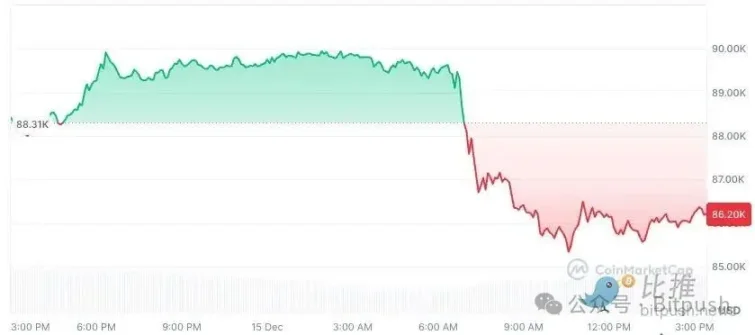
From a time perspective, this is not an isolated adjustment. Since hitting a new all-time high in mid-October, Bitcoin has accumulated a pullback of over 30%, with each rebound appearing brief and hesitant. Although ETF funds have not seen systematic outflows, marginal inflows have significantly slowed, making it difficult to provide the "sentiment foundation" for the market as before. The crypto market is transitioning from one-sided optimism to a more complex and patience-testing phase.
Against this backdrop, Mike McGlone, Senior Commodity Strategist at Bloomberg Intelligence, released a latest report, placing Bitcoin's current trend within a broader macro and cyclical framework and presenting a highly unsettling judgment: Bitcoin is highly likely to return to $10,000 by 2026. This is not alarmist but one of the potential outcomes under a special "deflationary" cycle.
The reason this view has sparked significant controversy is not just because the figure itself is "too low," but because McGlone does not treat Bitcoin as an independent crypto asset. Instead, he reexamines it within the long-term coordinate system of "global risk assets—liquidity—wealth regression."
"Deflation After Inflation"? McGlone Focuses Not on Crypto but on the Cycle Inflection Point
To understand McGlone's judgment, the key does not lie in how he views the crypto industry but in how he interprets the next phase of the macro environment.
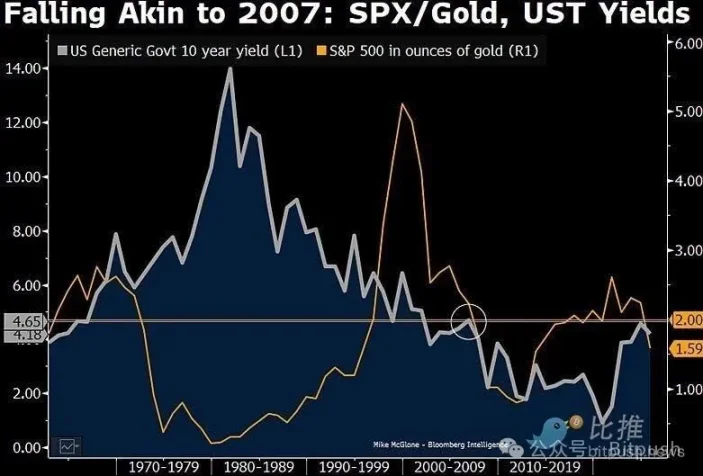
In his latest perspective, McGlone repeatedly emphasizes a concept: Inflation / Deflation Inflection (the turning point from inflation to deflation). In his view, global markets are near such a critical juncture. As inflation peaks in major economies and growth momentum slows, asset pricing logic is shifting from "fighting inflation" to coping with "deflation after inflation"—the phase of comprehensive price declines following the end of the inflation cycle. He writes: "Bitcoin's decline may resemble the stock market's response to Fed policy in 2007."
This is not the first time he has issued a bearish warning. As early as last November, he predicted Bitcoin would fall to the $50,000 mark.
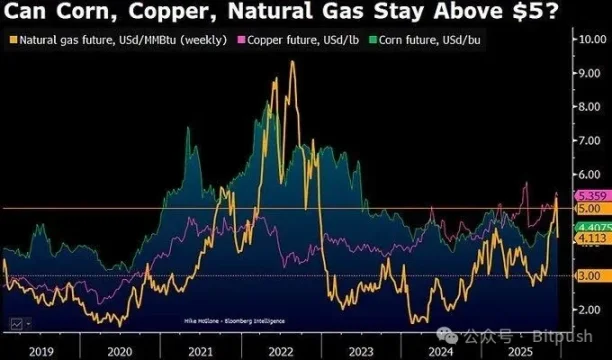
He points out that by around 2026, commodity prices may fluctuate around a key pivot—the "inflation-deflation demarcation line" for core commodities like natural gas, corn, and copper might settle near $5. Among these, only copper, with its genuine industrial demand support, might still stand above this pivot by the end of 2025.
McGlone notes: When liquidity recedes, the market will重新区分 (redistinguish) "real demand" from "financialization premium." In his framework, Bitcoin is not "digital gold" but an asset highly correlated with risk appetite and speculative cycles. When the inflation narrative recedes and macro liquidity tightens, Bitcoin tends to reflect this change earlier and more sharply.
In McGlone's view, his logic is not based on a single technical level but the叠加 (superposition) of three long-term paths.
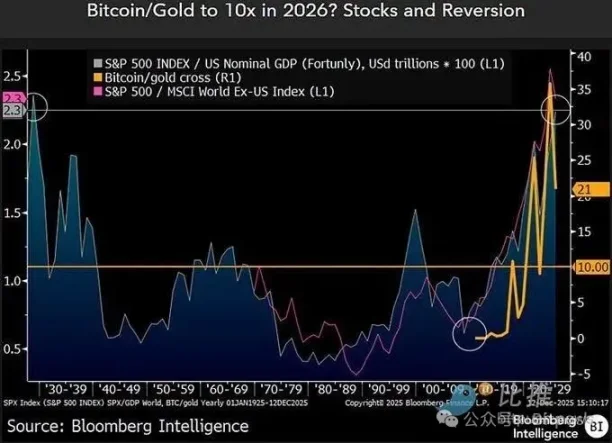
First, mean reversion after extreme wealth creation. McGlone has long emphasized that Bitcoin is one of the most extreme wealth amplifiers under the global宽松货币环境 (loose monetary environment) of the past decade. When asset price growth long outstrips实体经济增长 (real economic growth) and cash flow growth, the regression is not温和 (gentle) but剧烈 (violent). Historically, whether it was U.S. stocks in 1929 or the tech bubble in 2000, the commonality of the top phase was: the market repeatedly sought a "new paradigm" at highs, and the eventual adjustment幅度 (magnitude) often far exceeded the most pessimistic expectations at the time.
Second, the relative pricing relationship between Bitcoin and gold. McGlone特别强调 (particularly emphasizes) the Bitcoin/Gold ratio. This ratio was about 10x at the end of 2022, then expanded rapidly driven by the bull market, reaching over 30x in 2025. But this year, the ratio has fallen about 40%, dropping to around 21x. In his view, if deflationary pressures persist and gold remains firm due to safe-haven demand, a further return of the ratio to its historical range is not an激进假设 (aggressive assumption).
Third, systemic issues in the supply environment of speculative assets. Although Bitcoin itself has a clear supply cap, McGlone has多次指出 (repeatedly pointed out) that what the market is truly trading is not Bitcoin's "uniqueness" but the risk premium of the entire crypto ecosystem. When millions of tokens, projects, and narratives compete for the same risk budget, the entire sector tends to be uniformly discounted in a deflationary cycle, and Bitcoin can hardly完全脱离 (completely detach from) this revaluation process.
It should be noted that Mike McGlone is not a bull/bear spokesperson for the crypto market. As a senior commodity strategist at Bloomberg, he has studied the cyclical relationships between crude oil, precious metals, agricultural products, interest rates, and risk assets for a long time. His predictions are not always precisely timed, but their value lies in: he often raises structural contrarian questions when market sentiment is most consensus-driven.
In his latest remarks, he also主动复盘 (actively reviewed) his "errors," including underestimating the timing of gold breaking through $2,000 and misjudging the节奏 (rhythm) of U.S. Treasury yields and U.S. stocks. But in his view, these deviations反而反复印证 (instead repeatedly confirm) one point: the market is most prone to illusions about trends before cyclical inflection points.
Other Voices: Divergence Is Widening
Of course, McGlone's judgment is not market consensus. In fact, mainstream institutions' attitudes show clear分化 (divergence).
Traditional financial institutions like Standard Chartered have recently significantly lowered their medium-to-long-term target price for Bitcoin, reducing the 2025 expectation from $200,000 to about $100,000, and also adjusting the 2026 imagination space from $300,000 to about $150,000. In other words, institutions no longer assume that ETFs and corporate allocations will持续提供边际买盘 (continuously provide marginal buying) at any price range.
Research from Glassnode points out that Bitcoin's current fluctuation range between $80,000 and $90,000 has already put pressure on the market, with intensity comparable to the trend at the end of January 2022. The current market's relative unrealized loss has approached 10% of the market cap. Analysts further explain that such market dynamics reflect a state of "liquidity constraints, sensitivity to macro shocks," but it has not yet reached the level of typical bear market彻底抛售 (panic selling).
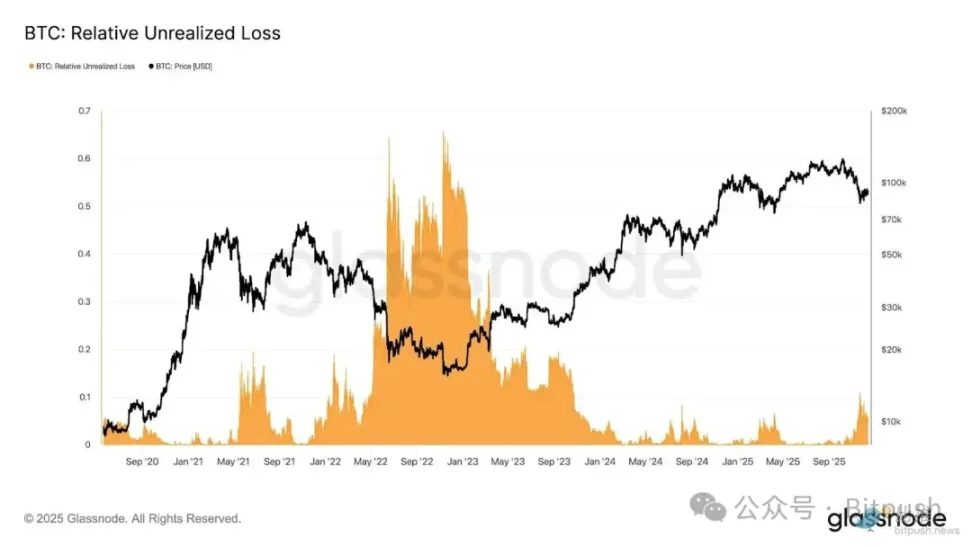
More quantitative and structure-focused 10x Research offers a more direct conclusion: they believe Bitcoin has entered the early stages of a bear market, with on-chain indicators, fund flows, and market structure all indicating that the downward cycle has not yet reached its end.
From a broader time dimension, the current uncertainty surrounding Bitcoin is no longer an issue of the crypto market itself but is firmly embedded in the global macro cycle. The upcoming week is被视为 (seen as) the most critical macro window period of the year-end by multiple strategists—the European Central Bank, the Bank of England, and the Bank of Japan will announce interest rate decisions successively, while the U.S. will迎来 (welcome) a series of delayed employment and inflation data. These data will provide a belated "reality check" for the market.
The Fed's FOMC meeting on December 10 had already released an unusual signal: not only did it cut rates by 25 basis points, but there were also three dissenting votes, and Powell直言 (stated bluntly) that job growth in previous months might have been overestimated. The密集出炉 (intensive release) of macro data this week will重塑 (reshape) the market's core expectations for 2026—whether the Fed can continue to cut rates or will have to press the pause button for a longer period. For risk assets, this answer might be more important than any bull-bear debate on a single asset.