Will Bitcoin repeat the 2021 ‘gasoline fractal’? THIS data says…

ambcryptoPublished on 2026-03-25Last updated on 2026-03-25

Abstract

Bitcoin is showing resilience by holding around $71,000 despite geopolitical tensions, but underlying signals suggest potential weakness ahead. A recurring fractal pattern linking Bitcoin to gasoline futures—similar to one observed in 2021—indicates a rejection of key resistance and a possible further decline before a market bottom forms. Additionally, global liquidity is tightening, with a $470 billion weekly contraction in M2 supply reducing capital available for risk assets like Bitcoin. While stablecoin supply has reached a new all-time high, indicating that capital remains on the sidelines ready to re-enter, ongoing geopolitical risks may continue to limit near-term upward momentum for Bitcoin.

Bitcoin has held a relatively firm structure despite escalating geopolitical tensions involving the United States, Israel, the Gulf states, and Iran. The market has absorbed repeated shocks, yet Bitcoin continues to trade without a decisive breakdown.

At the time of writing, Bitcoin [BTC] hovered around $71,000, showing resilience under pressure.

This suggests that current macro headwinds have not impacted price action as severely as anticipated, particularly when compared to the sharp dislocation seen during the liquidation event on the 10th of October, 2025.

However, beneath this stability, a developing pattern signals potential weakness ahead.

Energy markets and Bitcoin: A resurfacing correlation

The ongoing conflict has significantly disrupted global energy markets. Concerns surrounding the Strait of Hormuz, alongside refinery outages, have driven gasoline prices higher and tightened supply conditions.

Amid this backdrop, a fractal pattern has emerged linking Bitcoin’s price action with gasoline market movements, echoing a structure last observed in 2021.

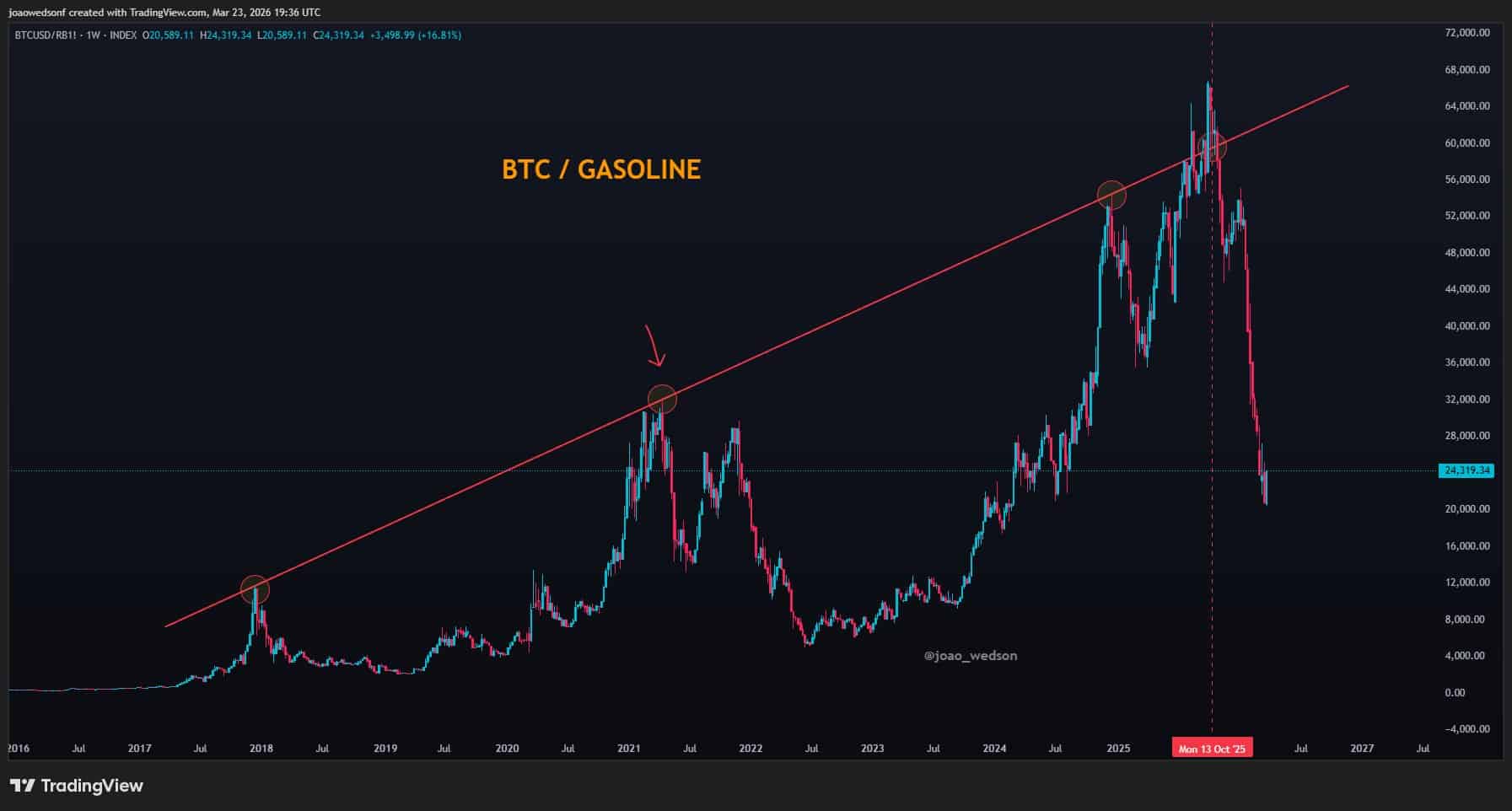
This relationship is reflected in the Bitcoin–RBOB Gasoline Futures Continuous Contract (NYMEX: RB1!), which tracks Bitcoin against the nearest expiring gasoline futures contract. Current chart behavior shows a notable alignment between both assets.
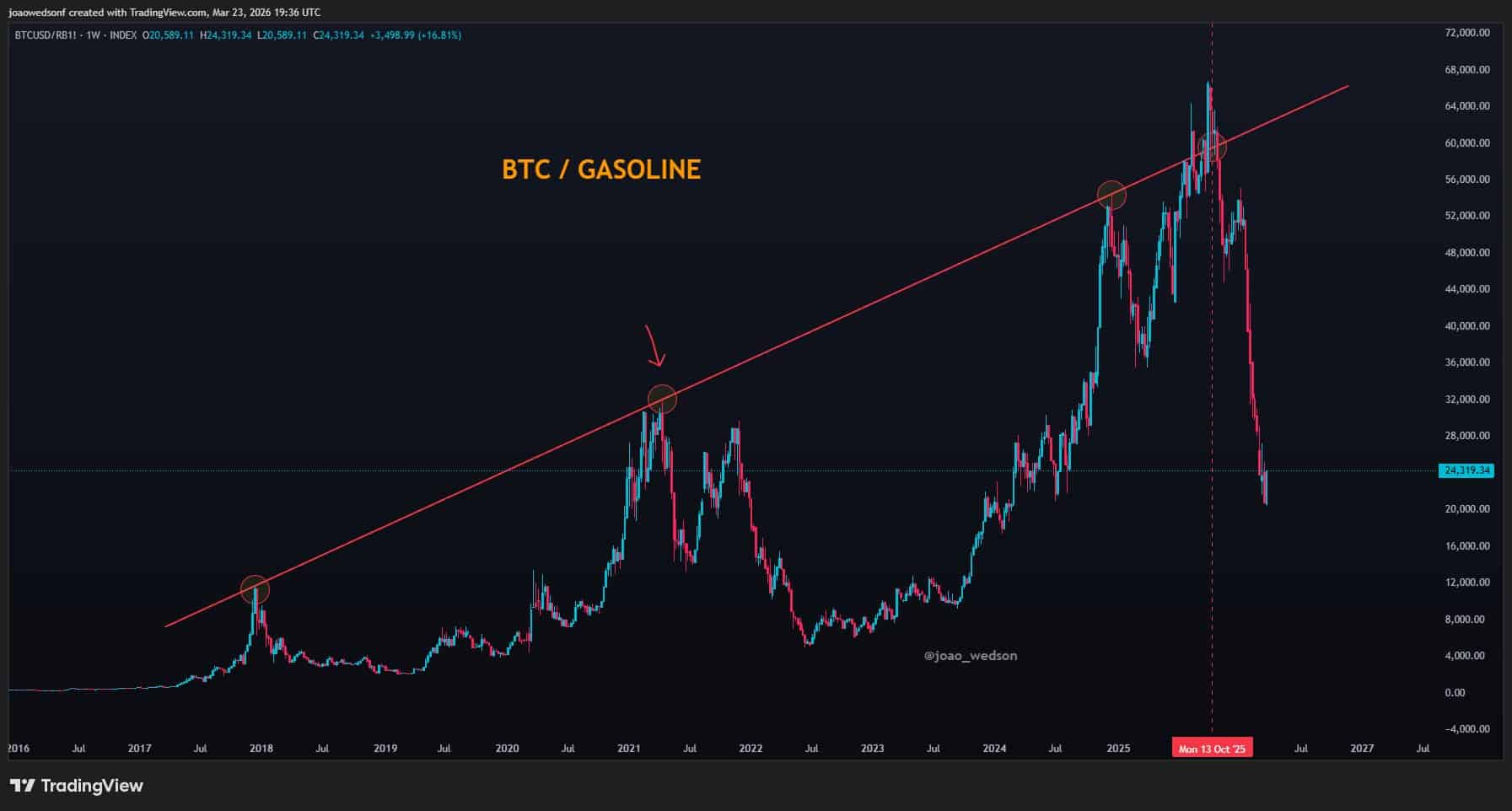
Source: Alphractal

Bitcoin appears to have rejected a key resistance trendline, formed a lower high, and entered a downward trajectory, closely mirroring its 2021 setup.

During that cycle, the pattern unfolded gradually before reaching a definitive bottom. A similar path may now be forming.

With no confirmed price floor in place, current conditions suggest Bitcoin could extend its decline before establishing a base, potentially setting up the next long-term rally phase.

Liquidity contraction signals caution

Global M2 supply remains a critical indicator for assessing market direction and identifying potential bottoms.

As a measure of total liquid money across major economies, M2 reflects the capital available for deployment into financial assets, including Bitcoin.

Recent data shows a sharp contraction of $470 billion in global M2 within a single week. This decline points to tightening liquidity conditions and reduced capacity for capital rotation into risk assets in the near term.
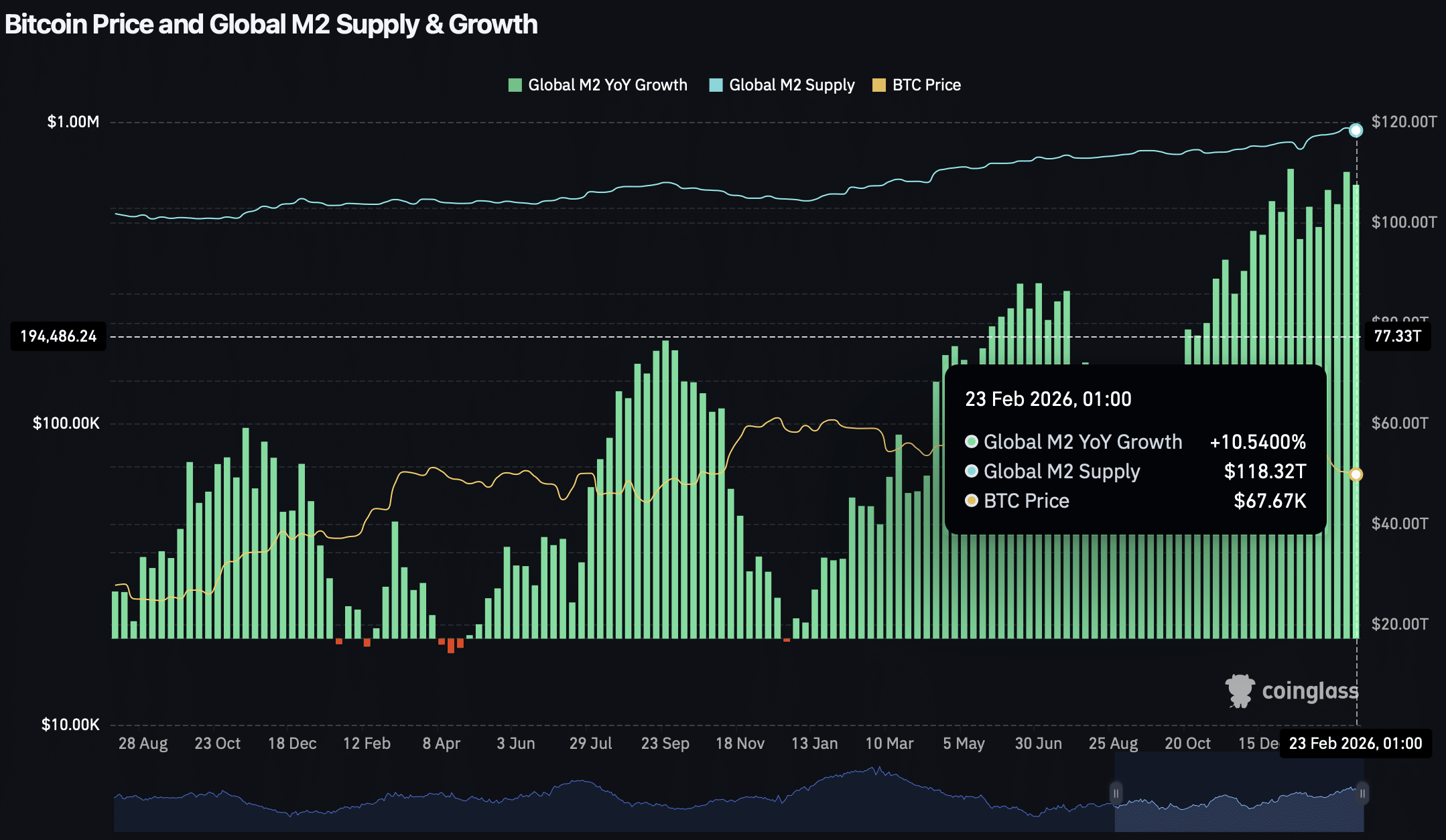
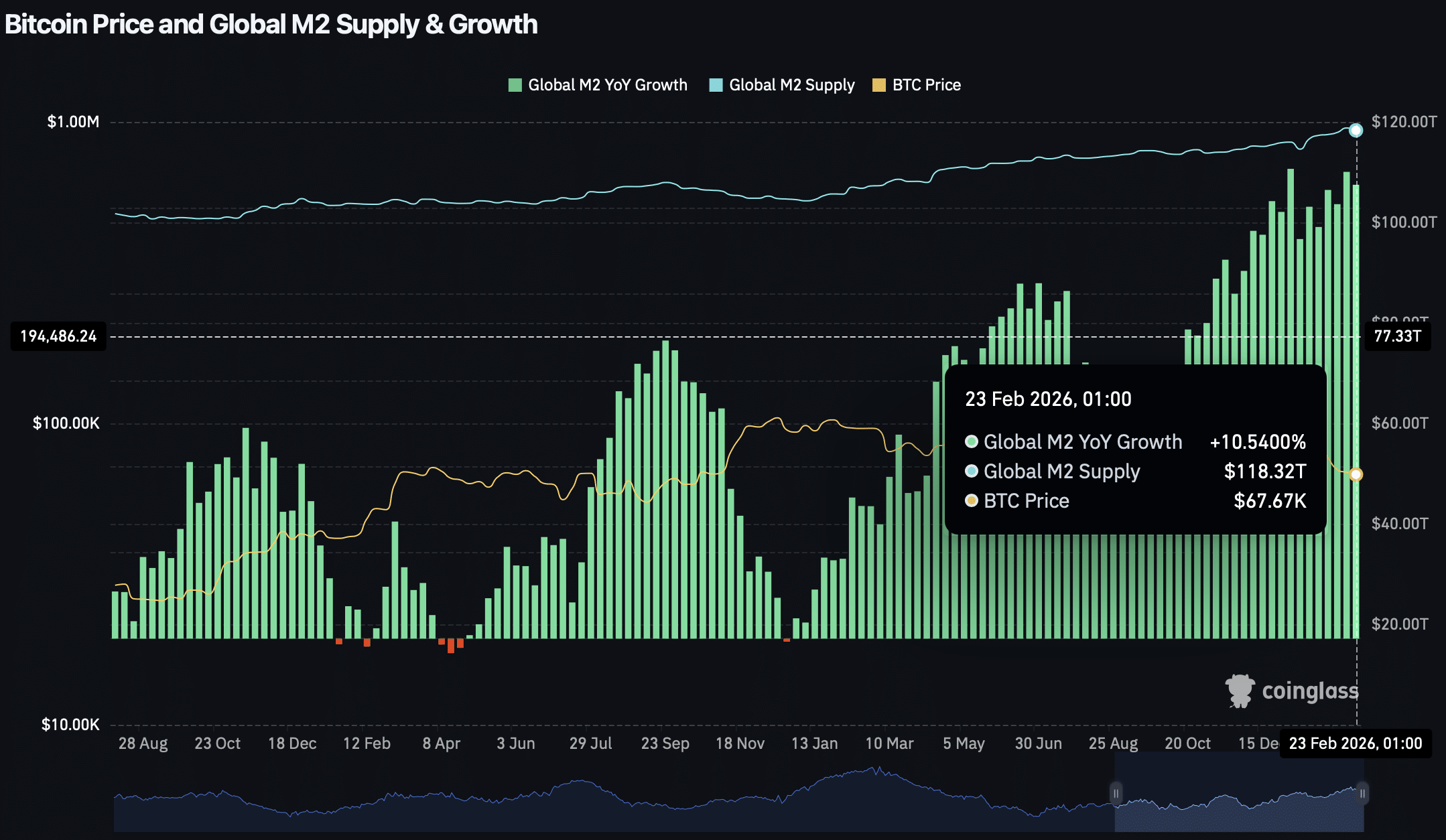
Source: CoinGlass

At the same time, traditional safe-haven assets are failing to attract sustained inflows. Instead, capital appears to be moving into select fiat positions and highly liquid instruments, indicating a defensive market stance.

Gold underscores this shift. The asset has posted its first bearish monthly performance since December 2024, declining 19% in March and erasing gains recorded in January and February 2026.

This correction represents a $6.6 trillion loss in market value over three months, a scale that highlights the extent of capital withdrawal across global markets and amounts to roughly 4.6 times Bitcoin’s current market capitalization.

Stablecoins point to sidelined capital

Stablecoin supply trends suggest that investors are not exiting the market entirely but repositioning.

Data from DeFiLlama shows that total stablecoin supply has reached a new all-time high of $316.9 billion. This rise signals a shift toward capital preservation rather than risk exposure.

Investors are increasingly holding stablecoins to shield against volatility while maintaining readiness to re-enter the market. This positioning reflects expectations of future opportunities rather than a loss of conviction.

However, as long as geopolitical tensions persist, capital is likely to remain concentrated in stable assets. This limits rotation into Bitcoin and may continue to weigh on price stability in the short term.


Final Summary

  • A Bitcoin–gasoline fractal pattern points to a higher likelihood of further downside.
  • Global M2 supply drops $470 billion, while gold sheds $6.6 trillion, reinforcing a cautious macro outlook.


Related Questions

QWhat is the current Bitcoin price and how is it performing amidst geopolitical tensions?

AAt the time of writing, Bitcoin is hovering around $71,000, showing resilience and holding a relatively firm structure despite escalating geopolitical tensions.

QWhat is the 'gasoline fractal' pattern and what does it suggest for Bitcoin's price?

AThe 'gasoline fractal' is a pattern linking Bitcoin’s price action with gasoline market movements, echoing a structure from 2021. It shows Bitcoin has rejected a key resistance trendline and formed a lower high, suggesting a potential extended decline before establishing a base.

QWhat does the sharp contraction in global M2 supply indicate for risk assets like Bitcoin?

AThe sharp $470 billion contraction in global M2 supply in a single week points to tightening liquidity conditions and a reduced capacity for capital to flow into risk assets like Bitcoin in the near term.

QWhy is the record-high stablecoin supply significant for the crypto market?

AThe record-high stablecoin supply of $316.9 billion signals that investors are shifting toward capital preservation, holding stablecoins to shield against volatility while remaining ready to re-enter the market, reflecting a defensive stance rather than a loss of conviction.

QHow has the performance of traditional safe-haven assets, like gold, impacted the market?

AGold posted its first bearish monthly performance since December 2024, declining 19% in March 2026 and erasing its prior gains. This $6.6 trillion loss in market value highlights a massive capital withdrawal from traditional safe havens, indicating a cautious macro outlook.

Related Reads

Cook's Curtain Call and Ternus Takes the Helm: The Disruption and Reboot of Apple's 4 Trillion Dollar Empire

Tim Cook has officially announced he will step down as CEO of Apple in September, transitioning to executive chairman after a 15-year tenure during which he grew the company’s market value from around $350 billion to nearly $4 trillion. He will be succeeded by John Ternus, a 50-year-old hardware engineering veteran who has been groomed for the role through increasing public visibility and internal responsibility. Ternus’s appointment signals a strategic shift toward hardware and engineering leadership, with Johny Srouji—head of Apple Silicon—taking on an expanded role as Chief Hardware Officer. This consolidation aims to strengthen Apple’s core technological capabilities. However, Cook’s departure highlights a significant unresolved issue: Apple’s delayed and fragmented approach to artificial intelligence. Despite early efforts, such as hiring John Giannandrea from Google in 2018, Apple’s AI initiatives—particularly around Siri—have struggled with internal restructuring and reliance on external partnerships, including with Google. The transition comes at a critical moment as Apple faces paradigm shifts with the rise of artificial general intelligence (ASI). The company’s closed ecosystem of hardware, software, and services—once a major advantage—now presents challenges in adapting to an AI-centric world where intelligence may matter more than the device itself. Ternus must quickly articulate a clear AI strategy, possibly starting at WWDC, to reassure markets and redefine Apple’s role in a new technological era. His task is not only to maintain Apple’s operational excellence but also to reinvigorate its capacity to innovate and lead in the age of AI.

marsbit11m ago

Cook's Curtain Call and Ternus Takes the Helm: The Disruption and Reboot of Apple's 4 Trillion Dollar Empire

marsbit11m ago

Trading

Spot
Futures

Hot Articles

What is $BITCOIN

DIGITAL GOLD ($BITCOIN): A Comprehensive Analysis Introduction to DIGITAL GOLD ($BITCOIN) DIGITAL GOLD ($BITCOIN) is a blockchain-based project operating on the Solana network, which aims to combine the characteristics of traditional precious metals with the innovation of decentralized technologies. While it shares a name with Bitcoin, often referred to as “digital gold” due to its perception as a store of value, DIGITAL GOLD is a separate token designed to create a unique ecosystem within the Web3 landscape. Its goal is to position itself as a viable alternative digital asset, although specifics regarding its applications and functionalities are still developing. What is DIGITAL GOLD ($BITCOIN)? DIGITAL GOLD ($BITCOIN) is a cryptocurrency token explicitly designed for use on the Solana blockchain. In contrast to Bitcoin, which provides a widely recognized value storage role, this token appears to focus on broader applications and characteristics. Notable aspects include: Blockchain Infrastructure: The token is built on the Solana blockchain, known for its capacity to handle high-speed and low-cost transactions. Supply Dynamics: DIGITAL GOLD has a maximum supply capped at 100 quadrillion tokens (100P $BITCOIN), although details regarding its circulating supply are currently undisclosed. Utility: While precise functionalities are not explicitly outlined, there are indications that the token could be utilized for various applications, potentially involving decentralized applications (dApps) or asset tokenization strategies. Who is the Creator of DIGITAL GOLD ($BITCOIN)? At present, the identity of the creators and development team behind DIGITAL GOLD ($BITCOIN) remains unknown. This situation is typical among many innovative projects within the blockchain space, particularly those aligning with decentralized finance and meme coin phenomena. While such anonymity may foster a community-driven culture, it intensifies concerns about governance and accountability. Who are the Investors of DIGITAL GOLD ($BITCOIN)? The available information indicates that DIGITAL GOLD ($BITCOIN) does not have any known institutional backers or prominent venture capital investments. The project seems to operate on a peer-to-peer model focused on community support and adoption rather than traditional funding routes. Its activity and liquidity are primarily situated on decentralized exchanges (DEXs), such as PumpSwap, rather than established centralized trading platforms, further highlighting its grassroots approach. How DIGITAL GOLD ($BITCOIN) Works The operational mechanics of DIGITAL GOLD ($BITCOIN) can be elaborated on based on its blockchain design and network attributes: Consensus Mechanism: By leveraging Solana’s unique proof-of-history (PoH) combined with a proof-of-stake (PoS) model, the project ensures efficient transaction validation contributing to the network's high performance. Tokenomics: While specific deflationary mechanisms have not been extensively detailed, the vast maximum token supply implies that it may cater to microtransactions or niche use cases that are still to be defined. Interoperability: There exists the potential for integration with Solana’s broader ecosystem, including various decentralized finance (DeFi) platforms. However, the details regarding specific integrations remain unspecified. Timeline of Key Events Here is a timeline that highlights significant milestones concerning DIGITAL GOLD ($BITCOIN): 2023: The initial deployment of the token occurs on the Solana blockchain, marked by its contract address. 2024: DIGITAL GOLD gains visibility as it becomes available for trading on decentralized exchanges like PumpSwap, allowing users to trade it against SOL. 2025: The project witnesses sporadic trading activity and potential interest in community-led engagements, although no noteworthy partnerships or technical advancements have been documented as of yet. Critical Analysis Strengths Scalability: The underlying Solana infrastructure supports high transaction volumes, which could enhance the utility of $BITCOIN in various transaction scenarios. Accessibility: The potential low trading price per token could attract retail investors, facilitating wider participation due to fractional ownership opportunities. Risks Lack of Transparency: The absence of publicly known backers, developers, or an audit process may yield skepticism regarding the project's sustainability and trustworthiness. Market Volatility: The trading activity is heavily reliant on speculative behavior, which can result in significant price volatility and uncertainty for investors. Conclusion DIGITAL GOLD ($BITCOIN) emerges as an intriguing yet ambiguous project within the rapidly evolving Solana ecosystem. While it attempts to leverage the “digital gold” narrative, its departure from Bitcoin's established role as a store of value underscores the need for a clearer differentiation of its intended utility and governance structure. Future acceptance and adoption will likely depend on addressing the current opacity and defining its operational and economic strategies more explicitly. Note: This report encompasses synthesised information available as of October 2023, and developments may have transpired beyond the research period.

363 Total ViewsPublished 2025.05.13Updated 2025.05.13

What is $BITCOIN

Discussions

Welcome to the HTX Community. Here, you can stay informed about the latest platform developments and gain access to professional market insights. Users' opinions on the price of BTC (BTC) are presented below.

活动图片