Why This Next Altcoin Season Could Be More Explosive Than 2021 As Signals Go Crazy

bitcoinistPublished on 2026-04-04Last updated on 2026-04-04

Abstract

Despite Bitcoin hitting new all-time highs, the crypto market has not yet experienced an altcoin season comparable to 2021. However, signals suggest the next altcoin season could be even more explosive. Analyst Mark Chadwick notes that altcoins are showing a strong bullish pattern against Bitcoin, with the ALT/BTC chart marking four consecutive green monthly candles—a pattern last seen in 2021, which led to a historic altcoin rally. Several factors support a stronger altcoin season this time: the Fed is increasing market liquidity, the Clarity ACT may provide clearer crypto regulations, and the SEC is becoming more pro-crypto under the Trump administration. Additionally, rising crypto trading activity on major exchanges like NYSE and NASDAQ, along with growing institutional adoption—such as Fannie Mae accepting Bitcoin as loan collateral and Mastercard developing blockchain payment systems—suggest a bullish setup. These catalysts could drive altcoins to outperform Bitcoin significantly.

The crypto market is yet to have an altcoin season the likes of what was seen back in 2021, despite the Bitcoin price hitting new all-time highs over the last two years. This has alluded to the fact that the Bitcoin dominance over the market remains very high, thus not leaving any room for altcoins to run. Nevertheless, this has not deterred the expectations of an altcoin season among investors, and many believe that when it finally comes, it will be more explosive than 2021.

Altcoin Market Is Winning Against Bitcoin

Bitcoin has often led the cryptocurrency and by extension, its performance has influenced the advent of altcoin seasons. This is due to the way altcoins measure up to the leading cryptocurrency with each cycle, and this one looks to be prepping for a major rally.

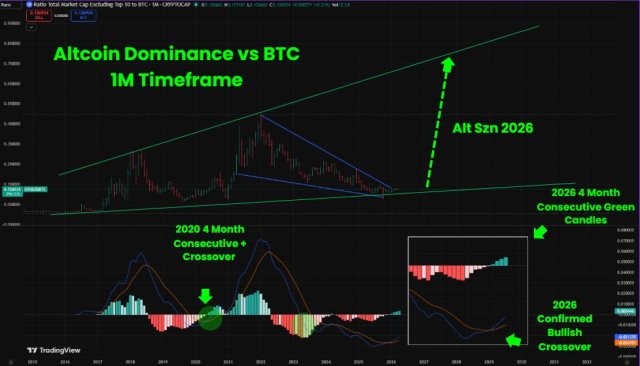
According to analyst Mark Chadwick on X, altcoins are already bringing a major bullish pattern against Bitcoin. This comes as the ALT/BTC chart has marked its fourth consecutive green monthly candle, and this has led to the confirmation of a bullish crossover.

The crypto analyst pointed out that the last time altcoins made such a bullish crossover against Bitcoin was back in 2021. The result of this was the most explosive altcoin season that the crypto market has seen to date, leading altcoins on runs that saw their values rise by many multiples.
Source: X

Why This Altcoin Season Will Be Better Than The Last

Despite the last altcoin season being one of legendary status, Mark believes that it will pale in comparison to what’s coming. A number of reasons were given for this as to why it will be a better altcoin bull market, and this has to do with the broader market optics.

Firstly, the analyst points out that the Fed is putting billions of dollars into the financial market. This is bullish as liquidity tends to drive growth. Next is that the Clarity ACT that will provide formal regulation for cryptocurrencies by putting them into categories of either securities or commodities.

Another bullish factor that the analyst points out is that the SEC is now pro-crypto with the Trump administration. Then, there is the fact that there has been rising activity from the NYSE and NASDAQ when it comes to crypto trading.

The last two of the catalysts given have to do with adoption. The first is the fact that Fannie Mae, the US Federal National Mortgage Association, announced last week that it will begin allowing Bitcoin as collateral for loans. Also, there is the fact that Mastercard is now building crypto rails to allow for payments using blockchain technology.

Taking all of these into account, Mark believes that it is a “setup of epic proportions.” If this plays out as expected, then the next altcoin season could surpass the previous one, and altcoins would end up winning against Bitcoin.

Altcoin market continues to struggle | Source: Crypto Total Market Cap Excluding BTC on Tradingview.com

Related Questions

QAccording to the article, what is the main reason why an altcoin season hasn't occurred despite Bitcoin's new all-time highs?

AThe Bitcoin dominance over the market remains very high, not leaving any room for altcoins to run.

QWhat specific bullish pattern on the ALT/BTC chart does analyst Mark Chadwick point to as a signal for an upcoming altcoin season?

AThe ALT/BTC chart has marked its fourth consecutive green monthly candle, confirming a bullish crossover.

QName two of the regulatory or institutional factors mentioned that could make the next altcoin season more explosive than 2021.

AThe Clarity ACT providing formal cryptocurrency regulation and the SEC being pro-crypto under the Trump administration.

QWhat recent announcement from Fannie Mae is cited as a bullish catalyst for crypto adoption?

AFannie Mae announced it will begin allowing Bitcoin as collateral for loans.

QBesides regulatory changes, what other major factor does the analyst attribute to driving market growth and a potential altcoin season?

AThe Fed is putting billions of dollars into the financial market, increasing liquidity which tends to drive growth.

Related Reads

The Verdict in Choi Tae-won's Divorce Case: Revealing the Inheritance Undercurrent Behind SK Hynix's Trillion-Won Empire

SK Group Chairman Chey Tae-won's high-profile divorce case, involving a record 1.38 trillion won settlement, has drawn attention to the succession plans for Korea's second-largest conglomerate, especially its crown jewel, SK hynix. Unlike traditional chaebol scripts centered on the eldest son, Chey's three children from his marriage to former President Roh Tae-woo's daughter, Roh Soh-yeong, are carving distinct, non-traditional paths. Eldest daughter Chey Yun-jung (b. 1989) is seen as the most evident successor. With a scientific and consulting background, she holds executive roles at SK bioscience and SK Inc.'s growth support department, focusing on future strategy and biopharma. Her marriage is to an AI infrastructure entrepreneur, not a traditional business alliance. Second daughter Chey Min-jung (b. 1991) took a unique route, voluntarily serving as a South Korean naval officer, including an anti-piracy deployment. She later worked on policy and strategy for SK hynix in Washington D.C. before co-founding an AI-driven healthcare startup. She married a former U.S. Marine Corps officer, connecting her to U.S. defense and policy circles—networks crucial for a global semiconductor giant. The only son, Chey In-geun (b. 1995), who studied physics like his father, worked briefly at SK E&S before joining McKinsey. Despite fitting the traditional "heir" profile as the eldest son, he remains silent and holds no public position or shares in SK, suggesting the old succession playbook is obsolete. As SK hynix's valuation soars, becoming a geopolitical asset in the AI era, the heirs' legitimacy is no longer automatic. They must prove themselves in fields like AI biotech, global policy, and strategic consulting. Their marriages also reflect new elite networks in tech and defense, not old political alliances. Their inheritance is the complex challenge of navigating a globalized, tech-driven world, not just a corporate throne.

marsbit22h ago

The Verdict in Choi Tae-won's Divorce Case: Revealing the Inheritance Undercurrent Behind SK Hynix's Trillion-Won Empire

marsbit22h ago

From OpenSea to OpenRouter: Is Alex Atallah Repeating His 'Exit at the Peak' Playbook?

From OpenSea to OpenRouter: Is Alex Atallah Repeating His "Exit at the Peak" Playbook? According to the Wall Street Journal, payments giant Stripe is in talks to acquire the AI model aggregation platform OpenRouter in a potential deal valuing the company near $100 billion. This would mark founder Alex Atallah's second creation of a company reaching a $100 billion valuation, following his co-founding of NFT marketplace OpenSea. OpenRouter, founded just over three years ago, has grown rapidly by acting as a unified gateway for developers to access over 400 AI models. It currently has about 10 million users and processes over 200 trillion tokens monthly. While the platform's annualized revenue is around $50 million, its valuation has skyrocketed from $1.3 billion in March 2026. The potential acquisition by Stripe, a company OpenRouter's founder once likened it to, represents a major expansion into AI infrastructure for the payments leader. This move echoes Atallah's previous timing with OpenSea, where he departed before the NFT market's significant downturn. For OpenRouter, selling now may be strategic. Despite its scale, its business model—charging a 5-5.5% fee on AI inference calls—faces pressure from competition, open-source models, and potential price wars among model providers, limiting its profitability narrative for an IPO. A key asset for potential acquirers like Stripe is OpenRouter's vast repository of real-world AI usage data, which offers unique insights into model performance and developer preferences that are difficult to replicate. Whether this potential deal signifies a new valuation benchmark for AI infrastructure or another market peak signal remains to be seen.

链捕手22h ago

From OpenSea to OpenRouter: Is Alex Atallah Repeating His 'Exit at the Peak' Playbook?

链捕手22h ago

Trading

Spot
活动图片





