Why Does the Automated Market Maker (AMM) Mechanism Fail in the Prediction Market Field?

marsbitPublished on 2026-04-14Last updated on 2026-04-14

Abstract

The article explores why Automated Market Makers (AMMs), particularly the x*y=k model popularized by Uniswap, fail in prediction markets despite their success in decentralized finance (DeFi). AMMs excel in DeFi by enabling permissionless liquidity provision and continuous trading for tokens that fluctuate indefinitely. However, prediction markets involve binary outcomes where assets settle to either $1 or $0 at expiration. This structural difference causes inherent flaws: liquidity providers (LPs) inevitably suffer losses as pools automatically rebalance toward the losing side upon settlement—making "impermanent loss" permanent. Additionally, AMMs distort price discovery for probability-based markets due to slippage and low liquidity. Early prediction platforms like Polymarket and Augur experimented with AMMs but abandoned them for Central Limit Order Books (CLOBs), which better handle precise probabilistic pricing and binary settlements. The article concludes that while AMMs revolutionized token swaps, their mechanics are mismatched for prediction markets, requiring alternative infrastructure that accommodates binary outcomes and mandatory settlement.

Author: Melee

Compiled by: AididiaoJP, Foresight News

In July 2017, Hayden Adams was laid off by his employer Siemens, where he worked as a mechanical engineer. His college roommate Karl Floersch was working at the Ethereum Foundation at the time and often told him about smart contracts. Adams had previously paid no attention. Now unemployed and looking for something to do, he decided to listen.

The Birth of the Automated Market Maker (AMM)

Floersch recommended a blog post by Vitalik Buterin about running an on-chain exchange using a mathematical formula instead of an order book. The principle was not to match buyers and sellers, but to allow traders to exchange with a pool of assets, with the price automatically set based on the ratio of tokens in the pool. No working version existed at the time. Adams took it on as a learning project, received a $65,000 grant from the Ethereum Foundation, and launched Uniswap in November 2018.
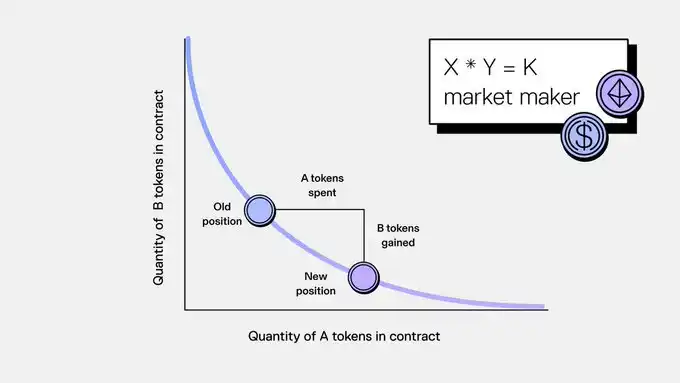
Its formula was deceptively simple: x * y = k.

Two tokens are placed in a pool, and the product of their quantities remains constant. When someone buys one token, they must deposit the other token, changing the ratio within the pool and adjusting the price accordingly. No order book, no matching engine, no professional market makers needed. Anyone can deposit tokens into the pool and earn fees from every transaction.

The automated market maker thus became the cornerstone of decentralized finance. Uniswap, Curve, Balancer, and dozens of other protocols handle billions of dollars in trading volume. On-chain order books are slow and expensive, and traditional market makers have no interest in tokens with only two hundred holders. Automated market makers allow anyone to create a liquid market for any asset at any time. Before AMMs, listing a new asset required permission and infrastructure. After AMMs, all you need is a liquidity pool.

The benefits were obvious. So, prediction markets naturally tried to adopt them too.

Automated Market Makers and Prediction Markets

Prediction markets face the same cold-start problem as token markets. You need liquidity before people are willing to trade, and you need traders before people are willing to provide liquidity. Little known is that Robin Hanson had proposed an automated market making solution for prediction markets years earlier in his 2002 Logarithmic Market Scoring Rule.

He thought he had theoretically solved the cold-start problem. However, in practice, the solution suffered from the same fundamental issue that every subsequent attempt to automate liquidity for prediction markets encountered: the formula couldn't distinguish between perpetually fluctuating tokens and equity certificates that expire.

Prediction market outcomes are binary. They ultimately settle to one or zero. In a token swap pool, both assets can fluctuate indefinitely, and the AMM formula works precisely because neither token is designed to go to zero.

Early Polymarket used an AMM based on the logarithmic market scoring rule. Augur also experimented with similar schemes. If automated liquidity pools worked for token swaps, they should, in theory, work for election betting too.

They didn't.

Why AMMs Fail in Prediction Markets

When a prediction market event settles, one side is worth one dollar, the other zero. For anyone providing liquidity to the pool, the mathematical outcome is nearly brutal. As the market moves towards settlement, the pool automatically rebalances towards the losing side.

Impermanent Loss

What decentralized finance traders call "impermanent loss" becomes completely "permanent" here. Every market settles, and every pool will eventually hold a pile of worthless shares.

In regular DeFi pools, trading fees can offset impermanent loss over time.
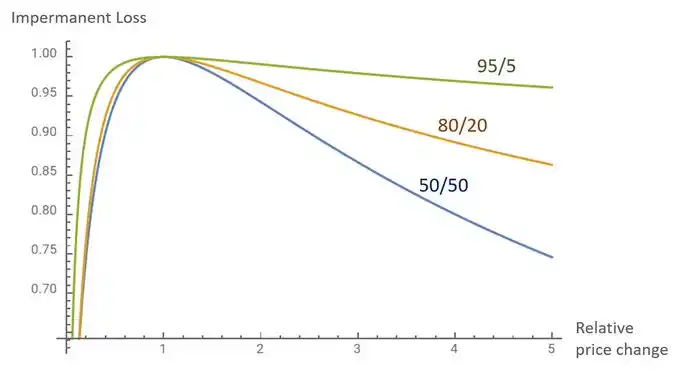
But in prediction markets, the loss is a structural certainty. The only question is how much the liquidity provider loses. Protocols have tried to persuade users to deposit assets into these pools through liquidity mining, reward programs, and various incentive structures. All of these are just different ways to subsidize users to lose money at a slower rate.

Price Discovery

Then there is the issue of price discovery. AMMs price assets based on the pool ratio and a fixed formula. For tokens, the "correct price" is a moving target, and a formula-driven approximation is sufficient. Prediction market prices are supposed to represent probabilities. The slippage introduced by the constant product curve distorts the signal, especially in low-liquidity markets, where a single trade can swing the implied probability by several basis points.

Is the Central Limit Order Book (CLOB) Better Than AMMs?

Polymarket realized this early on. In late 2022, the platform migrated from a logarithmic market scoring rule-based AMM to a central limit order book. AMMs were designed for continuous token swaps across a price range. Prediction markets require precise probability pricing on binary outcomes with known terminal values. They are entirely different problems.

The characteristics that made AMMs revolutionary for tokens—permissionless market creation, instant liquidity bootstrapping, no reliance on professional market makers—are exactly what prediction markets desperately need. The problem is that the specific mechanism, the constant function formula built for token swaps, breaks down when faced with the reality of binary outcomes and inevitable settlement.

The challenge for prediction markets is to replicate these effects with infrastructure that reflects how these markets actually settle.


Related Questions

QWhat is the core mathematical formula behind the Automated Market Maker (AMM) mechanism introduced by Uniswap?

AThe core mathematical formula is x * y = k, where x and y represent the quantities of two tokens in the pool, and k is a constant product.

QWhy do AMMs fail in the prediction market space according to the article?

AAMMs fail in prediction markets because these markets involve binary outcomes that eventually settle to $1 or $0, causing structural and certain losses for liquidity providers, unlike in token swaps where both assets can fluctuate indefinitely and fees can offset impermanent loss.

QWhat did early prediction market platforms like Polymarket and Augur experiment with?

AEarly platforms like Polymarket used an AMM based on Robin Hanson's Logarithmic Market Scoring Rule, and Augur also experimented with similar automated liquidity solutions.

QWhat is the key difference between token trading and prediction markets that makes AMMs unsuitable for the latter?

AToken trading involves assets designed to never go to zero and allows for continuous price fluctuations, while prediction markets have binary outcomes that definitively settle to $1 or $0, making AMM-induced losses certain rather than 'impermanent'.

QWhat solution did Polymarket eventually adopt to address the limitations of AMMs?

APolymarket migrated from an AMM based on the Logarithmic Market Scoring Rule to a Central Limit Order Book (CLOB) to better handle precise probability pricing and binary settlement in prediction markets.

Related Reads

In Jinjiang, Fujian, a Storage Super Unicorn Lies Quiet

In Fujian's Jinjiang, a city known for sportswear, lies a quiet semiconductor giant: Fujian Jinhua Integrated Circuit Co. (JHICC). Once a promising domestic DRAM manufacturer alongside Yangtze Memory and ChangXin Memory Technologies (CXMT), its journey was derailed in 2018 when the U.S. placed it on an Entity List and filed criminal charges for alleged trade secret theft. This halted production for years. A turning point came in February 2024 when a U.S. federal court found JHICC not guilty. However, it had lost crucial time. While CXMT soared to become a top-valued A-share company in 2024, JHICC, with an estimated valuation of 80 billion RMB, was just restarting. Its current output is primarily customized DDR4 chips, not the advanced DDR5/HBM demanded for AI, but it still benefits from the broader memory chip upcycle. JHICC's story is tied to Chen Zhengkun, a veteran engineer who left Micron to lead the venture. Founded in 2016 with state-backed funding, JHICC partnered with Taiwan's UMC to develop DRAM technology. Rapid progress was cut short by the U.S. actions, which Micron initiated, partly due to its heavy reliance on the Chinese market. Post-sanctions, Chen's team worked to rebuild the production line with reduced reliance on U.S. technology. According to its records, JHICC achieved small-scale production and revenue growth under immense pressure. It now focuses on the stable "niche" DRAM market (e.g., TVs, routers) with a monthly capacity of ~40,000 wafers, aiming for 60,000 by 2026. It holds over 1,000 patents but remains on the Entity List. For Jinjiang, investing in JHICC was a bold industrial leap. The local government provided unwavering financial and logistical support during the crisis, helping the company survive. JHICC has become the anchor for a growing local semiconductor cluster. Though its scale lags behind domestic peers, JHICC's persistence symbolizes a hard-won foothold in a global market long dominated by Samsung, SK Hynix, and Micron. Having missed one boom, it seeks a place in the new AI-driven memory supercycle.

marsbit24m ago

In Jinjiang, Fujian, a Storage Super Unicorn Lies Quiet

marsbit24m ago

Must-Watch Events Next Week|CLARITY Act Could Face Senate Vote; SpaceX, Circle to Report Earnings (8.3-8.9)

**Summary: Key Events and Developments to Watch (August 3-9)** The upcoming week is marked by significant financial disclosures, key legislative deadlines, and notable product updates. **Major Financial Events:** Several companies are scheduled to release their Q2 2026 earnings. American Bitcoin (ABTC) will report on August 3, followed by SpaceX and Hut 8 Mining Corp. on August 4, and Circle on August 5. Notably, a significant portion of SpaceX shares (up to 12% of total shares) will be unlocked on August 6 following their earnings release. **Key Legislative Deadline:** The U.S. Senate faces an August 7 deadline to secure 60 votes for the CLARITY Act, a bipartisan bill aiming to establish a federal regulatory framework for cryptocurrencies. The Senate may hold a full vote on the bill during the week. **Economic Data:** The U.S. July Non-Farm Payrolls report will be released on August 7, providing crucial labor market data. **Technology & Product Updates:** * **Shutdowns:** DeFi portfolio tracker Zapper and wallet app Ctrl Wallet will cease operations on August 3. * **Upgrades:** LayerZero will deprecate its v1 relayers on August 3. XRP Ledger's new version 3.3.0, featuring five new functions, is expected next week. * **AI:** Elon Musk announced that the advanced Grok 4.6 AI model is set for release around August 7. * **Bitcoin:** The BIP-110 forced signaling for a potential Bitcoin network change is scheduled to begin around August 8. **Other Notable Events:** Chinese robotics firm Unitree Tech has set its preliminary price inquiry for its IPO for August 5. South Korean exchange Upbit will delist AQT and AERGO tokens on August 3.

marsbit2h ago

Must-Watch Events Next Week|CLARITY Act Could Face Senate Vote; SpaceX, Circle to Report Earnings (8.3-8.9)

marsbit2h ago

Trading

Spot
活动图片




