Why Are the Most Believers in AGI Buying NVIDIA Put Options?

marsbitPublished on 2026-05-20Last updated on 2026-05-20

Abstract

The article analyzes the significant, market-moving 13F filing for Q1 2026 by Situational Awareness LP (SALP), a fund managed by former OpenAI researcher Leopold Aschenbrenner. While Aschenbrenner is a prominent believer in the accelerated arrival of AGI and has built the fund as a focused bet on AI infrastructure, the filing revealed large new put option positions (totaling billions in notional value) on key AI/semiconductor names like Nvidia, SMH ETF, Broadcom, and AMD. The article argues this is not a bearish turn on AI but a sophisticated hedging strategy. Given the macro backdrop in late March (rising oil prices, inflation concerns, higher-for-longer interest rates), the fund is managing volatility in its high-beta, high-valuation portfolio of AI infrastructure plays (like Bloom Energy, CoreWeave, Core Scientific). The puts act as "insurance" against a potential systemic pullback in the AI trade. Simultaneously, SALP maintained or added to core long positions in companies tied to power, data centers, compute, and storage—the "bottlenecks" expected to capture AI capital spending. It trimmed or exited some Q1 winners (e.g., Lumentum) and reduced leverage (e.g., selling CoreWeave calls), suggesting a rotation from crowded, high-momentum trades towards assets with clearer long-term fundamental pathways. The key takeaway is an evolution in the AI investment theme: from a broad, linear rally to a more discerning, "show-me-the-money" phase. The focus shifts from simply buyin...

Author: Jim, MSX Matong

During this round of US stock 13F disclosures, one of the most watched funds was not Bridgewater or Berkshire Hathaway, but a fund with a very distinctive name—Situational Awareness LP.

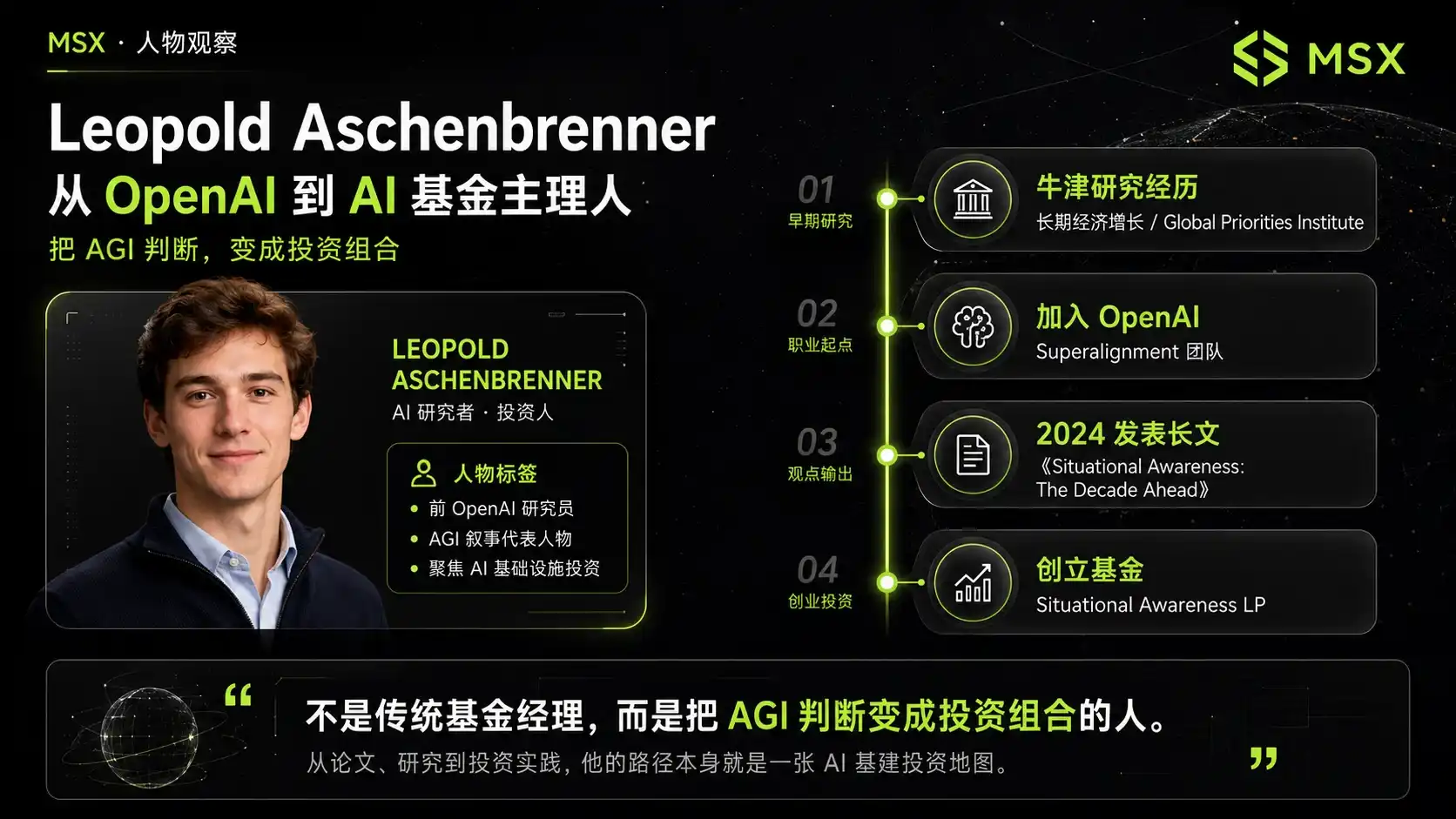
Its manager, Leopold Aschenbrenner, is not a traditional Wall Street veteran. He was a former member of OpenAI's Superalignment team. In 2024, he published a lengthy essay titled "Situational Awareness: The Decade Ahead". Its core thesis was very radical, stating that AGI might arrive sooner than most people think, and that what will be truly scarce in the future is not just the model capabilities themselves, but compute power, electricity, data centers, chips, storage, and the national-level resource competition surrounding the AI arms race.

Two years later, the facts have proven him right.

Leopold internalized a set of judgments about AGI in the coming decade and then mapped those judgments to the capital markets. Precisely because of this, Situational Awareness, from its inception, has not resembled a typical tech fund, but rather has been like directly translating the AGI roadmap into an AI infrastructure investment map.

This is also why its every move is closely watched in the AI investment space. The latest 13F filing shows that this most knowledgeable AI bull seems to be quietly building a large-scale position in put options.
I. SALP: A Product That Turns AGI Belief into a Fund

Public information shows that Leopold founded an investment company focused on AGI, backed by heavyweight Silicon Valley figures such as Patrick Collison, John Collison, Nat Friedman, and Daniel Gross.

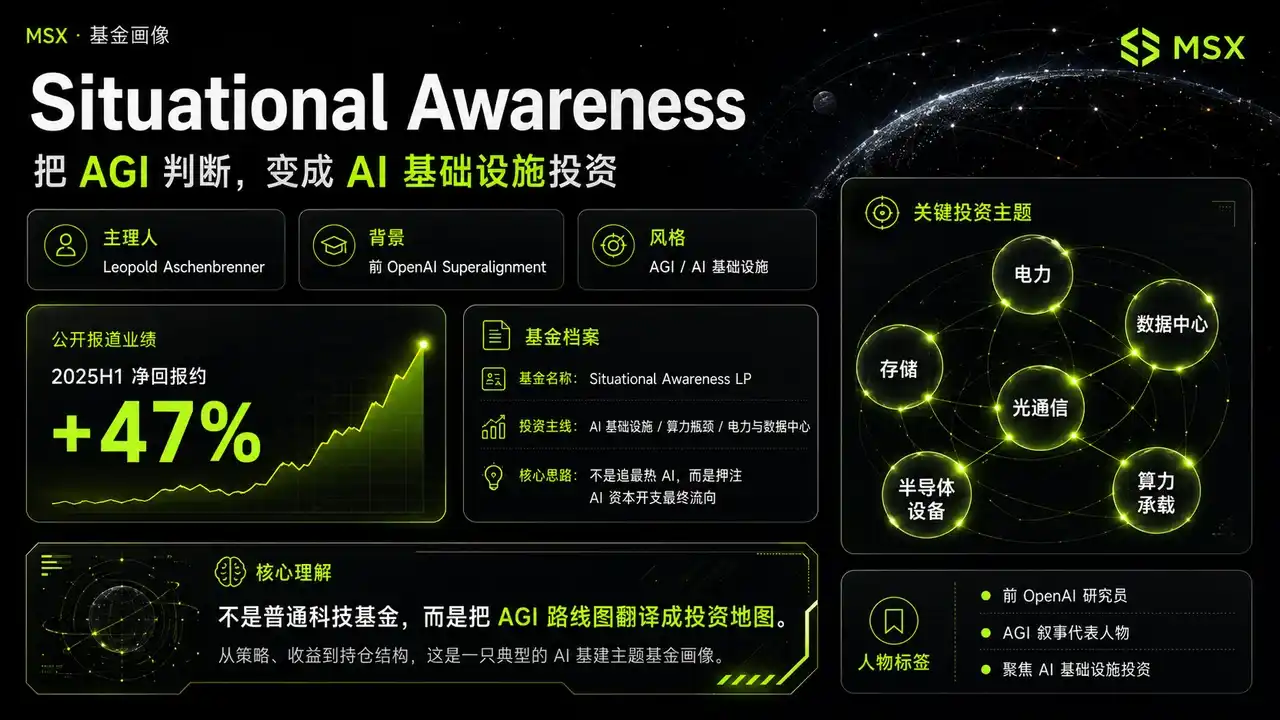
According to market reports, Situational Awareness achieved approximately +47% net returns after fees in the first half of 2025, significantly outperforming the S&P 500 and the tech hedge fund index during the same period. Its uniqueness lies in the fact that it is not simply bullish on "tech stocks," but highly focused on AI infrastructure, betting on where AI capital expenditures will ultimately flow.

As stated at the beginning, his underlying logic is: if AGI truly arrives faster, the first to be revalued might not necessarily be application-layer companies, but rather those controlling compute power, electricity, data centers, storage, optical communications, semiconductor equipment, and energy resources. Therefore, its high returns are not simply from buying the index, but from a basket of high-beta AI infrastructure stocks widening the gap: such as Bloom Energy, Sandisk, Lumentum, CoreWeave, Core Scientific, etc.
It's necessary to explain first what 13F is.

13F is a quarterly holdings disclosure filing that US institutional investment managers submit to the SEC, typically used to observe the quarterly holdings changes of large funds in US stocks, ETFs, and related options. However, it is essentially just a snapshot at the end of a quarter, telling the market only "what was disclosed at a certain point in time." It cannot fully reconstruct a fund's entire trading strategy, especially regarding options. 13F does not show strike prices, expiration dates, whether positions are paired with others, and cannot directly deduce the fund's true net exposure.

This is also the part most prone to misinterpretation when reading such filings.

The reporting date for this Q1 13F was March 31. Last10K shows the file was submitted on the evening of May 15 (ET), but the SEC acceptance time was May 18. That is to say, it wasn't simply "not filed," but there was a time lag between submission and the market actually seeing the disclosed results. Hence, discussions like "waiting for Leopold's 13F" appeared on social media.

More critically, the disclosed results of this 13F are not entirely as the market imagined. Many initially thought Leopold would continue aggressively adding to core AI assets like NVIDIA, Broadcom, AMD, TSMC, and ASML. But the reality is, SALP established large new PUT option positions covering a batch of AI and semiconductor core holdings, including the SMH semiconductor ETF, NVIDIA, Oracle, Broadcom, AMD, Micron, TSMC, ASML, Intel, and others.

This has prompted the market to reconsider a question: Why is the person who most believes in the accelerated arrival of AGI starting to buy insurance for AI leaders?

If simply chalked up to "being bearish on AI," that's too simplistic. What truly deserves analysis is under what macro backdrop he made this move, and what changes in AI trade structure this reflects.
II. Understanding SALP's Latest 13F: From Betting on AI to Managing AI Volatility

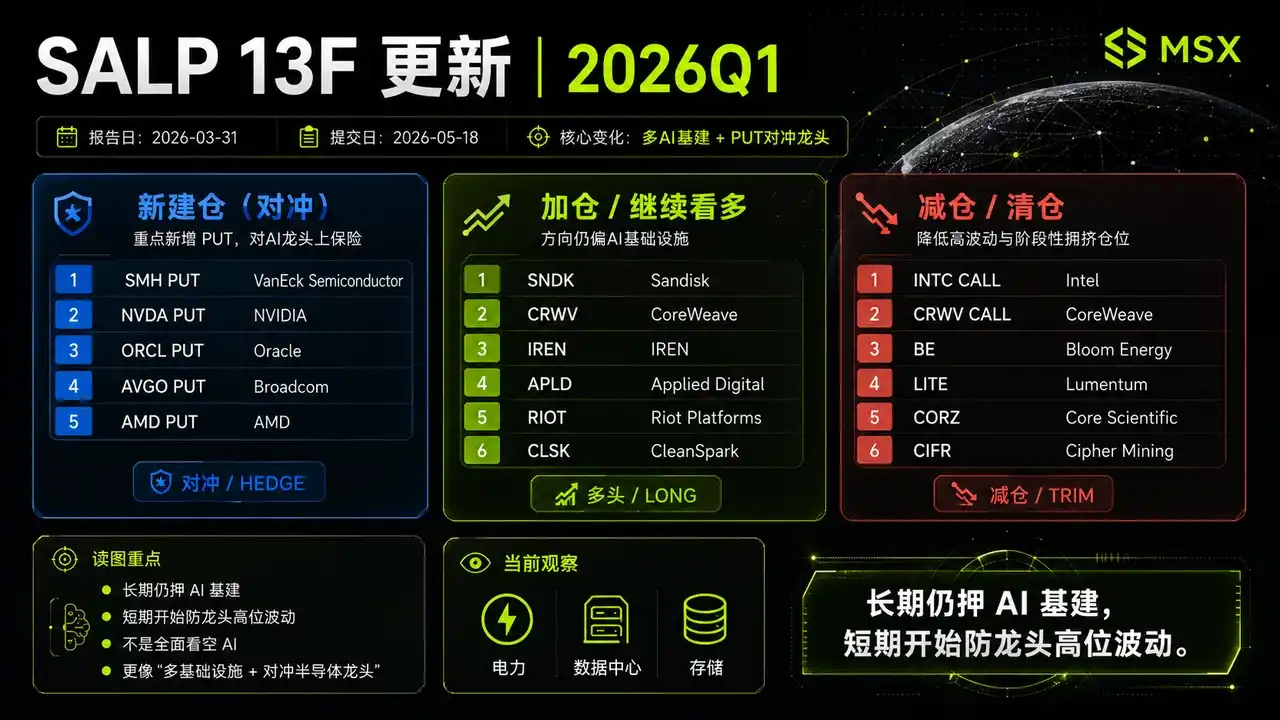
The most striking action revealed in this 13F is undoubtedly SALP's establishment of large put option positions:

  • The largest is a PUT on the SMH semiconductor ETF, with a disclosed value of approximately $2.043 billion;
  • Next is an NVDA PUT, about $1.568 billion;
  • Then an ORCL PUT, about $1.073 billion;
  • An AVGO PUT, about $1.006 billion;
  • And an AMD PUT, about $969 million;
  • In addition, it also established new MU PUT, TSM PUT, ASML PUT, INTC PUT positions, among others;

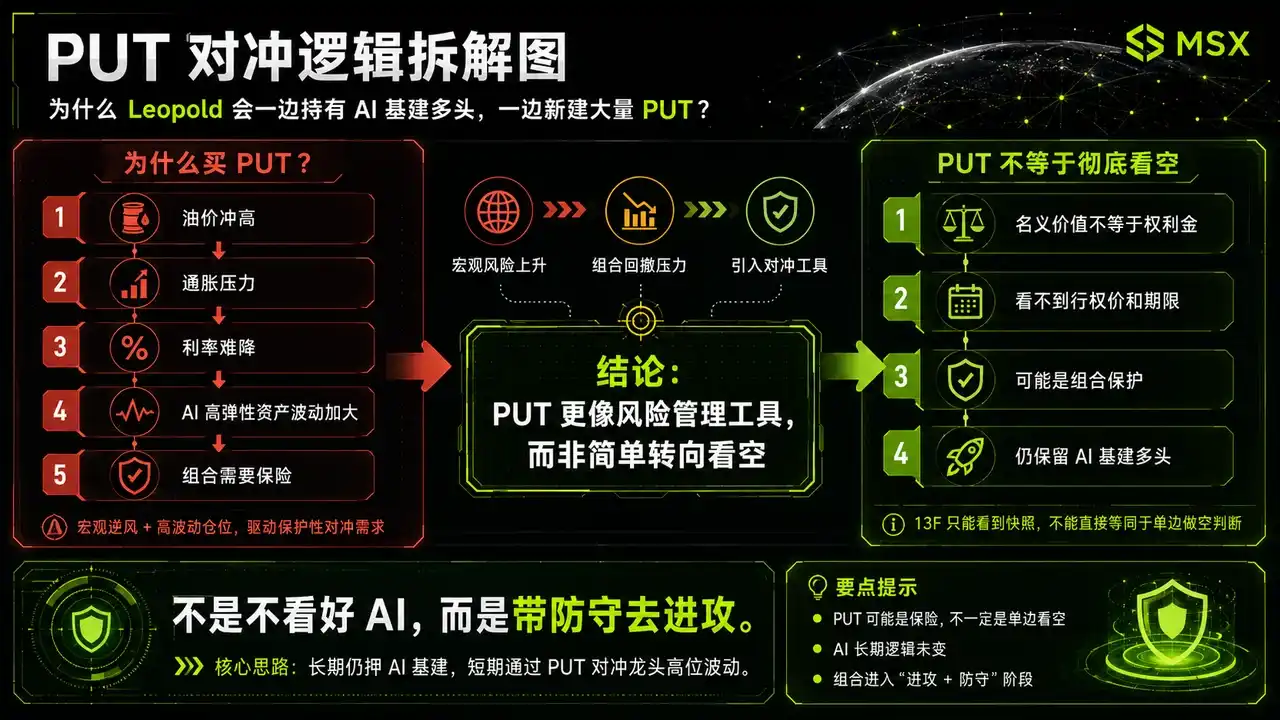
On the surface, this looks a lot like being bearish on AI leaders. But the issue is, PUTs do not necessarily represent outright shorting — after all, the option amounts in 13F are more of a nominal value disclosed based on the underlying security size, not equal to the fund's actual premium cost. More importantly, 13F doesn't show strike prices, expiration dates, whether positions are paired, or the true net exposure within the portfolio.

Therefore, directly stating Leopold is "completely bearish on NVIDIA and semiconductors" is not rigorous. A more reasonable understanding is that he is buying "insurance" for his AI infrastructure long portfolio. Because many of the holdings in SALP's original portfolio are themselves high-beta, high-volatility, rate-sensitive companies, like the aforementioned Bloom Energy, CoreWeave, Core Scientific, IREN, Applied Digital, Sandisk, etc. The long-term thesis for these assets is related to AI infrastructure, but short-term stock prices often heavily depend on risk appetite and the valuation environment.

Once the market starts de-risking due to rising oil prices, recurring inflation, higher interest rates, or geopolitical conflicts, these high-beta assets are often sold first. This also relates to the macro backdrop around late March: on one hand, Middle East tensions and US-Iran conflict risks were pushing up oil price expectations; on the other hand, rising oil prices could exacerbate inflation stickiness, weakening market confidence in rate cuts.

For high-valuation growth stocks, this equals "double pressure": oil prices push inflation, inflation suppresses rate cuts, rates don't come down, and the valuation of high-duration tech assets gets compressed.

Placed within this context, Leopold's establishment of numerous PUT positions becomes easier to understand. It's not about rejecting AI, but about acknowledging that no matter how strong the long-term AI logic is, it cannot completely ignore macro headwinds.

Especially for a fund like SALP, many holdings in its portfolio are high-beta assets. If it only held offensive positions, once a systemic market pullback occurred, portfolio NAV volatility would be very high. By buying PUTs on liquidity-rich, representative AI core assets like SMH, NVDA, AVGO, AMD, ORCL, it can use relatively standardized instruments to hedge systemic pullback risks for the entire AI trade.

The true meaning behind this is that Leopold has not changed from an AI bull to an AI bear, but has shifted from "unilaterally aggressively long AI" to "continuing to bet on AI infrastructure, but starting to manage the path volatility."

This is a more mature portfolio management approach.
III. So, Where is Leopold's Offensive Direction?

If establishing PUTs solves the "defense problem," then the list of additions, reductions, and liquidations truly tells us where Leopold's offensive direction lies.

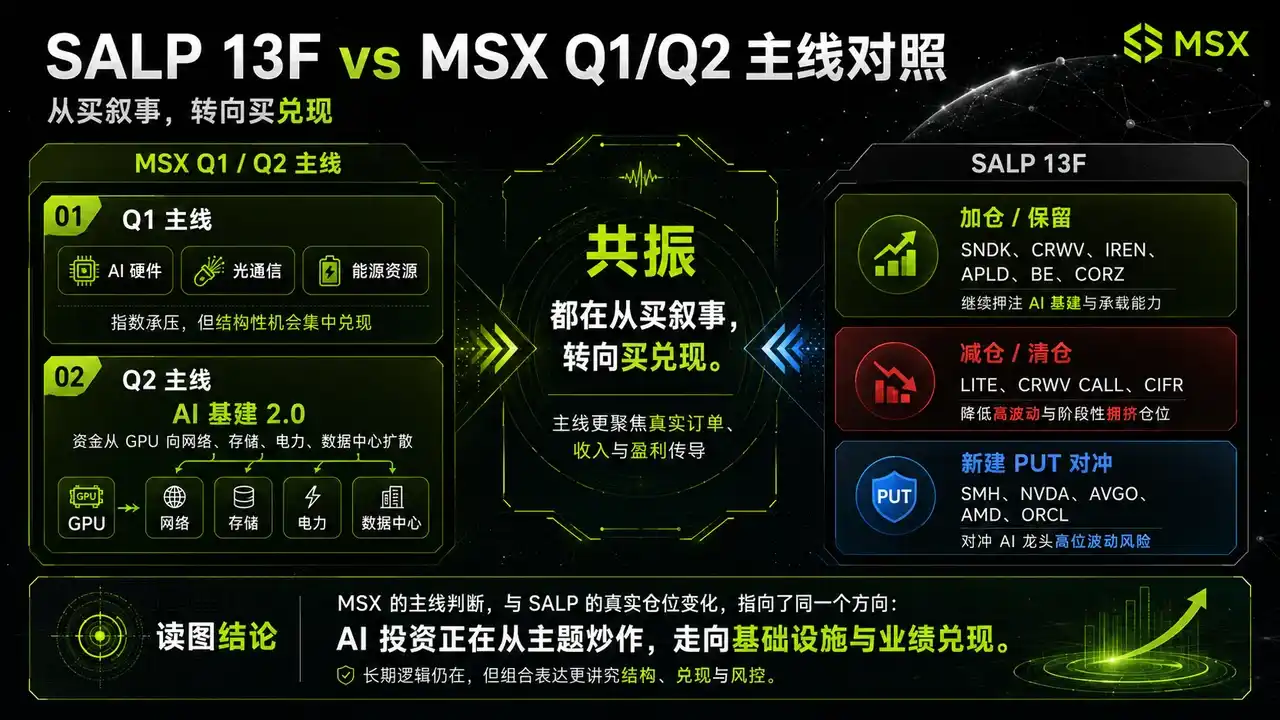
From the disclosures, SALP still retains and has added to a batch of AI infrastructure-related stocks. For example, it slightly added to its common stock position in Sandisk; common stock in CoreWeave, IREN, Applied Digital, Riot Platforms, CleanSpark, Bitfarms, Bitdeer are also on the addition list. Currently retained important long positions also include Bloom Energy, Sandisk, CoreWeave, IREN, Core Scientific, Applied Digital, etc.

This indicates it has not abandoned AI. On the contrary, it is still betting on the same long-term logic: AI capital expenditures will continue to flow downstream, and the true beneficiaries are those companies controlling electricity, data centers, storage, compute hosting, and infrastructure bottlenecks.

This is very close to MSX's Q2 thematic judgment. In "AI Infrastructure Rallied Throughout Q1; in Q2, Who Can Still Justify the 'High Valuation'?" we emphasized that the focus of AI trading has shifted from just GPUs to networks, storage, and power. The market is now more concerned about whose orders, revenues, and profits the continuously expanding capital expenditures of major firms will ultimately flow into. The reason why segments like equipment, networks, storage, and power are more advantageous is not because they are sexier, but because they better fit the current market's taste for earnings realization.

From this perspective, SALP's long positions are quite representative: Bloom Energy corresponds to power and independent energy supply; CoreWeave, Applied Digital, Core Scientific, IREN correspond to data centers, compute hosting, and infrastructure capacity; Sandisk, Micron, TSM-related positions correspond to storage, semiconductor manufacturing, and hardware supply.

In other words, Leopold is not avoiding buying AI; he is more concerned about where the AI money ultimately goes and who can turn that money into revenue on their financial statements.

Looking at reductions and liquidations, they are equally informative. SALP liquidated INTC CALL, Lumentum, Cipher Mining, and reduced positions in CoreWeave CALL, Bloom Energy, Core Scientific, among others. Notably, this is not simply an exit from a certain direction, but a reduction of some positions that have already rallied significantly, are highly volatile, or have stronger leverage attributes.

For example, with CoreWeave, it reduced CALLs but still holds common stock, indicating it's not abandoning CoreWeave entirely, but switching from a more aggressive option expression to a relatively more controlled common stock expression. Similarly, reductions in Bloom Energy and Core Scientific don't equate to thesis invalidation, but are more likely portfolio-level risk control and profit-taking.

The liquidation of Lumentum is even more intriguing. In MSX's Q1 review, AI hardware and optical communications were among the strongest-performing themes, with AXTI, AAOI, LITE, and LWLG achieving multi-fold gains. The strength of optical communications essentially stemmed from the explosion in demand for optical interconnect, optical modules, and network links from AI data centers. However, the issue is, the more a theme rallies in Q1, the more likely it faces crowded trades and diminishing risk-reward in Q2.

Therefore, Leopold's liquidation of LITE and reduction of some high-beta AI infrastructure positions may not necessarily represent a bearish view on the direction, but a more realistic acknowledgment: The most successful trade in Q1 may not be the trade with the best risk-reward in Q2.

This is the most important takeaway from this rebalancing. It's not about rejecting AI, but actively switching structure—from buying anything in the AI chain to retaining only those assets that can better absorb long-term capital expenditures, possess stronger infrastructure attributes, and are more resilient through macro volatility.

He's not giving up on AI; he's giving up on the linear fantasy that "all AI will rise together."
This 13F is essentially only a snapshot as of March 31 and does not represent the exact same positions Leopold still held by May. Yet, it still offers strong inspiration for the current market.

First, the long-term AI theme is not over, but the trade structure has changed. In the future, not everything AI will rise; the premium will go to those who can deliver, while crowded trades will require hedging.

Second, in a high-oil-price, high-interest-rate, high-volatility environment, the truly effective strategy is not simple all-out offense nor comprehensive defense, but playing offense with defense in place—core positions betting on certainty, marginal positions betting on upside, while using hedging tools to control portfolio drawdowns. Leopold's move essentially demonstrates this logic with real positions.

Third, this also confirms a major change in US stocks in 2026: index Beta weakens, while structural Alpha strengthens. In the past, simply buying the "Magnificent Seven" or NVIDIA might have been enough to win. But now the market is more discerning; it questions every company: Can your AI story ultimately turn into orders? Into revenue? Into profits? If not, valuations will compress no matter how high.

This is also why AI Infrastructure 2.0 becomes important. Future capital won't just look at GPUs, but will search down the chain of compute → interconnect → storage → power → data center infrastructure for segments that can truly deliver.

In Conclusion

If viewed superficially, the most eye-catching part of this 13F is that string of massive PUTs.

But if you truly go through the entire portfolio, you'll find that what Leopold did is not a "turn from AI bull to bear," but a more mature upgrade: long-term still betting on AI infrastructure, short-term starting to face the volatility risks of high-valuation, high-beta assets.

This is the most important takeaway from this 13F. It tells us that the direction of AI might still be right, but the path to that destination will certainly not be a straight line.

For true fund managers, what's important is not just betting on the correct end point, but also surviving and navigating the volatility along the way.

For ordinary investors, the biggest takeaway from this 13F is also clear: the AI trade in 2026 has shifted from "buying the story" to "buying the delivery"; from "buying the leaders" to "finding the bottlenecks"; from "unilateral offense" to "playing offense with defense."

This is the most interesting, and absolutely should not be ignored, signal.

Related Questions

QWho is the main person discussed in the article and what was his previous role?

AThe main person discussed is Leopold Aschenbrenner, who was previously a member of the Superalignment team at OpenAI.

QWhat is the name and primary focus of the investment fund mentioned in the article?

AThe fund is called Situational Awareness LP, and it primarily focuses on investing in AI infrastructure based on an AGI roadmap.

QAccording to the article, why did Situational Awareness LP buy a large number of put options on AI stocks like NVIDIA?

AThe fund bought put options not as a bearish bet on AI, but as 'insurance' or a hedge to manage potential volatility and systemic risk in its high-beta, AI infrastructure-focused portfolio, especially given the macroeconomic headwinds in late Q1.

QWhat is the article's explanation for the shift in the AI trading environment as signaled by this 13F filing?

AThe article explains that the AI trading environment has shifted from a phase of 'buying the story' to one of 'buying the proof.' The focus is now on which companies can convert AI capital expenditure into actual orders, revenue, and profits, leading to a preference for infrastructure bottlenecks like power, data centers, storage, and networking.

QWhat key AI infrastructure sectors or companies does Situational Awareness LP's long portfolio continue to focus on?

AIts long portfolio continues to focus on companies in key AI infrastructure sectors such as power and independent energy supply (e.g., Bloom Energy), data centers and compute hosting (e.g., CoreWeave, Core Scientific, IREN), and storage and semiconductor manufacturing (e.g., Sandisk).

Related Reads

Why Haven't Forex Stablecoins Taken Off?

Why FX Stablecoins Never Took Off: A Path Forward via Synthetic FX Despite the explosive growth of stablecoin-powered digital banking, which has seen ~$6B in VC investment and a 24x surge in crypto card spending in under a year, a major limitation persists: these banks are essentially dollar-only accounts. This leaves 95-99% of global accounts, which are denominated in non-USD currencies, underserved. Attempts to create native foreign currency (FX) stablecoins (like EURC) have largely failed, with total FX stablecoin TVL at ~$600M compared to $400B for USD stablecoins—a 700x gap. These FX tokens face critical challenges: fragile pegs due to low liquidity, limited exchange/FinTech acceptance, poor on/off-ramps, complex regional compliance, and a chicken-and-egg adoption problem. The article argues that the solution lies not in competing with entrenched USD stablecoin networks (USDT/USDC), but in adopting a synthetic FX model inspired by traditional finance. Specifically, it advocates for Mark-to-Market Non-Deliverable Forwards (NDFs)—cash-settled FX derivatives that allow users to maintain underlying USD stablecoin holdings while having their account balance and P&L denominated in a foreign currency. This approach offers key advantages: strong oracle-based pegs, retention of deep USD stablecoin liquidity and yield, superior on/off-ramps, scalability to any currency with a reliable feed, and capital efficiency. It mirrors how modern institutional FX markets operate. Primary use cases for on-chain NDFs include: 1. **Digital Banks/Wallets:** Enabling multi-currency accounts for international users without leaving the USD stablecoin ecosystem, boosting deposits and retention. 2. **FX Carry Trade Vaults:** Offering access to sovereign interest rate differentials (e.g., earning yield on BRL) in a more stable and scalable format than crypto-native products like Ethena. 3. **Global Enterprise Payments:** Allowing merchants to receive payments in local currency equivalents while settling in USD stablecoins, similar to services offered by Stripe for fiat. The conclusion is that synthetic FX, not native FX stablecoins, is the viable path to integrating foreign exchange into the growing stablecoin digital banking landscape, potentially unlocking the next phase of institutional DeFi and multi-trillion-dollar global adoption.

链捕手34m ago

Why Haven't Forex Stablecoins Taken Off?

链捕手34m ago

IOSG Founder: Web3 Is 'Losing Blood,' How Can Practitioners Survive Better?

IOSG Founder: Web3 Is "Bleeding Out" – How Can Practitioners Survive Better? In a candid reflection, the founder of IOSG Ventures voices deep concerns about the current state of Web3, describing an ecosystem experiencing severe "blood loss." Despite the recent MuShanghai event showcasing a successful pivot towards a more diverse, global community, a somber reality persists: many crypto-native attendees were there exploring exits or new labels in biotech, AI, and robotics. The core issue is identified as a breakdown in the ecosystem's positive feedback loop. Alarmingly, underestimated "low-probability bad events" are occurring simultaneously: a significant brain drain of Chinese developers to AI, a lack of breakout applications despite massive funding, and a widening credibility gap for practitioners globally, often stigmatized as scam artists. This has created a dire接班人 (successor) problem, with the next generation seeing little professional prestige or financial upside in crypto compared to fields like AI. A significant portion of the critique focuses on Ethereum and Vitalik Buterin. While not pessimistic about Ethereum's technology, the founder worries that critical development windows were missed by focusing on niche technical narratives like ZK and L2 instead of mass-market applications. A more urgent concern is that Vitalik may be isolated in an "information bubble," shielded from the grassroots community's hardships by layers of intermediaries, preventing crucial feedback from reaching him. The call is for Vitalik to return to a founder's mindset, re-engage directly with the community, and rally efforts for the next decade. The divergence between U.S. and Chinese OG (Original Gangster) ecosystems is stark. While many U.S. builders reinvest their wealth into the ecosystem, the Chinese scene suffers from a severe lack of "造血能力" (blood-making ability), with most market-driven funds struggling and many early success stories cashing out entirely. This threatens the entire Asian Web3 ecosystem's survival. For individual practitioners, survival advice is pragmatic: find your core "why," maintain life balance beyond token prices, continuously learn new skills (like AI), form small, trusted alliances for mutual support, and practice self-compassion. The industry's greatest need is not money or tech, but lighthouses—individuals at all levels who offer mentorship, grants, referrals, and honest reflection to guide others. The piece concludes with a direct appeal: OGs must pay forward the opportunities the industry gave them; founders must not struggle alone; and builders must continue their work, ensuring it remains a viable profession. The survival of Web3's "cathedral" depends not on any single leader but on the collective responsibility of everyone who remains.

marsbit1h ago

IOSG Founder: Web3 Is 'Losing Blood,' How Can Practitioners Survive Better?

marsbit1h ago

Deficits, Inflation, and the New Fed: The Deep Logic Behind US Bond Yields Breaking 5% and the Market Reset

In the week of May 15-19, 2026, U.S. long-term Treasury yields surged to multi-year highs, with the 30-year yield hitting 5.2%, a level unseen since 2007, and the 10-year yield climbing to 4.687%. Equity markets declined in response. Four primary factors are driving the rise in yields. First, stubborn inflation persists, with April wholesale prices rising 6% year-over-year, fueling expectations of potential future Fed rate hikes instead of cuts. Second, newly confirmed Fed Chair Kevin Warsh inherits a complex inflation battle, with markets closely awaiting his first FOMC meeting. Third, deteriorating U.S. fiscal health, marked by large deficits and rising debt servicing costs, is eroding the traditional "safe-haven" premium for Treasuries. Fourth, the "One Big Beautiful Bill" tax cuts are projected to add trillions to the national debt, contributing to Moody's recent credit rating downgrade. Rising yields pressure stocks through several channels: a higher discount rate reduces the present value of future earnings (especially for growth stocks); rising risk-free rates compress equity risk premiums, making bonds relatively more attractive; higher borrowing costs impact consumers and corporations; and a stronger dollar affects multinational earnings. For investors, the environment favors value and financial stocks over long-duration growth stocks. Bond investors find attractive yields in short to intermediate maturities, while income investors see the best fixed-income opportunities in over a decade. Key developments to watch include Chair Warsh's first FOMC meeting, upcoming inflation data, Treasury auction demand, and whether the 30-year yield approaches 6%, a level that could trigger a more sustained equity valuation reset. The bond market's message is clear: the era of cheap government borrowing is over, posing a central challenge for markets in late 2026.

marsbit1h ago

Deficits, Inflation, and the New Fed: The Deep Logic Behind US Bond Yields Breaking 5% and the Market Reset

marsbit1h ago

Is MicroStrategy Selling Bitcoin Not a Bearish Signal? Deconstructing the 5 Financial Logics Behind Corporate Bitcoin Divestment

The article "Is Strategy Selling Bitcoin Not a Bearish Signal? Decoding 5 Financial Logics Behind Corporate Bitcoin Divestment" analyzes why companies might sell their bitcoin holdings, arguing it's not necessarily negative. It begins by noting the market's surprise at Strategy's potential sale, contrasting its previous "never sell" stance. The core argument is that corporate decisions prioritize shareholder value, and selling bitcoin can be a rational strategic choice. The article outlines five key financial reasons for such sales: 1. **Increase Bitcoin Holdings Per Share:** Companies can use proceeds from bitcoin sales to repurchase shares when the stock price is undervalued relative to its bitcoin assets. This reduces the outstanding share count, potentially increasing the bitcoin amount backing each remaining share. 2. **Optimize Capital Structure & Reduce Financing Costs:** Building cash reserves through bitcoin sales can improve credit ratings (as favored by agencies like S&P), leading to lower future borrowing costs. Repaying debt with sale proceeds also reduces financial leverage. 3. **Legitimate Tax Planning:** In the absence of wash-sale rules for bitcoin in the US, companies can sell to realize capital losses, then repurchase, lowering the tax basis of their holdings and creating tax offsets. 4. **Counter Negative Market Narratives:** A controlled, non-disruptive sale could demonstrate market resilience and disprove fears that corporate selling would crash the market, thereby normalizing bitcoin as a corporate treasury asset. 5. **Repurchase Preferred Stock at a Discount:** If a company's preferred stock trades significantly below its face value, using bitcoin sale proceeds to repurchase it can retire expensive liabilities at a profit, saving on future dividend payments. The conclusion emphasizes that bitcoin's monetary properties offer flexibility. Strategic sales can protect corporate and shareholder interests, making asset utilization more important than rigid "hold" mandates.

marsbit2h ago

Is MicroStrategy Selling Bitcoin Not a Bearish Signal? Deconstructing the 5 Financial Logics Behind Corporate Bitcoin Divestment

marsbit2h ago

Trading

Spot
Futures

Hot Articles

How to Buy ONE

Welcome to HTX.com! We've made purchasing Harmony (ONE) simple and convenient. Follow our step-by-step guide to embark on your crypto journey.Step 1: Create Your HTX AccountUse your email or phone number to sign up for a free account on HTX. Experience a hassle-free registration journey and unlock all features.Get My AccountStep 2: Go to Buy Crypto and Choose Your Payment MethodCredit/Debit Card: Use your Visa or Mastercard to buy Harmony (ONE) instantly.Balance: Use funds from your HTX account balance to trade seamlessly.Third Parties: We've added popular payment methods such as Google Pay and Apple Pay to enhance convenience.P2P: Trade directly with other users on HTX.Over-the-Counter (OTC): We offer tailor-made services and competitive exchange rates for traders.Step 3: Store Your Harmony (ONE)After purchasing your Harmony (ONE), store it in your HTX account. Alternatively, you can send it elsewhere via blockchain transfer or use it to trade other cryptocurrencies.Step 4: Trade Harmony (ONE)Easily trade Harmony (ONE) on HTX's spot market. Simply access your account, select your trading pair, execute your trades, and monitor in real-time. We offer a user-friendly experience for both beginners and seasoned traders.

3.6k Total ViewsPublished 2024.03.29Updated 2025.06.04

How to Buy ONE

Discussions

Welcome to the HTX Community. Here, you can stay informed about the latest platform developments and gain access to professional market insights. Users' opinions on the price of ONE (ONE) are presented below.

活动图片