Why Are Several DeFi Projects Reaping the Benefits of the Robinhood Chain Boom?

marsbitPublished on 2026-07-13Last updated on 2026-07-13

Abstract

The recent surge in top DeFi tokens like Lighter (LIT), Morpho (MORPHO), Arbitrum (ARB), and Uniswap (UNI) is directly linked to the explosive launch of the Robinhood Chain Layer 2 network. While initially driven by meme coin speculation (e.g., CASHCAT), the chain is now showing signs of sustained activity, with its TVL doubling to $96M and DEX volume hitting ~$900M in a week. These specific tokens are seen as primary beneficiaries of the chain's growth narrative. Lighter is Robinhood Wallet's default perps platform. Arbitrum receives a share of protocol revenue as Robinhood Chain is built on its Orbit stack. Morpho holds the majority of the chain's TVL through the new Robinhood Earn product. Uniswap, the main DEX, has already facilitated ~$1B in volume, generating fees. The analysis suggests that while meme-driven hype may fade, these projects represent a more fundamental bet on Robinhood Chain's infrastructure and its potential to expand into areas like RWA and perps, offering a sustainable way to gain exposure to the chain's success.

Author: William M. Peaster

Compiled by: Plain Talk Blockchain

If you were to rank the top 100 cryptocurrencies by their gains over the past 7 days, a few heavyweight DeFi projects would stand out. Specifically, this week's top gainers include Lighter (LIT, +16%), Morpho (MORPHO, +15%), Arbitrum (ARB, +13%), and Uniswap (UNI, +9%).

While these projects belong to different sectors, their recent surge shares a very clear common thread: they are all significantly benefiting from the explosive launch of Robinhood Chain.

However, you might recall from my Wednesday article discussing the Robinhood Chain's "meme narrative" that while this Layer 2 launched with grand ambitions for tokenized assets, its early traffic has almost entirely been driven by memes like CASHCAT.

In other words, this resembles a familiar speculative frenzy we've seen on-chain before. But what has truly been noteworthy over the past 48 hours is how rapidly the scale of this activity is expanding.

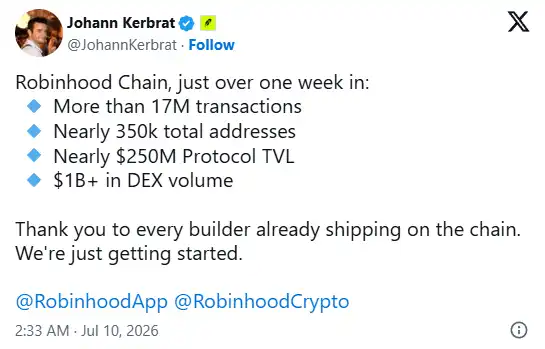
For instance, just in the past few days, according to DefiLlama data, Robinhood Chain's TVL (Total Value Locked) has doubled from $46 million to $96 million; meanwhile, the stablecoin market cap on this network has also risen above $270 million. Additionally, this L2 has facilitated around $9 billion in DEX trading volume this week, with over $5 billion occurring in the last 24 hours alone.

This early momentum suggests the beginning of real sustainability and even hints that this meme-sparked rally could spill over into more verticals in the future, such as RWA and Perpetuals. This is precisely why many traders this week have continued to increase their positions in assets that could benefit long-term from the rise of Robinhood Chain.

Thus, we witnessed the outperformance of LIT, ARB, MORPHO, and UNI over the past 7 days. At least at this stage, these tokens have been woven into Robinhood Chain's potential upward narrative. Specifically:

Lighter — It's still too early to tell if Lighter will become the next Hyperliquid, but being selected as Robinhood Wallet's default perpetuals platform is undoubtedly a major step in that direction. While perpetual trading volume on Robinhood Chain is not significant yet, if it truly accelerates later, Lighter stands to gain more revenue, which in turn translates into more LIT buyback and burn.

Arbitrum — Robinhood Chain is built on the Arbitrum Orbit tech stack, and 10% of the chain's net protocol revenue flows back to the Arbitrum ecosystem. How this revenue ultimately maps to the price of ARB is another matter; but Robinhood's early success further highlights the possibility of more large companies deploying Orbit chains in the future. This, in turn, could lead to increased revenue flowing to Arbitrum, which is clearly positive for ARB.

Morpho — The newly launched Robinhood Earn product is channeling USDG deposits into Morpho vaults, offering an annual percentage yield (APY) of approximately 7%. This is also why, out of Robinhood Chain's current $96 million TVL, roughly $65 million resides on Morpho. Like ARB, MORPHO is currently primarily a governance token, so how this new lending channel will impact the price remains to be seen. However, MORPHO essentially serves as a proxy for betting on the success of the Morpho engine, and Robinhood Earn is a catalyst for that engine.

Uniswap — Within its first week on Robinhood Chain, this DEX has facilitated approximately $1 billion in total trading volume. This level of activity surge generates considerable protocol fees, which can be further transformed into UNI buyback and burn. Therefore, if Robinhood Chain can sustain significant trading volume going forward, its success is beneficial for the long-term performance of UNI. Additionally, Uniswap serving as the primary DEX on this network from day one sends a signal to other companies that if they launch their own L2 in the future, they can follow a similar playbook.
From a broader perspective, it's true that the top meme on Robinhood Chain — CASHCAT — has skyrocketed 5000% in the past 7 days, far outpacing the gains of these blue-chip DeFi tokens. However, the future of CASHCAT depends more on sentiment and vibes; and as we all learned from the first major wave of meme coins, "vibes" themselves cannot last indefinitely.

What can endure are solid fundamentals and the infrastructure capable of supporting broader on-chain activities. Therefore, just one week after the launch of Robinhood Chain, LIT, ARB, MORPHO, and UNI have already become several pathways for betting on the chain's core thesis — you can participate in the growth narrative of Robinhood Chain without having to gamble on whether a particular meme will stay hot.

Now, it remains to be seen what performance these tokens will deliver under this new paradigm.

Related Questions

QWhat is the common driver behind the recent price surge of major DeFi tokens like LIT, MORPHO, ARB, and UNI according to the article?

AThe recent price surge is largely attributed to their significant benefits from the explosive launch of Robinhood Chain, which has generated substantial on-chain activity and liquidity.

QWhat key metric indicates the rapid growth of activity on Robinhood Chain in the past few days?

ARobinhood Chain's Total Value Locked (TVL) doubled from $46 million to $96 million in just a few days, according to DefiLlama data, indicating rapid growth.

QWhy is the Lighter (LIT) token considered a potential beneficiary of Robinhood Chain's growth?

ALighter is the default perpetual trading platform on the Robinhood Wallet. If perpetual trading volume on Robinhood Chain increases significantly, Lighter could generate more revenue, leading to more LIT token buybacks and burns.

QHow is the success of Robinhood Chain potentially beneficial for the Arbitrum (ARB) token?

ARobinhood Chain is built on the Arbitrum Orbit tech stack and directs 10% of its net protocol revenue back to the Arbitrum ecosystem. Its early success highlights the potential for more major companies to deploy Orbit chains, which could increase revenue flowing to Arbitrum and be bullish for ARB.

QWhat role does the Uniswap (UNI) token play in the context of Robinhood Chain's launch, and how might it benefit?

AUniswap served as the main DEX on Robinhood Chain from day one, facilitating around $1 billion in total volume in its first week. This high activity generates substantial protocol fees, which can be used for UNI token burns. Sustained high volume on Robinhood Chain would be beneficial for UNI's long-term performance.

Related Reads

In Jinjiang, Fujian, a Storage Super Unicorn Lies Quiet

In Fujian's Jinjiang, a city known for sportswear, lies a quiet semiconductor giant: Fujian Jinhua Integrated Circuit Co. (JHICC). Once a promising domestic DRAM manufacturer alongside Yangtze Memory and ChangXin Memory Technologies (CXMT), its journey was derailed in 2018 when the U.S. placed it on an Entity List and filed criminal charges for alleged trade secret theft. This halted production for years. A turning point came in February 2024 when a U.S. federal court found JHICC not guilty. However, it had lost crucial time. While CXMT soared to become a top-valued A-share company in 2024, JHICC, with an estimated valuation of 80 billion RMB, was just restarting. Its current output is primarily customized DDR4 chips, not the advanced DDR5/HBM demanded for AI, but it still benefits from the broader memory chip upcycle. JHICC's story is tied to Chen Zhengkun, a veteran engineer who left Micron to lead the venture. Founded in 2016 with state-backed funding, JHICC partnered with Taiwan's UMC to develop DRAM technology. Rapid progress was cut short by the U.S. actions, which Micron initiated, partly due to its heavy reliance on the Chinese market. Post-sanctions, Chen's team worked to rebuild the production line with reduced reliance on U.S. technology. According to its records, JHICC achieved small-scale production and revenue growth under immense pressure. It now focuses on the stable "niche" DRAM market (e.g., TVs, routers) with a monthly capacity of ~40,000 wafers, aiming for 60,000 by 2026. It holds over 1,000 patents but remains on the Entity List. For Jinjiang, investing in JHICC was a bold industrial leap. The local government provided unwavering financial and logistical support during the crisis, helping the company survive. JHICC has become the anchor for a growing local semiconductor cluster. Though its scale lags behind domestic peers, JHICC's persistence symbolizes a hard-won foothold in a global market long dominated by Samsung, SK Hynix, and Micron. Having missed one boom, it seeks a place in the new AI-driven memory supercycle.

marsbit1h ago

In Jinjiang, Fujian, a Storage Super Unicorn Lies Quiet

marsbit1h ago

Trading

Spot
活动图片





