Why Are Crypto Project Acquisitions Now Excluding Tokens?

marsbitPublished on 2025-12-18Last updated on 2025-12-18

Abstract

Recent acquisitions in the crypto space, such as Circle’s purchase of Interop Labs (developers of Axelar Network), have sparked controversy by focusing on acquiring teams and intellectual property while excluding the native tokens. In the Axelar case, the AXL token and network remain independent, leading to a 15% price drop and community backlash. Similar patterns emerged in other acquisitions: Kraken’s Ink acquired Vertex Protocol’s team and tech but abandoned the VRTX token, causing a 75% crash. Pump.fun acquired Padre and invalidated its token without compensation, and Coinbase integrated Vector.fun’s tech without involving the TNSR token. These cases reflect a broader “acquihire” trend common in Web2, where companies acquire talent and tech but avoid equity or token obligations. In crypto, however, this often leaves retail token holders with no rights or financial benefits, as tokens are designed to avoid regulatory scrutiny as securities—offering utility or governance instead of ownership or profit-sharing. This has led to growing tension between project teams and token holders, exemplified by Aave’s recent governance proposal to assert DAO control over IP, equity, and revenue—highlighting the misalignment between token-based incentives and traditional equity structures. The trend raises fundamental questions about the value and rights attached to tokens in decentralized ecosystems.

In the early hours of the day before yesterday, the Interop Labs team (the initial developer of Axelar Network) announced its acquisition by Circle to accelerate the development of its multi-chain infrastructure Arc and CCTP.

Normally, being acquired is good news. However, the further detailed explanation provided by the Interop Labs team in the same tweet caused an uproar. They stated that the Axelar network, foundation, and AXL token would continue to operate independently, with development work being taken over by CommonPrefix.
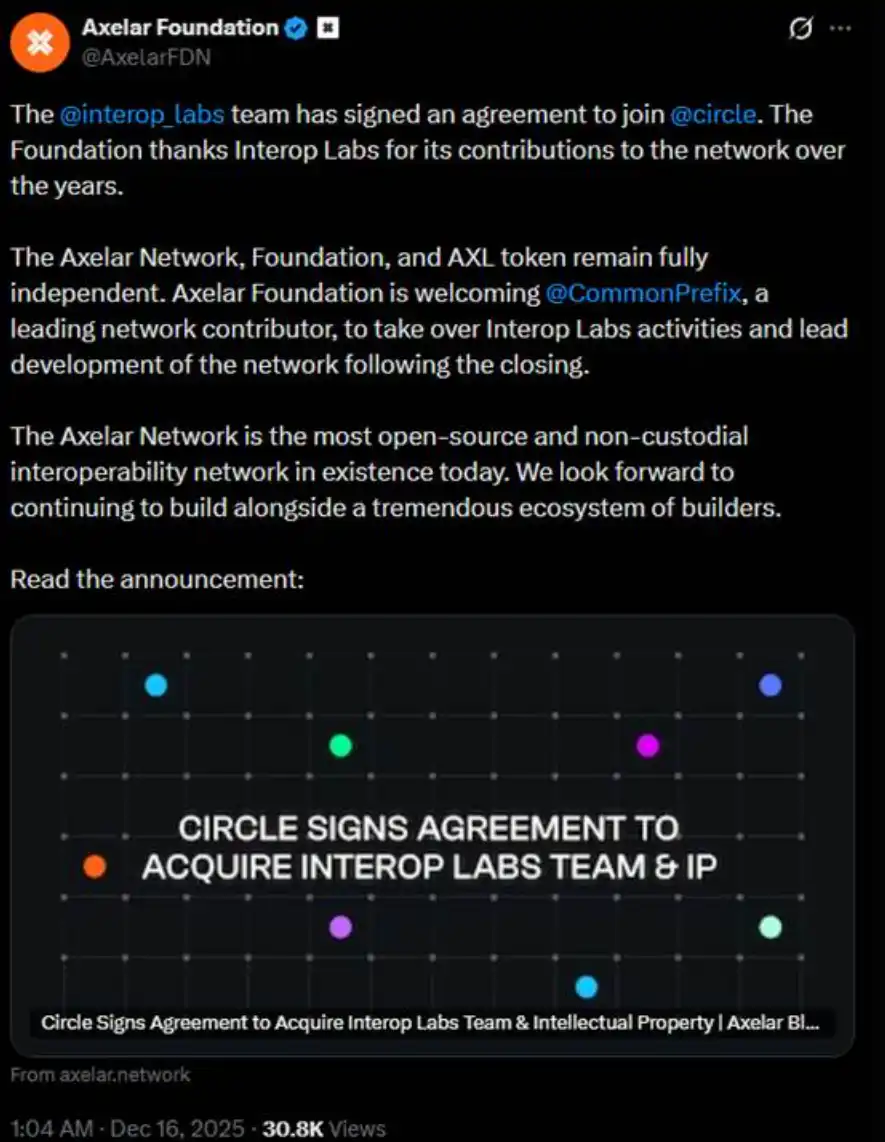
In other words, the core of this transaction is the "team merging into Circle" to promote the application of USDC in the fields of privacy computing and compliant payments, rather than a comprehensive acquisition of the Axelar network or its token system. The team and technology, Circle is taking. The original project, Circle is not managing.

After the acquisition news was announced, the price of Axelar token $AXL first rose slightly and then began to fall, currently down about 15%.
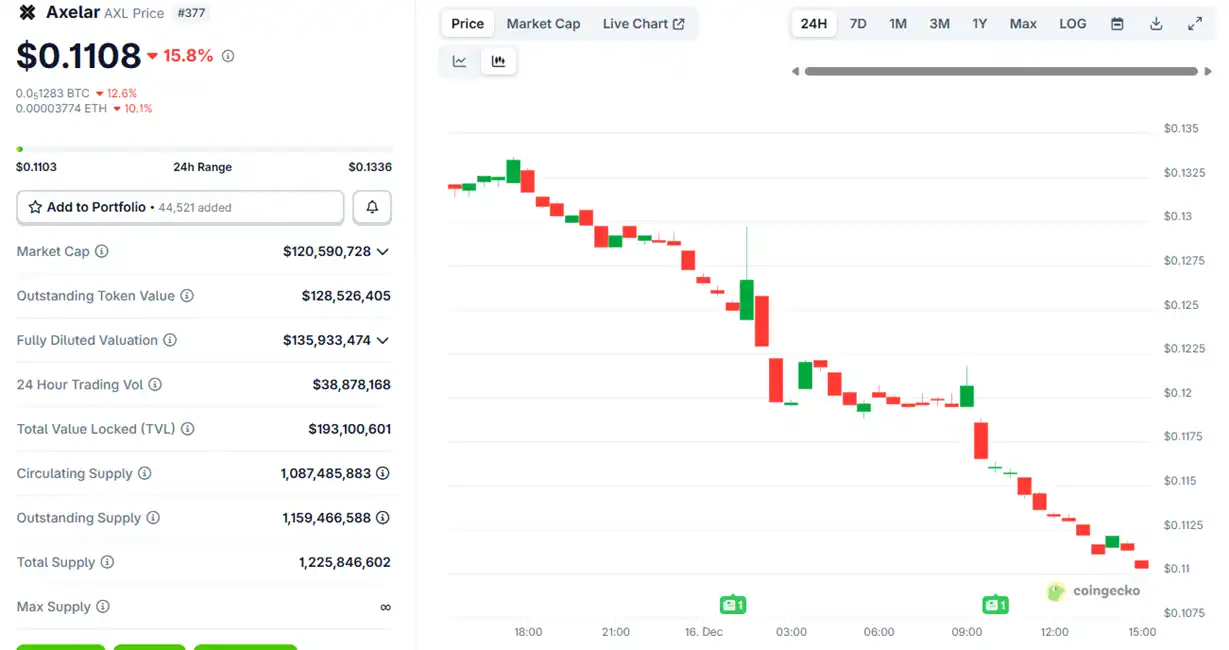
This arrangement quickly sparked intense discussions in the community about "token vs equity." Multiple investors questioned that Circle essentially acquired the core assets through the acquisition of the team and intellectual property, but bypassed the rights of AXL token holders.
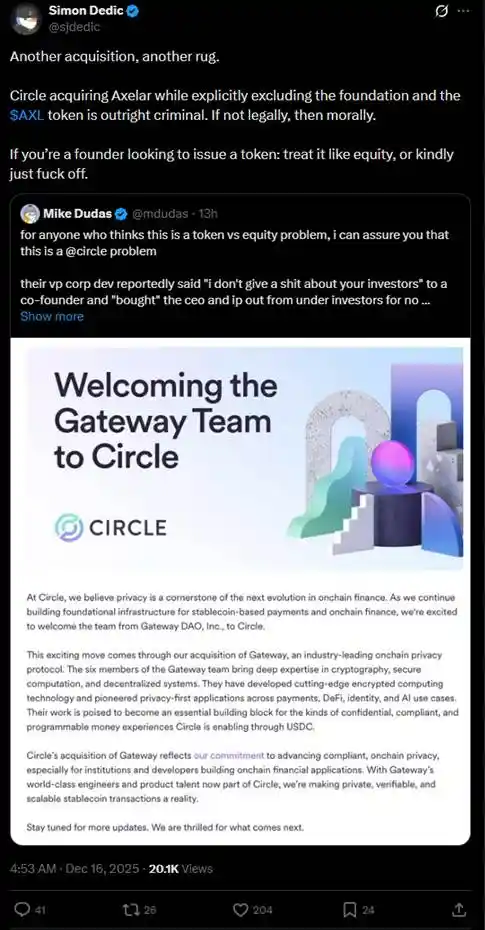
Over the past year, similar cases of "acquiring the team and technology, but not the token" have occurred repeatedly in the crypto space, causing serious harm to retail investors.

In July, Ink, the Layer 2 network under Kraken, acquired the decentralized trading platform Vertex Protocol based on Arbitrum, taking over its engineering team and trading technology architecture, including the synchronous order book, perpetual contract engine, and money market code. After the acquisition, Vertex shut down its services on 9 EVM chains, and the token $VRTX was abandoned. After the news was announced, $VRTX fell more than 75% that day and gradually "went to zero" (current market cap is only $73,000).
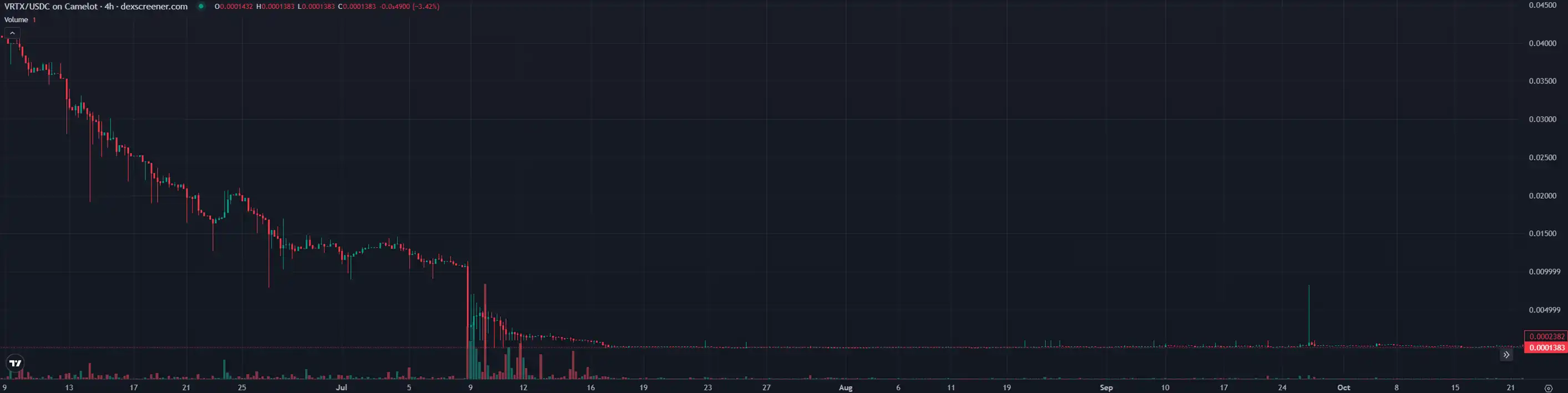
However, $VRTX holders at least had a tiny bit of comfort because they would receive a 1% airdrop during the TGE of Ink (snapshot has ended). Next, there are even worse cases, where the token is directly invalidated without any compensation.

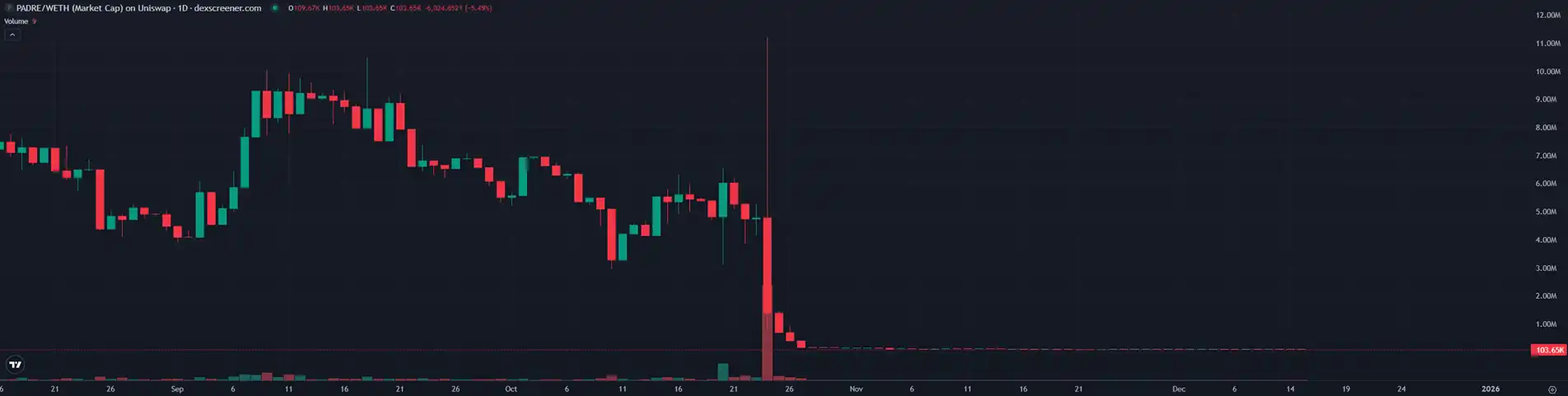
In October, pump.fun announced the acquisition of the trading terminal Padre. When the acquisition of Padre was announced, pump.fun also stated that the Padre token would no longer be used on its platform and directly indicated that there were no future plans for the token. Since the declaration of the token's invalidation was in the last reply of the thread, the token doubled instantly and then plummeted sharply. Currently, $PADRE has a market cap of only $100,000.
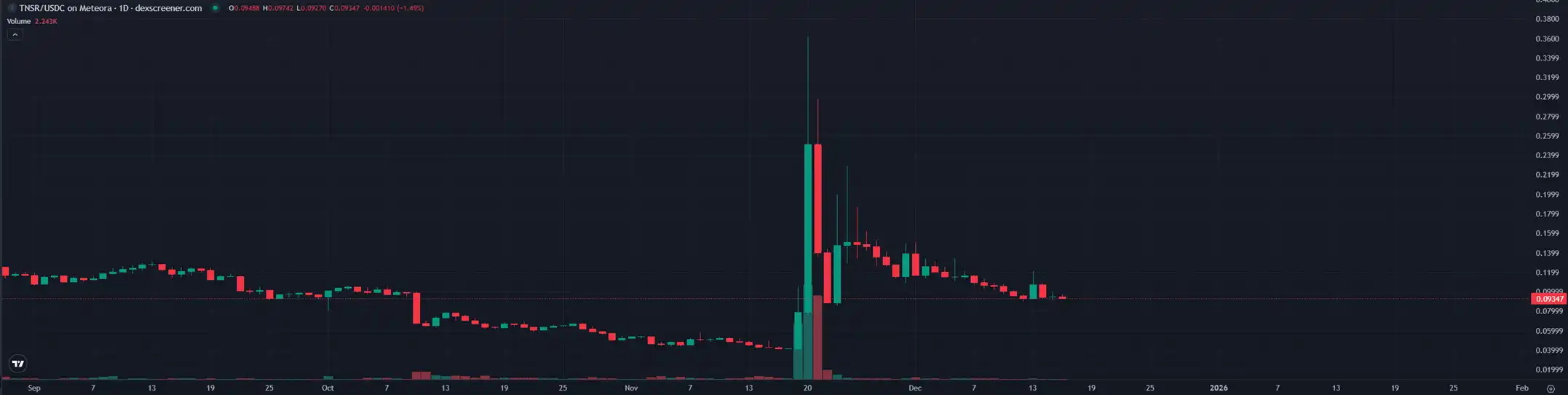
In November, Coinbase announced the acquisition of the Solana trading terminal Vector.fun built by Tensor Labs. Coinbase integrated Vector's technology into its DEX infrastructure, but did not involve the Tensor NFT market itself or the equity of $TNSR. Part of the Tensor Labs team moved to Coinbase or other projects.

The price movement of $TNSR was relatively stable among the examples, rising sharply and then falling back. The current price has returned to a level appropriate for an NFT market token and is still higher than the low before the acquisition news.
In Web2, it is legal for large companies to acquire small companies by "taking the team and intellectual property, but not the equity." This situation is called an "acquihire." Especially in the tech industry, "acquihire" allows large companies to quickly integrate excellent teams and technologies, avoiding the lengthy process of hiring from scratch or internal development, thereby accelerating product development, entering new markets, or enhancing competitiveness. Although it is unfavorable to small shareholders, it stimulates overall economic growth and technological innovation.

Nevertheless, "acquihire" must also satisfy the principle of "acting in the best interests of the company." The reason these examples in the crypto space have made the community so angry is precisely because the "small shareholders," as token holders, completely disagree that the project parties in the crypto space are "acting in the best interests of the company" for the better development of the project through acquisition. Project parties often dream of listing on the US stock market when the project itself can make big money, and then issue tokens to make money when everything is just starting or declining (the most typical example is OpenSea). After these project parties make money from the tokens, they turn around to find their next opportunity, leaving the past projects only in their resumes.

So, can retail investors in the crypto space only swallow their broken teeth? It was also the day before yesterday that Ernesto, former CTO of Aave Labs, published a governance proposal titled "$AAVE Alignment Phase 1: Ownership," firing a shot to defend token rights in the crypto space.

The proposal advocates that Aave DAO and Aave token holders clearly control core rights such as protocol IP, brand, equity, and revenue. Aave service provider representatives such as Marc Zeller publicly endorsed the proposal, calling it "one of the most influential proposals in Aave governance history."

Ernesto mentioned in the proposal, "Due to some past events, there is strong hostility towards Aave Labs in previous posts and comments, but this proposal strives to remain neutral. This proposal does not imply that Aave Labs should not be a contributor to the DAO or lacks the legitimacy or ability to contribute, but the decision should be made by Aave DAO."

According to the interpretation by crypto KOL @cmdefi, the cause of this conflict lies in Aave Labs replacing the front-end integrated ParaSwap with CoW Swap, after which the generated fees flowed to Aave Labs' private address. Accordingly, Aave DAO supporters believe this is a form of plunder because, with the existence of the AAVE governance token, all benefits should优先 flow to AAVE holders or remain in the treasury for DAO voting decisions. Additionally, previously, ParaSwap's revenue would continuously flow into the DAO. The new CoW Swap integration changed this status, further leading the DAO to believe this was a plunder.

This very directly reflects a contradiction similar to that between "shareholders and management," and again highlights the awkward positioning of token rights in the crypto industry. In the early days of the industry, many projects promoted the "value capture" of tokens (such as obtaining rewards through staking or directly sharing profits). But since 2020, SEC enforcement actions (such as lawsuits against Ripple and Telegram) have forced the industry to shift towards "utility tokens" or "governance tokens," which emphasize usage rights rather than economic rights. As a result, token holders often cannot directly share project dividends—project revenue may flow to equity held by the team or VCs, while token holders are like small shareholders contributing for free.

As in the examples mentioned in this article, project parties often sell teams, technological resources, or equity to VCs or large companies, while also selling tokens to retail investors. The final result is that resource and equity holders profit first, while token holders are marginalized or even get nothing. Because tokens do not have legally defined investor rights.

To avoid the regulation that "tokens cannot be securities," tokens are designed to be increasingly "useless." Because regulation is avoided, retail investors are placed in a very passive and unprotected position. The various cases that have occurred this year have, in a sense, reminded us that the current problem of "narrative failure" in the crypto space may not be that people no longer believe in narratives—narratives are still good, profits are still good, but when we buy tokens, what exactly can we expect?


Related Questions

QWhat is the main reason behind the recent trend of acquiring crypto projects without their tokens, as discussed in the article?

AThe main reason is to avoid regulatory risks, as tokens are often designed to be 'utility' or 'governance' tokens to circumvent securities regulations, leaving token holders with no legal investor rights. Acquirers focus on teams and intellectual property to integrate technology without assuming obligations to token holders.

QHow did the community react to Circle's acquisition of Interop Labs, and why?

AThe community reacted with outrage because Circle acquired only the team and intellectual property of Axelar Network, leaving the AXL token and its holders independent and excluded from the benefits of the acquisition, causing the token's price to drop significantly.

QWhat is an 'acquihire' in the context of Web2, and how does it relate to the crypto acquisitions mentioned?

AAn 'acquihire' in Web2 refers to an acquisition where a larger company buys a smaller one primarily for its team and technology intellectual property, rather than its equity or business operations. This relates to crypto acquisitions as it mirrors the pattern where acquirers take teams and IP but discard the tokens, harming散户 investors.

QWhat problem did Ernesto's proposal for $AAVE aim to address, according to the article?

AErnesto's proposal aimed to address the misalignment of interests by advocating for Aave DAO and token holders to explicitly control core assets like IP, brand, equity, and revenue, ensuring that benefits flow to token holders rather than being diverted to private entities like project teams or VCs.

QWhy are token holders in crypto projects often left with limited protection or benefits during acquisitions?

AToken holders have limited protection because tokens are deliberately designed without legal investor rights to avoid being classified as securities under regulations like those enforced by the SEC. This allows project teams and equity holders to prioritize their own interests during acquisitions, marginalizing token holders.

Related Reads

Annual Salary of Millions Competing for Electricians, Meta Rushes to Open Its Own Technical School

The AI boom is facing an unexpected bottleneck: a severe shortage of skilled construction workers and electricians. As tech giants like Meta, OpenAI, and Alphabet race to build massive data centers—such as OpenAI's $16 billion "Stargate" project—they are hitting a critical labor wall. The U.S. needs an estimated 130,000 more electricians, 240,000 construction workers, and 150,000 supervisors by 2030 for AI infrastructure alone, but tens of thousands of electrician jobs go unfilled each year. While AI companies offer high premiums, with electricians earning up to $280,000 annually, worker scarcity still causes massive losses—delays on a single project can cost $14.2 million per month. The complexity of building AI data centers, which require immense power (equivalent to powering hundreds of thousands of homes), sophisticated electrical systems, and advanced liquid cooling solutions, demands highly skilled technicians who are in short supply. To combat this, companies are investing heavily in training. Meta has committed $115 million to a free training school offering tuition, housing, and stipends, targeting 5,000 new workers. OpenAI is partnering with unions to secure skilled labor. These efforts are paying off, with a significant rise in Gen Z interest in trade schools over college. However, the power demands are staggering. AI data centers are driving a rapid surge in electricity consumption, projected to account for up to 12% of U.S. power use by 2028 and raising costs for consumers. Furthermore, the construction boom is project-based, leading to a potential future glut of trained workers once building peaks, which could depress wages industry-wide. The race for AI supremacy now depends as much on skilled hands as on advanced chips.

marsbit29m ago

Annual Salary of Millions Competing for Electricians, Meta Rushes to Open Its Own Technical School

marsbit29m ago

OpenAI No Longer Sells Its Most Expensive Model for Profit

OpenAI is shifting its business strategy away from promoting its most expensive, flagship models for every task. Recent price cuts—80% for GPT-5.6 Luna and 20% for Terra—signal a deeper change: the company now actively advises users that many tasks don't require the most powerful model. Instead, OpenAI recommends a tiered approach: use the high-end GPT-5.6 Sol for complex planning and analysis, then delegate execution to cheaper models like Luna. This mirrors moves by Anthropic, which recently launched Claude Opus 5 at half the price of its top model, Fable 5. Both companies are de-emphasizing flagship models as primary revenue drivers, using them instead for brand prestige and technological showcases. The industry is entering a "mass-market" phase, similar to automotive, where high-volume, cost-effective models handle daily operations and drive scale. OpenAI's price reductions are partly enabled by AI models themselves optimizing underlying code and infrastructure, creating a self-reinforcing cycle of efficiency gains and cost reduction. Competition is shifting from "who is smartest" to "who offers the best value." The goal is no longer selling individual models but fostering widespread API adoption and ecosystem lock-in. By making AI calls cheap and ubiquitous, companies like OpenAI aim to become the indispensable, utility-like infrastructure powering automated workflows—the "water and electricity" of software, quietly embedded everywhere.

marsbit29m ago

OpenAI No Longer Sells Its Most Expensive Model for Profit

marsbit29m ago

Will the Fed Definitely Raise Interest Rates in September? How Will Crypto and U.S. Stocks Withstand the Pressure?

The market's expectation for a September Fed rate hike surged dramatically in early August, jumping from under 50% to over 80% within a week. This shift followed a contentious July FOMC meeting, where a 9-3 vote to hold rates revealed growing dissent from hawkish members advocating for an immediate hike to combat persistent inflation. The primary catalyst for this repricing is rising oil prices, driven by renewed geopolitical tensions around the Strait of Hormuz, which threaten global supply. Energy costs directly influence inflation metrics, making the upcoming July CPI report (due August 12th) a critical data point. If it shows inflation reaccelerating, the probability of a September hike will solidify. For Bitcoin and crypto assets, this is typically bearish news. Bitcoin continues to behave as a high-beta, liquidity-sensitive risk asset. A rate hike raises the opportunity cost of holding non-yielding assets and could drive capital toward money markets, pressuring crypto prices in the short term. However, historical patterns suggest that if a hike is perceived as the end of a tightening cycle rather than the start, any negative price impact may be brief. U.S. stocks, particularly crypto-linked equities like Coinbase and growth-oriented tech stocks, are also vulnerable. Higher rates increase discount rates in valuation models, putting pressure on high-multiple companies. This coincides with a pivotal tech earnings season where investor focus has shifted from massive AI capital expenditure to tangible revenue and cash flow generation. Companies with negative cash flow and weak growth narratives could face heightened volatility if borrowing costs rise in September. In summary, a September Fed hike has evolved into a mainstream market scenario. Key factors to watch are oil prices, the July CPI report, and Fed communications, which will determine the final decision and its impact on volatile crypto and equity markets.

marsbit40m ago

Will the Fed Definitely Raise Interest Rates in September? How Will Crypto and U.S. Stocks Withstand the Pressure?

marsbit40m ago

Trading

Spot
活动图片




