Why Aave’s $42B risk model faces its first real test after Chaos Labs’ exit

ambcryptoPublished on 2026-04-07Last updated on 2026-04-07

Abstract

Risk management is central to DeFi protocol performance, especially during volatile periods. Aave, with $42.34B in TVL and $16.55B in loans, relies on continuous risk model adjustments rather than fixed settings. External teams like Chaos Labs have historically updated liquidation thresholds, borrow limits, and collateral rules in response to market conditions. Chaos Labs’ recent exit signals strain in Aave’s risk framework as the protocol scales. Their departure reflects deeper misalignments in risk management strategy and comes despite their critical role in overseeing Aave’s growth from $5.2B to over $26B in TVL. The exit also highlights operational and financial challenges, as the engagement remained unprofitable even with a proposed $5M budget. Aave now faces its first major test in risk continuity. Responsibility shifts to internal teams and other providers like LlamaRisk, but questions remain about response speed and coordination—especially as Aave introduces greater complexity with V4. While systems are currently stable, any delay in adjustments could allow risks to accumulate. Market confidence may now depend less on past performance and more on how effectively Aave manages this transition.

Risk management in DeFi now plays a central role in how protocols perform, especially during volatile periods. As Q1 2026 ended, Aave [AAVE] managed about $42.34 billion in TVL and $16.55 billion in loans; it relies on continuous adjustments rather than fixed settings.

Source: Stani Kulechov on X

External teams like Chaos Labs update liquidation thresholds, borrow limits, and collateral rules as conditions change.

As these updates happen more often, the system responds faster to market stress. This improves stability and user confidence, although it also means protocols depend more on external risk models as complexity increases.

Chaos Labs exit signals strain in Aave’s risk model

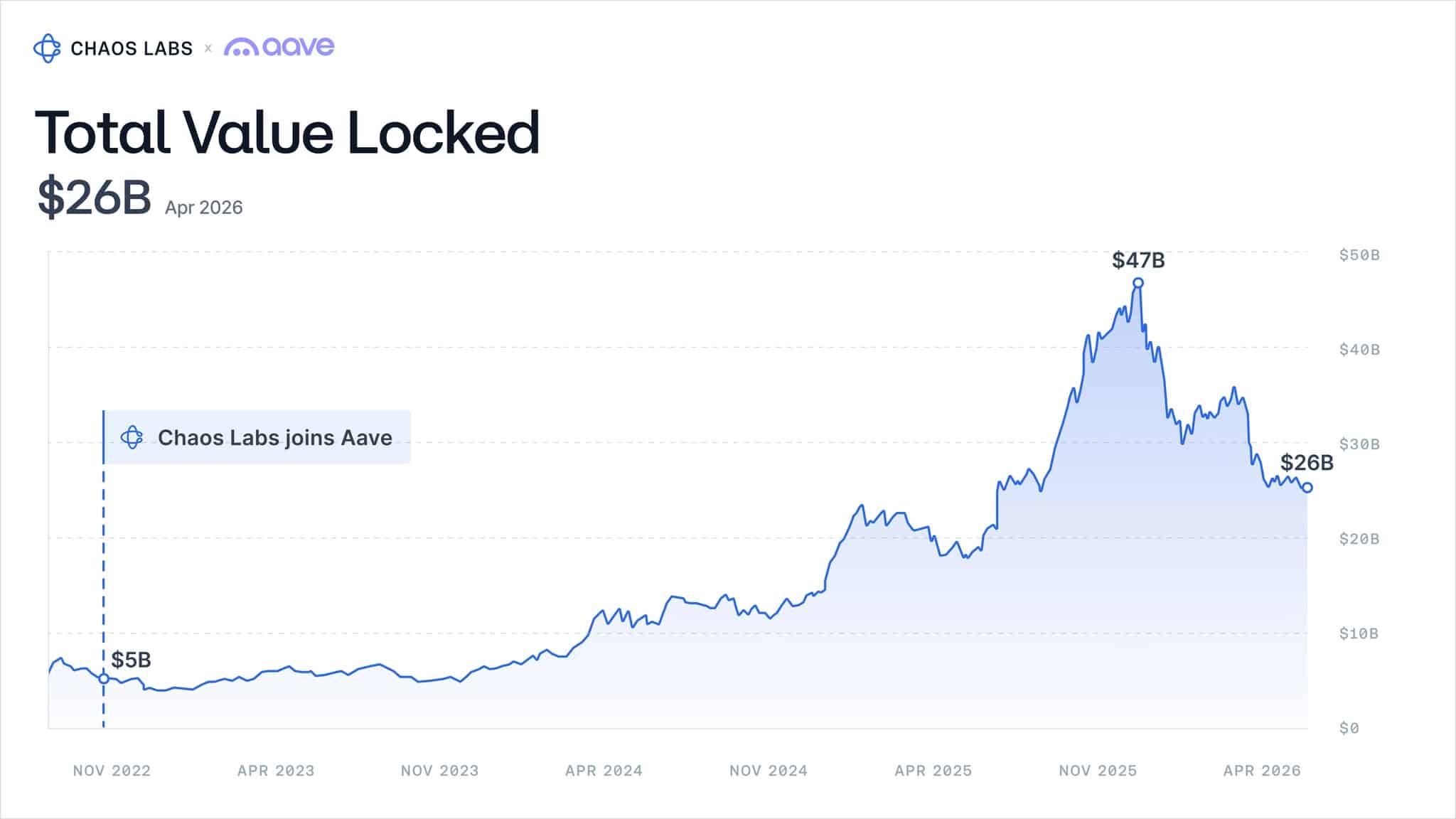
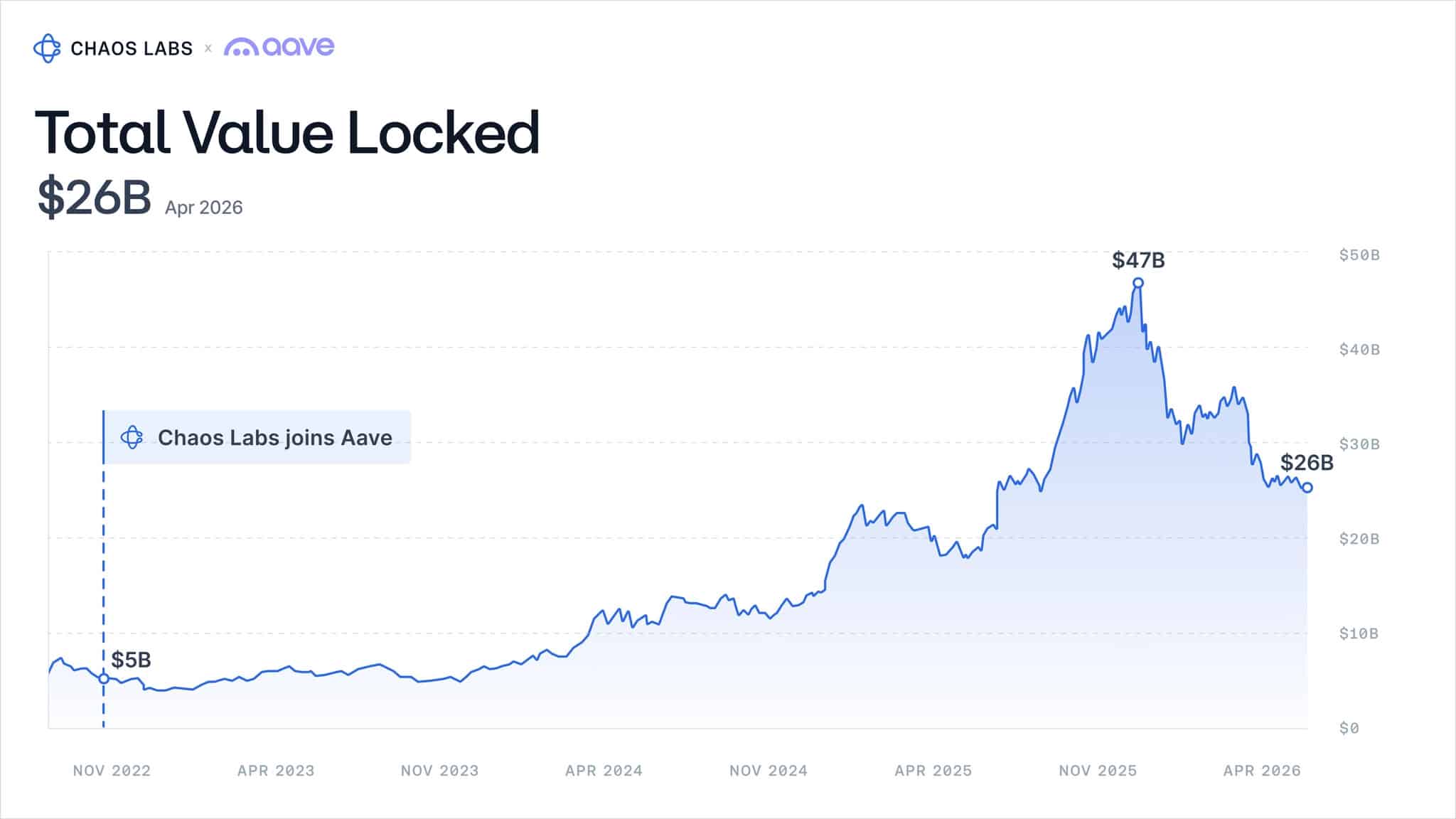
Chaos Labs’ exit signals more than a contributor change; it reflects growing strain in how Aave manages risk as it scales. For three years, Chaos Labs priced every loan while Aave’s TVL expanded from $5.2 billion to over $26 billion, processing $2.5 trillion in deposits and more than $2 billion in liquidations, according to Chaos Labs report.

Source: Governance. Aave.com

Yet, the exit was driven by deeper misalignment on how risk should be handled going forward. As core contributors left, workload and operational risk increased, while Aave V4 introduced greater complexity on an unfamiliar structure.

Stani Kulechov, founder and Aave’s CEO, applauded them in a post stating, “We also want to thank the entire Chaos Labs team for their contributions over the years, as they have helped bring the protocol we built into its current level of maturity.”

Consequently, the engagement remained loss-making despite a proposed $5 million budget. This shift suggests that as protocols grow, maintaining high-quality risk oversight becomes harder, which could affect long-term stability if demand outpaces control.

Aave’s risk continuity now faces its first real test

Aave now enters a critical transition as it absorbs the exit of a key risk contributor, shifting focus from performance to continuity.

With Chaos Labs gone, responsibility shifts to internal teams and providers like LlamaRisk, raising questions about response speed. Stani noted that “LlamaRisk already serves as a risk contributor to the Aave DAO and has deep familiarity with the protocol’s architecture and parameters. We support LlamaRisk increasing their budget to accommodate this additional workload and expanding their team as needed. “

As Aave expands toward V4, risk complexity increases, which places more pressure on coordination.

In the short term, systems remain stable; however, any slowdown in adjustments could allow risks to build gradually. This shift suggests that market confidence may now depend less on past performance and more on how effectively this transition is managed.


Final Summary

  • Aave stability relied on continuous risk updates, but Chaos Labs’ exit raises questions about maintaining the same responsiveness.
  • Aave now enters a transition where slower adjustments could increase risk, shifting focus from past performance to execution.

Related Questions

QWhat was the total value locked (TVL) and loan amount managed by Aave as Q1 2026 ended?

AAave managed about $42.34 billion in TVL and $16.55 billion in loans as Q1 2026 ended.

QWhy did Chaos Labs exit from its role in Aave's risk management?

AChaos Labs' exit was driven by deeper misalignment on how risk should be handled going forward, increased workload and operational risk as core contributors left, and the introduction of greater complexity with Aave V4 on an unfamiliar structure. The engagement also remained loss-making despite a proposed $5 million budget.

QWhat are the potential risks for Aave following Chaos Labs' departure?

AFollowing Chaos Labs' exit, potential risks include slower response speeds in risk adjustments, which could allow risks to build gradually. There is also increased pressure on coordination as Aave expands toward V4, and market confidence may now depend more on how effectively the transition is managed rather than past performance.

QWho is taking over the risk management responsibilities for Aave after Chaos Labs' exit?

AResponsibility shifts to internal teams and providers like LlamaRisk, which already serves as a risk contributor to the Aave DAO and has deep familiarity with the protocol's architecture and parameters.

QHow did Aave's TVL grow during Chaos Labs' three-year contribution?

ADuring Chaos Labs' three-year contribution, Aave's TVL expanded from $5.2 billion to over $26 billion.

Related Reads

Annual Salary of Millions Competing for Electricians, Meta Rushes to Open Its Own Technical School

The AI boom is facing an unexpected bottleneck: a severe shortage of skilled construction workers and electricians. As tech giants like Meta, OpenAI, and Alphabet race to build massive data centers—such as OpenAI's $16 billion "Stargate" project—they are hitting a critical labor wall. The U.S. needs an estimated 130,000 more electricians, 240,000 construction workers, and 150,000 supervisors by 2030 for AI infrastructure alone, but tens of thousands of electrician jobs go unfilled each year. While AI companies offer high premiums, with electricians earning up to $280,000 annually, worker scarcity still causes massive losses—delays on a single project can cost $14.2 million per month. The complexity of building AI data centers, which require immense power (equivalent to powering hundreds of thousands of homes), sophisticated electrical systems, and advanced liquid cooling solutions, demands highly skilled technicians who are in short supply. To combat this, companies are investing heavily in training. Meta has committed $115 million to a free training school offering tuition, housing, and stipends, targeting 5,000 new workers. OpenAI is partnering with unions to secure skilled labor. These efforts are paying off, with a significant rise in Gen Z interest in trade schools over college. However, the power demands are staggering. AI data centers are driving a rapid surge in electricity consumption, projected to account for up to 12% of U.S. power use by 2028 and raising costs for consumers. Furthermore, the construction boom is project-based, leading to a potential future glut of trained workers once building peaks, which could depress wages industry-wide. The race for AI supremacy now depends as much on skilled hands as on advanced chips.

marsbit1h ago

Annual Salary of Millions Competing for Electricians, Meta Rushes to Open Its Own Technical School

marsbit1h ago

OpenAI No Longer Sells Its Most Expensive Model for Profit

OpenAI is shifting its business strategy away from promoting its most expensive, flagship models for every task. Recent price cuts—80% for GPT-5.6 Luna and 20% for Terra—signal a deeper change: the company now actively advises users that many tasks don't require the most powerful model. Instead, OpenAI recommends a tiered approach: use the high-end GPT-5.6 Sol for complex planning and analysis, then delegate execution to cheaper models like Luna. This mirrors moves by Anthropic, which recently launched Claude Opus 5 at half the price of its top model, Fable 5. Both companies are de-emphasizing flagship models as primary revenue drivers, using them instead for brand prestige and technological showcases. The industry is entering a "mass-market" phase, similar to automotive, where high-volume, cost-effective models handle daily operations and drive scale. OpenAI's price reductions are partly enabled by AI models themselves optimizing underlying code and infrastructure, creating a self-reinforcing cycle of efficiency gains and cost reduction. Competition is shifting from "who is smartest" to "who offers the best value." The goal is no longer selling individual models but fostering widespread API adoption and ecosystem lock-in. By making AI calls cheap and ubiquitous, companies like OpenAI aim to become the indispensable, utility-like infrastructure powering automated workflows—the "water and electricity" of software, quietly embedded everywhere.

marsbit1h ago

OpenAI No Longer Sells Its Most Expensive Model for Profit

marsbit1h ago

Trading

Spot
活动图片