Who Will Make Money in the Age of Agents?

链捕手Published on 2026-05-27Last updated on 2026-05-27

Abstract

Who will capture value in an era where AI Agents become the primary blockchain users? Existing crypto value capture theories assume human users. "Fat Protocols" (2016) posited that protocols capture the most value as applications commoditize on open data, but this weakened as blockchain infrastructure proliferated and became interchangeable. The emerging "Fat Apps" theory argues applications capturing user relationships (like wallets and aggregators) win by controlling distribution and monetizing user flows. Agents fundamentally disrupt this logic. They don't value UX, brand, or convenience, bypassing the front-end moats of fat apps. This leads to several possible futures: 1. **"Headless" Apps**: Current app leaders (e.g., wallets) strip their front ends and become API infrastructure for Agents, preserving their value capture. 2. **Protocol Renaissance**: If integration is easy, Agents skip aggregators and interact directly with protocols, reviving the fat protocol thesis. 3. **Pricing Power Collapse**: Agents' rational, frictionless price shopping could commoditize the entire stack, compressing margins toward cost. Value flows to Agent owners or end-users. 4. **Unprecedented Activity**: Agents could enable entirely new, high-frequency economic activity (e.g., machine-to-machine commerce), expanding the total value pie. 5. **A New, Unnamed Model**: As with the internet's attention economy, a novel, unforeseen business model may emerge. Likely, human and Agent ecosyste...

Author: Jonah Burian

Compiled by: Jia Huan, ChainCatcher

Many speculate that the next billion blockchain users will be Agents. But few ask a further question: in that world, who will make money?

Every previous theory of value capture in crypto assumed the user was human. The "Fat Protocols" theory posited that protocols are best at monetizing human users.

The "Fat App" theory, which I explored with colleagues in "How to Capture Value" and "The Great Revaluation," argues that the application layer can do better. But Agents change the very nature of the user, and existing theories will be invalidated.

The Fat Protocols Theory

In 2016, @jmonegro proposed "Fat Protocols." For nearly a decade, it has been crypto's dominant theory of value capture.

The core idea: In the traditional internet, value aggregated at the application layer (@Google, @facebook), while underlying protocols (TCP/IP, HTTP) captured almost no value. The crypto world would completely reverse this. Blockchains share data publicly, so applications would gradually become commoditized.

And because using the network requires spending the protocol's token, the token would capture the resulting speculative value as usage grows. Every app's success would drive demand for the token. The underlying protocol would grow faster than any application built on it.
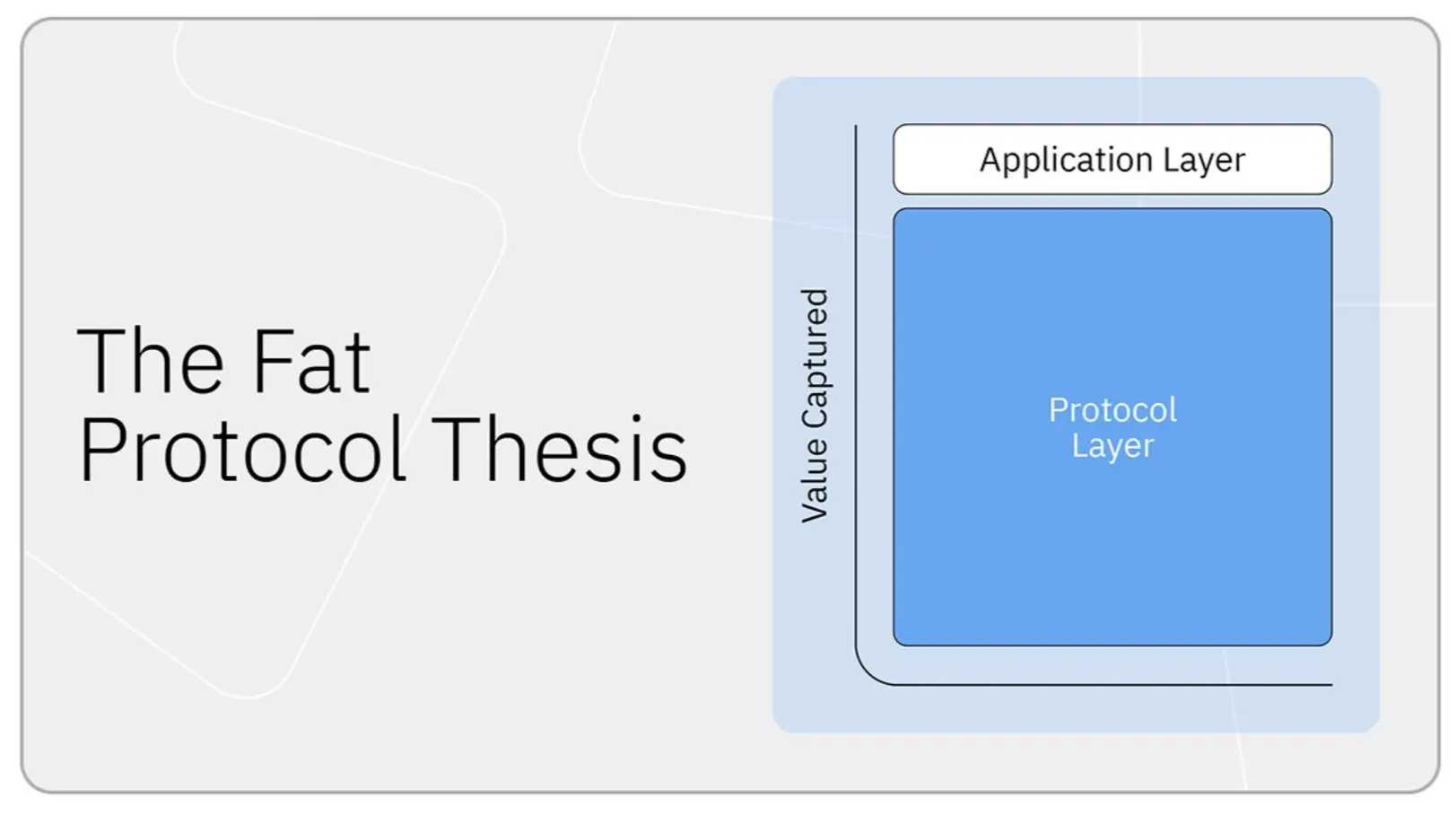
For years, this seemed correct. Bitcoin and Ethereum are worth far more than any company built on them.

This model works perfectly when the protocol itself is scarce, expensive to build, and hard to replace. In 2017, Bitcoin and Ethereum were very scarce; there weren't dozens of general-purpose L1s (Layer 1 networks) competing for the same workloads.

Block space was sufficiently constrained that owning the underlying asset felt like owning a piece of every app that needed it.

Today, reliable alternatives exist at every layer of the infrastructure stack: multiple high-throughput L1s, dozens of L2s, and modular settlement and data availability (DA) layers competing fiercely on price. Block space has shifted from constrained to abundant.

As bridges and aggregators make underlying chains nearly invisible to users, user switching costs have collapsed. Infrastructure has become interchangeable, and interchangeable commodities compete on price. The result: pricing power for protocols vanishes along with scarcity.

The Fat App Theory

By 2026, entities capturing most of the economic benefits were applications, not protocols: e.g., @phantom, @coinbase, @Polymarket, @Pumpfun.

In my view, the reason is that the most valuable asset in crypto is the user relationship.

If you control the user interface and transaction flow, you control distribution and can profit from almost any on-chain product a user touches: swaps, lending, staking, minting, and fiat on/off-ramps. This is probably also why funds are so obsessed with neobanks.
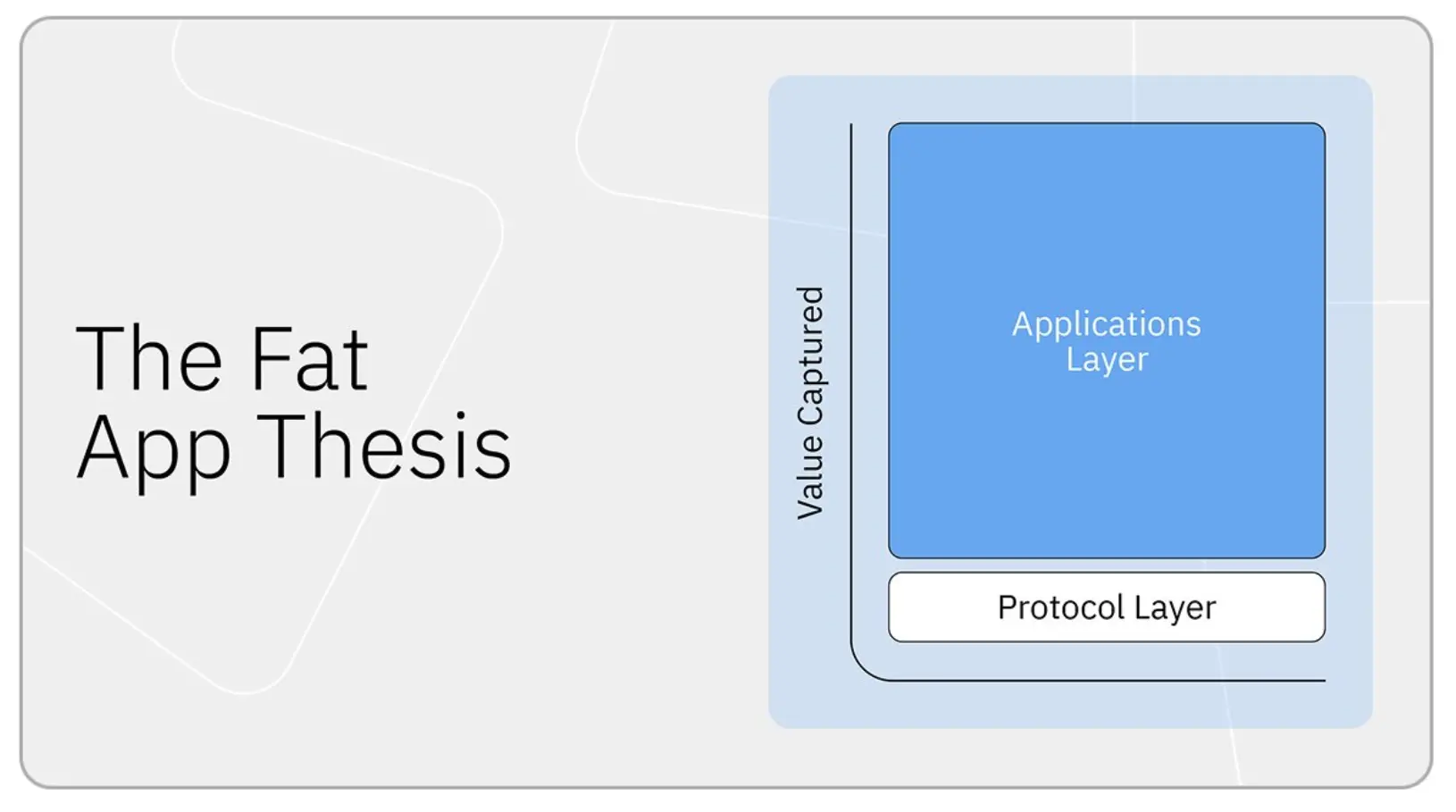
Apps also push infrastructure into a pure price war, compressing infrastructure margins to marginal cost. I documented this dynamic in "How to Capture Value." The same dynamic is playing out in stablecoins, which I've covered elsewhere.

Asset prices are reflecting this theory. Spencer and I called this shift "The Great Revaluation": in this cycle, value began aggregating at the layer that owns the user.

Why Agents Break This Logic

The Fat App theory assumes users are humans who value UX, brand, and convenience. But Agents don't care about these at all. They call APIs directly, have zero brand loyalty, and switch between platforms at zero cost.

When the user becomes software, owning the user relationship is no longer an impregnable moat. The entire Fat App theory's foundation—the frontend moat—is failing.

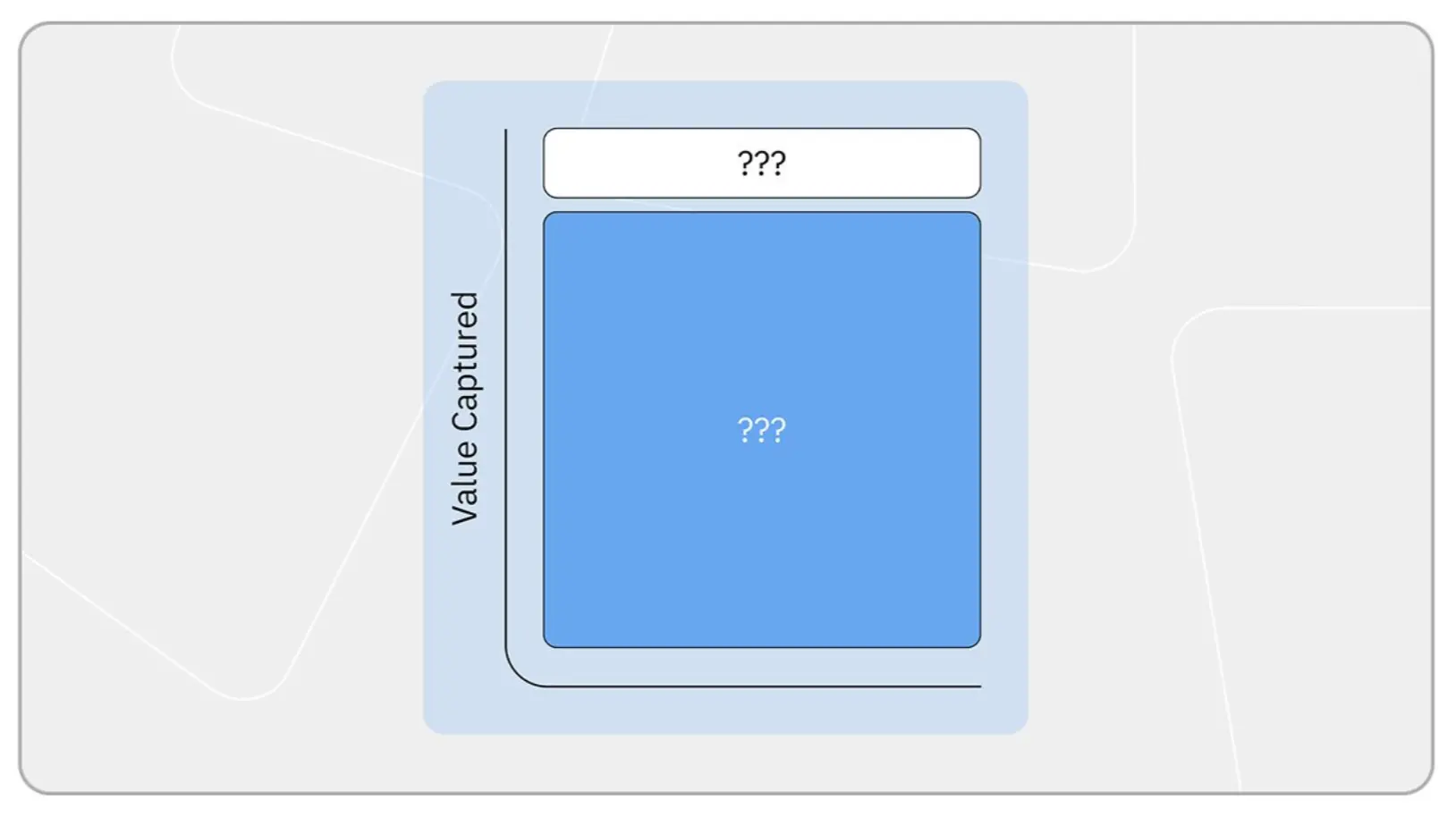
So who captures value in the age of Agents?
Apps Go 'Headless'

In one vision of the future, winners at the application layer maintain their lead by shedding their frontend interfaces (going 'headless').

Wallets and aggregators have already done the hardest work: integrations with dozens of protocols, routing logic, authentication, fiat on/off-ramp infrastructure.

The next logical step is to open this stack as an API for Agents, letting Agents route through them—just like humans route through @phantom or @JupiterExchange today.

In this world, the Fat App theory lives on. It just loses the frontend. Companies that won in the human era would transform into pure backend infrastructure for Agents. We already see legacy SaaS players like Salesforce moving in this direction.

A Protocol Renaissance

In another vision, Agents skip the middle layer entirely.

If integration becomes easy enough (well-documented APIs, standardized RPCs, predictable execution semantics), Agents have no real reason to pay an aggregator to do what they can do themselves. Aggregators' advantages in the human era were UX and dealing with routing complexity.

But Agents don't need UX, and routing is an engineering problem they're becoming increasingly good at solving.

If the world evolves this way, the Fat Protocols theory could see a renaissance.

Pricing Power Collapses Throughout the Stack

Perhaps Agents apply commoditizing pressure to every corner. They are perfectly rational, routing to the cheapest venue every time, with zero friction and zero loyalty.

Apps lose the ability to charge humans a UX premium. Aggregators and infrastructure also lose pricing power, because there is no inherent human inertia protecting them from price wars.

In this scenario, little profit is captured by anyone in the stack. Margins are forced toward marginal cost across the entire supply chain. Residual value accrues to the owners of the Agents or the ultimate users the Agents serve.

Crypto becomes a utility, and it's hard to make big money in utilities.

Agents Create Unprecedented Levels of Activity

A simple take on this: Agents do everything humans do, just faster and at greater scale. Even if margins are compressed, the overall pie grows.

I think there's a more interesting version.

Agents enable activity that was previously infeasible: e.g., continuously rebalancing portfolios for less than a penny in execution costs, machine-to-machine commerce between Agents, and entirely new markets that exist only because pricing and speed are beyond human tracking.

Current on-chain activity data doesn't show this because we assume a human is necessarily involved.

If this is the shift Agents bring, then the question changes from "How do we divide the existing pie?" to "How much new economic activity pours on-chain, and which layers are positioned to serve it?"

A Business Model That Hasn't Been Named Yet

In every cycle, we try to guess where value will flow and tend to think existing business models will extend into the future. This assumption usually makes us miss new models that haven't yet appeared.

When the internet was just being built, no one foresaw the attention economy. The idea that "slicing user attention and auctioning it to advertisers would become the dominant business model, and a single company could capture a significant share of global ad spend" was alien. It only seems inevitable in hindsight.

AI looks like one of the biggest technological disruptions in decades. In an Agent-dominated world, some value capture may flow to business models no one is even naming today. And the entities capturing it may not be those the market is currently focused on.

Key Points to Watch

The most likely outcome is not one system completely replacing another. For a long time, humans and Agents will coexist as crypto users, with vastly different maps of value capture.

As long as humans interact on-chain, the Fat App theory still applies: consumers willing to pay for UX, brand, and convenience will continue to pay premiums to apps owning those relationships. The layers involved in Agent transactions will be governed by a separate theory, regardless of which vision above materializes.

For builders, I think the question worth mulling over on the Agent side is: What actually makes an Agent come back to you instead of routing directly to the next cheapest alternative? UX might not be the answer. Liquidity, latency, settlement guarantees, etc., might be.


Related Questions

QAccording to the article, what is the core challenge posed by the rise of Agents for existing value capture theories in crypto?

AAgents break existing value capture theories because they change the nature of the 'user.' Both the 'Fat Protocol' and 'Fat App' theories assume users are humans who care about UX, brand, and convenience. Agents, being software, do not care about these things; they directly call APIs, have no brand loyalty, and switch between platforms with zero cost. This nullifies the application layer's front-end moat, which is central to the Fat App theory.

QWhat are the three possible scenarios presented in the article for value capture in an Agent-dominated future?

AThe article outlines three potential scenarios: 1) 'Headless' Apps: Existing application winners strip away their front-end and serve Agents via APIs, preserving the Fat App logic in a backend form. 2) Protocol Resurgence: Agents skip middlemen entirely and interact directly with protocols, potentially reviving the Fat Protocol theory. 3) Pricing Power Collapse: The hyper-rationality and zero-switching-cost of Agents drive commodification pressure across the entire stack, compressing margins towards cost, with value flowing to Agent owners or end-users.

QHow does the article differentiate the 'Fat Protocol' and 'Fat App' theories in terms of who captures value?

AThe 'Fat Protocol' theory, dominant for nearly a decade, posits that value aggregates at the protocol layer (like Ethereum) because applications built on open, shared data become commoditized, and protocol token usage captures speculative value. In contrast, the emerging 'Fat App' theory argues that value accrues at the application layer (like wallets and exchanges) because the most valuable asset is the user relationship—controlling the interface and transaction flow grants control over distribution and monetization.

QWhat key advantage do Agents have over human users that could fundamentally alter the crypto economic landscape?

AAgents possess hyper-rationality and zero-friction switching. Unlike humans, they are not influenced by UX, brand loyalty, or convenience. They will always route transactions to the cheapest or most efficient option instantly and without hesitation. This removes the inertia that protects applications and aggregators from pure price competition, potentially forcing the commodification of services across the technology stack.

QAccording to the author, what should builders focus on to capture value from Agent users, since UX is not the answer?

AThe author suggests builders should focus on attributes that would make an Agent choose their service repeatedly over a cheaper alternative. The answer is likely not UX. Instead, competitive advantages could be built around factors like superior liquidity, lower latency, stronger settlement guarantees, or other performance and reliability metrics that matter to automated, efficiency-seeking software.

Related Reads

A 134% Surge, 75 P/E Ratio: Why Is the Market Paying Up for Murata's 'Zero Growth'?

Murata Manufacturing, the world's largest passive components maker, saw its stock price surge 134% over the past year and hit a record high on May 28th, despite reporting nearly zero growth in operating profit for its latest fiscal year. This has pushed its valuation to a P/E ratio of approximately 75x. The disconnect is driven by a fundamental market re-rating. The catalyst was a late-May meeting where management upgraded the AI investment cycle outlook to "lasting until around 2030" and noted that demand for its components is roughly double its supply capacity, with customers prioritizing securing volume over price. While Murata's revenue grew only 5.0% and operating profit stagnated at ¥281.8 billion for the fiscal year ending March 2026, its guidance for the current fiscal year projects a 34.8% jump in operating profit to ¥380 billion. This sharp growth is underpinned by expectations that its AI/data center-related revenue will nearly double from ¥170 billion to ¥325 billion, becoming a key pillar of its business. Analysts highlight that this growth stems not from broad price hikes but from a shift towards higher-value, cutting-edge MLCCs for AI servers, where Murata holds over 70% market share. The market is now pricing Murata not as a cyclical component maker but as a critical "AI pick-and-shovel" supplier with structural pricing power. However, the high valuation also carries risk if future AI demand or quarterly guidance falls short of the elevated expectations.

marsbit9m ago

A 134% Surge, 75 P/E Ratio: Why Is the Market Paying Up for Murata's 'Zero Growth'?

marsbit9m ago

a16z: Why Do Prediction Markets Matter?

Prediction markets, which allow users to trade on the outcome of future events, have gained significant traction, especially in the U.S. At their core, these markets function like any other market by aggregating information from all participants and translating it into a price signal—in this case, the perceived probability of a specific event occurring. Unlike polls or surveys that offer static snapshots, prediction markets provide dynamic, quantifiable probability estimates that update in real-time as new information and participants enter. A key advantage is the incentive structure: participants risk their own capital, which encourages serious research and trading based on genuine knowledge. This can surface information that traditional methods might miss. Furthermore, prediction markets can be created for a vast array of specialized questions—from geopolitical events to AI model performance—that aren't covered by traditional financial markets. However, several challenges remain. Infrastructure issues include reliably determining event outcomes and resolving disputes. Market design must ensure participation from well-informed individuals while preventing manipulation, such as insider trading or attempts to sway public perception by artificially moving prices. Addressing these concerns around rules, participation, and contract design is crucial. If these hurdles are overcome, prediction markets could evolve into a powerful, widely-used tool for forecasting and navigating uncertainty.

marsbit19m ago

a16z: Why Do Prediction Markets Matter?

marsbit19m ago

Interview with 7 Ordinary Professionals: After AI Arrived, How Are You Doing?

This article interviews seven professionals from diverse fields like Web3, bulk chemical trading, digital agriculture, and traditional wholesale to examine the impact of AI on their work. Key themes emerge from the discussions. AI has become integral to their workflows, primarily for increasing efficiency in tasks such as coding, content creation, research, and data analysis. Individuals across roles, from developers to managers, report that AI tools like ChatGPT and Claude have significantly reduced workloads and accelerated learning, creating opportunities for "super individuals" or one-person teams. However, this efficiency comes with a double-edged sword. It intensifies competition, pushing professionals to constantly learn new tools and adapt, leading to widespread anxiety about job security and a heightened pressure to keep pace. Interviewees anticipate significant job reductions in roles like administrative support, finance, HR, customer service, and some creative fields. A recurring view is that AI acts as a "great equalizer," amplifying the capabilities of those who use it effectively while leaving others behind, potentially deepening polarization. Despite AI's capabilities, interviewees identify enduring human strengths. AI struggles with tasks requiring deep contextual understanding, complex judgment in areas like risk assessment and system stability (especially in finance/Web3), nuanced human communication, and handling exceptions in logistics and manufacturing. These areas remain firmly in the human domain. Consequently, many professionals are refocusing their career strategies. They plan to evolve from task executors into "complex system owners," "super coordinators" managing AI agents, or specialists in high-level areas like business context, risk control, product design, and personal branding. In summary, the article portrays AI not as an optional tool but as a transformative force reshaping job demands. While it automates routine work, it also creates new forms of pressure and competition. The future, as seen by these professionals, belongs to those who can strategically integrate AI to augment uniquely human skills like judgment, responsibility, and strategic oversight.

marsbit34m ago

Interview with 7 Ordinary Professionals: After AI Arrived, How Are You Doing?

marsbit34m ago

Satoshi Nakamoto Sued? $83.7 Billion Worth of BTC Up for 'Legal Claim'

An anonymous individual known as Noah Doe, along with two Wyoming LLCs, has filed a lawsuit in the New York Supreme Court. They are attempting to use New York's "lost and found" laws to claim legal ownership of approximately 837 billion USD worth of Bitcoin held in 39,069 dormant addresses. Crucially, this list includes addresses believed to belong to Bitcoin's creator, Satoshi Nakamoto (holding around 837 billion USD), alongside other long-inactive addresses from Mt. Gox and early Bitcoin holders. The plaintiff's legal strategy hinges on classifying these public Bitcoin addresses as "lost property." They submitted a USB drive containing only the public addresses to the New York Police Department, sent OP_RETURN notifications on the Bitcoin blockchain, and issued press releases. Their argument is that after these efforts and a waiting period, they should be granted ownership. A key, and highly controversial, claim is an unnamed "independent expert" valuing each address at under 10 USD, allowing for a faster legal process. Analysts from Galaxy point out major flaws in the case. The plaintiff never physically possessed the Bitcoin or private keys. The "under 10 USD" valuation is considered unrealistic, and allowing anonymous companies to claim such vast assets is highly unusual. Even if the plaintiff wins, they would only receive a court declaration of ownership, not the actual private keys to move the Bitcoin. The real danger lies in this court document acting as a "cloud on title." If any of these Bitcoins are later transferred to a regulated exchange or custodian, the plaintiff could present the judgment to freeze the assets, forcing the true owner into lengthy and de-anonymizing litigation to prove ownership. The outcome is uncertain, but the case highlights potential legal risks for dormant cryptocurrency holdings.

marsbit39m ago

Satoshi Nakamoto Sued? $83.7 Billion Worth of BTC Up for 'Legal Claim'

marsbit39m ago

Trading

Spot
Futures
活动图片




