Who is Placing Counterintuitive Bets in Prediction Markets?

Odaily星球日报Published on 2026-01-08Last updated on 2026-01-08

Abstract

Who Bets Against Common Sense in Prediction Markets? This article explores the counterintuitive players who provide liquidity by betting "Yes" on seemingly improbable events on prediction markets like Polymarket. Contrary to appearing irrational, these participants are often driven by calculated strategies. Three key groups are identified: 1. **The Lottery Players:** These individuals focus on high odds, betting small amounts for a potentially large payoff. They capitalize on the small but non-zero chance of a black swan event or a market settlement error, making such high-risk, high-reward bets a rational part of a diversified strategy. 2. **Bots:** Automated trading algorithms are significant liquidity providers. They quickly engage in new markets, scooping up ultra-cheap "Yes" shares and then placing slightly higher sell orders to profit from subsequent buyers (like lottery players or other bots). Some bots also trade to generate volume, potentially aiming to qualify for future airdrops. 3. **The Prediction Platforms:** Polymarket itself incentivizes liquidity through programs like maker incentives and holding rewards (e.g., a 4% APY for holding shares in specific markets). These financial incentives make providing liquidity on unlikely outcomes attractive, as rewards can offset potential losses or enhance gains, contributing significantly to market depth and volume. The analysis concludes that those betting against the consensus are not merely "stupid" but are often...

Original | Odaily Planet Daily (@OdailyChina)

Author | Golem (@web3_golem)

This week, I wrote an article reviewing the absurd event contracts on Polymarket, pointing out that betting on some seemingly outrageous contracts at this time would be profitable.

This made me wonder: who is going against "common sense" to provide "free money" for the market?

Bets that oppose our smart choices aren't completely without a chance of happening; there are certainly some people who firmly believe in their judgments (for example, some still believe the Earth is flat). But prediction markets aren't a "greater fool market." I believe that when players use real money to predict whether an event will occur, they will do their best to think as a "rational person," meaning their decisions are the most economical and profitable. Therefore, from this perspective, those users betting "Yes" on seemingly impossible event contracts must also have some kind of profit strategy; they aren't fools providing us with "high-certainty" financial opportunities for free.

After thinking and discussing, I believe that those providing counterparty liquidity in these absurd event markets likely fall into the following three categories (this article is meant to spark discussion, welcome feedback and corrections, X@web3_golem):

Lottery Players

The logic of lottery players is simple: they focus only on the odds, aiming for a small stake to win big.

Sometimes, real life is far more surreal than we imagine; even events that seem outrageous can happen. Moreover, although prediction markets settle based on the real world, settlement results can sometimes be distorted due to settlement conditions, system failures, and other factors. Polymarket has had instances where settlement results did not match reality due to issues with UMA's dispute resolution mechanism. A recent example is Polymarket ruling that the US military action in Venezuela did not constitute an "invasion."

Therefore, long-tail odds偏差 (bias) appear. Even for events with a very small probability of occurring, the Yes side still has a price of 1%-3%. As long as the odds are high enough, "lottery players" will buy, becoming one of the firm bottom buy supports.

But actually, this psychology of "lottery players" is also rational. For example, in the event contract "Will Putin step down before the end of 2026?", driven by common sense, most people will buy "No," and the probability already shows people's attitude. But the Yes side still has a 10% probability, meaning if you bet $10, you could get $100 back if Putin really steps down before the end of 2026—a 10x return. So, why not gamble?
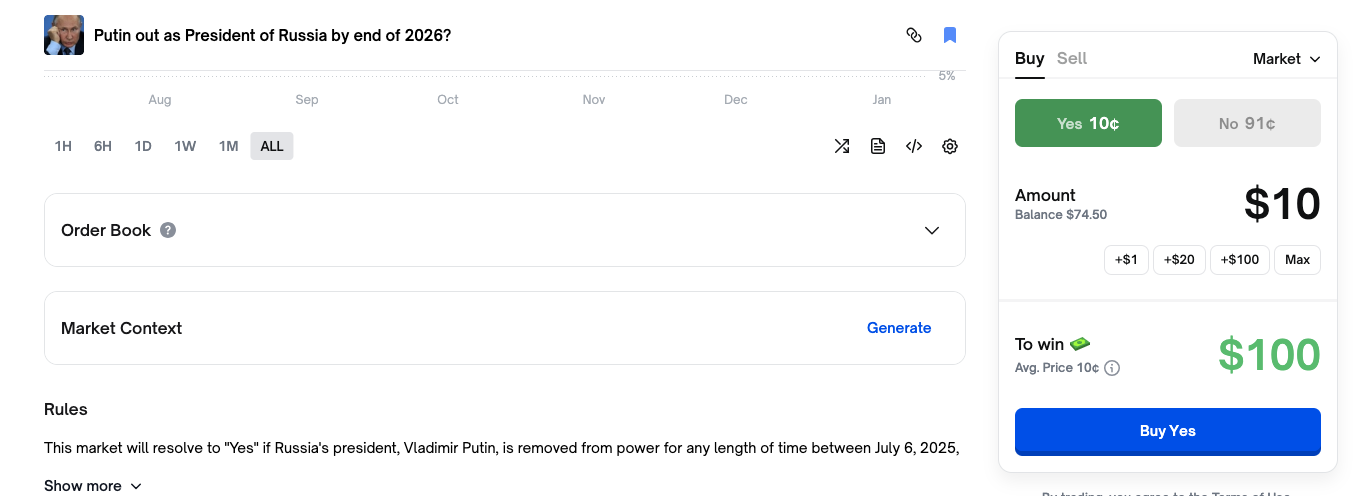
Furthermore, lottery players don't necessarily place heavy bets on a single market. Since prediction markets are不缺 (not short of) such high-odds events, by casting a wide net and hitting the jackpot a few times, there's still a chance to recoup costs and even profit.

They anticipate black swan events more than normal people. Therefore, they are happy to provide buy-side liquidity on the Yes side of "counterintuitive" markets (In some markets, Polymarket provides placing rewards and holding rewards, but this is not the main factor driving lottery players).

Bots

If an event contract itself has strong certainty, the intervention of players sweeping the尾盘 (end-of-market) will push the probability on one side to 99%-100% before settlement. The existence of "lottery players" can partially explain why these "counterintuitive" markets still have players taking the Yes sell orders (Odaily Note: Because Polymarket uses a shared order book, meaning when the No side has a buy order for 1 share at $0.99, the Yes side will correspondingly have a sell order for 1 share at $0.01), but they are always a minority group and cannot explain why these markets still have large trading volumes and good depth.

So, who else is injecting large amounts of liquidity into these markets? The answer is bots.

Market-making bots on Polymarket have developed very rapidly. Bots that trade automatically through the Polymarket API actively monitor all newly created markets and are often among the first participants. These bots can profit by actively trading in these markets.

In these "counterintuitive" markets, when the No side price is $0.99, due to the shared order book, the Yes side will have sell orders listed at $0.01. Market-making bots, like "lottery players," will also eat these $0.01 sell orders. But immediately after, they will list sell orders on the Yes side at $0.02, $0.03, or even higher, waiting for "lottery players" or other bots to成交 (execute the trade). The No side will also see buy orders at $0.98, $0.97, or even lower (Odaily Note: again due to the shared order book). Thus, the order book gains significant depth.

However, after communicating with the crypto VC Jsquare team (they invested in prediction market aggregator Rocket), they believe there aren't many bots executing this strategy on the market. In these "counterintuitive" markets, the speculative psychology of "lottery players" or regular players is enough to support most of the opposing orders.

The existence of some wash trading bots also provides market liquidity and trading volume for these "counterintuitive" and somewhat niche markets (compared to events like the US election). A wash trading bot places a buy order on the Yes side at $0.02, and another wash trading bot places a buy order on the No side at $0.98 to execute the trade.

This behavior is mainly to qualify for future prediction market airdrops. In high-frequency markets, orders might be matched by other players, so these "counterintuitive" event contracts are the ideal tools for wash trading.

Prediction Platforms

In addition to the above "lottery players" and bots, the prediction platforms themselves also contribute greatly to the liquidity of these markets.

Polymarket's mechanism includes two liquidity incentives: placing rewards and holding rewards. Placing rewards mean that in some specific markets, players can get rewards simply by placing orders within the maximum stipulated spread. Holding rewards mean that in some specific markets, players holding shares, whether Yes or No, can receive a 4% annualized holding reward.
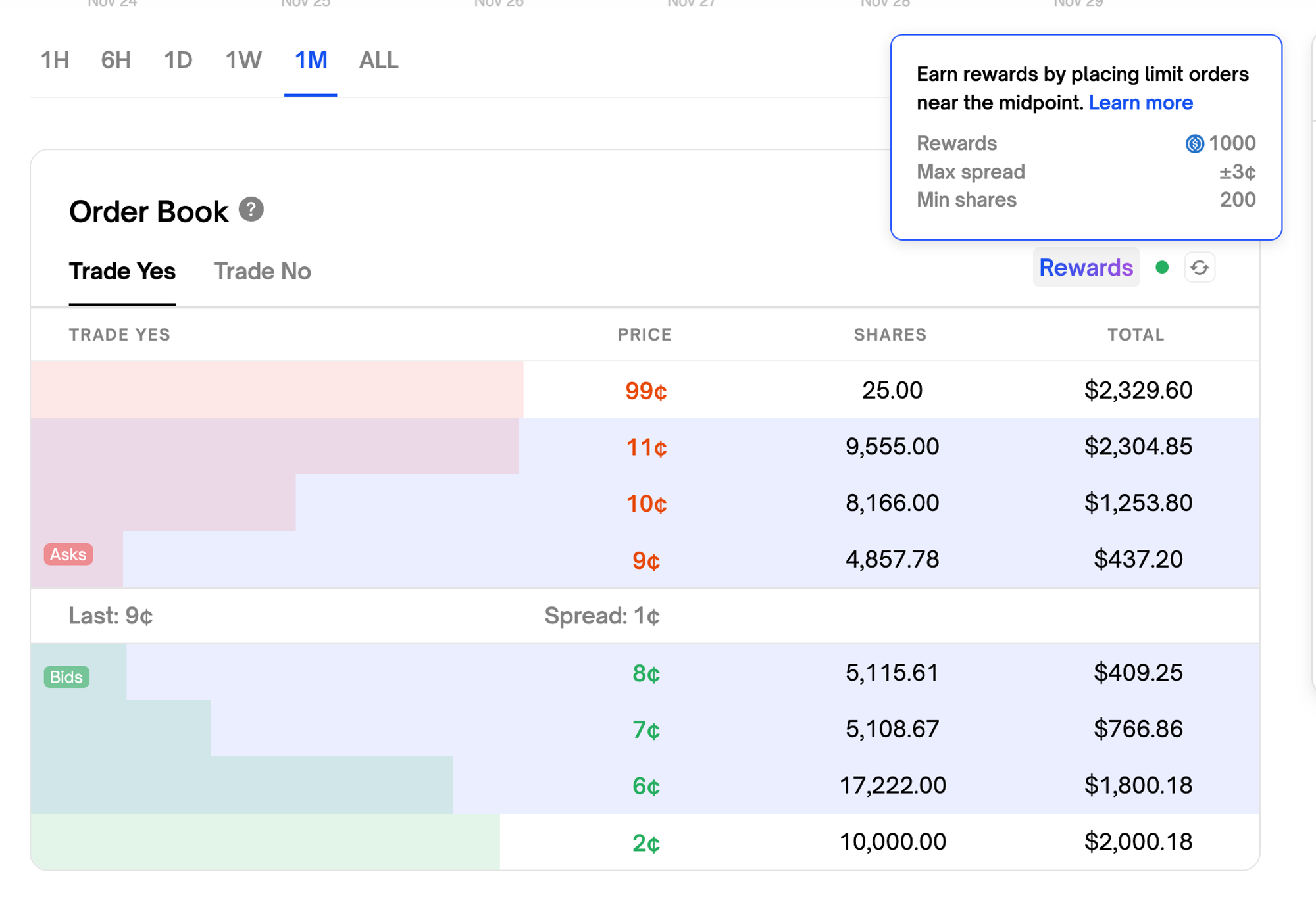
The highlighted part indicates the maximum spread range for placing rewards

According to statistics, Polymarket has invested about $10 million in market maker incentives, paying over $50,000 daily at its peak to maintain order book liquidity. These incentives have now decreased to just $0.025 per $100 traded.

These investments have indeed been effective, driving trading in many "counterintuitive" markets. For example, the event contract "Will Putin step down before the end of 2026?" has already seen over $1.3 million in trading volume. Holding shares in this contract yields a 4% annualized return. For players holding Yes shares, this equates to an ultimate annualized return of 14% (10% tail-end收益 (profit) + 4% platform reward), which is hugely attractive. For players holding No shares, the placing rewards and holding rewards also hedge some of the risk.
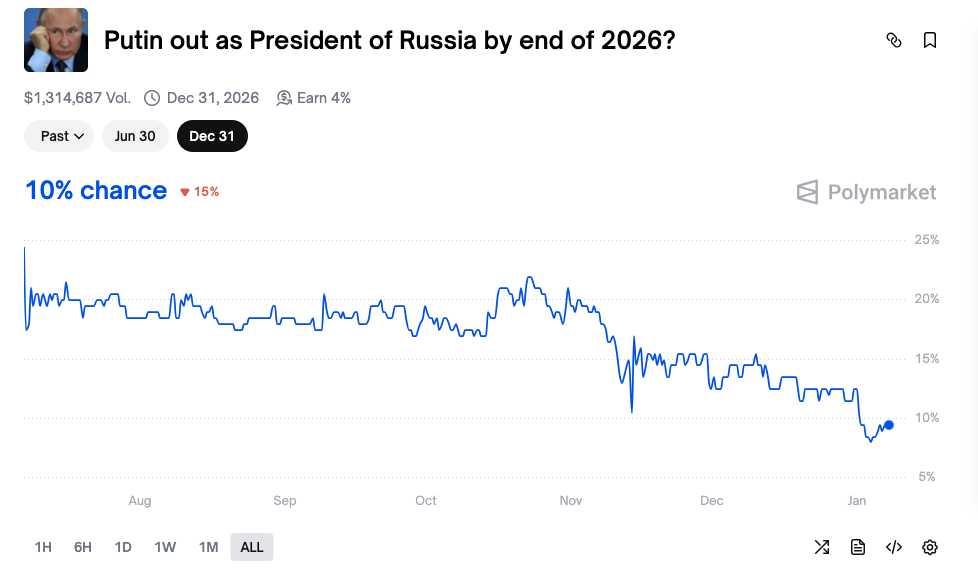
There is also speculation that, in addition to openly providing liquidity incentives, prediction markets themselves act as market makers, providing liquidity for these "counterintuitive" and niche markets to achieve advertising and marketing effects. But this is pure speculation, open for discussion.


Related Questions

QWho are the three types of participants providing liquidity in seemingly absurd prediction market contracts on Polymarket?

AThe three types are lottery players (who bet on high odds for small probabilities), trading bots (which automate trading for profits or airdrop farming), and the prediction platform itself (through incentives like order rewards and holding rewards).

QWhat is the primary motivation for 'lottery players' to bet on the 'Yes' side of low-probability events?

AThey are motivated by the high potential returns from low-probability events, akin to buying a lottery ticket, where a small bet could yield significant profits if the unlikely event occurs.

QHow do trading bots contribute to liquidity in 'anti-common sense' markets on Polymarket?

ATrading bots use APIs to automate trading, capturing low-priced orders and providing liquidity by placing higher sell orders or engaging in volume farming to qualify for potential airdrops.

QWhat role does Polymarket play in incentivizing liquidity for these markets?

APolymarket offers order rewards and holding rewards, such as annualized yields for holding shares, to encourage participation and liquidity provision in these markets.

QWhy might some participants believe that betting on unlikely events is rational despite low probabilities?

AThey view it as a calculated risk where the potential high returns, combined with platform incentives, justify the bet, especially if they diversify across multiple high-odds events.

Related Reads

Soaring Export Data for Memory Chips, Market Is Redefining the Valuation Anchor for Memory Stocks

Korean storage export data for the first 20 days of June shows substantial year-on-year increases in both value and price-per-kilogram for categories like DRAM, NAND, and SSDs. This signals a potential shift beyond simple demand recovery, indicating rising prices and a product mix shift towards higher-value items, possibly influenced by AI infrastructure needs. A key point is that the surge in price-per-kilogram is not simply a uniform chip price hike. It reflects a combination of actual price increases and, more importantly, an export structure increasingly dominated by high-value-density products like HBM (High-Bandwidth Memory) and advanced DRAM, which are critical for AI servers. This suggests AI-driven demand may be spilling over from just HBM into broader memory markets. SK Hynix stands to benefit directly due to its leading HBM position. For Samsung and Micron, the implication is potential for greater margin elasticity if the tightness in high-end memory spreads to enterprise SSD and NAND prices. However, the storage sector remains cyclical. Risks include supply expansion, inventory changes, and potential slowdowns in broader AI capital expenditure. Ultimately, while the strong export data supports upward revisions for storage company earnings and fuels discussion of an "AI infrastructure bottleneck premium," a definitive valuation shift from a cyclical to a structural story depends on upcoming quarterly reports. Investors need confirmation from SK Hynix, Samsung, and Micron that improvements in average selling prices, product mix, and, crucially,毛利率 are sustained over multiple quarters.

marsbit20m ago

Soaring Export Data for Memory Chips, Market Is Redefining the Valuation Anchor for Memory Stocks

marsbit20m ago

Why Does SpaceX Have Such a High Valuation Ceiling? The Answer Lies in Musk's Business Blueprint

SpaceX achieved a record-breaking IPO on June 12, 2026, with its market cap surging past $2.1 trillion. This valuation reflects its central role within Elon Musk's expansive, interconnected technological ecosystem. The article details how four core components form a synergistic closed-loop system: 1) **The "Brain" (xAI & Orbital Compute):** xAI provides AI models and massive ground/space-based supercomputing for simulation and decision-making across the system. 2) **The "Neural Logistics Core" (Starlink & Starship):** Starlink's low-latency satellite network enables global data transmission, while Starship's low-cost, reusable launch capacity aims to make large-scale space deployment economically viable. 3) **The "Physical Body" (Tesla & Optimus):** Tesla's manufacturing prowess and energy products support hardware production and power, pivoting toward mass-producing the Optimus humanoid robot for terrestrial and potential space-based labor. 4) **The "Human Interface" (Neuralink & X):** Neuralink seeks direct brain-computer communication, and the X platform provides real-time societal data. Together, these elements create three reinforcing "flywheels": manufacturing/logistics, data-driven iteration, and energy/compute/network synergy. This integrated approach promises lower costs, faster innovation cycles, and potential infrastructure-as-a-service offerings. However, it also concentrates technical, regulatory, and corporate governance risks. Ultimately, SpaceX's high valuation stems from its position as the indispensable infrastructural backbone—handling space transport, global communications, and future orbital computing—tying together Musk's entire vision for a self-reinforcing technological empire.

marsbit25m ago

Why Does SpaceX Have Such a High Valuation Ceiling? The Answer Lies in Musk's Business Blueprint

marsbit25m ago

Snap, Unprofitable for Nine Years, and a Decade-Long AR Obsession Without Return

Snap's AR Obsession: A Decade of Betting Against the Odds On June 16, Snap CEO Evan Spiegel unveiled the new AR glasses, Specs, priced at $2,195, causing the company's stock (SNAP) to plummet nearly 10%. The launch was met with intense criticism online, with investors questioning why a consistently unprofitable company would stake its future on an expensive product its core young user base can't afford. Snapchat, known for pioneering features like ephemeral Stories and popular AR lenses (like the iconic dog filter), has a history of innovation often copied by rivals like Instagram and Meta. Despite this, it has struggled to translate first-mover advantage into commercial success. Since its 2017 IPO, Snap has reported annual net losses, with a Q1 2026 loss of $89 million. Its stock is down 94% from its 2021 peak, hampered by iOS privacy changes, competition, and a young demographic less attractive to major advertisers. In this challenging context, Spiegel is doubling down on AR. He calls 2026 a "crucible moment," having recently laid off 16% of staff while reportedly investing over $3.5 billion cumulatively in its AR glasses line over nearly a decade. The new Specs represent a significant leap from the 2016 camera-focused Spectacles, offering true AR overlays, gesture control, and standalone operation. However, at $2,195, it faces tough comparisons. While more advanced than Meta's $799 Ray-Ban smart glasses, critics point to its heavier weight, short battery life, and features largely replicable by a smartphone. Facing pressure from investors to cut losses on the Specs project, Spiegel has refused, framing it as essential to Snap's long-term vision. The company finds itself in a paradoxical position: cutting costs while heavily funding a decade-long, unproven bet. Some see Specs as an awkward but necessary step in AR's evolution, akin to early mobile phones. Whether Spiegel is a visionary outlier or a gambler destined to fail remains an open question, highlighting the tension between long-term ambition and short-term market demands.

marsbit47m ago

Snap, Unprofitable for Nine Years, and a Decade-Long AR Obsession Without Return

marsbit47m ago

Annualized Revenue Exceeds $20 Billion, Kalshi Aims to Become the First Prediction Platform IPO?

Kalshi, a leading U.S. prediction markets platform, is reportedly in early, informal discussions for an Initial Public Offering (IPO). The company's annualized revenue now exceeds $2 billion, fueled by its dominance of over 90% of the domestic prediction market activity. This growth stems from a surge in trading volume—reaching a total of $52.7 billion—and an increase in fee rates, largely driven by sports event contracts like the NBA playoffs and the 2026 FIFA World Cup. Monthly active users are approximately 2 million. Kalshi recently raised $1 billion in a funding round led by Coatue Management, valuing the company at $22 billion. It has also expanded its offerings to include Bitcoin perpetual contracts and plans to launch a dedicated trading platform, Kalshi Pro. However, Kalshi's path to an IPO faces significant regulatory hurdles. The core risk involves jurisdictional conflicts, as multiple U.S. states are challenging its operations under local gambling laws. For instance, Arizona has filed criminal charges against the platform, while states like Kentucky have filed lawsuits. Kalshi and the Commodity Futures Trading Commission (CFTC) argue that its event contracts fall under exclusive federal jurisdiction as "swaps." The outcomes of these ongoing legal battles could critically impact Kalshi's core revenue and its IPO timeline. Analysts suggest that while an IPO could theoretically occur by late 2026, a more likely timeframe is late 2027 or 2028, contingent on resolving legal issues and favorable market conditions. If successful, its fundraising could significantly exceed $1 billion, given its current valuation and revenue multiple.

Foresight News1h ago

Annualized Revenue Exceeds $20 Billion, Kalshi Aims to Become the First Prediction Platform IPO?

Foresight News1h ago

Trading

Spot
Futures
活动图片