White Whale: A 'Doomed' Meme Coin's 500x Comeback in 30 Days?

marsbitPublished on 2025-12-29Last updated on 2025-12-29

Abstract

White Whale, a meme coin initially destined to fail, staged a dramatic 500x rally in under 30 days, surging from under $100k to a $57 million market cap. Launched on Pump.fun on October 13, 2025, as an unauthorized fan-made token using the image of crypto influencer @TheWhiteWhaleV2, it was conceived as “The People’s Whale”—a satire against market manipulation. Like most meme coins, it quickly faded into obscurity. The turning point came on December 7, 2025, when @TheWhiteWhaleV2 unexpectedly took over the project to protect his reputation. He committed to full transparency: all creator earnings would be returned to the community, and his personal token purchase was locked until 2063. He further invested $13k of his own funds to support liquidity and reward contributors. On-chain analysis revealed early signals of the revival: a sharp drop in top 100 supply on December 2, followed by “smart money” inflows from December 4. After the takeover, the top 100 holders (excluding CEX/DEX wallets) increased their holdings by over 80%. White Whale’s resurgence is a rare narrative of redemption and responsible management in the high-risk Solana meme coin ecosystem, transforming a near-dead joke into an anti-rug success story.

Author | DingDang (@XiaMiPP)

This is the story of a Meme coin that "should have died according to logic" but unexpectedly revived from rock bottom after being nearly forgotten by the market.

White Whale, in less than a month, surged nearly 500 times from a market cap of less than $100,000, with its current market cap temporarily reported at $57 million. The community is now calling for the next target: $100 million.

The Familiar Meme Coin Playbook: From Start to End

White Whale was launched via Pump.fun on October 13, 2025. It was originally created by a fan "borrowing" the avatar and image of crypto KOL @TheWhiteWhaleV2 as a joke. @TheWhiteWhaleV2 is a crypto OG on X with 828,000 followers. His avatar is a whale clad in armor with a stern and cold expression, embodying a serious and restrained style. He often shares trading philosophies and market insights. Perhaps because of this, fans see him as a positive "whale" symbol.
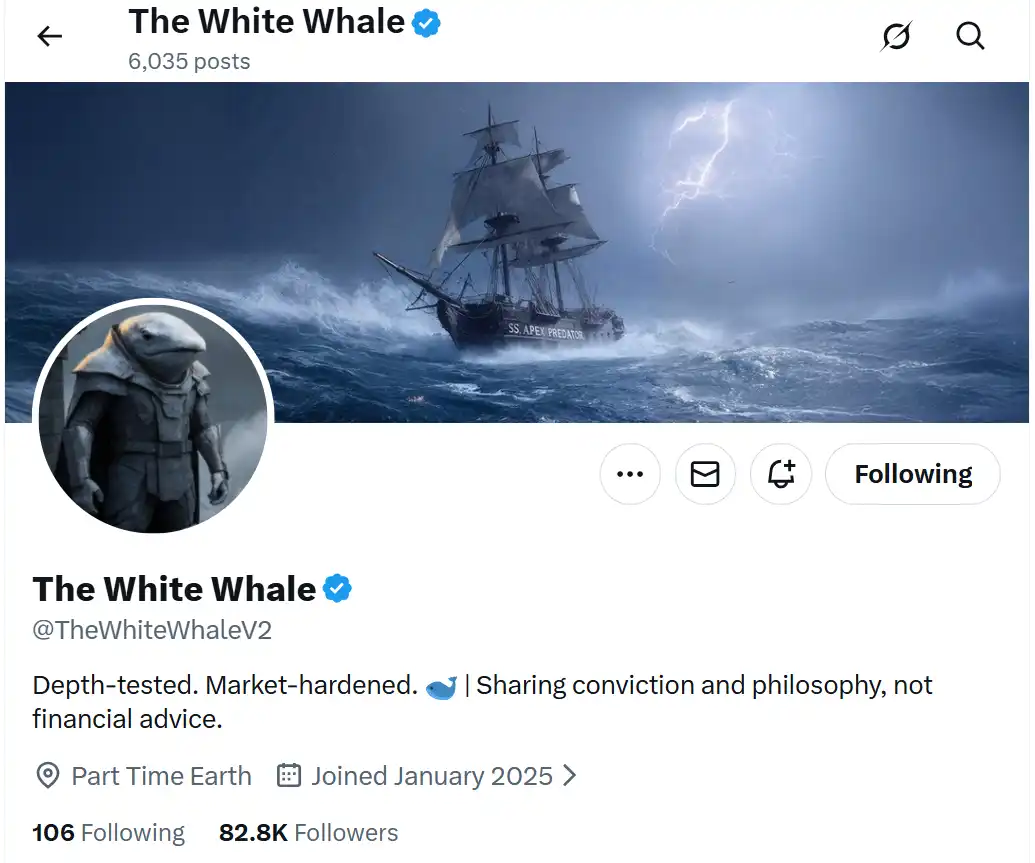
The initial narrative of the project was "The People's Whale," intended to satirize and resist manipulation by big whales or institutions in the crypto market, positioning itself as a tool for community counterattacks. But this was purely a fan's mischievous creation, without authorization or permission from @TheWhiteWhaleV2 himself. He even later tweeted that he thought "this thing will die within 48 hours." Similar incidents of "borrowing his avatar to issue a coin" had happened to him before.

This is precisely why it was originally "supposed" to be a dead Meme coin. On Pump.fun, thousands of Meme coins are born every day, and 99.9% of them die quickly; this coin was no exception. Shortly after its launch, its market cap briefly surged to around $100,000 after the bonding curve, then quickly cooled off. From mid-October to early December, the price mostly moved sideways, with trading volume near zero, almost forgotten. It was an ending the market had seen countless times.

A Dramatic Turnaround: The Whale's "Redemption" and Community Takeover

The turning point came on December 7, 2025.

@TheWhiteWhaleV2 himself suddenly posted an announcement: He was officially taking over the Treasury and control of this Meme coin. The reason was simple: fans had used his image and reputation without permission. He initially ignored it, but seeing that the coin had gained some (albeit small) traction, he was worried that if a Rug Pull happened in the future, it would damage his reputation. So he decided to "step in personally" to protect his brand.

He emphasized that this was not a coin he created and that he had even initially advised people not to buy it. But to take control of his own image and portrait rights, he had no choice but to take over.

Of course, that wasn't important.
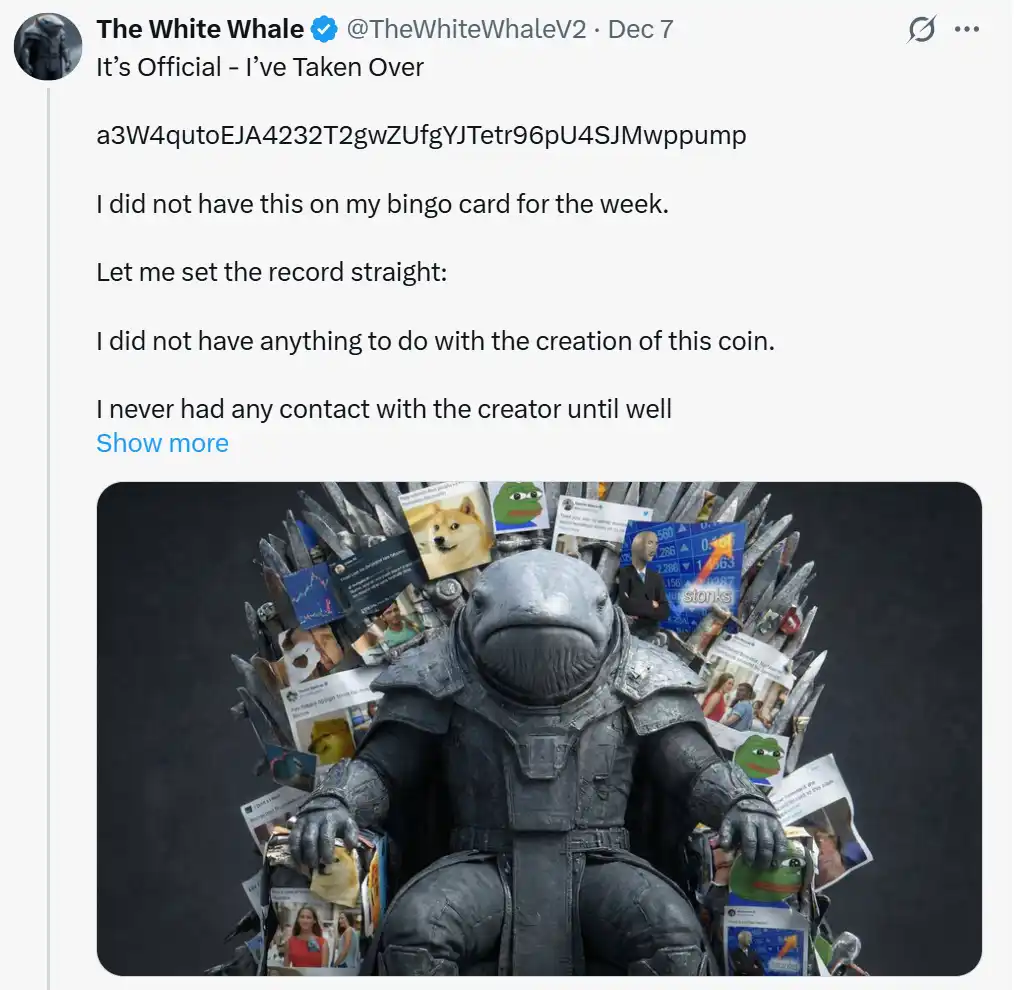
What was important was his promise: 100% of the creator revenue would be returned to the community, and he had also bought some tokens as a memento, with his own purchased portion never to be sold.

And he proved his sincerity with actions. On the day he announced the takeover, he spent $10,000 to buy 5.3 million tokens and locked them via the Streamflow protocol, with an unlock date set for 2063.
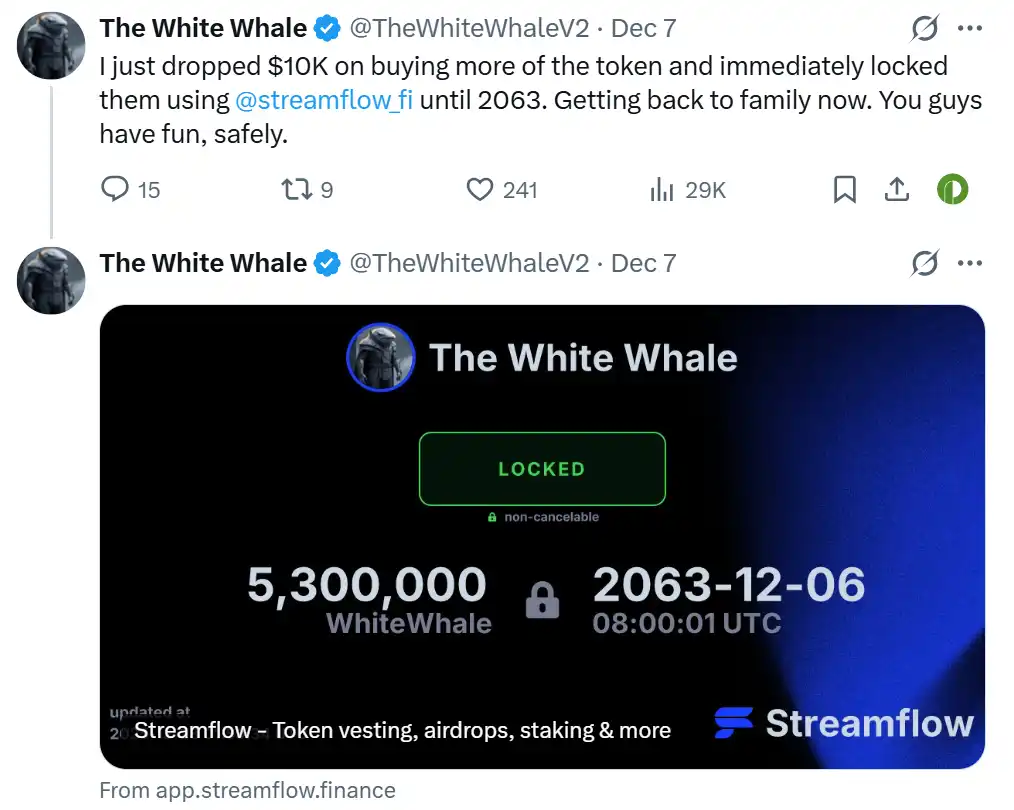
After that, he disclosed that he had already spent $130,000 to support the community, creating a pool on Wasabi and adjusting the LP bandwidth to reduce volatility for holders, and using personal funds to incentivize community contributors.

It was these series of operations that gradually allowed what was originally a "fan prank" to be reinterpreted by the community as a narrative sample about "good management."

What Story Does the On-Chain Data Tell?

After White Whale surged 100x, on-chain analyst @cryptorinweb3 revisited the token's indicator signals. According to the investigation, on December 2, @nansen_ai data showed that the token supply held by the top 100 holders suddenly dropped from 870 million to 140 million tokens. After checking the exchange labels, he found that this drop was mainly due to a large amount of funds flowing back to the main liquidity pool (LP). He reminded that when you see such a change in the top 100 holdings, it is always a signal worth investigating further.

紧接着, on December 4, the "smart money inflow" indicator he set up in Discord was triggered, accompanied by an increase in trading volume.

On December 7, @TheWhiteWhaleV2 himself announced the official takeover. And starting from December 8, after excluding CEX/DEX wallets, the real top 100 holders increased their holdings by over 80%, while exchange supply remained stable.

Let's revisit White Whale's token performance: from the "smart money anomaly" on December 4 to the official takeover on December 7, White Whale's increase was only about 6x, and it subsequently experienced a pullback; the real explosion, however, occurred in late December.

This was certainly driven by sentiment and capital, but on the other hand, the responsible attitude and transparent on-chain operations demonstrated by @TheWhiteWhaleV2 himself formed the foundation of the project.
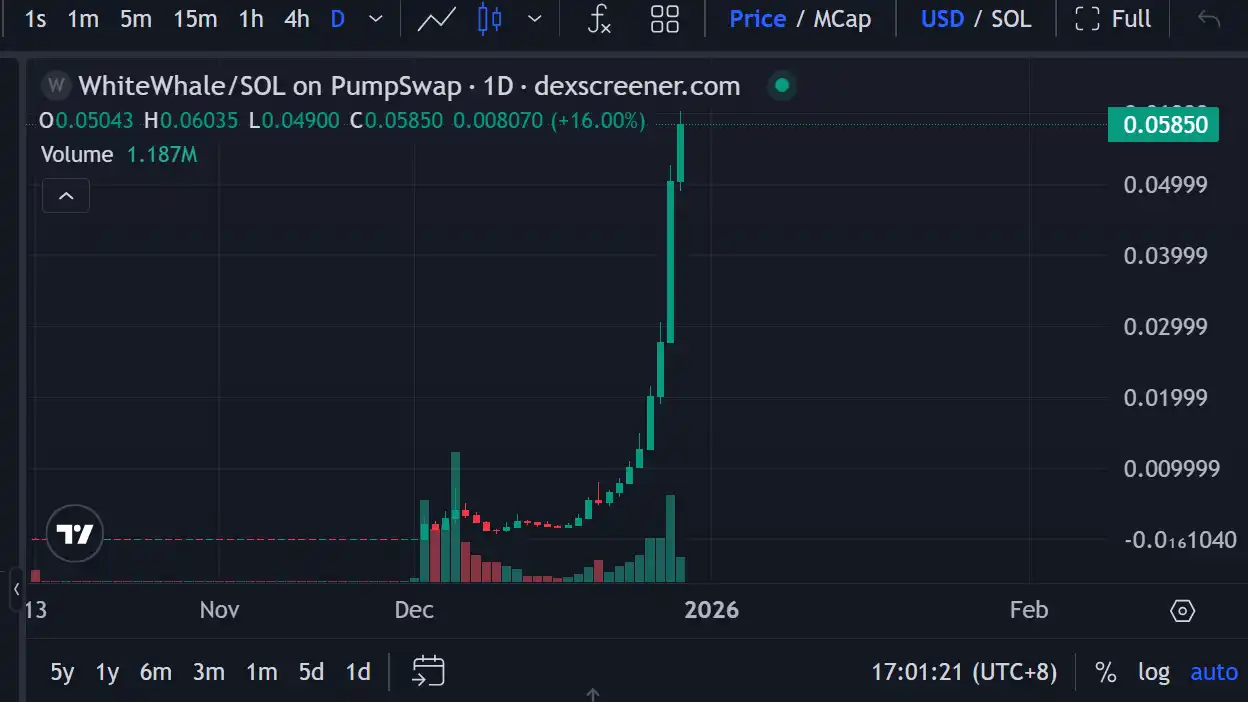
White Whale is essentially a microcosm of the Solana Meme coin ecosystem: random, chaotic, high-risk. But the reason it survived and became popular was due to an unexpected positive turn: a dying joke coin was taken over by the original figure himself in a "responsible, well-managed" manner, rebuilding trust and creating the most inspirational "anti-Rug" case at the end of 2025. Although we don't know how far it can go, in a market notorious for short-term games, this in itself is rare enough.


Related Questions

QWhat is the initial narrative and purpose of the White Whale meme coin?

AThe initial narrative of White Whale was 'The People's Whale', designed to satirize and resist manipulation by large whales or institutions in the crypto market, positioning itself as a tool for community counter-attacks.

QWho is @TheWhiteWhaleV2 and why did he decide to take over the White Whale project?

A@TheWhiteWhaleV2 is a crypto OG with 828,000 followers on X. He took over the White Whale project to protect his brand and image, as the coin was created without his permission using his avatar, and he wanted to prevent potential rug pulls that could damage his reputation.

QWhat key actions did @TheWhiteWhaleV2 take to demonstrate his commitment to the White Whale community?

AHe spent $10,000 to buy 5.3 million tokens and locked them via Streamflow until 2063, committed 100% of creator revenue back to the community, used $130,000 of personal funds to support the community, built liquidity pools on Wasabi, and incentivized community contributors.

QAccording to on-chain data, what significant signal occurred on December 2nd that indicated a change in the White Whale token?

AOn December 2nd, data from @nansen_ai showed that the token supply held by the top 100 holders suddenly decreased from 870 million to 140 million tokens, primarily due to funds flowing back into the main liquidity pool (LP).

QHow much did the White Whale meme coin increase in value within less than a month, and what is its current market capitalization target?

AWhite Whale surged nearly 500 times in less than a month, from under $100,000 to a current market cap of $57 million, with the community now targeting a $100 million market cap.

Related Reads

Should You Buy SpaceX Stock at $1.7 Trillion? Here's What the Market Is Worried About

SpaceX is preparing for a massive IPO aiming to raise around $75 billion at a valuation of approximately $1.75 trillion. While its achievements in reusable rockets and the profitable Starlink satellite internet service are clear, the market is concerned about the aggressive valuation. Key issues include: the current $1.75 trillion valuation, which is about 94 times 2025 revenue, seems to price in not just existing businesses but also unproven future ventures like AI infrastructure and orbital data centers. Financially, while Starlink is profitable, the AI division, bolstered by the acquisition of xAI, is incurring massive losses and consuming the majority of capital expenditures. This acquisition also introduced complex related-party financing arrangements and debt onto SpaceX's balance sheet. Furthermore, corporate governance poses a challenge. SpaceX's dual-class share structure ensures founder Elon Musk retains absolute control, limiting ordinary shareholders' influence over high-risk, long-term strategic decisions. The future success of ambitious projects like the Starship rocket—critical for lowering costs and enabling new services—remains a significant variable for the valuation. In summary, the market's apprehension (FUD) centers not on doubting SpaceX's past technological triumphs but on questioning how much premium public investors should pay for a future that combines proven profits with highly speculative and capital-intensive new ventures, all under a governance structure that offers limited shareholder oversight.

marsbit19m ago

Should You Buy SpaceX Stock at $1.7 Trillion? Here's What the Market Is Worried About

marsbit19m ago

Breaking the DeFi Cascading Liquidation Curse: Vitalik Proposes a New Solution

Vitalik Buterin has proposed a new DeFi design to eliminate the automatic liquidation mechanism that causes market instability during sharp downturns. The current system, used by protocols like Aave, triggers forced sales when collateral value falls below a threshold, often exacerbating price drops and creating systemic selling pressure. Buterin's alternative model is based on splitting an asset like ETH into two synthetic option-like tokens, P and N, pegged to a price index. Their combined value always equals one ETH. Instead of sudden liquidation, a position's value gradually drifts from its target peg if the market moves. Users must proactively rebalance their holdings to maintain their desired exposure, transferring the management burden from the protocol to the user or automated tools. A key advantage is the reduced reliance on real-time oracles. Pricing decisions are deferred until contract expiry, allowing for more robust, fault-tolerant oracle designs. This removes a clear liquidation threshold that speculators can target for manipulation or MEV extraction. However, significant challenges remain. Frequent rebalancing could incur high slippage and transaction costs, necessitating new liquidity provider models. The design is better suited for hedging instruments than for stablecoins requiring a rigid 1:1 peg. While not an immediate replacement for existing systems, the proposal challenges the foundational assumption that instantaneous forced liquidation is an unavoidable necessity in DeFi, opening the door for fundamentally different risk management architectures.

marsbit24m ago

Breaking the DeFi Cascading Liquidation Curse: Vitalik Proposes a New Solution

marsbit24m ago

The End of Single-Factor Cryptography

The article "The End of Single-Factor Crypto" posits a fundamental shift in the cryptocurrency ecosystem. It argues the era where crypto asset valuations were predominantly driven by, and correlated with, Bitcoin's price is ending. The space is bifurcating into two distinct economies: endogenous and exogenous. The endogenous economy represents traditional crypto, where token and project values are directly tied to crypto market prices. The emerging exogenous economy comprises projects and businesses that may utilize blockchain technology or tokens but derive their fundamental value from external, non-crypto factors like consumer demand, subscription revenue, or real-world utility. Examples include AI inference platforms like Venice, fintech lenders using blockchain for efficiency, and stablecoin/payment infrastructure companies acquired by giants like Mastercard and Stripe. This shift means investment analysis must change. For exogenous assets, evaluating traditional business fundamentals—such as revenue streams, unit economics, and competitive moats—becomes more critical than tracking Bitcoin charts. While endogenous assets like Bitcoin remain relevant, the growth of the exogenous category is driven by measurable demand independent of crypto price cycles, paving the way for a new, more diversified market phase. Consequently, crypto is evolving from a single-factor, reflexive asset class into a multifaceted ecosystem with varied drivers and investment theses.

marsbit24m ago

The End of Single-Factor Cryptography

marsbit24m ago

Morning Post | Bitmine Plans to Raise $300 Million Through Preferred Stock Issuance; Polymarket Accuses Kalshi of Commercial Espionage

ChainCatcher's Daily Crypto Brief: Key developments from the past 24 hours include significant funding moves, regulatory actions, and market predictions. Bitmine announced a $300 million preferred stock fundraising. Polymarket accused rival prediction platform Kalshi of corporate espionage, citing numerous suspicious coincidences in product launches, a claim Kalshi strongly denied. The U.S. Department of Justice, in a joint "Disruption Week" anti-fraud operation with companies like Coinbase and Meta, froze over $3.8 million in cryptocurrency linked to scams. In infrastructure news, Macau completed its integration with the multi-central bank digital currency bridge, mBridge, aiming to build efficient cross-border payment channels. Cosmos Labs acquired the block explorer Mintscan. Market-wise, Geoffrey Kendrick, Standard Chartered's Head of Digital Assets Research, stated Bitcoin is nearing a bottom around $63,000, maintaining a year-end target of $100,000. He noted stability in U.S. spot Bitcoin ETF holdings. Ahead of SpaceX's anticipated IPO, internal insiders at Rocket Lab (RKLB) sold over $18.41 million in stock. In tokenization, Goldman Sachs partnered with Apex and Archax to launch a tokenized real estate fund. The meme token tracker GMGN reported the top trending tokens: on Ethereum, HEX, SHIB, LINK, PEPE, mUSD; on Solana, TROLL, swarms, WORLDCUP, neet, Buttcoin; and on Base, PEPE, toby, ODDS, ELSA, SKI.

链捕手38m ago

Morning Post | Bitmine Plans to Raise $300 Million Through Preferred Stock Issuance; Polymarket Accuses Kalshi of Commercial Espionage

链捕手38m ago

Trading

Spot
Futures

Hot Articles

Discussions

Welcome to the HTX Community. Here, you can stay informed about the latest platform developments and gain access to professional market insights. Users' opinions on the price of MEME (MEME) are presented below.

活动图片