Most people in the crypto space think NFTs are over.
In the art world, most people think NFTs were a scam, a brief fooling of some Hollywood celebrities and Singaporean crypto founders before fading into obscurity.
Then there is a third group, the loudest one, which has been repeating the same three sentences for four years:
· "That's just a JPEG."
· "I can right-click and save your million-dollar monkey."
· "NFTs are a scam, just pump-and-dump schemes of random animal pictures."
If you've been online anytime after 2021, you've heard these lines, maybe even said them yourself.
But all of this is wrong, and the data makes it clear. I genuinely don't understand why no one is pointing it out publicly.
In 2025, the traditional art market turnover was $59.6 billion, up 4% from the previous year but still below its 2022 peak of $67.8 billion.
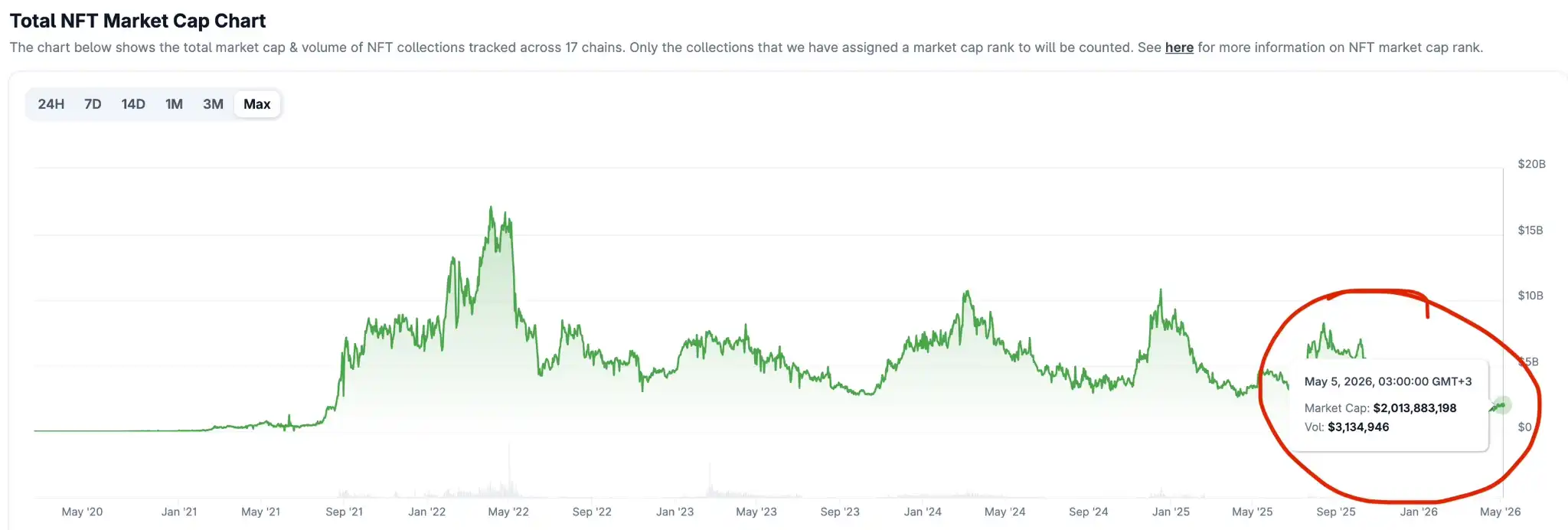
The current NFT market is worth about $2 billion, down roughly 90% from its peak. On the surface, you might say, "Exactly, NFTs lost."
But you can't just look at the surface. Because the entire art world—including museums, top galleries, auction houses, and the most seasoned collectors—has spent the past four years quietly building infrastructure for the very thing they call "dead."
This isn't a "pump piece" that will tell you your favorite PFP's floor price is about to 50x. This article will take you deep into:
· What the art world's gatekeepers did while everyone was watching price charts.
· Why every significant art movement in history was mocked for decades before being taken seriously.
· Why the bearish case on NFTs simply doesn't hold up.
1. The Market You Think is Impenetrable is Actually Shrinking
The traditional art market is $59.6 billion. That's the number from the Art Basel and UBS Art Market Report 2026, written by Dr. Clare McAndrew, the sector's most respected analyst for over a decade.
By NFT standards, that's huge. But here's what no one tells you about that number:
· Stagnant Growth: Down from the $67.8 billion high in 2022, having slid for two years before a small rebound.
· Mid-Market Erosion: The market for works under $50,000 has been eroding for over a decade.
· Hyper-Concentration of Value: In public auctions, works over $1 million make up less than 1% of lots but account for 54% of the total value.
· Wealth Transfer: The report also points to the coming tipping point: "The Great Wealth Transfer." Over $80 trillion in assets will pass from Baby Boomers to their children in the next two decades.
Read that "1% of lots, 54% of value" again. The traditional art market is not a real $60 billion market. It's a ~$30 billion market for the public, plus a ~$30 billion "super casino" at the top where billionaires trade Basquiats and Picassos as efficient tax shelters.
And that top market has a problem: the buyers are old, the dealers are old, the infrastructure is old. The kids inheriting $80 trillion did not grow up with Sotheby's catalogs.
They grew up online.
So, before we even talk about NFTs, understand this: the supposed competitor to NFTs is not a thriving, expanding market. It's an aging market with severe concentration issues facing a generational handoff to heirs who don't want the old stuff. And that's what people call a "safe asset."
At the high end, veteran collectors are increasingly focused on estate planning, liquidity, and legacy, not discovering new artistic mediums.
Now, look at what the people who run art have actually done with their own money.
2. The Gatekeepers Acted While You Weren't Looking
The art world has a very specific mechanism for legitimizing a new artistic medium. The playbook goes:
· A handful of artists create work in a new form.
· Critics mock. Collectors ignore.
· A few brave curators bring the work into institutional collections.
· Other museums see the acquisitions and follow.
· Auction houses see the institutional shift and start auctioning the work.
· Top galleries sign the artists.
· Prices rise for the next several generations.
This is the playbook. It worked for photography, video art, installation art. It works for every medium the art world initially decided "wasn't real art."
And this playbook is playing out right now with digital and on-chain art. Most people don't realize the early stages have already quietly completed.
Here is a partial list of permanent museum acquisitions:
· Museum of Modern Art (MoMA), New York: Acquired Refik Anadol's Unsupervised in 2023. The work hung in the museum's atrium for nearly a year, seen by 3 million visitors. The acquisition included a companion NFT and a blockchain memento visitors could mint.
That same year, MoMA also acquired Ian Cheng's 3FACE, a generative NFT that reads its owner's wallet contents and changes as the wallet changes. A conceptual artwork impossible without a blockchain.
· Centre Pompidou, Paris: Acquired 18 NFTs from 13 artists in 2023. The collection includes a CryptoPunk, an Autoglyph, and works by Sarah Meyohas, among others. Curator Marcella Lista described it as a natural continuation of works by canonical artists in their collection, like Bruce Nauman.
· Los Angeles County Museum of Art (LACMA): Holds one of the most authoritative on-chain art collections globally. In February 2023, collector Cozomo de' Medici donated 22 pieces of generative and blockchain art, including a CryptoPunk, Dmitri Cherniak's Ringer, and work by Tyler Hobbs.
It was the largest donation of blockchain art to a U.S. museum to date. Additionally, Art Blocks founder Erick Calderon donated the final version of Chromie Squiggle—the genesis piece of the entire on-chain generative art movement—directly to the museum. LACMA also established the first museum fund in the U.S. dedicated to digital art by women artists.
· Institute of Contemporary Art, Miami (ICA Miami): It moved early, accepting a donation of CryptoPunk #5293. In 2022, Yuga Labs donated a second Punk and launched the "Punks Legacy Project" to get CryptoPunks into museums worldwide.
· The Whitney Museum of American Art: Has been quietly collecting digital and net art for years, with two works by Rafaël Rozendaal in its permanent collection. It has run a digital exhibition platform called Artport since 2001.
· Buffalo AKG Art Museum: Held the "Peer to Peer" exhibition in late 2022, the first blockchain art exhibition at a U.S. museum. The curator's historical parallel is worth remembering: In 1910, the same museum held the first museum exhibition of photography in the U.S. In 1910, people still didn't think photography was art, three-quarters of a century after its invention.
· Solomon R. Guggenheim Museum: In 2024, exhibited Jenny Holzer's Light Line, a 900-foot-long scrolling LED installation incorporating AI-generated text.
The Centre Pompidou, MoMA, LACMA, ICA Miami, The Whitney, Buffalo AKG, and the Guggenheim combined form the institutional backbone of contemporary art in the U.S. and Europe. They have all formally committed to digital and on-chain art in the last four years.
People who aren't paying attention will tell you institutions don't care. The truth is, these institutions are already publicly in. The market is ignoring it only because floor prices are down.
3. Every Art Movement You Take Seriously Now Started as a Joke
This is the part crypto people often miss, but everyone in art understands.
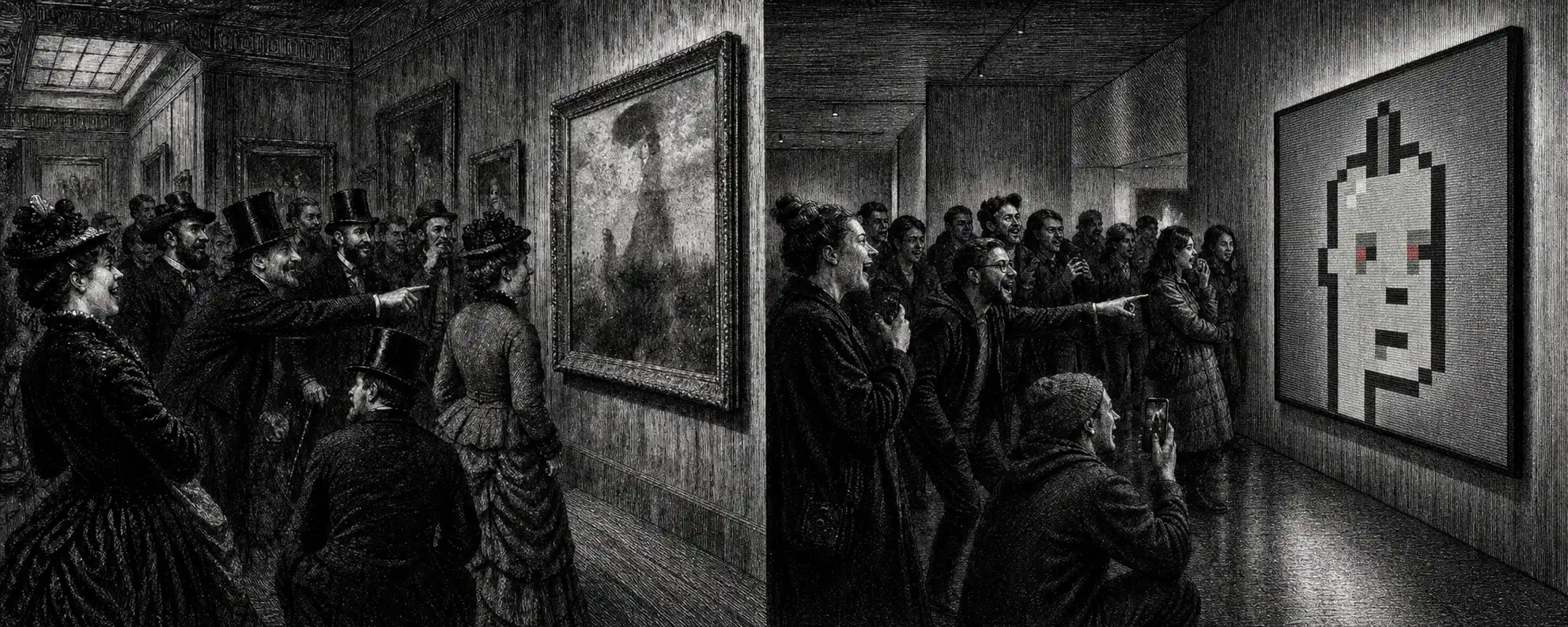
In 1863, the official French exhibition, the Paris Salon, rejected over 2,000 paintings. The outcry was so loud, and the rejections so many, that Napoleon III ordered the creation of the "Salon des Refusés." People flocked to see it—to laugh. The focus was Édouard Manet's Le déjeuner sur l'herbe (Luncheon on the Grass). Critics called it vulgar.
Today, it's considered one of the founding works of modern art. It hangs in the Musée d'Orsay. If it ever sold, its value would be a phone number.
In 1874, a group of artists, excluded from the official Salon, held their own show. A critic, mocking Claude Monet's painting Impression, Sunrise, coined the term "Impressionists" as an insult.
The name stuck. It later became the most important movement in history.
It wasn't until 1987—over a century after the Salon des Refusés—that a modern artwork broke the auction record previously held by Old Masters. Van Gogh's Sunflowers sold at Christie's for nearly $40 million.
Van Gogh sold one painting in his lifetime. Today, his works regularly fetch over $100 million at auction.
This lag is the path for every art revolution. Without exception.
It doesn't always take a century. But the pattern is: Mockery precedes acceptance. Institutional acceptance follows. Market repricing comes last.
Take Pop Art. In July 1962, Andy Warhol's Campbell's Soup Cans series opened at the Ferus Gallery in Los Angeles. A grocery store next door, in open mockery, stacked actual Campbell's soup cans in its window with a sign: "Get the real thing for 29¢." Only 5 of the 32 paintings sold. The gallery owner, Irving Blum, eventually bought the set back for $1,000.
Those 32 soup cans are now among MoMA's most prized possessions. One painting from the series later sold privately for over $9 million.
The grocery store is forgotten.
Take Conceptual Art. In 1967, Sol LeWitt published "Paragraphs on Conceptual Art" in Artforum. It opens with: "The idea becomes a machine that makes the art." The art world largely dismissed it as fringe philosophy.
Early conceptual artists deliberately made work—protocols, instructions, certificates—that couldn't be collected, partly to critique the gallery system. They tried to escape the market.
Sol LeWitt's auction record now exceeds $1.6 million. His wall drawings are now held by major museums worldwide.
Conceptually, a wall drawing is like a smart contract. Someone writes the rules. Someone executes. The "art" is in the protocol.
He invented the framework for how on-chain generative art would operate, fifty years before a blockchain existed to run it.
Now look at how long those births took. This part should make your eyes widen:
· Impressionism: ~124 years from 1863 mockery to first modern auction record broken in 1987.
· Pop Art: ~50 years from 1962 grocery store mockery to permanent MoMA acquisition by the late 1960s and eventual multi-million dollar sales.
· Conceptual Art: ~35 years from 1967 manifesto to million-dollar auction prices.
· NFT Art: Quantum, widely considered the first NFT, was minted in 2014. CryptoPunks launched in 2017. Christie's first major NFT art auction was in 2021. That's seven years.
Seven years.
The Impressionists held eight exhibitions before the world even knew what to call them. The first NFT artists are still making work. Most of them are still alive. Most are still mid-career. The same playbook that priced Manet, Van Gogh, Warhol, and LeWitt is already playing out on them.
Impressionism took decades to go from mockery to billions in market cap. Conceptual art faced the same resistance.
The pattern is: A new medium appears. The mainstream dismisses it. Then a critical mass of creators and collectors adopt it. Institutions follow. Then capital floods in.
NFTs are moving faster than any art movement in history.
"The idea becomes a machine that makes the art." —Sol LeWitt, 1967
He was talking about wall drawings. But he also perfectly described a smart contract.
4. Top Galleries Have Already Voted With Their Feet
If you want to know which artists will be in textbooks 20 years from now, don't look at auction prices. Look at which galleries signed them. Pace, Gagosian, Hauser & Wirth—these galleries control who gets into museums and who gets into textbooks. They are the most conservative players in the art world. They only sign an artist when they believe that artist will matter in 50 years.
Pace Gallery: Founded 1960. Represents the estates of artists like Rothko and Sol LeWitt—the artist whose conceptual lineage most closely ties to NFT art. Pace launched Pace Verso, its dedicated NFT and Web3 platform, in November 2021. Since then, they've worked with a roster of their blue-chip artists on NFT projects:
· Jeff Koons (sculpture sent to the moon)
· Maya Lin
· Trevor Paglen
· teamLab
· DRIFT
· Tara Donovan
· Lucas Samaras
· John Gerrard
· Loie Hollowell
· Leo Villareal
· Random International
Look at that list. These aren't crypto-native upstarts. They are established names in contemporary art, releasing NFT work for the first time through one of the top three galleries.
Then, in March 2023, Pace did something even more significant. They gave Tyler Hobbs—a generative art artist who grew up on-chain—a solo exhibition at their flagship New York gallery. Twelve large-scale paintings derived from his QQL algorithm, shown in the same rooms as Rothkos and Calders.
The QQL Mint Pass had sold for $17 million the previous September. A month later, in the crypto bear market, its secondary market cap peaked at $28 million.
Pace giving a solo show to a generative NFT artist wasn't a stunt. It was a vote.
It's not an isolated case:
· Lehmann Maupin became the first commercial gallery to accept crypto payments.
· Hauser & Wirth exhibited Jenny Holzer's NFT-related work.
· Gagosian accepts crypto payments.
· Sotheby's launched its dedicated metaverse marketplace in 2021. It has since done over $100 million in NFT sales and continues to pay artist royalties when most of the market abandoned them.
· Christie's launched Christie's 3.0 in October 2022, the first fully on-chain auction platform from a major auction house.
Auction houses and top galleries don't have to do this. They do just fine without crypto. They're doing it because the smart people in the most conservative corners of the art world have looked at the data and concluded that the next 25 years of collecting is heading here.
5. The Hard Data
Mike Winkelmann created one digital painting every day for thirteen years and posted them online. Almost no one cared. He had a small fan base, no gallery representation, no museum attention, zero footprint in the traditional art world.
Then, in March 2021, Christie's auctioned a file containing all 5,000 works stitched together. It sold for $69.3 million. His online name is Beeple.
Now, bring all the data together.
· Beeple, Everydays: The First 5000 Days: $69.3 million at Christie's, March 2021. The first purely digital NFT artwork offered by a major auction house. Beeple instantly became the third most valuable living artist at auction in history.
· Pak, The Merge: $91.8 million in sales in 2021, arguably the highest public sale for a living artist, though disputed as it was sold in multiple units.
· Beeple, HUMAN ONE: $29 million at Christie's, November 2021. A hybrid physical/digital sculpture with a dynamic NFT component.
· Dmitri Cherniak, Ringers #879: $6.2 million at Sotheby's, June 2023, in the depths of the bear market. The second-highest price ever for a generative artwork. Sotheby's GRAILS auction that day totaled ~$11 million and set eight new artist records. This wasn't 2021 hype. This was conviction in the 2023 crypto winter.
· Tyler Hobbs, Fidenza #725: Sold for over $1 million at Sotheby's Contemporary Art Evening Sale in May 2023, five times its high estimate.
· XCOPY, Right-click and Save As Guy: Sold for ~$7 million on SuperRare in late 2021. Multiple of his works have sold for millions.
· Refik Anadol: Beyond the MoMA acquisition, he became the first artist to have a months-long residency projecting on the exterior of the Las Vegas Sphere in September 2023. His work has been shown at Walt Disney Concert Hall, Casa Batlló, and the Venice Architecture Biennale. He was Google's first artist in residence in 2016.
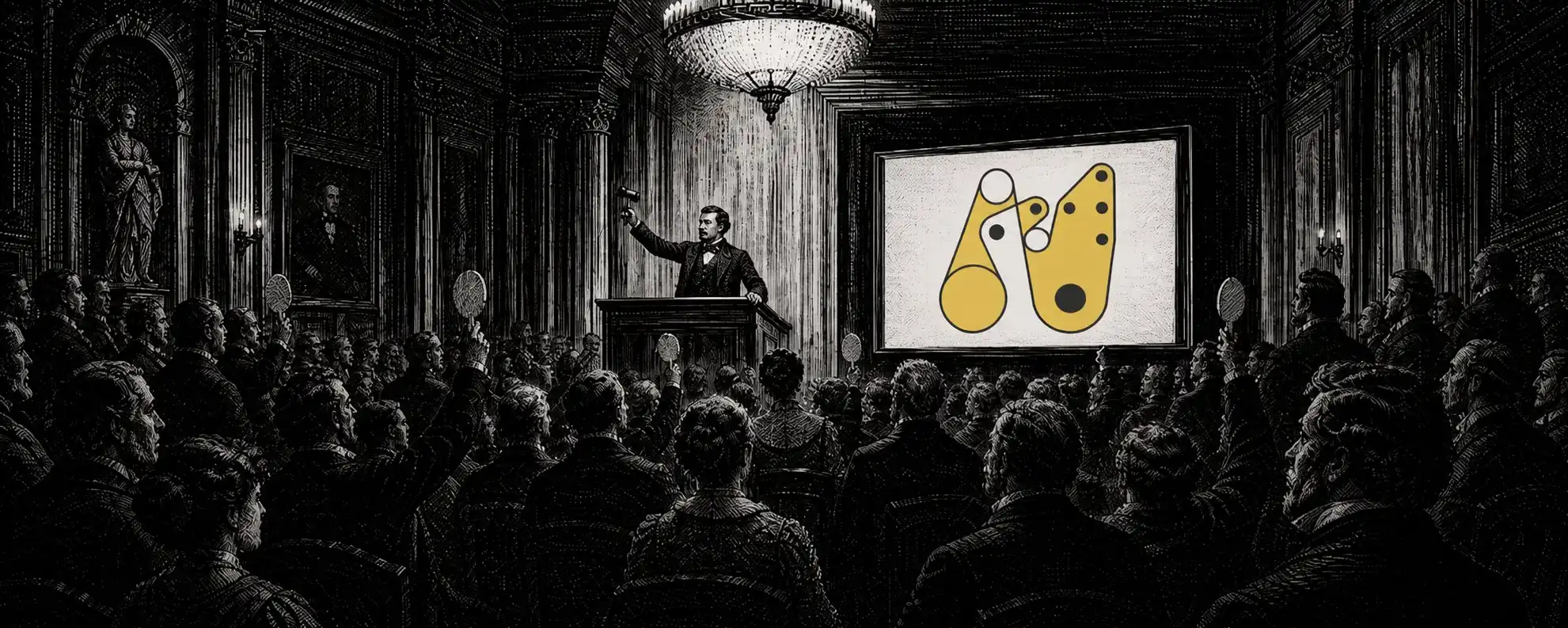
These aren't isolated data points. They are a body.
There now exists a cohort of digital artists active in the art world with seven- and eight-figure auction prices, museum acquisitions across three continents, and representation in the top galleries of contemporary art.
That cohort didn't exist five years ago.
The hype bubble is gone. The infrastructure remains. And the people building that infrastructure aren't waiting for you to figure it out.
6. A New Generation of Medici is Already Collecting
If you want to know where the future market for an asset class is heading, find the people accumulating during the bear market.
There is a collector who goes by "Cozomo de' Medici." The name is not an accident.
The original Medici funded Botticelli, Michelangelo, and Donatello when they were unknowns and painting itself was a new medium. The ROI on those bets, stretched across time, is nearly infinite.
The Medici understood, when no one else did, that the medium was changing, and the people who realized it first would shape the canon.
In February 2023, Cozomo de' Medici donated 22 pieces of generative art to LACMA. The name Medici says it all. They are betting that net art will be remembered like the Florentine Renaissance.
They aren't alone:
· Punk6529: The anonymous collector who bought The Goose for $6.2 million. He runs a museum district in the metaverse displaying over two thousand works. His personal collection was once worth over $20 million. He has written publicly for years that NFTs aren't a trade; they are a new system for owning digital culture.
· Flamingo DAO: A group of ~100 members who started raising funds in October 2020. They hold the only complete set of CryptoPunk attributes in existence and a complete set of Autoglyphs. They hold an Alien Punk, bought for ~$750k in 2021, now worth ~$13 million. Their portfolio's peak valuation was $1 billion.
· PleasrDAO: Bought the only existing copy of a Wu-Tang Clan album from the U.S. federal government, which had seized it from Martin Shkreli. They also bought Edward Snowden's Stay Free NFT for over $5 million. They bought the original Doge meme NFT and fractionalized it. PleasrDAO is backed by a16z.
These aren't retail speculators or casual buyers. They are collectors and collectives with enough capital, conviction, and cultural literacy to keep investing after the NFT hype faded and to treat NFT collecting as an investable thesis.
Add in the anonymous institutional collectors, the family offices buying quietly, and the fact that Christie's now has enough on-chain bidding to justify its own platform, and the picture doesn't match the public narrative of "NFTs are dead."
NFTs are being accumulated. Just not by people posting their portfolios on X every day.
The Medici example is the entire trade:
Find the medium that future institutions will want to collect before those institutions realize they need to collect it, and buy the foundational works for pennies relative to their future value.
That's what the original Medicis did.
7. The Reframe
If you've read this far, you know what I'm about to say.
The traditional art market is shrinking, concentrating, and aging. Its primary buyers are old. Its infrastructure was built for a generation that didn't grow up online. The next generation, which did, is about to inherit $80 trillion from them.
The most important contemporary art institutions in the U.S. and Europe have formally committed to digital and on-chain art.
Every major art movement of the last 150 years was mocked for decades before being taken seriously. NFT art is 7 to 12 years old.
Top galleries have already chosen. Pace gave Tyler Hobbs a solo show. Sotheby's runs a dedicated digital art platform. Christie's runs a fully on-chain auction platform.
The auction prices are there. Beeple at $69 million. Pak at $91 million. Cherniak at $6.2 million in a bear market. Anadol on the Vegas Sphere.
Collectors are accumulating en masse: Flamingo, PleasrDAO, 6529, Cozomo, and the family offices you never hear about.
Here is what most people get wrong about NFTs.
They think NFTs are a trading category. They are not. They are an ownership system. Before NFTs, digital culture had infinite distribution and zero ownership. Everything spread, nothing could be held, and all value accrued to platforms, not the creators or collectors of the work.
NFTs flipped that. Culture can now spread infinitely and be owned finitely.
That's the key. The price of art has always been a function of three things: provenance, story, and cultural relevance. On-chain ownership doesn't replace any of these. It enhances all three.
Blockchain-based, socially-consensus-scarce artwork is the new scarce good, and the people collecting it now are doing what every generation of canonical collectors did at the beginning of every medium that ended up mattering.
And the thing that makes the entire argument airtight is this:
On-chain artwork is the first major category of art whose ownership history can be programmatically, publicly, and timestamped from the moment of its creation.
It doesn't solve everything: copyright, storage, authorship, and cultural value still matter. But it solves provenance better than the traditional art market does.
The traditional art market loses billions annually to fakes, lost provenance, and attribution disputes. America's oldest gallery, Knoedler Gallery (165 years old), sold $80 million in fakes—including Rothkos and Pollocks—before closing in 2011. Even Christie's $450 million Salvator Mundi sale is officially listed as "attributed to Leonardo da Vinci." It's disputed.
On-chain art doesn't have that problem. The provenance is the medium. Every previous owner is verifiable. Every transaction is timestamped. Every smart contract is auditable.
For the first time in history, an artwork and its complete ownership history are an immutable mathematical object.
You can right-click save the JPEG. You can't right-click save the provenance. That's the point.
It's the ultimate realization of the "dematerialization" Sol LeWitt described in 1967.
The idea is the machine. The machine makes the art. The blockchain records it all.
If you actually run the numbers on the museum acquisitions, auction records, gallery representation, collector cohorts, historical timelines, inheritance math, structural problems in the traditional market, and the property rights advantages of on-chain provenance, it's impossible for NFT art to stay at a $2 billion market cap forever.
$2 billion is the current market cap of an asset class:
· Whose foundational works are being collected by the world's most prestigious museums;
· Whose artists are being signed by the world's most conservative galleries;
· Whose work is being quietly accumulated by the world's most professional collectors;
· With the clearest provenance system ever invented;
· With a multi-trillion-dollar inheritance tailwind heading straight for buyers who grew up with screens.
The bet isn't on price. It's on the medium.
And the medium has already won the only debate that matters: The institutions that decide what "art" is have decided.
The part of NFT art that actually matters survived the speculative crash and is institutionalizing faster than most historically contested art movements.
The bear case is that NFTs died because the speculative market collapsed. The institutional record says: The speculation died. The medium survived.
This isn't to say all PFPs are coming back—most won't. It's not to say everything collected in 2021 is important. It's to say the foundational works of on-chain art are being canonized in real-time, collected, interpreted, and cemented.
The point isn't "NFTs are back."
The point is that digital art is entering art history, and most people are still treating it like a passing fad.
In 1965, you could buy a Warhol for the price of a used car. That same painting now sells for nine figures. Foundational digital art right now is priced exactly like Warhol was in 1965. That's not an opinion. It's a data point you can look up.
The Salon laughed at Manet. The grocery store laughed at Warhol. The people laughing at Beeple, Anadol, Hobbs, and Cherniak now sound exactly like the people who laughed at every new medium before it became art.
History always reveals who looks stupid in that trade. The only question now is whether you move before the people who haven't read this article do.