Where Will DeFi Go Next?

marsbitPublished on 2026-01-12Last updated on 2026-01-12

Abstract

The DeFi sector has approached its previous all-time high in Total Value Locked (TVL), reaching $225 billion in late 2025, yet growth has stagnated with only a 10% increase over four years. This indicates that the current user base—largely crypto-native—may have reached saturation. The next phase of growth must come from attracting mainstream users. Stablecoins have seen significant expansion, with USDT and USDC surpassing $260 billion in combined market cap, exceeding the entire DeFi TVL. The rise of yield-bearing stablecoins and Real-World Assets (RWA), now over $20 billion, reflects strong demand for on-chain yield. However, these products remain largely confined to crypto-savvy users. Compared to the fintech sector, which manages over $2 trillion in customer assets, DeFi remains a niche. To break through, DeFi must prioritize simple, secure, and收益-focused products that appeal to ordinary users, rather than complex financial structures or speculative mechanisms. Embedded DeFi integrations within fintech apps could help bridge this gap, but consumer-facing protocols that simplify access to yield will be key to capturing the next wave of adoption.

Editor's Note: DeFi is once again approaching its historical high but has failed to break through significantly, revealing not a lack of products but a bottleneck in user growth. The expansion of stablecoins, yield-bearing stablecoins, and RWA indicates that the demand for moving funds on-chain and earning yields remains strong, yet it has not been truly brought to the mass market.

This article argues that the next step for DeFi lies not in more complex structures or speculative designs, but in simple, secure, yield-focused products, along with user-friendly access and distribution methods for ordinary users. Only when DeFi begins to target fintech users, rather than solely serving crypto-native audiences, can a new growth cycle truly begin.

Below is the original text:

Current Situation

In 2025, DeFi's total value locked (TVL) reached a new historical high, but it did not significantly exceed the peak of 2021. As the market gradually cools, a question worth revisiting is: where will the next wave of capital and users come from?

Driven by DeFi Summer, TVL climbed to $204 billion by the end of 2021. Subsequently, following the collapse of events like FTX and the market entering a bear phase, the capital scale declined steadily. Later, DeFi struggled to recover, reaching $225 billion in October 2025. However, a mere 10% growth over four years can hardly be considered explosive. The earliest participants in DeFi—primarily crypto-native users and traders—may have nearly reached the "ceiling."
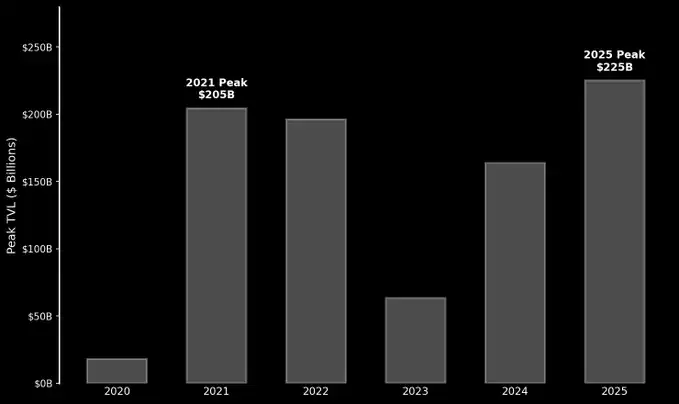
The proximity of these two peaks is indeed cause for caution, but it does not yet constitute a "survival crisis." The current user base—though highly engaged and loyal—is not large enough to propel DeFi to the next level on its own.

To achieve a breakthrough, DeFi needs to reach a larger audience. The good news is that such an audience does exist—it is still on the sidelines, waiting to be properly "onboarded" with the right tools and products.

A Glimmer of Hope

Over the past year, the stablecoin market has been one of the biggest beneficiaries. The amount of USD on-chain has reached a historical high, more than ever before. USDT and USDC have continued to grow steadily, with their combined market capitalization exceeding $260 billion—meaning that the scale of stablecoins alone is already larger than the entire DeFi market.
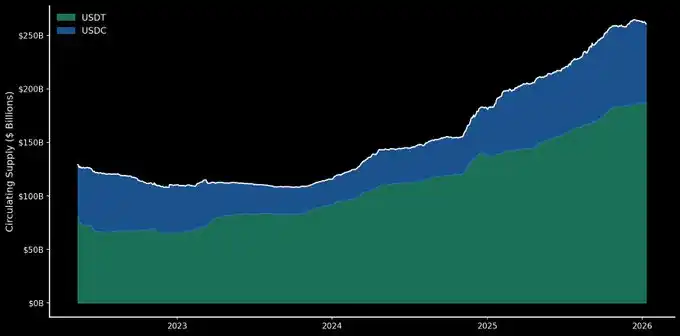
Even without parabolic growth in DeFi, people continue to mint stablecoins, indicating that the demand for moving funds on-chain remains strong. At the same time, an increasing number of users are beginning to access the yields provided by DeFi, and the growth in this area points to where the next breakthrough may come from.

The rise of yield-bearing stablecoins and RWA (real-world assets) further confirms this trend. According to @stablewatchHQ data, the scale of yield-bearing stablecoins has exceeded $20 billion, with products like sUSDS and sUSDe gaining significant adoption over the past year or so. Parallel to yield-bearing stablecoins, RWA has also made progress on-chain: these products, backed by traditional assets such as treasury bonds, offer real yields and are growing rapidly.

The problem is that they currently primarily cater to crypto-native users and large on-chain holders. As long as this remains the case, their potential will be underestimated. If they can be productized and packaged in a way that is more accessible to everyday users, yield-bearing stablecoins and RWA present enormous opportunities in the mass market.

Retail Has Not Yet Arrived

To understand the scale of this opportunity, it is helpful to compare DeFi with fintech. Currently, the entire DeFi TVL is approximately $164 billion. In contrast, global mobile fintech apps manage over $2 trillion in customer assets; the top 100 neobanks alone have assets totaling $2.4 trillion. By comparison, DeFi is currently almost a negligible fraction.
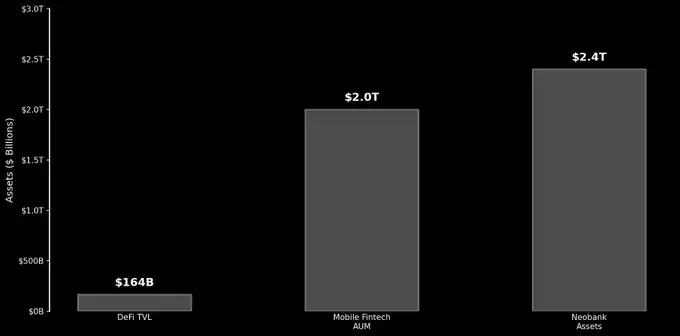
The notion that "if you build it, they will come" can only drive limited growth. If DeFi wants to continue expanding, it must compete for the ordinary users that have made fintech so vast.

In 2025, the success of protocols like Aave, Ethena, and Pendle has demonstrated a strong demand for yield among market participants. They were the highlights of the year, attracting significant capital and attention. If such products can be delivered to the masses in a clear, understandable, and low-barrier manner, the potential encompasses (literally) trillions of dollars in capital and tens of millions of potential users.

The Path Forward

The real test for DeFi in the coming year is whether it can make yield opportunities easily and safely accessible to ordinary people. Growth will not come from more complex financial structures, the 100th liquidity mining pool, the 100th perpetual futures DEX, or the millionth airdrop. Growth will come from simple, reliable products—built on decentralized protocols—that solve real problems for ordinary people. And yield should be center stage (ahem, Aave App, ahem).

Today, hundreds of millions of people use banking and fintech apps daily, already accustomed to managing their funds on their phones. If DeFi can capture even a small share of this, it will be enough to trigger a new wave of growth, and it will not once again stall at the $200 billion TVL level.

Embedded DeFi will play a crucial role in this—fintech companies and neobanks integrating on-chain yield capabilities directly into their products. But teams should not stop there. The protocols that are truly consumer-facing and at the forefront will capture the greatest upside; those that continue to optimize only for crypto-native users will ultimately be competing for a pie that may no longer be expanding.

DeFi will win.

Related Questions

QWhat is the main reason DeFi has not experienced explosive growth despite reaching a new TVL high in 2025?

AThe main reason is that DeFi has primarily served crypto-native users and traders, who are nearing their 'ceiling,' and has failed to attract a broader audience of ordinary users.

QWhat evidence suggests that there is still strong demand for moving funds on-chain?

AThe stablecoin market has reached a new all-time high, with USDT and USDC combined市值 exceeding $260 billion, which is larger than the entire DeFi market.

QWhat types of products have shown significant growth and adoption in the past year, indicating potential for broader appeal?

AYield-bearing stablecoins (like sUSDS and sUSDe) and Real World Assets (RWA) have seen substantial growth, offering real yields and attracting significant adoption.

QHow does the size of DeFi's TVL compare to the assets managed by fintech applications and neobanks?

ADeFi's TVL is about $164 billion, while global mobile fintech apps manage over $2 trillion in customer assets, and the top 100 neobanks alone hold $2.4 trillion in assets, making DeFi a negligible fraction in comparison.

QWhat is the key challenge for DeFi to achieve its next growth cycle and attract mainstream users?

AThe key challenge is to create simple, secure, and收益-focused products that are easy for ordinary users to understand and use, rather than developing complex financial structures or relying solely on crypto-native optimizations.

Related Reads

Why Do You Always Lose Money on Polymarket? Because You're Betting on News, While the Pros Read the Rules

Why do you always lose money on Polymarket? Because you bet on news, while the pros study the rules. This article explains how top traders ("che tou") profit by meticulously analyzing market rules, not just predicting events. Polymarket, a prediction market platform, often sees disputes over event outcomes due to ambiguous rule wording. For instance, a market asking "Who will be the leader of Venezuela by the end of 2026?" was misinterpreted by many who bet on Delcy Rodríguez, assuming she held power. However, the rules specified "officially holds" as the formally appointed, sworn-in individual. Since Nicolás Maduro was still recognized as president officially, he won the market—even being in prison. To resolve such disputes, Polymarket uses a decentralized arbitration system via UMA protocol. The process involves: 1. Proposal: Anyone can propose a market outcome by staking 750 USDC, earning 5 USDC if unchallenged. 2. Dispute: A 2-hour window allows challenges with a 750 USDC stake; successful challengers earn 250 USDC. 3. Discussion: A 48-hour period on UMA Discord for evidence and debate. 4. Voting: UMA token holders vote in two 24-hour phases (blind then public). Outcomes require >65% consensus and 5M tokens voted; otherwise, four re-votes occur before Polymarket intervention. 5. Settlement: Results are final and automatic. Unlike traditional courts, Polymarket’s system lacks separation between arbitrators and stakeholders—voters often hold market positions, creating conflicts of interest. This leads to herd mentality in discussions and non-transparent outcomes without explanatory rulings, preventing precedent formation. Thus, success on Polymarket hinges on deep rule interpretation, not just event prediction, exploiting gaps between reality and contractual wording.

marsbit2h ago

Why Do You Always Lose Money on Polymarket? Because You're Betting on News, While the Pros Read the Rules

marsbit2h ago

DeepSeek Funding: Liang Wenfeng's 'Realist' Pivot

DeepSeek, a leading Chinese AI company, has initiated its first external funding round, aiming to raise at least $300 million at a valuation of no less than $10 billion. This move marks a significant shift from its founder Liang Wenfeng’s previous idealistic stance of rejecting external capital to maintain independence. Despite strong financial backing from its parent company, quantitative trading firm幻方量化 (Huanfang Quant), which provided an estimated $700 million in revenue in 2025 alone, DeepSeek faces mounting challenges. Key issues include a 15-month gap in major model updates, delays in its flagship V4 release, and the loss of several core researchers to competitors offering significantly higher compensation. The company is also undergoing a strategic pivot by migrating its infrastructure from NVIDIA’s CUDA to Huawei’s Ascend platform, a move aligned with China’s push for technological self-reliance amid U.S. export controls. However, DeepSeek lags behind rivals like智谱AI and MiniMax—both now publicly listed—in areas such as product ecosystem, multimodal capabilities, and commercialization. The funding round, though relatively small in scale, is seen as a way to establish a market-validated valuation anchor, making employee stock options more competitive and facilitating talent retention. It also signals DeepSeek’s transition from a pure research-oriented organization to a commercially-driven player in the global AI ecosystem.

marsbit3h ago

DeepSeek Funding: Liang Wenfeng's 'Realist' Pivot

marsbit3h ago

Trading

Spot
Futures
活动图片