When Big Money Seriously Enters the Market, How Does the Liquidity Bottleneck of RWA Manifest?

比推Published on 2026-01-16Last updated on 2026-01-16

Abstract

When large capital enters the market, the liquidity bottlenecks of Real-World Asset (RWA) tokenization become evident. Tokenized assets, such as gold (e.g., PAXG, XAUT) and stocks (e.g., TSLAx, NVDAx), suffer from significant slippage and shallow market depth compared to traditional markets like CME. For instance, a $4 million trade in tokenized gold can incur up to 150 basis points of slippage, while traditional markets show negligible impact even at $20 million. Decentralized exchanges (DEXs) exacerbate the issue, with trades sometimes facing premiums as high as 68% or persistent slippage of 25–50 basis points. Liquidity shortages also destabilize market structure, causing price volatility and cascading effects like cross-platform liquidations, as seen with PAXG on Binance triggering $9 million in liquidations on Hyperliquid. These problems stem from structural constraints: high minting/redemption fees, slow redemption cycles (T+1 to T+5), and capital inefficiencies for market makers. Without deep, reliable liquidity, tokenized assets struggle to scale, hindering their use as collateral or in DeFi. The solution requires a new market structure that integrates off-chain liquidity, eliminates redemption delays, and avoids fragmenting liquidity across platforms. Tokenization itself isn’t flawed, but the current market infrastructure fails to support it at scale.

Author: @ballsyalchemist

Translator: Ding Dang

Original Title: When Big Money Starts Getting Serious, the Liquidity Issues of RWA Become Apparent


Liquidity is the prerequisite for an asset to gain confidence. When the market has sufficient depth, large amounts of capital can be smoothly absorbed, whales can freely build positions, and assets can be used as reliable collateral. This is because lenders know that they can exit at any time if needed. However, if the asset itself lacks liquidity, the situation is the opposite. Shallow liquidity struggles to attract users, and insufficient users further compress trading depth, eventually forming a self-reinforcing "liquidity depletion cycle."

Tokenization was initially highly anticipated: it was seen as a key tool to enhance capital liquidity, unleash the financial utility of DeFi, and bridge on-chain and off-chain assets. Ideally, traditional financial markets worth trillions of dollars would be brought on-chain, allowing anyone to trade freely, use assets as collateral for loans, and combine and innovate in ways that are difficult to achieve in the traditional financial system through DeFi.

However, the reality is that beneath the surface prosperity, most tokenized assets operate in extremely fragile, illiquid markets that cannot support meaningful capital scales. The "liquidity" that is a prerequisite for financial composability and practical utility has not been truly realized. These issues are not noticeable in small transactions, but once capital attempts to move at scale, the hidden costs and risks quickly emerge.

The Current Reality of Liquidity

The first hidden cost of tokenized assets is reflected in slippage.

Taking tokenized gold as an example, the chart below compares the expected slippage of major centralized exchanges and traditional gold markets at different trade sizes, and the difference is clear.
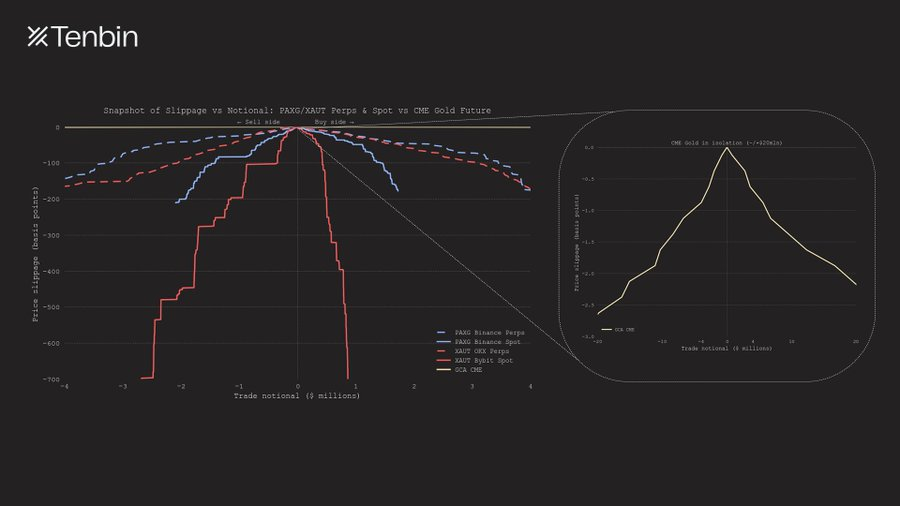
PAXG / XAUT Perpetual vs. Spot vs. CME Deliverable Gold Futures: Trade Size and Slippage

As trade size increases, the slippage for PAXG and XAUT perpetual contracts rises rapidly and exponentially. At a nominal trade size of about $4 million, slippage approaches 150 basis points. In contrast, CME's slippage curve is almost flush with the horizontal axis, barely noticeable.

At the spot market level, the liquidity constraints of PAXG and XAUT are even more apparent. Even when selecting the most liquid spot trading venues for each, the effective depth provided by their order books on either the buy or sell side is less than $3 million. This liquidity ceiling is directly reflected in the curve "cutting off" prematurely at smaller trade sizes.

The right side separately shows CME's slippage curve; its nearly flat shape intuitively reflects the depth advantage of traditional markets. Even for trade sizes far exceeding $4 million, the expected slippage remains highly stable. A $20 million gold futures trade has a price impact of even less than 3 basis points. In terms of magnitude, CME's liquidity depth is far beyond that of any comparable product in the crypto market.

This difference has direct consequences. In deep traditional markets, even large trades have almost negligible price impact; in the shallow markets of tokenized assets, the same operation immediately incurs significant costs, and the difficulty of closing positions increases rapidly with size. The daily average trading volume comparison below clearly shows this gap, and this issue is not unique to the gold market but applies to other assets as well.
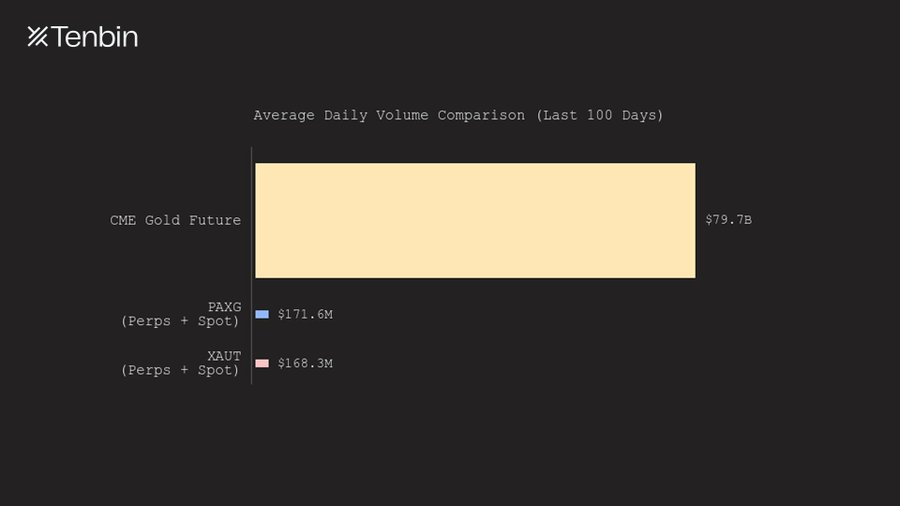
CME Gold Futures vs. PAXG / XAUT Perpetual and Spot: Daily Trading Volume Comparison

The above discussion mainly focuses on CEXs. So, if we switch to AMM DEXs, does the situation improve? The answer is恰恰相反, it only gets worse.

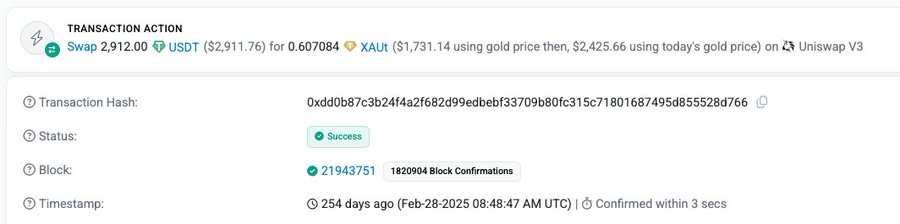
For example, in a February 2025 XAUT transaction, a user spent 2,912 USDT but only obtained XAUT worth about $1,731 at the real gold price at the time, effectively paying a whopping 68% premium for this trade.
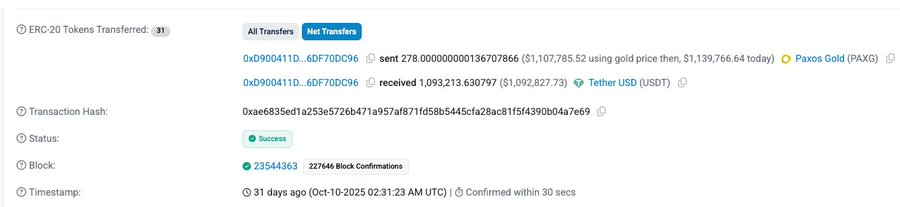
In another transaction, a user exchanged PAXG worth about $1.107 million (at the then gold price) for 1.093 million USDT, with a slippage of about 1.3%. Although the slippage is not as extreme as the former, it is still unacceptably high when price impact in traditional markets is typically measured in single-digit basis points.
Furthermore, over the past six months or so, the average slippage for XAUT and PAXG trades on Uniswap has consistently remained in the 25–35 basis point range, and even exceeded 50 basis points during certain periods.
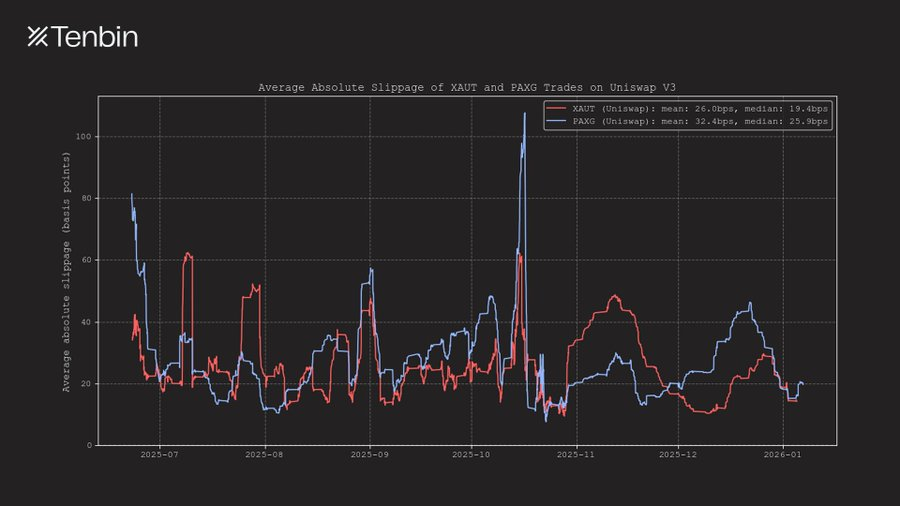
Average Absolute Slippage for XAUT and PAXG on Uniswap V3

This article chooses gold as the primary analysis object because it is currently the largest non-dollar, non-credit tokenized asset on-chain. But the same problems also appear in the tokenized stock market.
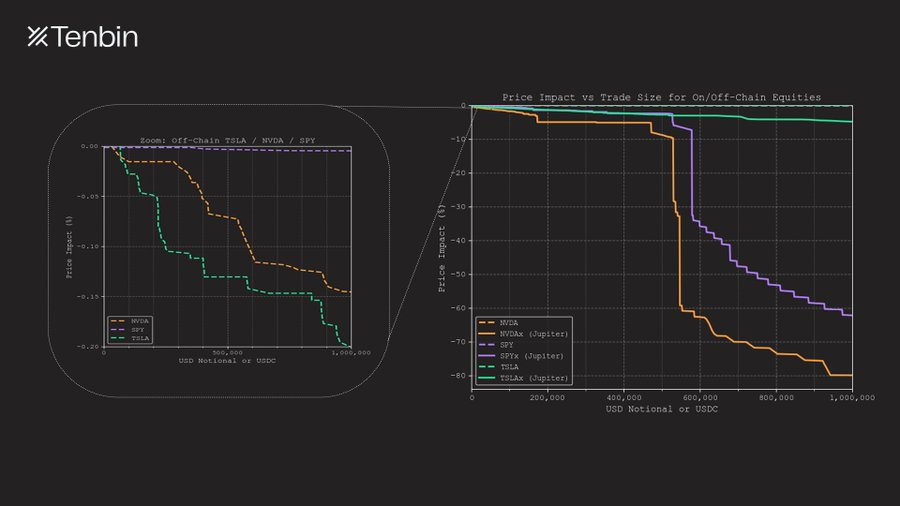
NVDAx / TSLAx / SPYx vs. Nasdaq NVDA / TSLA / SPY: Trade Size and Slippage

TSLAx and NVDAx are among the top tokenized stocks by market cap. On Jupiter, a $1 million TSLAx trade has a slippage of about 5%; while NVDAx's slippage is as high as 80%, almost rendering it untradeable. In contrast, in traditional markets, a trade of the same size in Tesla or Nvidia stock has a price impact of only 18 basis points and 14 basis points respectively (this doesn't even include off-exchange liquidity like dark pools).

These costs are easily overlooked in small trades but become unavoidable once trade sizes increase. Insufficient liquidity directly translates into actual losses.

Why is the Tokenized Market More Dangerous?

The problems brought by insufficient liquidity are not limited to transaction costs; they can directly破坏 the market structure itself.

When market liquidity is thin, the price discovery mechanism becomes fragile, order book noise increases significantly, and oracle data sources are affected by this noise. In highly interconnected systems, even极小规模的交易 can trigger巨大的连锁反应.
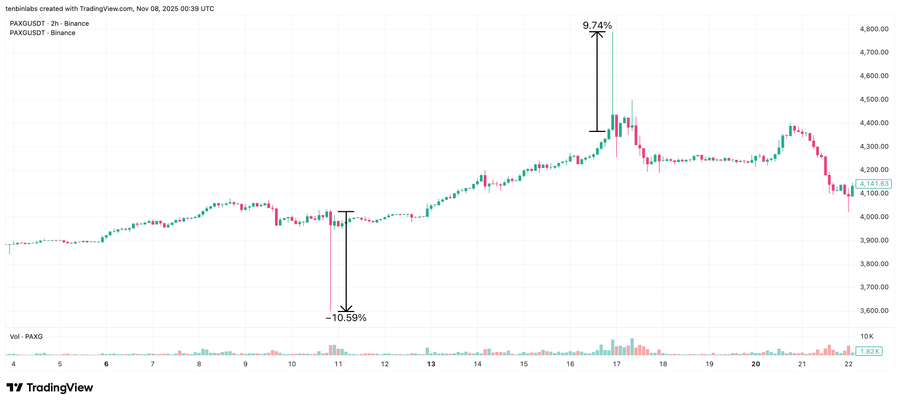
In mid-October 2025, PAXG on the Binance spot market experienced two明显的"anomalous" events within a week. On October 10th, the price dropped 10.6%; on October 16th, it surged 9.7%. Both fluctuations quickly returned to their original levels, almost certainly not caused by fundamental changes but rather a direct manifestation of order book fragility.

Because the tokenized asset ecosystem is highly interconnected, this instability is not confined to a single exchange. Binance spot holds the highest weight in Hyperliquid's oracle construction, so during these two anomalous fluctuations, $6.84 million in long positions and $2.37 million in short positions were liquidated on Hyperliquid, with the liquidation规模甚至超过了 Binance itself.

This result is concerning. It shows that a single illiquid market is enough to amplify and propagate volatility across multiple trading venues. In extreme cases, this structure could even increase the risk of oracle manipulation. Even traders who never participated in the original spot market may passively suffer losses due to liquidations, price distortions, and widening spreads.

Ultimately, all these issues stem from the same fact: the primary market lacks real, scalable liquidity.
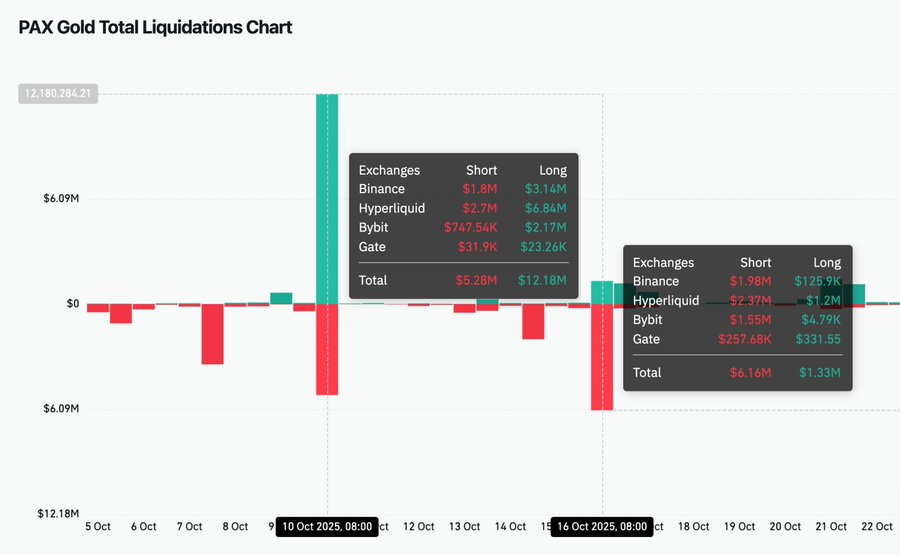
PAXG Liquidation Chart on Coinglass

Insufficient Liquidity is a Structural Problem

The lack of liquidity for tokenized assets is a structural problem.

Liquidity does not automatically appear just because an asset is tokenized. It relies on the continuous supply from market makers, who themselves are subject to strict capital constraints. They allocate capital to markets where inventory can be turned over efficiently, risks can be continuously hedged, and positions can be exited with minimal time and cost friction.

Most tokenized assets恰恰 fail to meet these key requirements.

First, for market makers to provide liquidity, they must first complete asset minting. But in reality, minting itself comes with explicit costs. Issuers typically charge minting and redemption fees ranging from 10–50 basis points;同时, the minting process often involves operational coordination, KYC checks, and settlement through custodians or brokers, rather than direct on-chain execution. Market makers need to advance funds and wait for several hours or even days to actually obtain the tokenized asset.

Second, even after inventory is generated, it cannot be redeemed instantly. The redemption周期 for most tokenized assets is measured in "hours or days," not seconds. Common redemption rules are T+1 to T+5, accompanied by daily or weekly quota limits. For larger positions, a complete exit often takes several days or even longer.

From a market maker's perspective, such inventory is largely equivalent to "low-liquidity assets" that cannot be quickly recovered and redeployed.

To maintain market depth, market makers must hold inventory over a longer周期, continuously bear price volatility risk and hedge, while waiting for redemption to complete. During this time, the same capital could have been deployed to other crypto markets—where little inventory is needed, hedging is continuous, and positions can be closed at any time. Precisely because of this, the opportunity cost is particularly high in the crypto market.

Faced with this trade-off, rational liquidity providers naturally choose to allocate capital to other markets.

The existing market structure is also insufficient to solve this problem. AMMs transfer inventory risk to liquidity providers but do not eliminate redemption constraints; while order book-based trading venues fragment market makers' liquidity across multiple exchanges, further weakening overall depth.

The final result is持续不足的流动性, forming a vicious cycle. Insufficient liquidity discourages participation, and lack of participation in turn further削弱 liquidity. The entire tokenized asset ecosystem is thus trapped in this cycle.

A New Market Structure

Insufficient liquidity is a structural obstacle restricting the scaled development of tokenized assets.

Shallow market depth cannot support practically meaningful position sizes, and the fragile market structure amplifies and transmits local volatility to different protocols and trading venues. Assets that cannot be exited smoothly under predictable conditions自然也难以 serve as credible collateral. Under the current mainstream tokenization model, liquidity is chronically constrained, and capital efficiency remains low.

For tokenized assets to truly become usable at scale, the market structure itself must change.

What if the price discovery and liquidity supply of assets could be directly mapped from off-chain markets, rather than being rediscovered and cold-started on-chain? What if users could acquire tokenized assets at any trade size without forcing market makers to hold low-liquidity inventory long-term? What if the redemption mechanism were fast enough, with clear paths and no restrictions?

Asset tokenization has not failed due to the technical path of "putting assets on-chain."

Where it has truly failed is that the market structure supporting these assets was never truly established.


Twitter:https://twitter.com/BitpushNewsCN

Bitpush TG Discussion Group:https://t.me/BitPushCommunity

Bitpush TG Subscription: https://t.me/bitpush

Original Link:https://www.bitpush.news/articles/7603514

Related Questions

QWhat is the main liquidity challenge faced by tokenized real-world assets (RWA) when large capital enters the market?

AThe main challenge is the significant slippage and high transaction costs due to shallow liquidity. Large trades cause exponential increases in slippage, making it difficult to execute sizable transactions without substantial price impact, unlike in deep traditional markets like CME where slippage remains minimal even for large trades.

QHow does the liquidity of tokenized gold (e.g., PAXG/XAUT) compare to traditional gold markets in terms of slippage?

ATokenized gold markets exhibit much higher slippage compared to traditional markets. For instance, a $4 million trade in PAXG/XAUT perpetual contracts can incur nearly 150 basis points of slippage, while CME gold futures show almost negligible slippage even for trades exceeding $20 million, with price impact as low as 3 basis points.

QWhat structural issues cause liquidity shortages in tokenized asset markets?

ALiquidity shortages are structural due to high minting/redemption fees (10-50 bps), slow redemption processes (T+1 to T+5), and operational delays. Market makers face capital constraints, inventory risks, and opportunity costs, as they cannot quickly redeem or redeploy capital, leading to rational allocation of liquidity to more efficient crypto markets instead.

QHow did liquidity fragmentation in tokenized markets lead to cross-platform volatility, as seen with PAXG in October 2025?

AIn October 2025, PAXG experienced sharp price swings on Binance due to thin order books. This volatility propagated to other platforms like Hyperliquid through oracle dependencies, causing $6.84 million in long liquidations and $2.37 million in short liquidations, demonstrating how fragile liquidity in one market can amplify risks across interconnected ecosystems.

QWhy do automated market makers (AMMs) like Uniswap worsen liquidity issues for tokenized assets?

AAMMs exacerbate liquidity problems because they concentrate inventory risk on liquidity providers without solving redemption constraints. For example, XAUT trades on Uniswap saw extreme premiums (e.g., 68% in one case) and consistently high average slippage of 25-35 basis points, making them inefficient for large-scale transactions compared to traditional markets.

Related Reads

After Three Consecutive Quarters of Decline, Can the Crypto Market Find a Window for Stabilization in Q3?

The cryptocurrency market has just concluded its worst-performing quarter since 2022, with total capitalization dropping 12.6% to $2.1 trillion. All core metrics indicate capital is leaving the sector, not just rotating within it. Bitcoin fell 14.2% and Ethereum dropped 25.4% in Q2, breaking their previous correlation with US tech stocks. A key driver is the reversal in US spot Bitcoin ETF flows, which saw a net outflow of approximately $4.67 billion in Q2, including a record monthly outflow near $4.5 billion in June. While recent data suggests long-term holders are accumulating again, sustained ETF outflows mean continued selling pressure. Market focus is now singularly on the Federal Reserve. The upcoming July FOMC meeting is seen as the most critical event for Q3. A dovish signal could support Bitcoin reclaiming a $68,000-$84,000 range, while a hawkish stance might establish a new trading band around $50,000-$56,000. Additionally, regulatory uncertainty persists, with the progress of the crucial *CLARITY Act* stalling in the Senate, reducing its perceived 2026 passage probability to 40-45%. Despite the broad downturn, a few sectors showed growth. Prediction markets saw nominal volume surge 48.7% year-over-year to $113.8 billion, and tokenized collectibles transaction volume rose 143% quarterly to $1.4 billion. The Real-World Asset (RWA) tokenization sector also continued steady growth, now representing ~$28.1 billion in on-chain value. The market's foundation for an extreme crash appears limited, with Bitcoin price hovering near its 200-week moving average. However, the trading paradigm has shifted from narrative-driven speculation to decisions based on price action, policy developments, and interest rate expectations, making a broad sentiment-driven rally unlikely in the near term.

marsbit9h ago

After Three Consecutive Quarters of Decline, Can the Crypto Market Find a Window for Stabilization in Q3?

marsbit9h ago

BIT Trading Moment: BTC Still Suppressed by Weekly 200 EMA, Rejection May Restart Decline; Storage and Semiconductors that Surged Last Night Begin Falling in Evening Trading

**Crypto & Stock Market Wrap: Bitcoin Tests Resistance, Stocks Retreat After AI Surge** Bitcoin consolidates around $66,000, facing key resistance near $68,000—an area seen as a major psychological and technical hurdle where previous rallies have failed. Analysts note the cryptocurrency is caught between its 200-week moving average (~$63,333) and 200-week EMA (~$68,328). A clear break above $68k is needed to signal a stronger bullish trend, while a rejection could lead to a retest of $63k support. Market sentiment remains cautious, with low futures open interest pointing to a low-liquidity rebound rather than a full bull market. Bitcoin spot ETFs saw another $203 million inflow. US stock futures pointed lower after a strong Tuesday session led by a massive rebound in semiconductors and memory stocks. The rally was fueled by renewed optimism about AI-driven hardware demand, with Micron, SanDisk, and SK Hynix surging. However, those gains reversed in pre-market trading. Super Micro Computer (SMCI) soared over 20% after hours on strong guidance and a record backlog. Other standouts included Rocket Lab and nuclear energy plays Oklo and X-Energy. Rising oil prices (Brent above $91) and climbing Treasury yields (10-year near 4.64%), however, are reigniting inflation concerns and acting as a headwind for equities. In Asia, markets were mixed. South Korea's KOSPI pared early gains to close slightly higher as semiconductor stocks like SK Hynix gave back initial surges. Japan's Nikkei edged lower as the yen hit a fresh 38-year low against the dollar, raising fears of potential market intervention. Key events to watch include the Samsung Galaxy launch, AMD's AI event, and a slew of major tech earnings from Alphabet, Tesla, and IBM after the close on Wednesday, followed by the ECB meeting and Intel's earnings on Thursday.

marsbit10h ago

BIT Trading Moment: BTC Still Suppressed by Weekly 200 EMA, Rejection May Restart Decline; Storage and Semiconductors that Surged Last Night Begin Falling in Evening Trading

marsbit10h ago

Former CFTC Chairman, Circle President Tarbert: Preaching Long-Termism While Cashing Out $30 Million Himself

Former CFTC Chairman and Circle President Heath Tarbert has consistently advocated for a long-term vision in public, urging patience from investors as Circle’s stock price has fallen significantly from its peak. However, it has been revealed that since Circle’s IPO, Tarbert has continuously sold his CRCL shares through pre-arranged trading plans, cashing out approximately $30 million, without making any public market purchases. This contrast between his public messaging and personal actions has drawn criticism. Tarbert joined Circle in July 2023 as Chief Legal Officer, leveraging his regulatory experience to help guide the company through its IPO and expansion. Despite promoting stablecoins as long-term infrastructure, he established a 10b5-1 trading plan just before Circle went public, leading to substantial stock sales over the following year. In March 2026, he initiated another plan to sell more shares. His career trajectory highlights a pattern of moving between high-level regulatory roles and influential positions in the financial sector. After resigning as CFTC Chairman in early 2021, he joined Citadel Securities as Chief Legal Officer just 27 days later, during a period of intense regulatory scrutiny for the firm. He later joined Circle, aiding its efforts to navigate regulatory challenges for its public listing. While Tarbert's expertise in policy and compliance is valuable to companies like Circle, his actions—advocating long-term confidence while personally divesting—raise questions about the alignment between his public statements and his private financial decisions, leaving investors who followed his advice to bear the market risks.

marsbit10h ago

Former CFTC Chairman, Circle President Tarbert: Preaching Long-Termism While Cashing Out $30 Million Himself

marsbit10h ago

Gate Research Institute: The 'Wall Street-ization' Wave of Crypto Financial Products – Competition or Integration?

The article titled "Gate Research Institute: Are Crypto Financial Products Sparking a 'Wall Street' Wave—Competition or Convergence?" explores the evolving relationship between the crypto ecosystem and traditional finance (TradFi). The piece begins by reflecting on Bitcoin's original 2009 vision of decentralization, disintermediation, and moving away from banks. It then contrasts this with the 2024 landscape, where key crypto assets like Bitcoin are increasingly held through Wall Street products like ETFs issued by giants like BlackRock. The article questions whether this signifies that TradFi is systematically taking over the rights to issue, price, custody, and distribute crypto financial assets. The core argument is that this is not a zero-sum takeover but rather a bidirectional convergence where each side addresses the other's weaknesses. Crypto offers 24/7 global markets, programmable settlement, and open access but lacks compliant channels, institutional-grade custody, deep fiat liquidity, and mainstream distribution. TradFi possesses these but is constrained by legacy systems, limited operating hours, and slow settlement. Two primary convergence paths are highlighted: * **Path A (CEX to TradFi):** Exemplified by Gate, which has progressed from offering tokenized stocks and CFDs to providing direct, real stock trading (US, Hong Kong, South Korea) within its platform, using USDT. * **Path B (TradFi to Crypto):** Exemplified by Robinhood, which has integrated crypto trading, acquired exchanges like Bitstamp, and is moving traditional assets like stocks onto the blockchain via tokenization and its own Layer 2. Both paths are ultimately competing to become the next-generation, unified financial account—a "super account" where users can seamlessly trade cryptocurrencies, stocks, ETFs, RWA (Real World Assets), and tokenized treasury products in one interface. The growth of RWA and tokenized treasuries (e.g., BlackRock's BUIDL) is presented as the asset-layer fusion, providing stable, yield-bearing assets on-chain and acting as a bridge between the two worlds. In conclusion, the "Wall Street-ization" of crypto is framed as a mutual transformation. Decentralized ideals persist in the protocol layer, while at the application layer, a more efficient, global, and accessible unified capital market is emerging from this convergence. The future competition lies not between crypto exchanges and stockbrokers, but between platforms vying to offer the most comprehensive asset coverage, liquidity, and user experience within a single account.

marsbit10h ago

Gate Research Institute: The 'Wall Street-ization' Wave of Crypto Financial Products – Competition or Integration?

marsbit10h ago

Trading

Spot
活动图片





