What happened in crypto today: Hormuz tensions, oil prices impact the market

ambcryptoPublished on 2026-03-23Last updated on 2026-03-23

Abstract

Trump’s 48-hour ultimatum over the Strait of Hormuz triggered a crypto market downturn, reinforcing Bitcoin’s role as a macro stress outlet. BTC swung between $68,265 and $71,051 before settling near $69,195, down 2.2%, with over $123 million in liquidations. Ethereum fell 2.1%, and the Fear and Greed Index dropped to 9, indicating rising fear. The sell-off spread to altcoins like XRP and SOL, with total market cap falling to $2.37 trillion. Bitcoin dominance rose to 58.2%, showing a defensive shift into BTC rather than altcoins. Spot Bitcoin ETFs saw $163 million in outflows on March 18, reversing prior inflows, though cumulative inflows remain above $56 billion. The market appears reactive, with fragile liquidity and no significant new capital entering.

Trump’s 48-hour ultimatum over the Strait of Hormuz quickly spilled into crypto, reinforcing Bitcoin’s [BTC] role as the first macro stress outlet. Within hours, BTC swung between $68,265 and $71,051 before settling near $69,195, down 2.2%.

In fact, this sharp range expansion signals rapid repricing rather than stable demand. At the same time, liquidations surged to over $300 million, an 80% increase, with over $123 million from BTC, indicating that forced unwinds dominated price action.
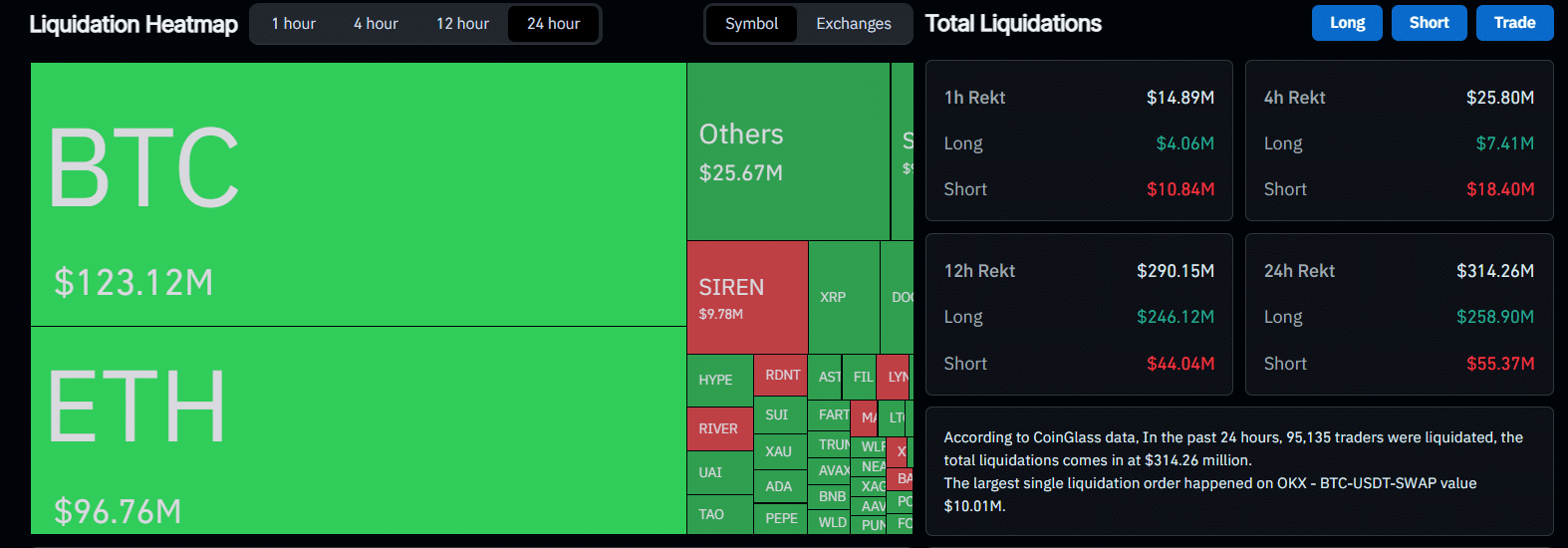
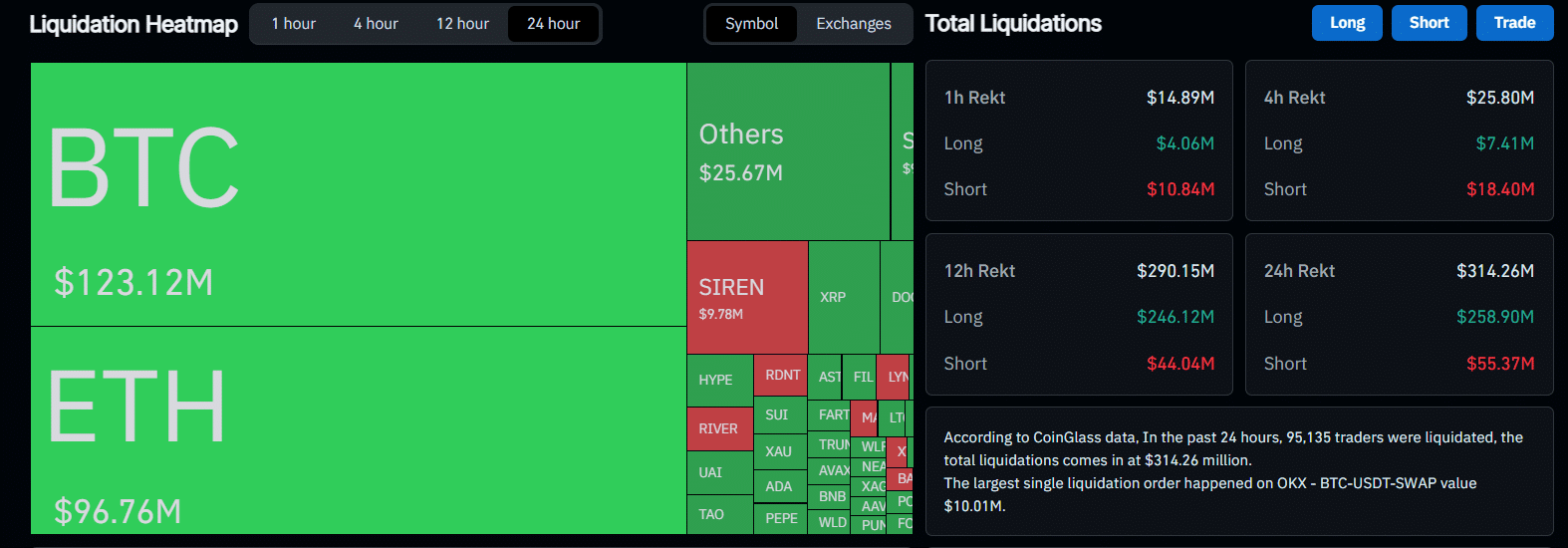
Source: CoinGlass

Meanwhile, Ethereum [ETH] fell 2.1%, confirming broad risk sensitivity. As volatility increased, the Fear and Greed Index dropped to 9, while shorts rose to 51.7%.

This setup implies that traders are shifting toward protection rather than accumulation, which suggests fragile liquidity and a market driven more by reaction than conviction.

Market-wide correction unfolds in tandem

Bitcoin’s drop set off a broader reaction, as altcoins moved lower in tandem but with varying intensity. Ethereum fell 3.01% to $2,091, while Ripple [XRP] dropped 3.04% and Solana [SOL] declined 2.86%, showing coordinated but uneven pressure.

In fact, this spread highlights how altcoins amplify downside when liquidity tightens, yet still track Bitcoin’s direction closely. Meanwhile, total market cap slipped to $2.37 trillion, signaling capital outflows, although not a full breakdown in structure.

At the same time, the CoinMarketCap 20 Index fell 2.5%, confirming broad weakness across large caps. This setup implies risk appetite is softening, while capital becomes more selective, meaning altcoins remain vulnerable but can stabilize quickly if Bitcoin regains momentum.

Bitcoin reflects macro stress amid oil-driven risks

As Hormuz tensions intensified, Bitcoin remained aligned with risk assets, not a safe-haven shift. Bitcoin dominance rose to 58.2%, up 0.27%, signaling rotation into BTC over altcoins rather than broad inflows.

This reflects defensive positioning within crypto, not renewed risk appetite. Meanwhile, ETF flows reflected shifting conviction across the market. On the 17th of March, Spot Bitcoin ETFs recorded $199 million in net inflows.

However, this trend quickly reversed. On the 18th of March, flows flipped to $163 million in outflows, signaling short-term uncertainty.

Even so, cumulative inflows still exceed $56 billion. As a result, underlying institutional interest continues to persist despite recent fluctuations.

As the price holds near $68,700–$69,000, stability appears conditional rather than strong. At the same time, stablecoin supply shows no sharp expansion, indicating limited fresh liquidity entering the market.


Related Questions

QWhat was the immediate impact of Trump's 48-hour ultimatum over the Strait of Hormuz on the cryptocurrency market?

AThe news caused Bitcoin's price to swing between $68,265 and $71,051, ultimately settling near $69,195 with a 2.2% drop, and triggered over $300 million in liquidations.

QHow did the broader altcoin market react to Bitcoin's price drop?

AAltcoins moved lower in tandem, with Ethereum falling 3.01%, Ripple (XRP) dropping 3.04%, and Solana (SOL) declining 2.86%, showing coordinated but uneven pressure.

QWhat did the rise in Bitcoin dominance to 58.2% signify about market sentiment?

AIt signaled a defensive rotation of capital into Bitcoin over altcoins, reflecting risk-off positioning within crypto rather than a broad shift into crypto as a safe-haven or renewed overall risk appetite.

QWhat was the trend in Spot Bitcoin ETF flows around March 17th and 18th?

ANet inflows of $199 million were recorded on March 17th, but this quickly reversed to $163 million in outflows on March 18th, indicating short-term uncertainty among investors.

QWhat does the lack of a sharp expansion in stablecoin supply indicate about the market?

AIt suggests that there is limited fresh liquidity entering the cryptocurrency market, meaning recent price action is more driven by existing capital repositioning than by new money flowing in.

Related Reads

In Jinjiang, Fujian, a Storage Super Unicorn Lies Quiet

In Fujian's Jinjiang, a city known for sportswear, lies a quiet semiconductor giant: Fujian Jinhua Integrated Circuit Co. (JHICC). Once a promising domestic DRAM manufacturer alongside Yangtze Memory and ChangXin Memory Technologies (CXMT), its journey was derailed in 2018 when the U.S. placed it on an Entity List and filed criminal charges for alleged trade secret theft. This halted production for years. A turning point came in February 2024 when a U.S. federal court found JHICC not guilty. However, it had lost crucial time. While CXMT soared to become a top-valued A-share company in 2024, JHICC, with an estimated valuation of 80 billion RMB, was just restarting. Its current output is primarily customized DDR4 chips, not the advanced DDR5/HBM demanded for AI, but it still benefits from the broader memory chip upcycle. JHICC's story is tied to Chen Zhengkun, a veteran engineer who left Micron to lead the venture. Founded in 2016 with state-backed funding, JHICC partnered with Taiwan's UMC to develop DRAM technology. Rapid progress was cut short by the U.S. actions, which Micron initiated, partly due to its heavy reliance on the Chinese market. Post-sanctions, Chen's team worked to rebuild the production line with reduced reliance on U.S. technology. According to its records, JHICC achieved small-scale production and revenue growth under immense pressure. It now focuses on the stable "niche" DRAM market (e.g., TVs, routers) with a monthly capacity of ~40,000 wafers, aiming for 60,000 by 2026. It holds over 1,000 patents but remains on the Entity List. For Jinjiang, investing in JHICC was a bold industrial leap. The local government provided unwavering financial and logistical support during the crisis, helping the company survive. JHICC has become the anchor for a growing local semiconductor cluster. Though its scale lags behind domestic peers, JHICC's persistence symbolizes a hard-won foothold in a global market long dominated by Samsung, SK Hynix, and Micron. Having missed one boom, it seeks a place in the new AI-driven memory supercycle.

marsbit1h ago

In Jinjiang, Fujian, a Storage Super Unicorn Lies Quiet

marsbit1h ago

Trading

Spot
活动图片




