What Are the Key Challenges in Robinhood's Advancement of Tokenized Stocks?

marsbitPublished on 2026-01-30Last updated on 2026-01-30

Abstract

Robinhood's push into tokenized stocks faces a key challenge: accurately reflecting corporate actions like stock splits and dividends on-chain. While blockchain-based tokenization promises real-time synchronization and transparency, Robinhood’s custom contracts on Arbitrum deviate from standard ERC-20 logic, causing significant data misinterpretations by third-party platforms. High-yield ETFs with frequent return-of-capital distributions and reverse stock splits require dynamic rebasing mechanisms that adjust token supply to reflect underlying NAV erosion or share consolidation. However, external data aggregators using conventional ERC-20 models overestimate circulating supply and market cap—sometimes by 10x to 100x—because they fail to capture these off-ledger adjustments. Of the 21 mismatched tokens identified, reported supply was inflated by 56%, with ~90% of errors stemming from dividend-driven NAV adjustments and the rest from reverse splits. Unlike Solana’s Token-2022 standard—which natively supports UI-scaling extensions—EVM chains lack a rebasing standard, forcing issuers like Robinhood and xStocks to use custom implementations. A proposed ERC-8056 standard aims to create a unified interface for corporate actions on Ethereum, which would improve interoperability and data accuracy across platforms.

Compiled by: Ken, Chaincatcher

Legendary investor Warren Buffett holds an almost religious, steadfast opposition to the concept of "stock splits."

The reason Berkshire Hathaway Class A shares trade at over $700,000 per share is that Buffett believes stock splits are merely a formalistic move that does not change the fundamental value of the enterprise. In Buffett's world, if you cut a pizza into eight slices instead of four, you don't get more pizza. You just have more dishes to wash.

While stock splits may not be a "big deal" from a valuation perspective, they are highly regulated activities overseen by the U.S. Securities and Exchange Commission and enforced by exchanges.

When a company announces a stock split, it must file a Form 8-K and notify shareholders in advance before the change takes effect. This critical time window allows transfer agents to adjust the share register, brokers to update internal systems, and data providers like Bloomberg to update their data feeds—so that a $500 stock doesn't appear to have crashed to $50 overnight after a 10-for-1 split.

Stock splits are not the only corporate actions that require this high level of coordination. Dividend distributions present similar complexities.

On the ex-dividend date, the stock price is adjusted downward by the amount of the dividend. Some funds, particularly high-yield income funds, take this practice to the extreme. They frequently distribute income, but these distributions are largely return of capital, essentially returning the investor's principal to them rather than paying investment profits. While the number of shares remains the same, the net asset value (NAV) is steadily eroded over time.

Tracking the performance of these funds requires a clear distinction between price return and total return.

Assume you hold 100 shares of a high-yield ETF, priced at $100 per share (an investment of $10,000). The fund distributes $5 per share monthly, with 90% classified as return of capital. After 12 months, you received $60 per share in cash (total $6,000), but the fund's NAV has dropped from $100 to $46. At this point, the total price return is negative $5,400, but the total return is $10,600 (remaining NAV $4,600 plus distributions of $6,000), a positive return of 6%.

These are precisely the problems blockchain is supposed to solve.

A single, shared ledger, updated atomically and visible to everyone simultaneously. If everyone reads from the same on-chain record, corporate actions like stock splits and dividends would propagate instantly throughout the system, eliminating the cumbersome and frantic reconciliation work currently done between isolated intermediaries.

It was this promise that led to a warm market reception when Robinhood (@RobinhoodApp) CEO Vlad Tenev announced the tokenized stock strategy in June 2025.

Six months on, Robinhood's tokens are officially live, and data is flowing. Unfortunately, some issues are beginning to surface.

The Good

Robinhood's announcement acted as a catalyst for the market.

Other issuers quickly moved to launch competing products. Backed Finance (acquired by Kraken) launched xStocks (@xStocksFi) on Solana, followed by Ondo Global Markets (@OndoFinance) launching its tokenized stock product.
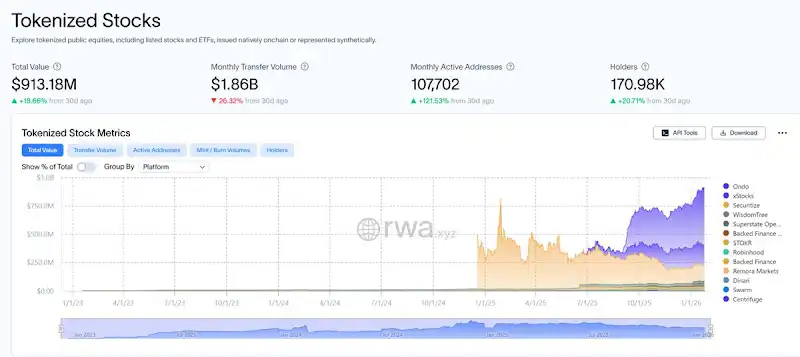
RWA.xyz data as of January 23, 2026

Tokenized stocks had a truly breakout year. In the second half of 2025 alone, the asset class grew by 128%, pushing the total asset value to nearly $1 billion.
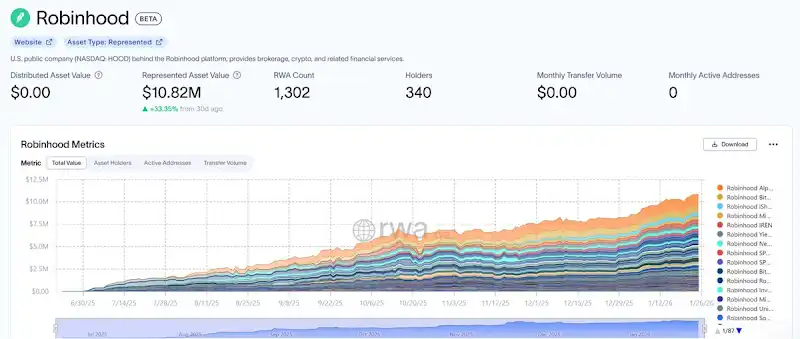
RWA.xyz data as of January 23, 2026

Robinhood's tokenized U.S. stocks and ETFs are now available to European customers. Each token is issued on the Arbitrum network, fully backed by stocks held by Robinhood, and enables 24/5 trading with zero commission. Relevant data is available on RWA.xyz.

However, accurately capturing the metrics for Robinhood's tokenized stocks has proven more complex than anticipated.

The Bad

Most blockchain data platforms index tokens assuming they follow standard conventions. For ERC-20 tokens, this means tracking mints and burns, accumulating the total supply from zero, and calculating market cap as supply multiplied by price.

This works for thousands of tokens on Ethereum and other EVM networks. But ERC-20 was not designed for securities that undergo corporate actions. The standard does not natively support stock splits, reverse splits, or benchmark adjustments driven by dividends.

Consequently, Robinhood had to use custom contracts to properly handle these events and ensure the rights of its end-users. These tokens work fine within the Robinhood App, but their mechanics are opaque to external data platforms and incompatible with DeFi protocols—both of which assume standard ERC-20 tokens.

When we compare the token supply calculated using standard ERC-20 logic with the actual on-chain data, the discrepancies are too large to ignore. Some tokens are off by a factor of 10, others by as much as 100.

Almost all errors can be attributed to two causes: (1) NAV erosion from dividends and (2) reverse stock splits.

NAV Erosion from High-Yield ETF Dividends

Data as of January 23, 2026

These are high-yield option income ETFs that pay frequent distributions, with 90% or more of the payout classified as "return of capital." Each distribution returns cash to investors, but this is primarily a return of principal rather than investment profits. The number of shares remains constant, while the NAV steadily declines over time.

Robinhood's contracts address this by decoupling "shares" from "tokens." The holder's share count remains the same, but an internal multiplier adjusts the reported token supply downward as return of capital accumulates, reflecting the erosion of the underlying NAV.

However, data platforms following the standard ERC-20 model simply add up mints and burns. This approach fails to capture this re-basing adjustment, overestimating the circulating token supply and thus the reported market cap.

Reverse Stock Splits
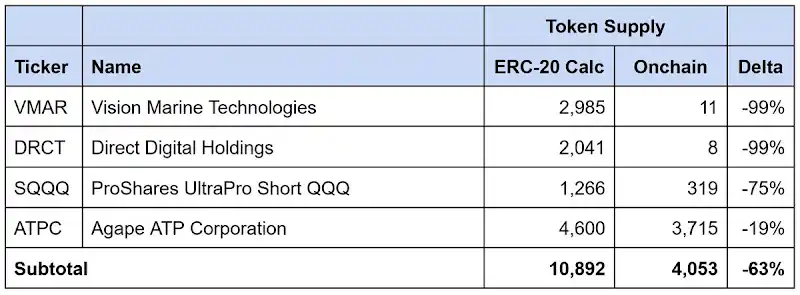
Data as of January 23, 2026

The same issue arises with reverse stock splits. Reverse splits increase the per-share price by consolidating shares, often to meet exchange listing requirements. The number of shares is reduced proportionally, but the price per share increases proportionally, leaving the total value unchanged.

Again, Robinhood's contracts adjust the token supply to reflect the reverse split, while third-party platforms following the standard ERC-20 model overestimate the circulating supply and reported market cap.

Total Robinhood Data Discrepancy
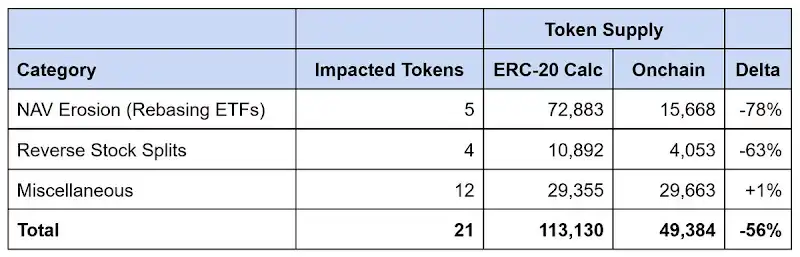
Data as of January 23, 2026

Among the 21 tokens we identified with data mismatches, the reported supply was overestimated by approximately 64,000 tokens, a discrepancy of up to 56%. NAV erosion from high-yield ETFs accounted for about 90% of this gap, with reverse stock splits explaining the remainder.

Any data platform relying on standard ERC-20 logic to calculate supply will severely overestimate the market cap of Robinhood's tokenized stocks, often by multiples.

The Solution

Tokenized Stock Taxonomy: Models & Infrastructure
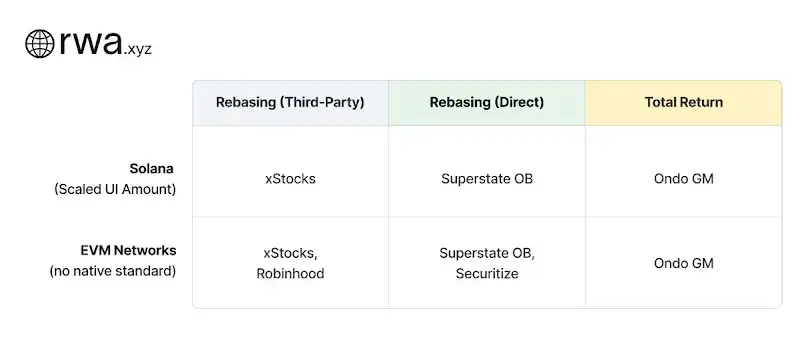
Tokenized stock issuers have taken different approaches to handling corporate actions. They can be broadly categorized into two types.

Rebasing Models

Rebasing models maintain现货价格平价 (spot price parity): meaning 1 token should always trade close to the price of 1 underlying share. When a corporate action occurs, token balances are automatically adjusted to maintain this relationship. Issuers using this method fall into two camps based on their relationship with the underlying asset issuer:

  • Rebasing (Third-Party): The issuer operates independently of the company whose stock is tokenized. Both xStocks (@xStocksFi, under Backed Finance / Kraken) and Robinhood (@RobinhoodApp) take this approach. Tokens are backed by custodied shares, but due to no direct relationship with the underlying issuer, they replicate economic exposure without conferring legal ownership.
  • Rebasing (Direct): The issuer partners with the public company to tokenize its shares. Superstate's Opening Bell (@SuperstateInc) and Securitize (@Securitize) operate as SEC-registered transfer agents and serve as the official shareholder registry. Because tokens are issued in coordination with the company, the tokens themselves are the legal securities, affording holders actual shareholder rights not available in the third-party model.

Both structures require multiplier infrastructure to reflect corporate actions on-chain.

Solana's Token-2022 standard natively provides a scaling UI amount extension. The issuer simply updates a multiplier, which then adjusts the balance displayed in the user interface without changing the raw token amount. For example, a 2-for-1 stock split changes the multiplier from 1.0 to 2.0; wallets显示 double the balance, while the underlying raw token count remains unchanged. As the standard is native to Solana, data platforms can directly query for multiplier changes.

EVM networks currently lack an equivalent standard. Issuers like xStocks and Robinhood have had to build their own multiplier mechanisms. While balances adjust correctly and wallets display prices consistent with the spot price, these implementations are bespoke. Third parties relying on standard ERC-20 calls cannot detect when the multiplier changes or query its current value. Therefore, each issuer's specific implementation must be understood separately.

This is why Chris Ridmann of Superstate and Gilbert Shih of Robinhood co-drafted ERC-8056, a proposed draft standard aiming to introduce a standardized "Scaling UI Amount Extension" for ERC-20 tokens. This would provide data platforms with a unified interface for tracking corporate actions across issuers.


Related Questions

QWhat are the key challenges Robinhood faces in advancing tokenized stocks according to the article?

AThe key challenges are accurately handling corporate actions like stock splits, reverse splits, and dividend-driven principal return distributions within the ERC-20 standard framework. Their custom contracts for these events are opaque to external data platforms and DeFi protocols, leading to significant miscalculations in reported token supply and market capitalization by third parties using standard ERC-20 logic.

QHow do high-yield ETFs cause net asset value erosion, and how does it affect token supply calculations?

AHigh-yield ETFs frequently distribute dividends, with over 90% often classified as a return of principal. This returns the investor's own capital rather than profit, so the share count remains the same but the net asset value (NAV) steadily declines over time. Robinhood's contracts use an internal multiplier to adjust the reported token supply downward to reflect this NAV shrinkage. Standard ERC-20 data platforms, which simply sum mints and burns, cannot capture this re-basing, causing them to overestimate the circulating token supply and market cap.

QWhat problem does a reverse stock split create for tokenized stocks on-chain?

AA reverse stock split reduces the number of shares to increase the price per share, keeping the total value constant. Robinhood's contracts adjust the token supply to reflect this change. However, third-party data platforms using the standard ERC-20 model fail to account for this adjustment, leading them to overestimate the circulating supply and the reported market capitalization of the token.

QWhat are the two main categories of models for handling corporate actions in tokenized stocks?

AThe two main categories are Rebasing Models. These maintain spot price parity (1 token ≈ 1 share) and automatically adjust token balances during corporate actions. They are further divided into Rebasing (Third-Party), where the issuer is independent of the company (e.g., xStocks, Robinhood), and Rebasing (Direct), where the issuer partners with the public company and the token is the legal security itself, providing actual shareholder rights (e.g., Superstate, Securitize).

QWhat proposed solution aims to standardize the handling of corporate actions for ERC-20 tokenized stocks?

AERC-8056 is a draft proposal co-authored by Chris Ridmann of Superstate and Gilbert Shih of Robinhood. It aims to introduce a standardized 'Scaling UI Amount Extension' for ERC-20 tokens. This would provide a unified interface for data platforms to track corporate actions across different issuers on EVM networks, which currently lack a native standard like Solana's Token-2022.

Related Reads

STAR 50 Soars 10.73%, Why Did A-Shares Stage a "V-Shaped Reversal"?

After a prolonged decline, the Chinese A-share market staged a strong rally on July 21. The STAR 50 index surged 10.73%, its largest single-day gain in nearly a year, leading a broad-based "V-shaped" reversal. The Shanghai Composite Index rose 1.79%, the Shenzhen Component Index gained 4.81%, and the ChiNext Index jumped 7.05%. Total market turnover reached 2.97 trillion yuan, an increase of 256.1 billion yuan from the previous session, with over 3,100 stocks advancing. The semiconductor sector spearheaded the rebound, with related ETFs posting significant gains. Analysts attribute the surge to three converging factors. First, coordinated capital inflows from "national team" institutions, insurance funds, listed company buybacks, and fund house self-purchases have bolstered market liquidity and confidence. Second, supportive policy signals, including commitments from regulators to ensure stable market operations, provided a favorable backdrop. Third, a stabilization and recovery in overseas markets, notably South Korea, created a positive external environment. Institutions suggest the most severe panic selling phase for the tech sector has likely passed, following a significant digestion of crowded positions and leveraged funds. While short-term volatility may persist, the medium to long-term outlook remains underpinned by enduring trends like AI computing demand expansion and semiconductor localization. The market's focus now shifts to the sustainability of supportive fund flows, earnings reports, and upcoming catalysts from the global AI industry chain.

marsbit6m ago

STAR 50 Soars 10.73%, Why Did A-Shares Stage a "V-Shaped Reversal"?

marsbit6m ago

U.S. Tech Momentum Stocks Post Largest Single-Day Gain Ever, But Is the Plunge Over?

US tech momentum stocks staged a sharp rebound on Tuesday (July 21st). Morgan Stanley's TMT Momentum Factor surged over 12%, marking its largest single-day gain on record, exceeding even peaks from the 2000 dot-com bubble. Key momentum indices from Goldman Sachs also posted their strongest daily performances in years. The rally was led by semiconductors, with the Philadelphia Semiconductor Index jumping 4.6%. This rebound followed three consecutive down days and a cumulative 33% plunge in momentum stocks, one of the steepest drawdowns since the dot-com era. Analysts attribute the surge largely to a short squeeze. Heavy selling had pushed high-beta momentum stocks into deeply oversold territory, forcing many short sellers, particularly in Asia, to cover their positions, creating a self-reinforcing buying spiral. However, the rebound's internals appear weak. Trading volume was notably low, and advancing stocks still lagged decliners on the S&P 500, indicating a narrow, concentrated rally rather than broad market participation. Diverging views emerge on the outlook. BTIG warns the bounce has hit key resistance and recommends selling into strength, citing extreme volatility and historical parallels to past market tops. Conversely, Goldman Sachs and UBS believe the momentum unwind is nearing its end, suggesting it may be time to gradually add exposure, as positioning has been significantly reduced. They caution, however, that high volatility warrants a measured approach, potentially using defined-risk strategies. The upcoming earnings season, particularly reports from major tech firms like Alphabet, is seen as a critical test for the rally's sustainability. Simultaneously, bond markets flashed a warning, with yields rising partly due to spiking oil prices. Analysts note that if long-term Treasury yields break decisively higher, it could pose a significant headwind for equities, especially growth stocks.

marsbit13m ago

U.S. Tech Momentum Stocks Post Largest Single-Day Gain Ever, But Is the Plunge Over?

marsbit13m ago

U.S. Tech Momentum Stocks Record Largest Single-Day Gain Ever, but Has the Rout Ended?

U.S. tech momentum stocks staged a dramatic rebound on Tuesday, July 21st. Key momentum indices like the Morgan Stanley TMT Momentum Factor and Goldman Sachs' High Beta Momentum Long Index posted historic or near-historic single-day gains, fueled largely by semiconductor stocks. This sharp rally followed a severe three-day sell-off that saw momentum stocks plunge 33%, marking one of the steepest pullbacks since the dot-com bubble. Analysts attribute the bounce primarily to a short squeeze, as forced covering from over-leveraged traders, particularly in Asia, created a buying spiral. However, the rally's health is questioned due to weak market breadth—overall trading volume was low, and decliners outnumbered advancers in the S&P 500 despite the index's gain—suggesting a narrow, concentrated surge rather than broad recovery. Opinions on the sustainability diverge. BTIG strategists warn the rebound has hit key resistance levels, citing extreme volatility and historic stock dispersion as signs of an ongoing broader correction, and recommend selling into strength. Conversely, Goldman Sachs and UBS view the aggressive momentum unwinding as nearing its end, noting reduced positioning and a lack of new fundamental catalysts. They suggest the sell-off presents a selective opportunity to add exposure, albeit cautiously and gradually using defined-risk strategies. The immediate trajectory hinges on the ongoing earnings season, with market focus on Alphabet's capital expenditure guidance for AI investment clarity. Meanwhile, bond markets present a risk, with rising Treasury yields—potentially heading toward 5.5%—and widening credit spreads for mega-cap tech companies posing a threat to equity valuations. The combination of technical factors, earnings results, and macro conditions leaves the durability of the rebound in doubt.

链捕手16m ago

U.S. Tech Momentum Stocks Record Largest Single-Day Gain Ever, but Has the Rout Ended?

链捕手16m ago

Long-Divided Must Unite, Long-United Must Divide: When L1 Becomes Its Own Rollup, What Is Ethereum's Endgame?

"The Inevitable Cycle: When L1 Becomes Its Own Rollup – What is Ethereum's Endgame?" For years, the Ethereum community grappled with concerns that L2s were fragmenting the ecosystem and eroding L1's value. While L2s provided cheaper execution, they also splintered liquidity and the unified user experience of a single chain. This has prompted a fundamental reassessment of the relationship between L1 and L2. Ethereum's roadmap is evolving. The "Scale" initiative merges L1 and L2 expansion into a holistic framework. L1 itself is advancing with higher gas limits, statelessness, and zkEVM verification, no longer content to be just a low-throughput settlement layer. Consequently, the primary value proposition of L2s is shifting from merely providing cheap blockspace to offering L1 cannot easily provide: application-specific optimizations, privacy features, and flexible governance models. L2s are becoming a spectrum of execution environments with varying degrees of security inheritance from Ethereum. A critical challenge in this multi-chain future is interoperability. The vision is to make Ethereum "feel like one chain again." This relies on advancements in native account abstraction (like EIP-7702) and intent-based architectures (Open Intents Framework), where users declare desired outcomes, and solvers handle the complex cross-chain execution. Furthermore, shortening Ethereum's finality time from minutes to seconds is crucial, as it underpins trust between chains for bridges, stablecoins, and cross-chain applications. Perhaps the most provocative idea is that Ethereum L1 itself could become a form of "its own Rollup." As zkEVM and proof systems mature, high-performance nodes could execute transactions and generate validity proofs. Regular validators would then verify these proofs instead of re-executing all transactions. This blurs the traditional L1/L2 hierarchy, making "Rollup" more of a general execution-verification architecture. Native Rollup aims to integrate L2 validation more directly into the Ethereum protocol, allowing L2s to inherit L1's security more fully and move away from reliance on security councils. In the end, L2s are not destined to replace L1 or be made obsolete by it. The likely future is a unified system where diverse execution environments—each optimized for specific use cases like DeFi, gaming, or privacy—coexist. They will share a common foundation of security, liquidity, and verifiable state, seamlessly connected to restore a cohesive user experience. The next phase for Ethereum is not just about scaling through separation, but about intelligently reintegrating what was separated back into a coherent whole.

链捕手32m ago

Long-Divided Must Unite, Long-United Must Divide: When L1 Becomes Its Own Rollup, What Is Ethereum's Endgame?

链捕手32m ago

Trading

Spot
活动图片




