WEEX Completes $2 Million WXT Buyback, Rewarding User Support for 'Futures Mining'

marsbitPublished on 2025-12-16Last updated on 2025-12-16

Abstract

Global cryptocurrency exchange WEEX has completed a $2 million buyback of its native token WXT, repurchasing 72,571,028 WXT tokens. The move is part of the platform’s effort to reward users for their participation in the "Futures Mining" campaign, which offers up to 30% trading fee rebates in WXT. The campaign, originally scheduled to end on December 15, has been extended by 10 days to December 25 due to high user demand. Participants receive real-time WXT rewards for each futures trade, with higher trading volumes unlocking greater rebate tiers, ranging from Bronze to King Miner levels. To prevent inflation and support token value, WEEX used its own funds for the buyback, maintaining WXT’s scarcity. Since its launch in July 2024, WXT has seen significant growth, with year-to-date gains of around 70%, making it one of the top-performing exchange tokens. WEEX has conducted four buybacks to date, burning 41.24% of WXT’s total supply. Additional token utility includes fee discounts, airdrops, and membership benefits, offering holders an estimated annualized return of 660.61%.

On December 16, globally leading cryptocurrency trading platform WEEX announced the completion of a new round of WXT buyback worth $2 million, totaling 72,571,028 WXT tokens repurchased.

This WXT buyback aims to reward global users for their support of WEEX's 'Futures Mining' campaign. The event offers up to 30% trading fee rebate rewards for users participating in futures trading, with rewards distributed in real-time via WXT tokens.

In other words, 'Futures Mining' transforms users' daily futures trading into a novel, fully trading volume-driven 'mining' model—the higher the trading volume, the higher the fee rebate ratio, with all WXT rewards credited instantly.

'Futures Mining' Continues to Boom, Event Extended by 10 Days

WEEX 'Futures Mining' aims to return platform growth dividends to users through the innovative incentive model of 'trading is mining'. During the event, users receive real-time WXT-based fee rebates for each futures open/close order, with rebates up to 30%.

Since its launch on November 26, the event has attracted active participation from global users, with trading heat continuously rising. According to WEEX official data, as of 18:00 on December 16 (UTC+8), the top 100 users on the 'Futures Mining' leaderboard have accumulated a total futures trading volume of $9.172 billion, with total mining rewards of 3,015,047.7 WXT (data updating in real-time).
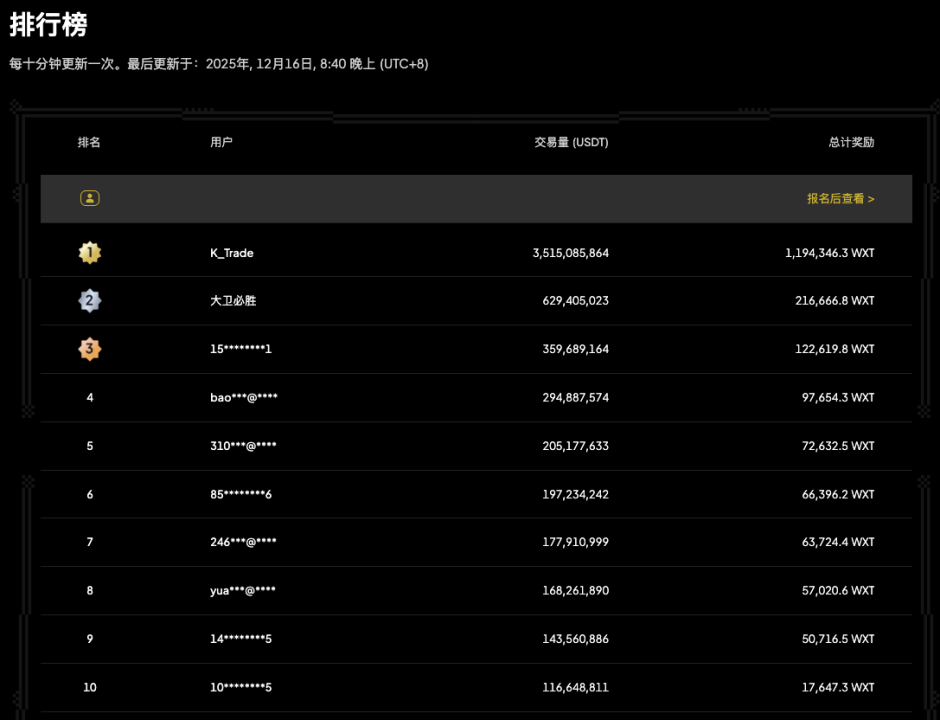
Due to the novel mechanism, generous rewards, and support for second-level settlement with instant rewards, the event has seen daily new participants and trading volumes repeatedly hit record highs after launch, with many users requesting an extension. Therefore, WEEX has extended the event by 10 days, moving the deadline from the original December 15 to December 25, allowing more users sufficient time to participate and continue enjoying mining rebate benefits.

This adjustment only extends the event duration; the rules remain unchanged: users click to register and participate in futures trading to receive WXT-based fee rebates, with WXT rewards credited in real-time after each open/close order.

Based on the miner tier mechanism of the 'Futures Mining' event, users start at the 'Copper Miner' tier. After trading begins, they can unlock Copper, Silver, Gold, Platinum, Diamond, and King tiers sequentially based on cumulative trading volume. The higher the trading volume, the higher the miner tier and fee rebate ratio, up to 30%. After the extension, users' unlocked miner tiers and rebate ratios remain effective. Trading fees generated during the extension will still be rebated in real-time at the corresponding ratio. Users can check their reward amounts and status in real-time via the WEEX App or official website.

72.57 Million WXT Buyback Completed, Ensuring Deflationary Effect

Unlike the token inflation issues faced by trading mining launched by other CEXs or liquidity mining on DeFi platforms, WEEX 'Futures Mining' not only maintains WXT's deflation but also genuinely demonstrates 'user rewards' sincerity through the $2 million WXT buyback supporting mechanism.

As previously announced, WEEX used platform funds to conduct a WXT buyback on the open market on December 16. By 17:00 (UTC) on December 16, the buyback plan was completed as scheduled, totaling 72,571,028 WXT repurchased at an average price of 0.027559 USDT/WXT.

Thus, the circulating supply of WXT will not increase due to the 'Futures Mining' event, maintaining WXT's scarcity and value stability, ensuring users' mining收益. Long-term, as WEEX's user base and trading volume continue to grow, the platform can invest more resources to further empower the WXT ecosystem, enhancing WXT's long-term appreciation potential.

Since its launch in July 2024, WXT has seen a maximum increase of over 358%, with a cumulative increase of over 180% to date. According to CMC data, WXT has risen about 70% year-to-date, ranking among the top 5 CEX platform tokens for yearly gains.

This outstanding performance is attributed to WEEX's long-term empowerment of the WXT ecosystem. To date, WEEX has completed 4 WXT buybacks via open market operations, cumulatively repurchasing 4,196,774,851 WXT tokens. The first three buybacks have been burned, with the burned amount accounting for 41.24% of WXT's total issuance, fully demonstrating WEEX's long-term support and confidence in the WXT token ecosystem.

In addition to buyback and burn, WEEX continues to empower WXT through various mechanisms such as WE-Launch new token listing airdrops, trading fee discounts, and trader权益 upgrades, resulting in a comprehensive annualized yield of up to 660.61% for WXT holders.

As the core of the WEEX ecosystem, WXT is dedicated to incentivizing partners, contributors, and active users of the exchange community. Through the 'Futures Mining' event and WXT buyback mechanism, WEEX not only creates more profit opportunities for users but also further consolidates WXT's market position.

Join WEEX now to experience the new 'Futures Mining' model and easily unlock more profits: https://www.weex.com/zh-CN/events/futures-trading/trade-to-earn


Related Questions

QWhat is the total amount and value of WXT tokens repurchased by WEEX in this round?

AWEEX repurchased a total of 72,571,028 WXT tokens, valued at $2 million.

QWhat is the main purpose of the 'Futures Mining' event launched by WEEX?

AThe main purpose of the 'Futures Mining' event is to reward users for their contract trading by providing up to 30% fee rebates, distributed in real-time with WXT tokens.

QHow does the miner ranking system work in the 'Futures Mining' event?

AUsers start as 'Copper Miners' and can unlock higher ranks (Silver, Gold, Platinum, Diamond, King) based on their cumulative trading volume. A higher rank grants a higher fee rebate percentage, up to 30%.

QHow does WEEX ensure the WXT token remains deflationary despite the mining rewards?

AWEEX uses its own funds to repurchase WXT tokens from the open market, which offsets the new tokens issued as mining incentives, thus maintaining the token's scarcity and deflationary nature.

QWhat is the cumulative amount of WXT tokens that WEEX has repurchased and burned to date?

AWEEX has repurchased a cumulative total of 4,196,774,851 WXT tokens, with the first three batches already burned, accounting for 41.24% of the total WXT issuance.

Related Reads

From Theft to Re-entry: How Was $292 Million "Laundered"?

A sophisticated crypto laundering operation was executed following the $292 million hack of Kelp DAO on April 18. The attack, attributed to the North Korean Lazarus group, began with anonymous infrastructure preparation using Tornado Cash to fund wallets untraceably. The hacker exploited a vulnerability in Kelp’s cross-chain bridge, stealing 116,500 rsETH. To avoid crashing the market, the attacker used Aave and Compound as laundering tools—depositing the stolen rsETH as collateral to borrow $190 million in clean, liquid ETH. This move triggered a bank run on Aave, causing an $8 billion drop in TVL. After consolidating funds, the attacker fragmented them across hundreds of wallets to evade detection. A major breakpoint was THORChain, where over $460 million in volume—30 times its usual activity—was processed in 24 hours, converting ETH into Bitcoin. This shift to Bitcoin’s UTXO model exponentially increased tracing complexity by shattering funds into countless untraceable fragments. The final destination was Tron-based USDT, the primary channel for illicit crypto flows. From there, funds were cashed out via OTC brokers in China and Southeast Asia, using unlicensed underground banks and UnionPay networks outside Western sanctions scope. Ultimately, the laundered money supports North Korea’s weapons programs, which rely heavily on crypto hacking for foreign currency. The incident underscores structural challenges in DeFi: its openness, composability, and lack of central control make such laundering not just possible, but inherently difficult to prevent.

marsbit1h ago

From Theft to Re-entry: How Was $292 Million "Laundered"?

marsbit1h ago

Google and Amazon Simultaneously Invest Heavily in a Competitor: The Most Absurd Business Logic of the AI Era Is Becoming Reality

In a span of four days, Amazon announced an additional $25 billion investment, and Google pledged up to $40 billion—both direct competitors pouring over $65 billion into the same AI startup, Anthropic. Rather than a typical venture capital move, this signals the latest escalation in the cloud wars. The core of the deal is not equity but compute pre-orders: Anthropic must spend the majority of these funds on AWS and Google Cloud services and chips, effectively locking in massive future compute consumption. This reflects a shift in cloud market dynamics—enterprises now choose cloud providers based on which hosts the best AI models, not just price or stability. With OpenAI deeply tied to Microsoft, Anthropic’s Claude has become the only viable strategic asset for Google and Amazon to remain competitive. Anthropic’s annualized revenue has surged to $30 billion, and it is expanding into verticals like biotech, positioning itself as a cross-industry AI infrastructure layer. However, this funding comes with constraints: Anthropic’s independence is challenged as it balances two rival investors, its safety-first narrative faces pressure from regulatory scrutiny, and its path to IPO introduces new financial pressures. Globally, this accelerates a "tri-polar" closed-loop structure in AI infrastructure, with Microsoft-OpenAI, Google-Anthropic, and Amazon-Anthropic forming exclusive model-cloud alliances. In contrast, China’s landscape differs—investments like Alibaba and Tencent backing open-source model firm DeepSeek reflect a more decoupled approach, though closed-source models from major cloud providers still dominate. The $65 billion bet is ultimately about securing a seat at the table in an AI-defined future—where missing the model layer means losing the cloud war.

marsbit7h ago

Google and Amazon Simultaneously Invest Heavily in a Competitor: The Most Absurd Business Logic of the AI Era Is Becoming Reality

marsbit7h ago

Trading

Spot
Futures
活动图片




