Weekly Token Unlocks: HYPE Unlocks Tokens Worth Approximately $320 Million

marsbitPublished on 2026-01-04Last updated on 2026-01-04

Abstract

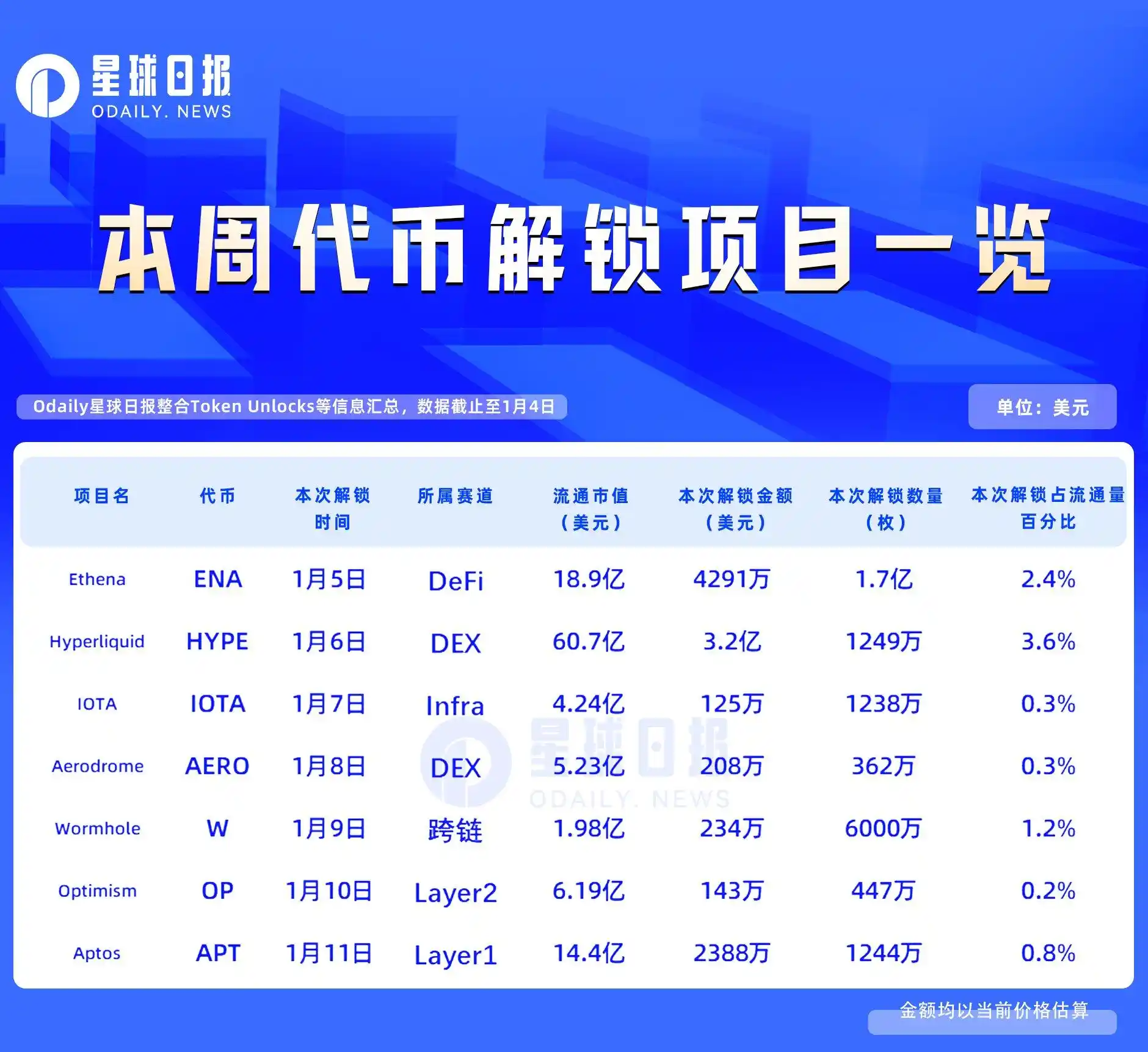
This week's major token unlocks feature significant releases from Hyperliquid and Ethena. Hyperliquid, a high-performance blockchain aiming to build a fully on-chain open financial system, will unlock 12.49 million tokens, valued at approximately $320 million. Ethena Labs, the creator of the algorithmic stablecoin USDe, will unlock 170 million tokens, worth roughly $42.91 million. USDe maintains its peg by utilizing collateral in BTC and stETH, generating yield from staking rewards and funding rates from short perpetual futures positions. Both projects have provided their specific token release schedules.

Hyperliquid

Project Twitter: https://x.com/HyperliquidX

Project Website: https://hyperfoundation.org/

This Unlock Amount: 12.49 million tokens

This Unlock Value: Approximately $320 million

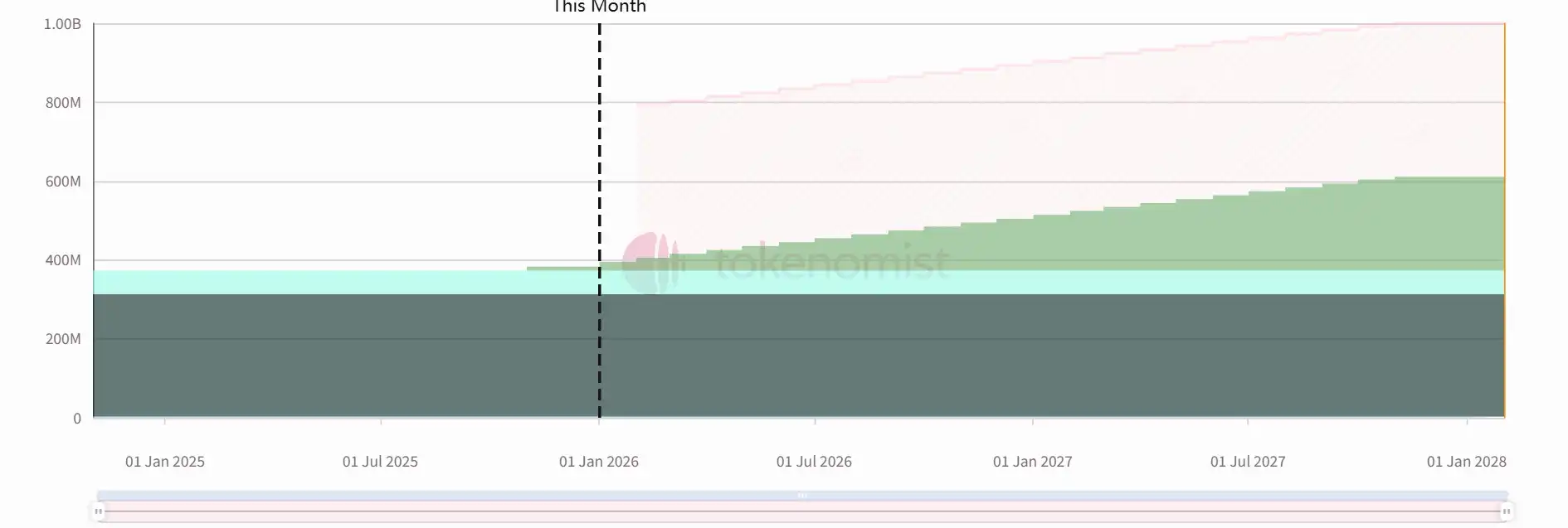
Hyperliquid is a high-performance blockchain built with the vision of creating a fully on-chain open financial system. Liquidity, user applications, and trading activities synergize on a unified platform, aiming to accommodate all financial operations.

Specific release curve is as follows:
Ethena

Project Twitter: https://x.com/ethena_labs

Project Website: https://www.ethena.fi/

This Unlock Amount: 170 million tokens

This Unlock Value: Approximately $42.91 million

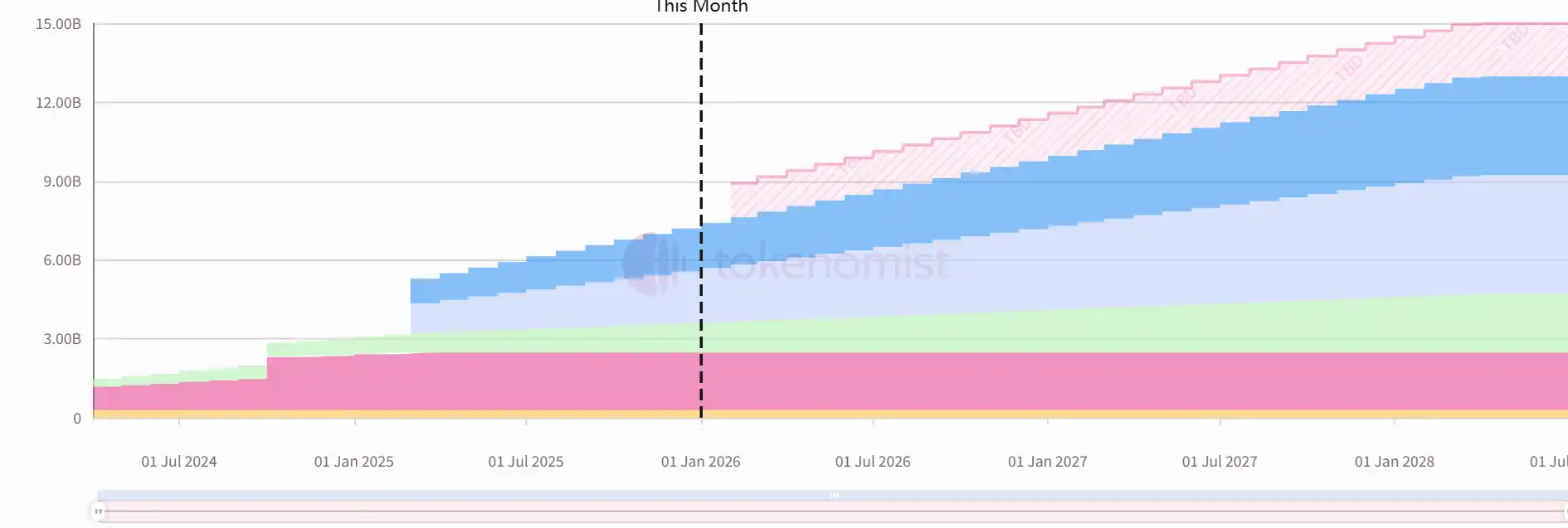
The algorithmic stablecoin USDe, launched by Ethena Labs, currently relies on collateral such as BTC and stETH, along with their inherent yields. It simultaneously creates Bitcoin and ETH short positions to balance Delta and utilizes perpetual/futures funding rates to maintain the peg and provide yields. Essentially, it uses the yield from spot positions to hedge the losses from the one-time short positions, achieving balance while capturing ETH staking yields and short position funding rates.

Specific release curve is as follows:
Related Questions

QWhat is the total value of tokens unlocked by Hyperliquid this week?

AApproximately $320 million worth of tokens.

QHow many HYPE tokens were unlocked in this event?

A12.49 million tokens.

QWhat is the purpose of the Hyperliquid blockchain?

ATo build a fully on-chain open financial system that unifies liquidity, user applications, and trading activities on a single platform.

QHow many ENA tokens were unlocked by Ethena Labs this week?

A170 million tokens.

QWhat is the mechanism behind Ethena Labs' algorithmic stablecoin USDe?

AIt uses collateral like BTC and stETH, creates short positions in Bitcoin and ETH to balance Delta, and utilizes perpetual/futures funding rates to maintain the peg and provide yield.

Related Reads

GitHub, Transfixed by AI

On the night of February 9th, GitHub suffered a major outage caused by a simple configuration change—reducing a cache refresh interval from 12 to 2 hours—that triggered a cascade of failures. This was not an isolated event, but part of a broader pattern. In early 2026, GitHub experienced at least 8 major incidents, failing to meet its promised 99.9% availability. These outages stemmed from structural issues: explosive growth in load, tight service coupling, and insufficient protection against abnormal traffic. This unprecedented load is driven by AI Agents. In 2025, GitHub handled ~1 billion commits. By 2026, weekly commits reached 275 million, projecting to ~14 billion for the year—a 14x increase. AI tools like Claude Code now contribute 4.5% of all public repository commits, with weekly submissions surging 25x in just three months. AI-generated pull requests jumped from 4 million to 17 million per month in half a year. Unlike human developers, AI Agents work continuously, generating commits at a scale that overwhelms infrastructure designed for human rhythms. The surge also shattered GitHub's business model. Copilot's flat-rate pricing, based on assisting human developers, became unsustainable as Agentic AI sessions consumed resources worth hundreds of dollars for a few dollars in fees. In response, GitHub imposed usage limits and, by June 1st, shifted to a pay-per-use "AI Credits" system. Facing this new reality, GitHub realized a 10x scaling plan was insufficient. It announced a need to *redesign* its architecture for 30x current scale—decoupling services, adding fault isolation, and improving change management to prevent cascading failures. Other platforms like Stripe and AWS are facing similar challenges with AI Agents. Fundamentally, GitHub is transitioning from a human collaboration platform to an "exhaust pipe" for automated AI workflows. Its detailed post-mortem reports aim to maintain trust during this turbulent rebuild. The February outage was not just a technical glitch, but a signal of the software industry's entry into a new, AI-driven era.

marsbit32m ago

GitHub, Transfixed by AI

marsbit32m ago

Both Suffer Massive Losses Exceeding $90 Billion, Which Is in Greater Peril: Strategy or Bitmine?

Facing massive paper losses exceeding $90 billion each amidst a sharp market downturn, "Digital Asset Treasury" (DAT) giants Strategy and Bitmine find themselves in a precarious position, but with different underlying risks. Strategy, heavily invested in Bitcoin (BTC), faces significant financial strain. Its strategy relies heavily on debt, including convertible notes and preferred stock (STRC) requiring substantial dividend payments. With its cash reserves dwindling and BTC offering no staking yield for cash flow, Strategy's high leverage makes it vulnerable. A continued price decline could force asset sales to meet obligations, potentially creating a negative feedback loop. Its market value has already fallen sharply. In contrast, Bitmine, an Ethereum (ETH) holder, appears on firmer financial ground. It primarily funds its purchases through equity offerings (like ATM programs), avoiding debt pressure. It also generates income by staking a large portion of its ETH holdings. While not immune to market drops and shareholder dilution concerns, Bitmine maintains more flexibility, recently announcing a new preferred share offering to raise further capital. The core divergence lies in their financing: Bitmine uses equity (investor money), while Strategy uses debt (borrowed money). Consequently, Bitmine currently faces less immediate liquidity pressure than Strategy, which must navigate the dual challenge of servicing debt/dividends and a declining core asset (BTC) price.

marsbit39m ago

Both Suffer Massive Losses Exceeding $90 Billion, Which Is in Greater Peril: Strategy or Bitmine?

marsbit39m ago

Trading

Spot
Futures
活动图片