Web3 Teams, Stop Wasting Your Marketing Budget on Platform X

marsbitPublished on 2026-03-12Last updated on 2026-03-12

Abstract

Web3 marketing teams are wasting budgets on ineffective X platform campaigns, as traditional promotion strategies have become obsolete. The classic model—announcement, followed by coordinated KOL posts, and then community discussion—no longer works due to X's new partnership disclosure rules, which make paid promotions obvious to users. This triggers ad avoidance instead of organic engagement. X rewards drama, memes, and debates, not formal announcements. Using Starknet's recent strkBTC campaign as a case study, the author notes that their promotional efforts resulted in low organic mentions and engagement. The solution is to flip the strategy: start by creating narrative tension through debates and comparisons (e.g., "Ethereum L2 vs. Bitcoin L2"), encourage community-generated content, and only then release the official announcement. The goal is to dominate conversations, not just broadcast messages. For developer outreach, building ecosystem prestige and showcasing success stories is more effective than announcement-led campaigns. The key takeaway: marketing must prioritize sparking discussion rather than controlling the message.

Original Author / Stacy Muur

Compiled by / Odaily Planet Daily Golem(@web 3_golem)

Every month, Green Dots conducts research on KOL promotional campaigns on Platform X to understand the strategies of other Web3 marketing teams and track which strategies and post styles are truly effective. However, due to the new paid partnership policy introduced by X, which has changed the marketing landscape on Platform X(Related reading: Musk casually overturns the rice bowl of crypto KOLs), most Web3 projects' promotional strategies are no longer suitable. Stacy Muur reveals in this article the common problems in many recent Web3 promotional activities, using Starknet as the case study for this analysis.

Author's statement: This is not targeting Starknet; their technical strength remains strong. Despite the many doubts and suspicions from the outside world after the airdrop and TGE, the team continues to release and develop products, which deserves respect. But this article focuses only on one aspect: marketing strategy. Starknet's recent new product promotion is just a typical example.

How did Starknet conduct its advertising promotion?

Starknet recently launched strkBTC [₿] and invited some content creators on Platform X to promote this event. They adopted a very classic promotion model:

  1. First, release an announcement with a promotional video;
  2. Within 12-48 hours of the announcement, KOLs will post collaborative promotional posts;
  3. Subsequently, publish articles to specifically explain the advantages of the product.

Even though this promotion was conducted in late February, to comply with Platform X's paid partnership policy, some creators included the paid partnership label when posting related content. But the focus of this article is not on the disclosure of payments, but on the effectiveness of this promotion strategy itself.

On February 10th, around another announcement released by Starknet, their marketing team conducted another KOL promotion. Exactly the same routine: first release a video announcement, then promote it through KOLs.

Of course, Starknet also has other promotional methods, such as publishing several long articles and conducting some promotional activities in the Korean language region.
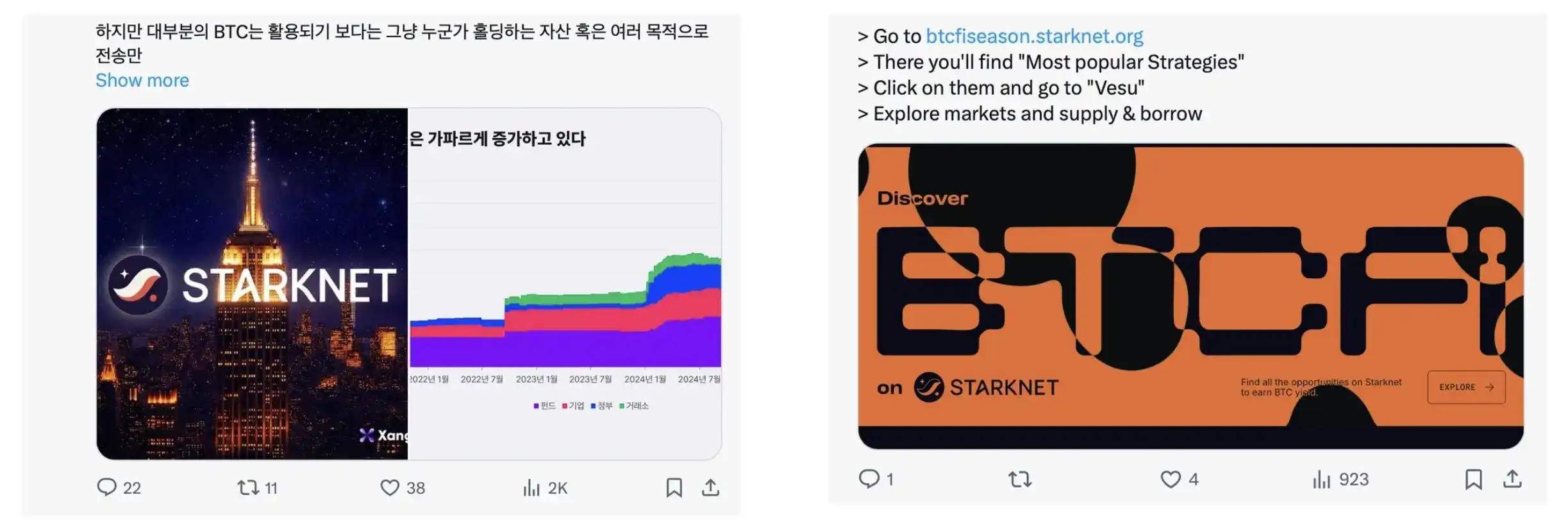
For the record, I don't know who was responsible for managing this campaign, nor whether any agency was involved. I am merely providing some thoughts from an outsider's perspective, from a marketer's point of view.

One problem is obvious throughout the promotion: the screening of creators participating in the promotion is weak.

X is essentially a perception layer. Ideally, creator promotions on X should bring:

  • More discussion about the brand
  • Trigger more voluntary posts from independent creators
  • Drive the production of more community content
  • Stronger ecosystem activation

But is that what we see? Not really.

If you use simple filtering conditions on X to view popular posts mentioning Starknet in February, the results are obvious.
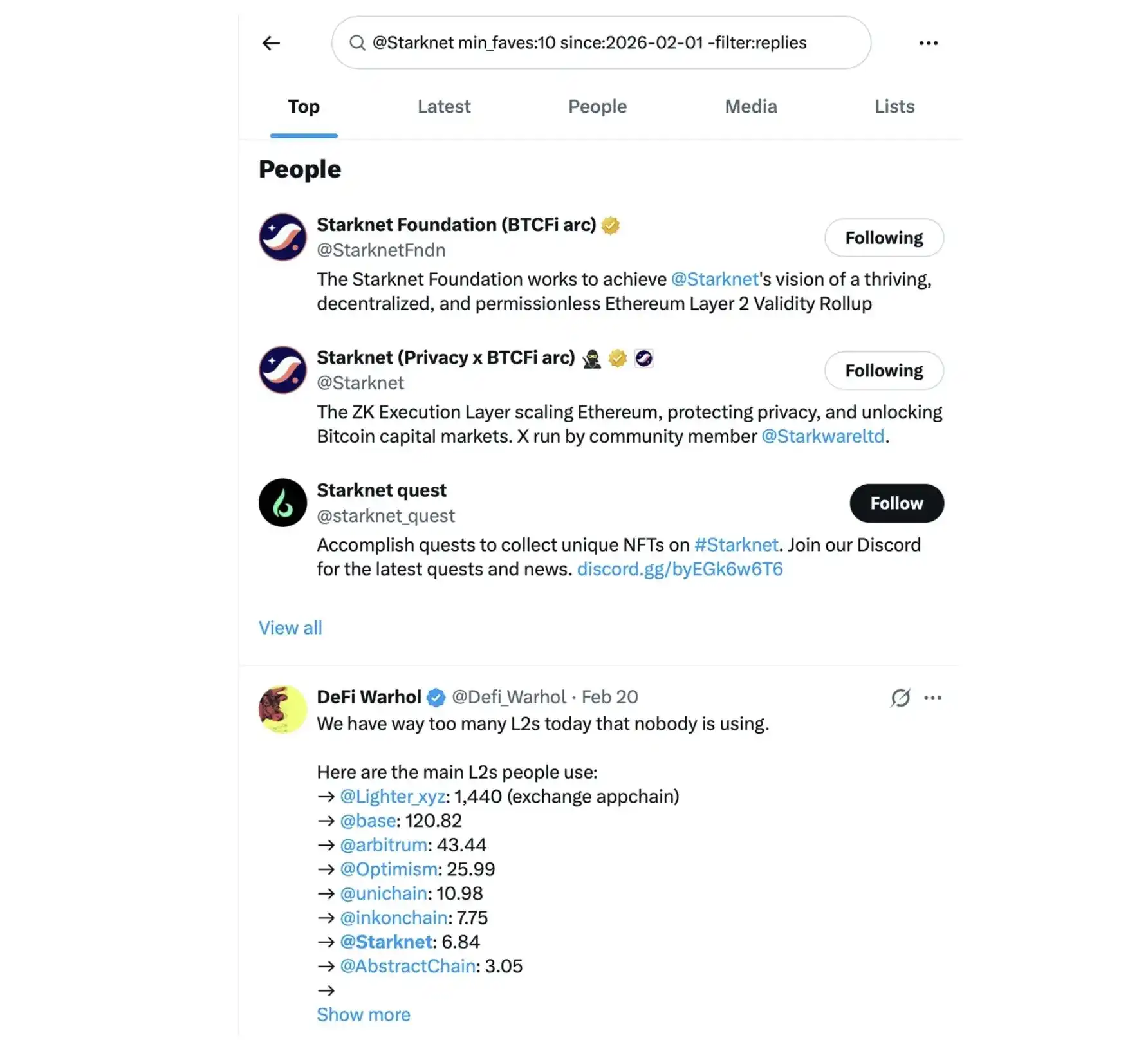
The most mentioned post was actually from Warhol. Overall, in February, only a little over 100 independent posts mentioning Starknet received more than 10 likes. For a well-known L2 ecosystem, this number is not high.

Some popular organic mentions of Starknet included:

  • Mookie's post about token unlocks (approx. 10k views)
  • Warhol's post about the best internship brands in the crypto industry (approx. 16k views)
  • Warhol's L2 rating list (approx. 30k views)
  • santiment's post ranking L2s by developer activity (approx. 50k views)
  • mztacat's post about the "Big Four companies" (approx. 82k views)

The above roughly constitutes Starknet's mention volume on Platform X in February. This leads to a more important question, not just concerning Starknet, but concerning the fact that the classic Web3 marketing strategy is gradually failing on Platform X.

Why is the classic Web3 advertising strategy failing?

For years, the default mode of Web3 marketing has been this: Announcement -> KOL promotion -> Community discussion.

This classic model worked when X's timeline was less crowded, narratives were strong, and most promotions were not easily identifiable as paid promotions. But it started failing after the following changes occurred.

Paid disclosure kills implicit virality

Once creators started adding paid disclosure information, this promotion model became obvious to followers.

First, users see an announcement, then within the next 24 hours, 5-10 similar promotional posts appear, all with largely identical content. Users can immediately recognize this structure. It doesn't trigger community discussion; instead, it sends a signal that "this is an ad campaign."

In the environment of Crypto Twitter, ads rarely spark community discussion; they are usually just scrolled past.

KOL behavior is now very easy to identify

Crypto Twitter has matured; people understand how KOL marketing works.

When the same group of creators quotes the same announcement with slightly different wording, it's easily interpreted as a coordinated promotion. And once KOL content is clearly identified as a promotion, user engagement drops because the audience switches from curiosity mode to ad-filtering mode.

X rewards buzz, not announcements

X is not a distribution channel; it's a narrative space. Unless a Web3 project's announcement can trigger the following, they rarely become trending topics:

  • Arguments and debates
  • Meme coins
  • Hot takes
  • Competition between KOLs

Without these dynamic factors, dissemination can only bring brief user reach but cannot truly win users' minds. Therefore, to truly gain buzz, Web3 projects should change the sequence of their marketing campaigns.

The old promotion flow was: Announcement -> KOL promotion -> Community discussion. The new promotion structure should be: First build the topic -> Spark creator debate -> Generate community content -> Finally announce, so the announcement becomes the final confirmation moment, not the starting point.

If the project skips the narrative stage, promotion has nothing to build on.

How to redesign a promotion campaign for Starknet

Let's get back to reality. Starknet carries heavy baggage. The previous airdrop phase triggered a lot of fear, uncertainty, and doubt. Explanations and promotional videos alone cannot solve this problem; the project needs to control the conversation to resolve it. Different goals also require different marketing strategies.

If the goal is to win mindshare

The strategy should be to actively engage in controversy. Don't try to suppress critics; design topics that can spark debate.

For example:

  • "Which L2 is better for developing BTCFi?"
  • "Ethereum L2 vs Bitcoin L2"
  • "Top 5 ecosystems for BTCFi developers"

Then sponsor posts related to ranking lists, posts comparing Starknet with other projects, and posts with debates. Maybe half the timeline will support Starknet, and the other half will attack Starknet, but both sides increase exposure. Creating drama is not bad marketing; marketing that goes unnoticed is bad.

If the goal is to dominate the narrative

Then stop publishing lengthy PR articles; few people read them. Instead, publish visual infographics, ecosystem maps, competitor comparisons, and short frameworks that KOLs can reuse. Giving creators space to remix content is far more powerful than content they can only quote.

The goal of dominating the narrative is not one good article, but dozens of derivative articles. This is how narratives spread.

If the goal is to attract developers

Then remember that developer acquisition is a B2B model. Posting announcements on X is not effective for developer onboarding. What projects should do is:

  • Build topic momentum
  • Build ecosystem prestige
  • Showcase developers who have already found success there

Once this trend forms, onboarding developers becomes much easier. Because developers also chase hotspots.

Conclusion

The traditional Web3 promotion model (Announcement -> KOL promotion) is dying on X. The new model is more like: Design the topic -> Spark creator interest -> Trigger discussion -> Let the community run with it.

The project's announcement is still important, but it should no longer be the beginning of the promotion campaign; it should be the end point.


Related Questions

QAccording to the article, why is the classic Web3 marketing strategy of 'announcement → KOL promotion' no longer effective on platform X?

AThe strategy is no longer effective due to several key changes: paid disclosure labels make the promotional nature obvious to users, the coordinated posting by KOLs is easily recognized as a campaign, and the X platform's algorithm rewards engaging topics and drama rather than simple announcements.

QWhat does the author suggest is the new, more effective structure for a marketing campaign on X?

AThe author suggests the new structure should be: design a debatable topic → spark creator debate → generate community content → and finally, publish the official announcement as the confirmation point, not the starting point.

QWhat was identified as a major problem with Starknet's recent promotional campaign on X?

AA major problem was the weak vetting of the creators involved in the promotion, which failed to generate significant independent discussion, community content, or ecosystem activation.

QWhat specific type of content does the author recommend creating to dominate public opinion, instead of long PR articles?

AThe author recommends creating visual infographics, ecosystem maps, competitor comparisons, and short, reusable frameworks that creators can easily remix and build upon, leading to dozens of derivative posts.

QFor the goal of attracting developers, what does the article say is more effective than making announcements on X?

AFor attracting developers, it is more effective to build topic momentum, create ecosystem prestige, and showcase developers who have already found success on the platform, as developer acquisition is a B2B process that follows trends.

Related Reads

Gensyn AI: Don't Let AI Repeat the Mistakes of the Internet

In recent months, the rapid growth of the AI industry has attracted significant talent from the crypto sector. A persistent question among researchers intersecting both fields is whether blockchain can become a foundational part of AI infrastructure. While many previous AI and Crypto projects focused on application layers (like AI Agents, on-chain reasoning, data markets, and compute rentals), few achieved viable commercial models. Gensyn differentiates itself by targeting the most critical and expensive layer of AI: model training. Gensyn aims to organize globally distributed GPU resources into an open AI training network. Developers can submit training tasks, nodes provide computational power, and the network verifies results while distributing incentives. The core issue addressed is not decentralization for its own sake, but the increasing centralization of compute power among tech giants. In the era of large models, access to GPUs (like the H100) has become a decisive bottleneck, dictating the pace of AI development. Major AI companies are heavily dependent on large cloud providers for compute resources. Gensyn's approach is significant for several reasons: 1) It operates at the core infrastructure layer (model training), the most resource-intensive and technically demanding part of the AI value chain. 2) It proposes a more open, collaborative model for compute, potentially increasing resource utilization by dynamically pooling idle GPUs, similar to early cloud computing logic. 3) Its technical moat lies in solving complex challenges like verifying training results, ensuring node honesty, and maintaining reliability in a distributed environment—making it more of a deep-tech infrastructure company. 4) It targets a validated, high-growth market with genuine demand, rather than pursuing blockchain integration without purpose. Ultimately, the boundaries between Crypto and AI are blurring. AI requires global resource coordination, incentive mechanisms, and collaborative systems—areas where crypto-native solutions excel. Gensyn represents a step toward making advanced training capabilities more accessible and collaborative, moving beyond a niche controlled by a few giants. If successful, it could evolve into a fundamental piece of AI infrastructure, where the most enduring value in the AI era is often created.

marsbit7h ago

Gensyn AI: Don't Let AI Repeat the Mistakes of the Internet

marsbit7h ago

Why is China's AI Developing So Fast? The Answer Lies Inside the Labs

A US researcher's visit to China's top AI labs reveals distinct cultural and organizational factors driving China's rapid AI development. While talent, data, and compute are similar to the West, Chinese labs excel through a pragmatic, execution-focused culture: less emphasis on individual stardom and conceptual debate, and more on teamwork, engineering optimization, and mastering the full tech stack. A key advantage is the integration of young students and researchers who approach model-building with fresh perspectives and low ego, prioritizing collective progress over personal credit. This contrasts with the US culture of self-promotion and "star scientist" narratives. Chinese labs also exhibit a strong "build, don't buy" mentality, preferring to develop core capabilities—like data pipelines and environments—in-house rather than relying on external services. The ecosystem feels more collaborative than tribal, with mutual respect among labs. While government support exists, its scale is unclear, and technical decisions appear driven by labs, not state mandates. Chinese companies across sectors, from platforms to consumer tech, are building their own foundational models to control their tech destiny, reflecting a broader cultural drive for technological sovereignty. Demand for AI is emerging, with spending patterns potentially mirroring cloud infrastructure more than traditional SaaS. Despite challenges like a less mature data industry and GPU shortages, Chinese labs are propelled by vast talent, rapid iteration, and deep integration with the open-source community. The competition is evolving beyond a pure model race into a contest of organizational execution, developer ecosystems, and industrial pragmatism.

marsbit9h ago

Why is China's AI Developing So Fast? The Answer Lies Inside the Labs

marsbit9h ago

3 Years, 5 Times: The Rebirth of a Century-Old Glass Factory

Corning, a 175-year-old glass company, is experiencing a dramatic revival as a key player in AI infrastructure, driven by surging demand for high-performance optical fiber in data centers. AI data centers require vastly more fiber than traditional ones—5 to 10 times as much per rack—to handle high-speed data transmission between GPUs. This structural demand shift, coupled with supply constraints from the lengthy expansion cycle for fiber preforms, has created a significant supply-demand gap. Nvidia has invested in Corning, along with Lumentum and Coherent, in a $4.5 billion total commitment to secure the optical supply chain for AI. Corning's competitive edge lies in its expertise in producing ultra-low-loss, high-density, and bend-resistant specialty fiber, which is critical for 800G+ and future 1.6T data rates. Its deep involvement in co-packaged optics (CPO) with partners like Nvidia further solidifies its position. While not the largest fiber manufacturer globally, Corning's revenue from enterprise/data center clients now exceeds 40% of its optical communications sales, and it has secured multi-year supply agreements with major hyperscalers including Meta and Nvidia. Financially, Corning's optical communications revenue has surged, doubling from $1.3 billion in 2023 to over $3 billion in 2025. Its stock price has risen nearly 6-fold since late 2023. Key future catalysts include the rollout of Nvidia's CPO products and the scale of undisclosed customer agreements. However, risks include high current valuations and potential disruption from next-generation technologies like hollow-core fiber. The company's long-term bet on light over electricity, maintained even through the telecom bubble crash, is now being validated by the AI boom.

marsbit9h ago

3 Years, 5 Times: The Rebirth of a Century-Old Glass Factory

marsbit9h ago

Trading

Spot
Futures
活动图片




