Warsh Ends the 'Dollar Devaluation Trade'? Crypto Market Continues Plunge Over Weekend, Bitcoin Breaks Below $80,000 Mark

华尔街日报Published on 2026-02-01Last updated on 2026-02-01

Abstract

The cryptocurrency market experienced a significant sell-off over the weekend, with Bitcoin falling below the $80,000 mark to its lowest level since April of last year. The decline, which extended a month-long downward trend, was partly triggered by former President Trump’s nomination of Kevin Warsh as the next Federal Reserve Chair. Analysts suggest that Warsh’s expected hawkish stance on inflation may reduce the appeal of “sell America” trades, including bets against the U.S. dollar. During the sell-off, Bitcoin dropped as much as 10% to around $75,710, while Ethereum and Solana saw even steeper declines of over 17%. Approximately $1.6 billion in long and short positions were liquidated within 24 hours, with outflows from spot ETFs further indicating weak investor interest. Market observers noted particularly low retail engagement, with trading volumes expected to remain subdued in the near term. Notably, Bitcoin failed to attract safe-haven demand despite heightened geopolitical tensions between Israel and Iran, as well as a surge in gold and silver prices. Instead, traditional assets like precious metals and cash continued to be preferred shelters for investors concerned about fiat currency risks. Regulatory uncertainty in the U.S., including delays in crypto market structure legislation, also contributed to the negative sentiment. Warsh nomination appears to have reversed earlier strong rallies in cryptocurrencies, gold, and silver, as markets anticipate a less interv...

The cryptocurrency market experienced a new round of sell-offs over the weekend, with Bitcoin falling below the $80,000 mark to its lowest level since April of last year, extending a month-long downward trend. This selling wave, which began after Trump nominated Warsh as Fed Chair, has not only hit cryptocurrencies hard but also reversed the gains in gold and silver, as market bets on dollar devaluation are unraveling.

Amid thin liquidity and limited buying interest, Bitcoin's decline reached 10% at one point on Saturday, touching a low of $75,709.88. Other major tokens like Ethereum and Solana saw even steeper drops, falling by 17% and over 17% respectively. According to CoinGecko data, the total market value of cryptocurrencies evaporated by approximately $111 billion in the past 24 hours.
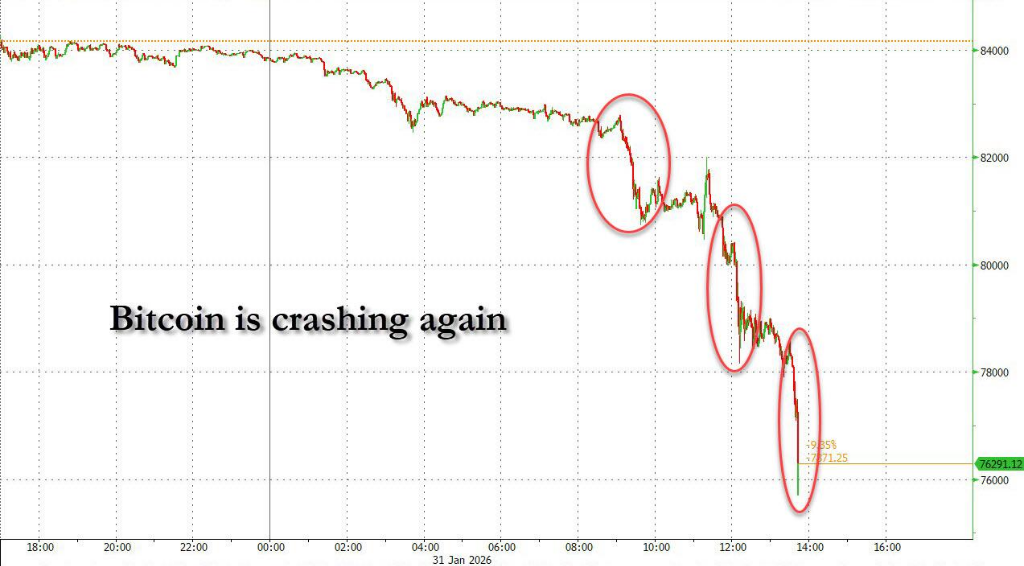
This decline occurred against a backdrop of thin liquidity and limited buying interest, amplifying the drop of the world's largest cryptocurrency to over 30%. Data from market tracker Coinglass showed that about $1.6 billion in long and short positions were liquidated during the same period, with most occurring in the last four hours, primarily concentrated in Bitcoin and Ethereum.

The news of President Trump nominating Warsh to serve as the next Chair of the Federal Reserve seemed to exacerbate the cryptocurrency decline. As previously reported by Wall Street Insights, former Goldman Sachs executive Gavyn Davies stated that choosing Warsh reduces the risk of a crisis triggered by the "Sell America" trade, as he is expected to be resolute in guarding against inflation.

Liquidation Scale Expands, Retail Interest Remains Low

According to data from market tracker Coinglass, approximately $1.6 billion in long and short positions were liquidated in the past 24 hours, with most occurring in the last four hours, primarily concentrated in Bitcoin and Ethereum.

After closing at $83,817 on Friday, Bitcoin fell to $78,092 by Saturday evening, a drop of 7%. This decline brings it back to levels seen after April '25, continuing weeks of macro-level disappointment.
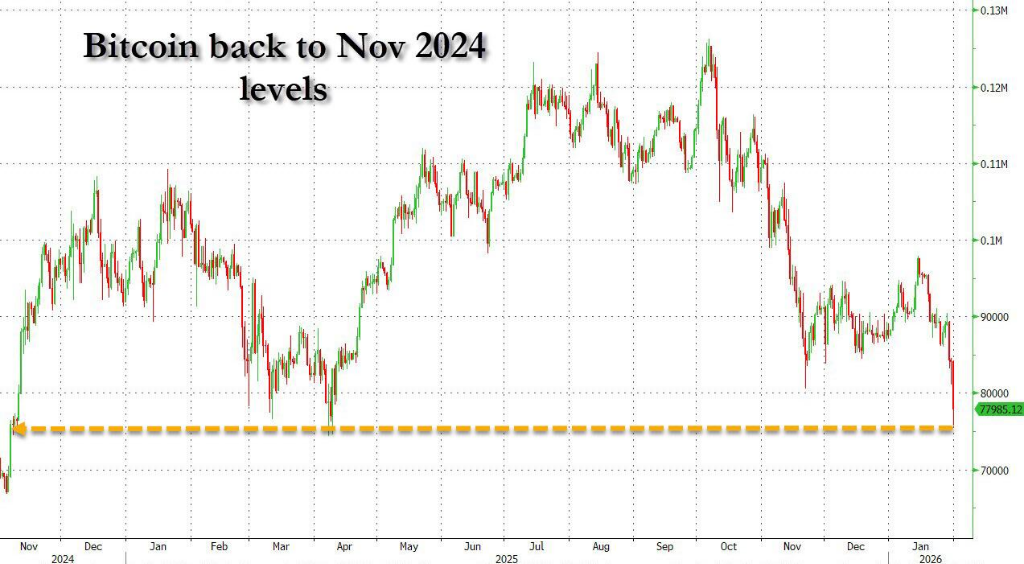
Needham analyst John Todaro said, "The current levels indicate extremely low interest from retail investors," adding that trading volume could remain low for "the next one or two quarters." Continued outflows from spot ETFs further confirm the waning investor interest.

Safe-Haven Attribute Fails, Gold and Silver Become Preferred

Davies, the former chief economist and partner at Goldman Sachs Group, stated that Warsh's policy mix might be welcomed by market participants, though he wishes to reduce the Fed's role in the markets, meaning he may be less willing to intervene during stock market turbulence. "Many market observers would like this combination—a smaller balance sheet alongside more deregulation of the banking system."

Gavyn Davies, Co-founder and Chairman of Fulcrum Asset Management and head of the London office, said in a video posted on the company's website:

"The market, including the dollar, will breathe a significant sigh of relief. Choosing Warsh reduces the risk of that truly crisis-inducing 'Sell America' trade."

Despite the dollar weakening for most of January and growing investor wariness towards the policy risks of the Trump administration, this change failed to boost cryptocurrency market sentiment. Similarly, when gold prices surged to record highs, Bitcoin failed to respond meaningfully.

Louis Navellier of Navellier & Associates said, "Silver and gold have become the tools for investors worried about fiat currency." After gold and silver experienced significant pullbacks on Friday, Bitcoin still failed to attract inflows. Traditional safe-haven funds remain concentrated in metals and cash.

This absence of buying highlights the dilemma of Bitcoin's role in a broader investment portfolio. Geopolitical risks have failed to spark demand, and Bitcoin's dual positioning as both a momentum trade and a hedge against currency devaluation is now in trouble.

Geopolitical Tensions and Regulatory Uncertainty

Bitcoin prices could also be affected by escalating tensions between Israel and Iran. According to Xinhua News Agency, Trump stated that the US and Iran are negotiating, and an advisor to Iran's Supreme Leader said a "negotiation framework" is taking shape. Earlier on January 31st, social media was flooded with rumors about the assassination of the commander of Iran's Islamic Revolutionary Guard Corps Navy, drone attacks on naval bases, and explosions in multiple locations. Iranian media debunked these rumors one by one, stating that the claims were untrue.

Furthermore, delays in new market structure regulations for the US cryptocurrency industry have dampened interest in digital assets. The market had anticipated that regulatory clarity would boost confidence, but the Senate committee's shift in focus to housing issues has led to a postponement of cryptocurrency legislation.

It is worth noting that although Warsh has called Bitcoin a "good asset" and a "good cop on the beat for policy," his nomination news seems to have reversed the strong rally in gold, silver, and cryptocurrencies. The market expects that Warsh may wish to reduce the Fed's role in the markets, meaning he might be less willing to intervene during periods of stock market turbulence.


Related Questions

QWhat triggered the latest sell-off in the cryptocurrency market according to the article?

AThe sell-off was triggered by former President Trump's nomination of Kevin Warsh as the next Federal Reserve Chair, which led to a reversal of the 'dollar贬值交易' (dollar devaluation trade) as markets expect Warsh to be tough on inflation.

QHow much did Bitcoin's price drop to during the weekend sell-off, and what was the percentage decline?

ABitcoin's price dropped to $75,709.88 during the sell-off, representing a decline of 10% at its lowest point, and it fell below the $80,000 mark.

QWhat was the total value erased from the cryptocurrency market in the past 24 hours, as per CoinGecko data?

AApproximately $111 billion was erased from the total cryptocurrency market value in the past 24 hours, according to CoinGecko data.

QWhy did the article mention that Bitcoin's 'safe-haven'属性失效 (safe-haven attribute failed)?

ABitcoin's safe-haven attribute failed because it did not attract meaningful inflows even as gold and silver reached record highs or during geopolitical tensions, with traditional safe-haven funds remaining concentrated in metals and cash.

QWhat impact did Kevin Warsh's nomination have on market expectations regarding the Federal Reserve's role?

AKevin Warsh's nomination led markets to expect that he would want to reduce the Federal Reserve's role in markets, meaning he might be less willing to intervene during stock market turbulence, and he is anticipated to focus on a smaller balance sheet and banking deregulation.

Related Reads

Must-Watch Events Next Week|CLARITY Act Could Face Senate Vote; SpaceX, Circle to Report Earnings (8.3-8.9)

**Summary: Key Events and Developments to Watch (August 3-9)** The upcoming week is marked by significant financial disclosures, key legislative deadlines, and notable product updates. **Major Financial Events:** Several companies are scheduled to release their Q2 2026 earnings. American Bitcoin (ABTC) will report on August 3, followed by SpaceX and Hut 8 Mining Corp. on August 4, and Circle on August 5. Notably, a significant portion of SpaceX shares (up to 12% of total shares) will be unlocked on August 6 following their earnings release. **Key Legislative Deadline:** The U.S. Senate faces an August 7 deadline to secure 60 votes for the CLARITY Act, a bipartisan bill aiming to establish a federal regulatory framework for cryptocurrencies. The Senate may hold a full vote on the bill during the week. **Economic Data:** The U.S. July Non-Farm Payrolls report will be released on August 7, providing crucial labor market data. **Technology & Product Updates:** * **Shutdowns:** DeFi portfolio tracker Zapper and wallet app Ctrl Wallet will cease operations on August 3. * **Upgrades:** LayerZero will deprecate its v1 relayers on August 3. XRP Ledger's new version 3.3.0, featuring five new functions, is expected next week. * **AI:** Elon Musk announced that the advanced Grok 4.6 AI model is set for release around August 7. * **Bitcoin:** The BIP-110 forced signaling for a potential Bitcoin network change is scheduled to begin around August 8. **Other Notable Events:** Chinese robotics firm Unitree Tech has set its preliminary price inquiry for its IPO for August 5. South Korean exchange Upbit will delist AQT and AERGO tokens on August 3.

marsbit1h ago

Must-Watch Events Next Week|CLARITY Act Could Face Senate Vote; SpaceX, Circle to Report Earnings (8.3-8.9)

marsbit1h ago

Stocks Are Plummeting More Sharply Than Cryptocurrencies. Where Has the Money Gone?

Stock Markets Plunge Deeper Than Cryptocurrencies: Where Did the Money Go? In late July, Seoul's Kospi index triggered circuit breakers for two consecutive days, plummeting over 40% from its June high. The collapse was led by heavyweight stocks like SK Hynix, whose record profits still disappointed investors, and devastating leveraged ETFs, with one major product losing over 83% of its value. This signaled a global, forced deleveraging targeting the most crowded trades. Interestingly, while stocks exhibited extreme volatility akin to crypto markets, Bitcoin rose nearly 15% in July after a prior steep drop. Analysis shows the money fleeing equities did not flow into Bitcoin. Instead, Bitcoin had already absorbed its sell-off in May-June, when U.S. spot Bitcoin ETFs saw historic outflows. The true safe-haven beneficiary was gold, whose price rose over 20% year-on-year, highlighting a decoupling between Bitcoin and gold as "digital gold." The sell-off was a targeted unwinding of leveraged positions in tech and semiconductors, accelerated by broker-dealer risk management and shifts in the AI narrative, including new competition from Chinese memory chipmakers. The retreat path was clear: from high-valuation tech stocks to cash and U.S. Treasuries, then to gold. For Bitcoin to attract sustained institutional inflows, conditions like eased global liquidity pressure, a "soft-landing" Fed rate cut, and U.S. regulatory clarity via legislation like the stalled CLARITY Act are needed. Currently, Bitcoin is not a safe haven but an already-cleared asset. Its low correlation with tech stocks, however, makes it a potential diversification play for institutional portfolios once the storm passes. The money isn't here yet, but the positioning is underway.

marsbit1h ago

Stocks Are Plummeting More Sharply Than Cryptocurrencies. Where Has the Money Gone?

marsbit1h ago

In Conversation with Ray Dalio: We Are Currently in an AI Bubble, with 1% of My Portfolio in Bitcoin

Ray Dalio, founder of Bridgewater Associates, warns in an interview that the current AI boom shows classic bubble characteristics, which could lead to significant economic downturns as seen in past cycles like 1929 or 2000. He explains that speculative enthusiasm, fueled by debt and overvaluation, often precedes a crash when rising rates or taxation force asset sales, causing widespread losses and recession. Dalio also outlines his "Big Cycle" theory, describing an approximate 80-year pattern where widening wealth gaps, massive government deficits, and shifting geopolitical power (like China's rise) create internal conflict and global instability. He emphasizes that we are in a late-cycle, transitional phase where traditional powers like the US and UK face decline. For personal wealth protection, Dalio advises diversification beyond cash into assets like stocks, bonds, real estate, and particularly gold, which he prefers over Bitcoin. While he holds about 1% of his portfolio in Bitcoin as a non-printable hard asset, he views gold as more secure from technological or governmental threats. Regarding AI's impact, Dalio believes it will disproportionately benefit capital owners, worsening inequality by replacing both physical and cognitive labor. He suggests that human intuition and emotional intelligence, combined with AI, will be key for future workers. On taxation, Dalio argues that wealth taxes are impractical and risk triggering asset sell-offs, reducing productive investment. He points to the UK as a cautionary example of debt, low productivity, and political strife. Geopolitically, Dalio foresees a more regionalized world, with the US showing weakness in prolonged conflicts like with Iran, akin to past imperial declines. The ideal outcome, he suggests, is coexisting powerful blocs (e.g., Americas, China-Asia Pacific) without major war.

marsbit5h ago

In Conversation with Ray Dalio: We Are Currently in an AI Bubble, with 1% of My Portfolio in Bitcoin

marsbit5h ago

Trading

Spot
活动图片