Wall Street Giants Vie for GPU Futures, Crypto Market Already in Early Skirmish

marsbitPublished on 2026-05-22Last updated on 2026-05-22

Abstract

Wall Street giants CME and ICE are racing to launch GPU futures, marking a pivotal shift as computing power transforms from a critical IT resource into a tradable financial asset. In mid-May, both exchanges announced plans for futures contracts tied to GPU compute pricing indices, aiming to establish a benchmark and provide hedging tools for the volatile, trillion-dollar AI compute market. ICE partnered with data provider Ornn for a broad index covering enterprise and consumer GPUs, while CME teamed with Silicon Data to focus on an H100 leasing index with cash settlement. This push for financialization addresses a key industry pain point: the lack of risk management tools in a market dominated by a few cloud providers, where prices are opaque and highly unstable. Proponents argue futures will help large cloud operators and AI labs lock in costs and manage investment risk. However, challenges remain, including the intangible nature of compute, high market concentration, and the potential for leveraged speculation to exacerbate price swings and resource inequality. Notably, the crypto market has moved faster. Platforms like Architect Financial have already launched perpetual contracts tied to compute indices, leveraging DeFi's agility to create a parallel, global market. As Wall Street awaits regulatory approval, the race to define and control the pricing of "21st-century oil" is accelerating both in traditional and decentralized finance.

Author: Jae, PANews

Computing power has become the "new oil of the 21st century" fueling global AI operations. The computing power arms race driven by AI is transcending the physical boundaries of information technology and deeply penetrating the veins of modern financial infrastructure.

Larry Fink, the head of global asset management giant BlackRock, once pointed out that in the context of scarce AI ecosystem resources, a futures market linked to computing power might emerge. This prophecy found concrete evidence in May.

Within just one week, two leading players in the traditional financial market, CME Group and Intercontinental Exchange (ICE), the parent company of the New York Stock Exchange, announced plans to develop GPU computing power futures markets one after another.

Computing power is transforming from an intangible technological resource into a standardized financial asset that can be speculated on, traded, and hedged. The fierce competition among Wall Street giants for the pricing power of this new macro commodity also marks the official opening of the era of computing power asset financialization.

GPU Futures Become New Wall Street Battleground: ICE Aims for Universal Coverage, CME Seeks First-Mover Advantage

In this beachhead landing war for the financialization of computing power assets, the two Wall Street titans have chosen different entry paths.

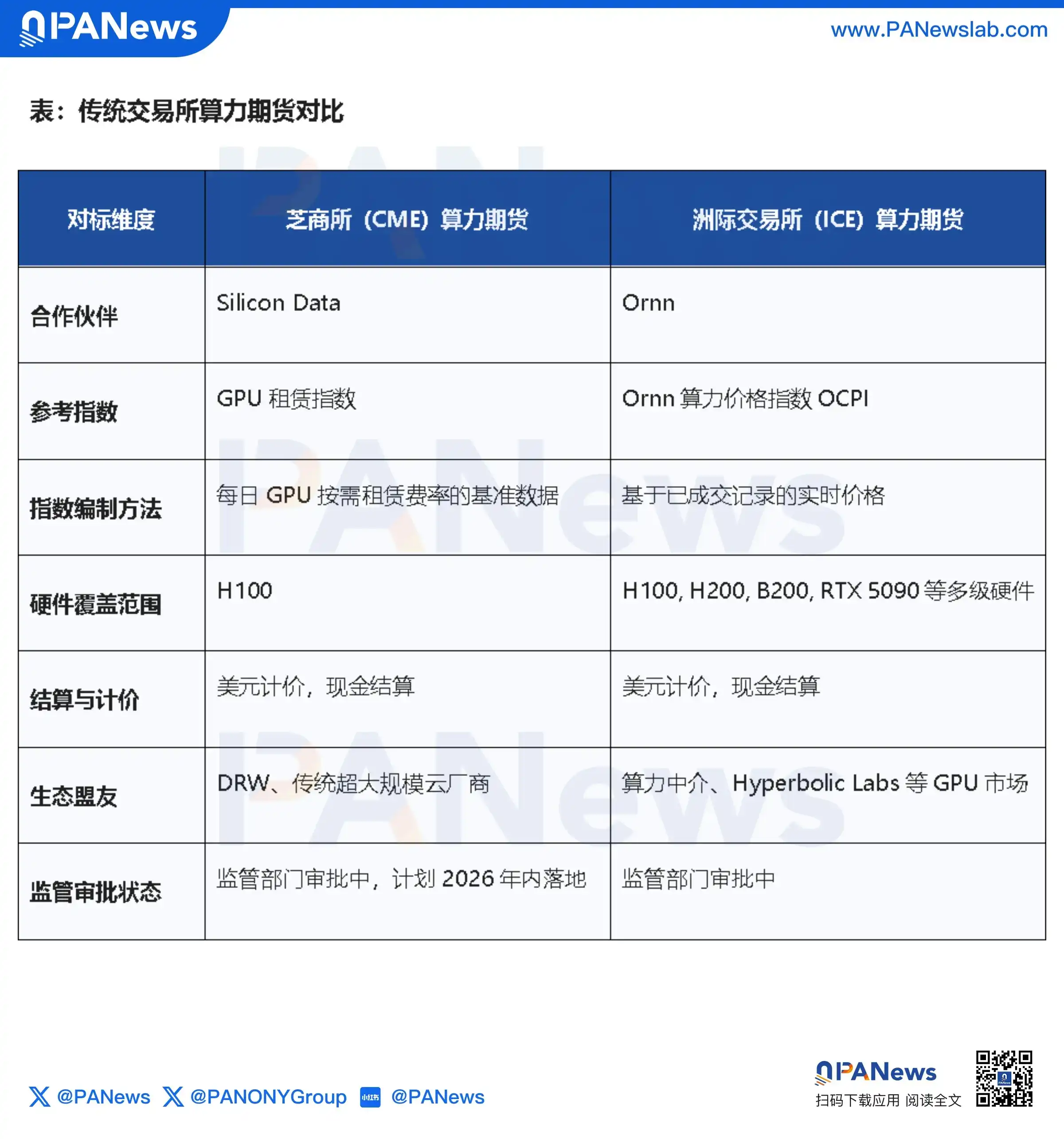
On May 19th, ICE, in collaboration with data provider Ornn, entered the fray, planning to launch a series of GPU computing power futures contracts based on the Ornn Computing Price Index (OCPI).

The OCPI introduced by ICE is the world's first computing power index constructed from real transaction records. Ornn ensures the transparency of this pricing data by distributing the index in real-time to Bloomberg Terminals through its subsidiary Ornn Data, thereby avoiding the issue of "listed price distortion."

Ornn co-founder and CEO Kush Bavaria believes computing power has grown into a trillion-dollar market, and ICE's futures listing will provide a risk transfer layer for institutional buyers and computing power operators.

ICE's computing power futures contracts cover not only mainstream enterprise-grade high-end GPUs like H100, H200, and B200 but also include high-end consumer-grade graphics cards like the RTX 5090, offering refined hedging options for computing power needs across different scenarios. This means ICE is attempting to seize pricing power for computing power across the entire spectrum, from cloud to edge, and from training to inference.

To further solidify the index's industrial foundation, Ornn has also brought in Hyperbolic Labs, one of the world's largest GPU marketplaces, as an ally. Its co-founder and CEO, Jasper Zhang, pointed out that the current GPU market is increasingly resembling the global commodity market, and ICE's move precisely addresses the risk management pain points of new computing power service providers (Neoclouds) and AI labs.

Rather than saying ICE is actively entering the computing power futures market, it's more accurate to say it is rushing to catch up. In fact, CME had already made the first move a week earlier.

On May 12th, CME announced it would partner with GPU market intelligence and benchmark data provider Silicon Data, backed by trading giant DRW, to launch the world's first computing power futures contracts. As a benchmark in the global derivatives market, CME's entry signifies that computing power has officially been included in the sequence of "macro commodities" recognized by Wall Street.

Unlike ICE's broad approach, CME's computing power futures are anchored to Silicon Data's compiled "H100 Lease Index." By providing daily standardized tracking of real-time on-demand leasing rates across major cloud service providers and new GPU cloud platforms, it establishes a unified pricing benchmark for a highly fragmented and opaque spot market.

To avoid depreciation and transportation losses associated with physical hardware delivery, CME's GPU futures contracts will adopt a cash settlement model. The underlying asset being traded is not the physical chip but expectations for future H100 leasing prices.

For large-scale cloud service providers, this provides a much-needed hedging tool. When a cloud service provider invests billions in procuring H100s, it only needs to establish a short position in the CME computing power futures market to lock in a minimum return on investment (ROI) for its servers, thereby mitigating the risk of asset devaluation caused by plummeting computing power prices.

This approach closely mirrors the logic that once turned crude oil, natural gas, and electricity into commodities.
Computing Power Futures Ignite Pricing Power Battle, Financialization Brings Both Opportunities and Tests

Since the wave of large language models swept the globe, computing power has leapt from an "IT resource" to a "strategic material" contested by the AI triumvirate (OpenAI, Anthropic, Google) and Silicon Valley giants like Meta. Simply put, whoever hoards more GPUs holds the entry ticket to the AI era.

But problems have also emerged: the computing power market is too expensive and too unpredictable.

The four cloud giants—Amazon AWS, Microsoft Azure, Oracle, and Google GCP—control about 78% of global IT power capacity and 69% of H100 supply. Spot leasing prices sometimes surge severalfold, only to plummet during chip generation updates. If an AI lab wants to lock in computing power a year in advance, it may have to pay a significant premium; if not, it faces the risk of supply disruption.

What's more troublesome is that the computing power market lacks hedging instruments.

DRW founder Don Wilson frankly stated: The explosive growth of capital-intensive investments like data centers has historically been constrained by the lack of effective risk management tools. The launch of a computing power futures market is a solution to this pain point.

One could argue that whoever masters the pricing power of computing power masters the Bretton Woods system of the AI era.

The battle for computing power pricing rights between the two Wall Street giants reveals that this emerging factor of production is at a historical intersection of "financialization" and "commoditization." This evolution is underpinned by industry cycles but also accompanied by non-negligible potential risks.

From a supply-demand cycle perspective, the global computing power market is entering a new phase of rebalancing. Although early-stage explosive growth in AI applications led to extreme supply-demand mismatch for high-end GPUs and leasing prices soared multiple times, with the large-scale completion of data center construction and chip generation iterations, spot prices will exhibit high volatility. The market urgently needs forward pricing tools to smooth out risks.

However, the "intangible nature" of computing power means it cannot replicate the delivery logic of traditional commodities. Physical chips have a short lifecycle, typically facing technological obsolescence or depreciation within 18 to 24 months, rendering physical delivery forward contracts invalid. Therefore, using a "standard computing unit," such as converting to a benchmark unit like 1 hour of H100 runtime, supplemented by cash settlement, has become the industry's recognized optimal solution. However, this also increases the complexity of pricing models.

Furthermore, the supply side of computing power is highly concentrated, and the spot market is essentially an oligopoly. Building a derivatives market on such a structure creates an inherent fragility in the price discovery mechanism, making futures prices susceptible to indirect manipulation via spot prices.

More importantly, once the computing power derivatives market fully opens, its leverage attributes might amplify price volatility in the spot market. Inflows of leveraged capital and speculative fervor could drive up procurement costs for computing power, turning small and medium-sized AI enterprises into the "harvested," potentially evolving into a "financial hunt" that further exacerbates the uneven distribution of computing resources.

Wall Street Awaits Approval, Crypto Players Already Charging Ahead

While Wall Street's two major exchanges still await regulatory approval, players in the crypto market have already taken the lead.

As early as January this year, Architect Financial Technologies, founded by the former president of FTX US, partnered with Ornn to launch perpetual contracts linked to the OCPI-H100 index through its AX platform.

As more platforms follow suit, it's not impossible that centralized exchanges (CEX) will successively list related computing power futures markets. Additionally, they might launch structured wealth management products for ordinary users or fixed investment products tied to GPU leasing rates, further achieving seamless integration between the crypto market and traditional financial macro assets.

Compared to the heavily regulated CME and ICE facing lengthy approval processes, perpetual decentralized exchanges (Perp DEX) operating on smart contracts possess higher agility and the institutional advantage of permissionless innovation.

Perp DEXs also don't need to go through the lengthy listing procedures of CEXs. For instance, developers only need to stake 500,000 HYPE tokens (or potentially lower thresholds in the future) to list computing power perpetual contracts linked to GPU indices on Hyperliquid's HIP-3 market. This product development capability will allow DeFi to establish a global computing power speculation market unrestricted by geography or barriers, operating even outside Wall Street's regular trading hours.

However, computing power futures is, after all, a nascent asset class with relatively high risk coefficients in its early stages. The computing power market is predominantly over-the-counter (OTC), making data sources susceptible to manipulation. In more extreme cases, such as facing black swan events like technological breakthroughs or chip embargoes, computing power indices might experience non-continuous, sharp price fluctuations. Both scenarios can lead to price distortion, triggering large-scale liquidations of highly leveraged contracts.

Regardless, the Wall Street giants' scramble for computing power futures marks an inflection point in the convergence of AI infrastructure and modern finance.

GPU computing power, once viewed more as an IT resource, is being experimented with as a quantifiable, tradable, hedgeable standardized asset, embedding the logic of technological resource allocation into the global financial system.

With the commoditization of computing power assets, its resource allocation logic may also shift from relying solely on spot procurement to being increasingly influenced by financial market price signals. In the future, computing power might gradually form more mature price discovery mechanisms and capital allocation systems, much like foundational factors of production such as energy and electricity.


Related Questions

QWhich two major Wall Street exchanges are competing to launch GPU computing power futures, and what are the key features of their respective proposed contracts?

AChicago Mercantile Exchange Group (CME Group) and Intercontinental Exchange (ICE) are competing. CME, partnering with Silicon Data, plans to offer cash-settled futures contracts based on the 'H100 rental index' to hedge against price fluctuations for large cloud providers. ICE, partnering with data provider Ornn, aims to offer a broader range of futures based on the Ornn Computing Power Index (OCPI), covering both enterprise-grade (e.g., H100, H200) and high-end consumer-grade GPUs (e.g., RTX 5090) to establish pricing power across the entire computing spectrum.

QAccording to the article, what is the primary problem or pain point in the current AI computing power market that these futures contracts aim to solve?

AThe primary problem is the extreme volatility and unpredictability of computing power prices in a fragmented and opaque market. Prices can surge or plummet dramatically due to supply-demand imbalances and rapid hardware iteration. Major AI companies and cloud providers lack effective risk management tools to hedge against these price swings, making long-term planning and investment difficult.

QWhat potential risks does the article associate with the financialization of computing power through futures markets?

AKey risks include: 1) Price manipulation due to the highly concentrated, oligopolistic nature of the underlying spot market (controlled by major cloud providers). 2) Amplified price volatility as leverage and speculative capital enter the derivatives market. 3) Increased procurement costs for smaller AI firms, potentially exacerbating resource inequality. 4) The inherent complexity of creating a pricing model for an 'intangible' asset like computing power that faces rapid technological obsolescence.

QHow have cryptocurrency market players reacted to the trend of computing power financialization, compared to traditional Wall Street institutions?

ACryptocurrency market players have moved faster and with more agility. For example, Architect Financial Technologies launched a perpetual contract tied to the OCPI-H100 index as early as January. The article suggests that decentralized perpetual contract exchanges (Perp DEXs) could create permissionless, global markets for computing power speculation, operating outside traditional trading hours and with lower listing barriers than heavily regulated Wall Street exchanges or even centralized crypto exchanges (CEX).

QWhat is the core 'commodity' being traded in proposed computing power futures contracts like CME's, and how is it settled to avoid physical hardware issues?

AThe core commodity is the future price expectation for standardized computing power units, specifically the rental/lease rate for GPU runtime (e.g., one hour of H100 computing time). To avoid issues related to the physical depreciation, transportation, and rapid obsolescence of hardware chips, these contracts are designed to be cash-settled. The contracts are settled financially based on the difference between the contracted price and the benchmark index price at expiration, rather than requiring the physical delivery of GPUs.

Related Reads

AI Trading Cools, South Korean Stocks Plunge 1.8%, Spot Gold Rises 1%, Bitcoin Dives

A sell-off in AI-related stocks, triggered by Broadcom's disappointing earnings forecast, sent shockwaves through global markets. South Korea's KOSPI led Asia's decline, plunging 1.8% as the risks from concentrated chip stock gains and surging leveraged investments came to the fore. The tech-heavy Nasdaq 100 futures fell 0.5% following Broadcom's 14% after-hours plunge, which signaled a slower-than-expected transition to AI clients. This pullback extended Wall Street's weakness, halting the S&P 500's nine-day rally amid hawkish Fed signals and renewed Middle East tensions. South Korean authorities convened an emergency meeting, pledging "immediate measures" against market volatility and warning of record-high stock margin debt. The adjustment rippled across assets: Bitcoin fell to around $64,000, its lowest since February, while safe-haven gold rose 1% on bargain hunting. Oil prices dipped on Middle East ceasefire news. Market analysts noted the sell-off was driven by profit-taking after massive gains, particularly in chip stocks like Samsung and SK Hynix, which now dominate the KOSPI. Wall Street banks are divided on Korea's outlook, with Goldman Sachs raising its target while Citigroup and others warn of overvaluation and a potential bubble. Bridgewater's Ray Dalio noted that great technological shifts often create bubbles. Meanwhile, Fed officials' hints at potential future rate hikes added to the cautious mood ahead of key U.S. jobs data.

华尔街日报19m ago

AI Trading Cools, South Korean Stocks Plunge 1.8%, Spot Gold Rises 1%, Bitcoin Dives

华尔街日报19m ago

Seeking Alpha's Hot Article: Why Might the U.S. Stock Market Crash in June?

In a recent Seeking Alpha article, financial professor and analyst Damir Tokic argues that the US stock market may be poised for a significant crash in June 2026. The core thesis centers on a "mega-bubble" in equities, particularly within the technology sector, which has driven the S&P 500 to near-record valuations, with a Shiller P/E ratio exceeding 40—a level comparable to the 2000 dot-com bubble. Tokic identifies two primary catalysts for a potential collapse. First, he points to unsustainable market exuberance fueled by what he terms the "Trump Stimulus"—massive AI capital expenditure by tech giants, which he believes is politically driven and cannot last. Second, and more urgently, he highlights the escalating Iran war as a critical threat. The ongoing closure of the Strait of Hormuz has created a severe global energy supply crunch. Strategic petroleum reserves are projected to hit critically low operational levels by June, potentially causing oil prices to spike above $200 per barrel and triggering a severe, supply-driven inflationary shock. This scenario, Tokic warns, would force the Federal Reserve's hand. Despite currently maintaining a dovish bias, the Fed would likely be compelled to officially pivot to a hawkish stance at its June FOMC meeting to combat soaring inflation and bond yields. He contends that such a shift—or even a failure to act, which would destroy Fed credibility—could be the trigger that punctures the market bubble. The resulting downturn, he concludes, could rival the bear markets of 2000 and 2008, advising investors to prepare for a major correction.

marsbit41m ago

Seeking Alpha's Hot Article: Why Might the U.S. Stock Market Crash in June?

marsbit41m ago

AI PC Battle: Bet on the Toll Booth, Not the Camp

**Title:** The AI PC Battle: Don't Bet on Sides, Bet on the Tollbooth **Summary:** The AI PC competition is moving beyond simple "x86 vs. Arm" narratives. The core investment thesis should focus on identifying which players can sustain margins, cash flow, and pricing power throughout the upgrade cycle, rather than backing a particular architecture. The opportunity is analyzed in three layers: 1. **The Advanced Foundry Tollbooth:** TSMC is positioned to collect "tolls" regardless of which chip designer wins, due to its dominant ~70% share in advanced semiconductor manufacturing, which is essential for high-end AI PC chips. 2. **Compute & Platform Spillover:** AMD represents an offensive in the x86 CPU+GPU space, while NVIDIA leverages its GPU and CUDA software stack dominance. Both benefit from the demand for increased local AI compute. 3. **Architecture Diffusion & Turnaround Plays:** ARM and Intel offer potential for significant upside (elasticity), but investments here require stricter discipline due to higher execution risks and competitive challenges. The industry is transitioning from concept to shipment validation. While short-term forecasts for AI PC adoption have been revised down slightly due to tariffs and procurement delays, the long-term trend towards AI becoming a standard PC feature remains intact. The key driver for upgrade cycles will be whether compelling enterprise applications (e.g., privacy-sensitive computing, low-latency inference) emerge beyond consumer-focused features like meeting summarization. Investment strategy should prioritize companies with platform-level advantages and recurring revenue streams. TSMC offers high certainty as the foundational tollbooth. AMD presents a strong offensive play within the established ecosystem. ARM and Intel are higher-risk, higher-potential-reward turnaround bets. The report cautions against chasing short-term hype and emphasizes a disciplined, long-term approach focused on buying ecosystem strength and cash-flow certainty after market enthusiasm subsides. **Key Risks:** Underwhelming AI PC applications slowing upgrade cycles; slow improvement in Windows on Arm compatibility; macro/tariff impacts on PC demand; potential advanced node supply-demand mismatches affecting TSMC; high overall AI sector valuations making stocks vulnerable to a risk-off shift in markets.

marsbit56m ago

AI PC Battle: Bet on the Toll Booth, Not the Camp

marsbit56m ago

Ten-Thousand-Word Analysis: From $10 to $290, MRVL Wins the Entire AI Era by 'Not Making GPUs'

Marvell Technology's stock price surged from under $10 in 2016 to a record $290 in June 2026, fueled not by making GPUs, but by dominating AI infrastructure connectivity. This analysis argues the market misvalues MRVL as merely a smaller Broadcom in custom AI chips, overlooking its true, unique position. Marvell's core strength lies in enabling high-speed data flow for AI clusters through three interconnected businesses. First, it holds a commanding ~70% market share in high-speed optical DSPs (essential for data center light modules), a deep-moat business with accelerating growth. Second, its custom AI chip design business serves hyperscalers like AWS, Microsoft, and Google, with a significant revenue pipeline despite lower margins. Third, stable cash flows come from Ethernet switch chips and enterprise storage controllers. Together, they form a full-stack "AI data movement" platform. CEO Matt Murphy's transformative leadership since 2016, involving strategic divestments, key acquisitions (like Inphi for optical DSPs), and securing long-term agreements with major cloud providers, repositioned the company. A pivotal $2 billion strategic investment from NVIDIA in 2026 underscored Marvell's critical role in the AI ecosystem, particularly through collaborations like NVLink Fusion. While Marvell faces risks—including client concentration (losing the Amazon Trainium3 design), lower-margin business mix, competitive threats, insider selling, and complex supply chains—its fundamentals remain strong. The optical interconnect moat is widening with the acquisition of Celestial AI (photonics fabric), and financial metrics show accelerating revenue growth and operating leverage. With a PEG ratio suggesting undervaluation relative to its growth, the thesis is that the market undervalues Marvell's monopolistic position in AI "plumbing" while overemphasizing its competitive custom chip segment. The story transcends investing, symbolizing how in any complex system—from the internet to AI—the value of "connection" ultimately surpasses that of individual "nodes."

marsbit1h ago

Ten-Thousand-Word Analysis: From $10 to $290, MRVL Wins the Entire AI Era by 'Not Making GPUs'

marsbit1h ago

Trading

Spot
Futures
活动图片




