Author: Winnie, CryptoPulse Labs
On May 11, Circle successfully raised $222 million in a pre-sale funding round for its new blockchain and native token ARC. Following the completion of the funding, the fully diluted valuation of the ARC network reached $3 billion.
While this figure itself is not staggering, what truly captured market attention was the investor lineup behind it. From the world's top venture capital firm a16z to Wall Street giants like BlackRock and Intercontinental Exchange, and further to crypto and tech capital like ARK Invest and General Catalyst, the consortium nearly covers key institutions across the global financial system.
This makes ARC more than just a blockchain project funding event; it resembles a collective bet on the future financial infrastructure. It also marks a new stage where the stablecoin industry is shifting from product competition to system competition.
I. Circle's Transformation: From Stablecoin Issuer to Financial System Architect
Looking back at Circle's development path, its core identity has long been very clear: it is a stablecoin issuing company, with USDC as its flagship product.
The logic of USDC is not complicated. Its core is to establish a credible digital dollar, providing a relatively stable medium of exchange in the crypto market through transparent reserves, a compliant structure, and a USD peg mechanism.
At this stage, Circle functioned more like an on-chain bank, responsible for issuing, custody, and maintaining user trust in the digital dollar.
However, the problem lies in the fact that this model is inherently dependent. Although USDC is important, it operates on external public chains like Ethereum and Solana. The performance, cost, and congestion of these chains directly impact the user experience of USDC. In other words, Circle controls the issuance of money but not the system through which it circulates.
The emergence of ARC is precisely a response to this structural problem.
From its design logic, ARC is not intended to become another general-purpose public chain, but rather a highly verticalized on-chain infrastructure. Its core objective is to specifically serve the circulation, payment, and settlement system for stablecoins.
In other words, if USDC is the digital dollar, then ARC aims to build the financial highway on which that digital dollar runs. In this system, a stablecoin is no longer just an asset flowing on a chain. It is integrated into a unified settlement network, forming a complete closed loop from issuance to transfer to settlement.
The key significance of this design is that, for the first time, Circle is attempting to integrate currency issuance and currency circulation within the same system, thereby breaking free from dependence on external public chains. At a deeper level, this transformation is essentially a restructuring of the business model.
In the past, Circle relied primarily on interest income from reserve assets, essentially operating as an asset management-style stablecoin company. If ARC successfully operates, it will have the opportunity to shift towards an infrastructure fee model, similar to a payment network or settlement system provider.
This suggests that Circle's role may evolve from issuing dollars to defining how dollars flow in the digital world. The significance of this change is not merely a product upgrade but a leap from the application layer to the protocol layer.
II. Top Investors Gather: A Mutual Embrace of Traditional Finance and Crypto Capital
The primary reason this funding round for ARC garnered widespread attention is not the amount raised, but the signal conveyed by the investor structure itself.
Leading this round is the renowned venture capital firm Andreessen Horowitz (a16z). Its $75 million investment not only provides financial support but, more importantly, confirms ARC's positioning as Web3 infrastructure.

In a16z's investment logic, ARC is clearly not an ordinary application project but appears more like a component of the future internet financial system.
However, what truly shocked the market was the collective entry of traditional financial institutions. Traditional financial giants, including BlackRock, Intercontinental Exchange (parent company of the NYSE), Apollo Funds, Standard Chartered Ventures, SBI Group, and Janus Henderson Investors, participated in various forms.
The commonality among these institutions is very clear: they essentially control or are deeply involved in the global flow of funds and settlement systems.
Simultaneously, crypto-native capital also participated, including institutions like ARK Invest, General Catalyst, Haun Ventures, and Bullish. This structure is quite rare because it signifies that two financial systems, long separate in the past, are reaching a consensus around a single infrastructure project.
If the logic of crypto investment over the past decade has been to find high-growth assets, then this round of funding for ARC is more like searching for the gateway to the future financial system.
Venture capital is betting on technological evolution, Wall Street is betting on settlement efficiency, crypto capital is betting on ecosystem dominance, and Circle happens to stand at the intersection of these three forces.
This kind of simultaneous betting by multiple parties is uncommon in financial history. It resembles more of a system-level alignment in advance: the future of finance may no longer be a fragmented system but may gradually converge towards a unified on-chain settlement layer.
III. From Trading Tool to Financial Infrastructure Reconstruction: Stablecoins Enter a New Era of Infrastructure
ARC's current fully diluted valuation of $3 billion, viewed in isolation, is just a funding figure. But placed within the industry structure, it actually represents a deeper shift: stablecoins are evolving from trading tools into the core layer of financial infrastructure.
In the past, discussions about blockchain focused more on public chain performance, DeFi ecosystems, or exchange liquidity. However, as stablecoins gradually become the unit of account for the on-chain economy, the entire competitive logic is changing.
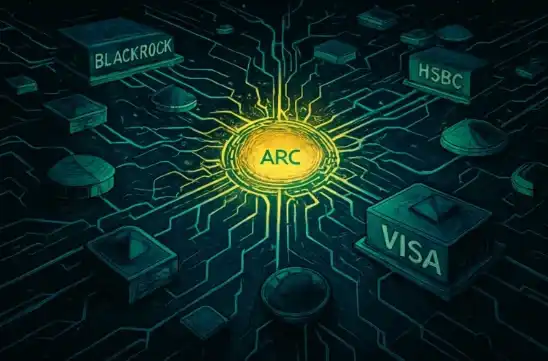
Whoever controls the circulation path of stablecoins holds the key gateway to on-chain finance.
Against this backdrop, Circle's strategy becomes very clear. First, solve the trust problem with USDC; then, solve the circulation problem with ARC; finally, form a complete closed-loop system from issuance to settlement.
If this structure is established, then Circle will no longer be just a stablecoin company but may evolve into an infrastructure operator for the on-chain financial system.
In terms of industry impact, this model could bring about changes at three levels. First, cost structure optimization: cross-chain transfers and settlement of stablecoins will be processed within a unified system, significantly reducing transaction costs and friction. Second, lower barriers for institutional access: banks, funds, and payment companies can directly connect to a unified on-chain system without needing to adapt to multi-chain ecosystems. Third, a strengthening trend of financial standardization: on-chain finance may gradually form foundational standards similar to internet protocol layers, and ARC has the opportunity to become one of the core participants.
More importantly, once such infrastructure is proven successful, its impact will no longer be confined to the crypto industry but may gradually touch the core links of traditional finance, especially cross-border payment and settlement systems.
The existing SWIFT system has operated for decades. If the on-chain stablecoin system establishes advantages in efficiency and cost, then the reconstruction of financial infrastructure is no longer a theoretical question but a matter of time.
Conclusion
The $222 million funding event for ARC is, in essence, not just a simple project funding story but a staged signal of financial system evolution.
When capital from different systems like BlackRock, Intercontinental Exchange, and ARK Invest simultaneously bets on the same chain, it indicates that the market has already begun to acknowledge a trend: stablecoins are no longer just trading tools but are becoming one of the candidate standards for global financial infrastructure.
What's truly worth watching is not how high ARC's valuation can go, but whether it will become one of the default paths for future global capital flow. And if this trend holds true, then today's $222 million may be just a small step in the prologue of the entire financial system's reconstruction.






