Vitalik: Decentralization Without Losing Commerciality, A 'Symbiotic' Solution from the Perspective of Power Balance

marsbitPublished on 2026-01-01Last updated on 2026-01-01

Abstract

In his article, Vitalik Buterin explores the tension between the benefits and dangers of concentrated power in three key forces: Big Business, Big Government, and Big Mob. While these forces drive progress, their unchecked growth leads to monopolies, oppression, and populist extremism. Buterin argues that the solution lies in maintaining a balance of power, both within and between these forces. Historically, natural "diseconomies of scale" and diffusion effects prevented extreme centralization. However, modern factors like rapid technological advancement, automation, and proprietary technology have intensified scale economies, threatening this balance. To counteract this, Buterin proposes strategies to enforce greater openness and diffusion. These include regulatory measures (e.g., EU’s USB-C mandate, banning non-compete agreements), adversarial interoperability (e.g., third-party clients, decentralized exchanges), and pluralistic collaboration models. He also introduces D/acc (Defensive Accelerationism) to develop open, defensive technologies that reduce security anxieties without requiring centralization. Ultimately, the goal is to empower entities to have positive impact without achieving hegemony, ensuring a decentralized, robust, and ethical global ecosystem.

Original Author: Vitalik Buterin

Original Compilation: Saoirse, Foresight News

Many of us are wary of "Big Business." We appreciate the products and services that corporations provide, but we resent the multi-trillion dollar monopolistic closed ecosystems, the quasi-gambling electronic games, and the corporations that manipulate entire governments for profit.

Many of us also fear "Big Government." We need the police and courts to maintain public order and rely on the government for various public services, but we are dissatisfied with the government arbitrarily picking "winners" and "losers," restricting people's freedom of speech, freedom to read, and even freedom of thought, and we oppose government human rights abuses or waging war.

Finally, many of us fear the third corner of this triangle: the "Big Mob." We recognize the value of an independent civil society, charities, and Wikipedia, but we detest mob lynchings, cancel culture, and extreme events like the French Revolution or the Taiping Heavenly Kingdom movement.

Essentially, we aspire to progress—whether technological, economic, or cultural—but we simultaneously fear the three core historical forces that have driven this progress.

A common approach to solving this dilemma is the concept of a balance of power. If society needs powerful forces to drive development, then these forces should check and balance each other: either through internal balance within a single force (e.g., competition among businesses) or through checks and balances between different forces, ideally a combination of both.

Historically, this balance has largely occurred naturally: due to geographical distance limitations or the need to coordinate large numbers of people for global tasks, natural "diseconomies of scale" constrained excessive concentration of power. However, in this century, this rule no longer holds: the three forces mentioned above are simultaneously becoming more powerful and inevitably interacting frequently.

In this article, I will delve into this theme and propose several strategies to protect the increasingly fragile "balance of power" characteristic of today's world.

In a previous blog post, I described this emerging world where 'Big X' will exist in all fields for the long term as a "dense jungle."

Why We Fear Big Government

People's fear of government is not without reason: the government possesses coercive power and is fully capable of harming individuals. The power the government has to destroy an individual is far beyond what Mark Zuckerberg or cryptocurrency practitioners could ever hope to possess. For this reason, for centuries, liberal political theory has revolved around the core issue of "taming the leviathan"—enjoying the benefits of government maintaining law and order while avoiding the drawbacks of a "monarch who can arbitrarily dispose of his subjects."

(Taming the leviathan: a political science concept referring to institutional designs such as the rule of law, separation of powers, and decentralization of power to constrain the government—this "public power body with strong coercive power that may infringe on individual rights"—ensuring its function of maintaining social order while preventing abuse of power and balancing public order with individual freedom.)

This theoretical system can be condensed into one sentence: the government should be a "rule-maker," not a "game player." That is, the government should strive to be a reliable "arena," efficiently resolving interpersonal disputes within its jurisdiction, rather than an "actor" actively pursuing its own goals.

This ideal state can be achieved in various ways:

  • Libertarianism: believes the rules the government should enforce are essentially only three—no fraud, no theft, no killing.
  • Hayekian liberalism: advocates avoiding central planning; if market intervention is necessary, it should clear goals rather than specify means, leaving specific implementation to market exploration.
  • Civil libertarianism: emphasizes freedom of speech, religion, and association, preventing the government from imposing its own preferences in the cultural and ideological spheres.
  • Rule of law: the government should clearly define "what is allowed and what is not" through legislation, with courts responsible for enforcement.
  • Common law supremacism: advocates completely abolishing legislative bodies, with a decentralized court system making rulings on individual cases, each ruling setting a precedent and gradually evolving the law.
  • Separation of powers: divides government power into multiple branches that supervise and check each other.
  • Subsidiarity principle: holds that problems should be solved by the lowest-level institution capable of handling them, minimizing the concentration of decision-making power.
  • Multipolarity: at a minimum, avoid a single country dominating the globe; ideally, achieve two additional checks and balances:
  1. Avoid any country becoming overly hegemonic in its region;
  2. Ensure each individual has multiple "backup options" to choose from.

Even in governments not traditionally "liberal," similar logic applies. Recent research has found that among governments classified as "authoritarian," "institutionalized" governments often promote economic growth better than "personalized" governments.

Of course, completely preventing the government from being a "game player" is not always possible, especially when facing external conflict: if an "actor" declares war on the "rules," the "actor" will ultimately win. But even when the government needs to temporarily play the role of "actor," its power is usually strictly limited—for example, the Roman "dictator" system: the dictator had great power during emergencies, but once the crisis passed, power returned to its normal state.

Why We Fear Big Business

Criticism of corporations can be succinctly categorized into two types:

  1. Corporations are bad because they are "inherently evil";
  2. Corporations are bad because they are "devoid of vitality."

The root of the first problem (corporate "evil") is that corporations are essentially efficient "goal optimization machines," and as their capabilities and scale expand, the core goal of "profit maximization" increasingly deviates from the goals of users and society at large. This trend is clearly visible in many industries: industries often start driven spontaneously by enthusiasts, full of vitality, but over time, they gradually become profit-oriented, eventually conflicting with user interests. For example:
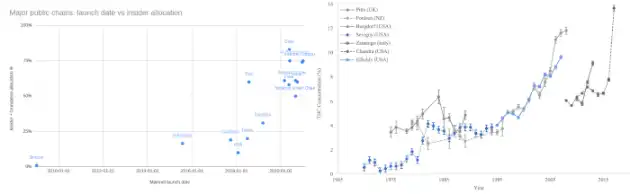
Left: Proportion of tokens directly allocated to insiders in newly issued cryptocurrencies between 2009-2021; Right: Concentration of THC (the psychoactive component) in cannabis between 1970-2020.

The video game industry also shows this trend: this field, initially centered on "fun and a sense of achievement," now relies increasingly on built-in "slot machine-like mechanics" to maximize extraction of money from players. Even mainstream prediction markets are beginning to show worrying tendencies: no longer focusing on pro-social goals like "optimizing news media" or "improving governance," but instead focusing on sports betting.

The above cases stem more from the combination of increased capability and competitive pressure, while another type of case is directly related to corporate scale expansion. Generally, the larger a corporation is, the more capable it is of "distorting its surrounding environment" (including economic, political, cultural) to achieve its own interests. A corporation that is 10 times larger can gain 10 times the benefit from distorting the environment to some extent—therefore, it will engage in such behavior much more frequently than a small corporation, and once it acts, the resources it mobilizes will be 10 times those of a small corporation.

Mathematically, this is consistent with the logic of "why a monopoly sets prices above marginal cost, increasing profits at the expense of social deadweight loss": in this scenario, the "market price" is the distorted "environment," and the monopoly "distorts the environment" by limiting supply. The ability to distort is proportional to market share. But stated more generally, this logic applies to various scenarios, such as corporate lobbying, De Beers-style cultural manipulation campaigns, etc.

The second problem (corporate "devoid of vitality") manifests as corporations becoming dull, rigid, risk-averse, resulting in large-scale homogenization both within corporations and between corporations. (The homogenization of architectural styles is a typical manifestation of corporate "devoid of vitality.")

Architectural homogenization is a typical form of corporate mediocrity.

The term "soulless" is interesting—its meaning lies somewhere between "evil" and "devoid of vitality." It is apt to describe corporations as "soulless" for "making users addicted for clicks," "forming cartels to raise prices," "polluting rivers"; and it is equally apt to describe them for "making global cityscapes uniform," "making 10 Hollywood movies with identical plots."

I believe these two types of "soulless" phenomena both stem from two factors: motivational commonality and institutional commonality. All corporations are highly driven by the "profit motive." If many powerful entities share the same strong motive and lack strong countervailing forces, they will inevitably develop in the same direction.

"Institutional commonality" stems from corporate scale expansion: the larger the scale, the more incentive a corporation has to "shape the environment." A $1 billion corporation will invest far more in "shaping the environment" than 100 $10 million corporations; simultaneously, scale expansion exacerbates homogenization—Starbucks contributes more to the "homogenized urban atmosphere" than 100 competitors each 1% of its size combined.

Investors may exacerbate both trends. For a (non-sociopathic) startup founder, growing the company to $1 billion and benefiting the world would be more satisfying than growing to $5 billion and harming society (after all, the yachts and planes $4.9 billion can buy are far from worth "being hated by the world"). But investors are further removed from the "non-financial consequences" of their decisions: as market competition intensifies, investors willing to pursue $5 billion scale will get higher returns, while those satisfied with $1 billion scale will get lower (or even negative) returns, making it hard to attract capital. Additionally, investors holding shares in multiple portfolio companies often passively push these companies to form a "merged super-entity" to some extent. However, both trends have an important constraint: investors' "monitoring ability" and "accountability ability" regarding the internal situation of their portfolio companies are limited.

Meanwhile, market competition can alleviate "institutional commonality," but whether it can alleviate "motivational commonality" depends on whether different competitors have "differentiated motives not oriented toward profit." In many cases, corporations do have such motives: for example, sacrificing short-term profit in the name of "publicly disclosing innovations," "adhering to core values," or "pursuing aesthetic value." But this is not inevitable.

If "motivational commonality" and "institutional commonality" cause corporations to be "soulless," then what is the "soul"? I believe that, in this context, the "soul" is essentially diversity—those non-homogeneous qualities between corporations.

Why We Fear the Big Mob

When people speak positively of "civil society"—the part of society that is neither profit-oriented nor governmental—they always describe it as "composed of numerous independent institutions, each focusing on different areas." If you ask an AI to explain "civil society," the examples it gives are大抵如此 (largely the same).
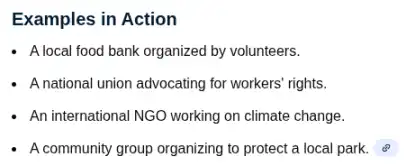
When people criticize "populism," what often comes to mind is the opposite scenario: a highly charismatic leader inciting millions to follow him, forming a large group pursuing a single goal. Populism, though flying the banner of "ordinary people," is more about constructing the illusion of "people united as one"—and this "unity" often manifests as support for a certain leader and opposition to a "hated external group."

Even when people criticize civil society, the argument always revolves around "its failure to achieve the mission of 'numerous independent institutions each playing to their strengths,' instead promoting some spontaneously formed common agenda"—such as the phenomenon criticized by the "Cathedral" theory.

Balance Between Forces

In all the above cases, we are discussing the internal balance of power within each of the three "forces." But different forces can also check and balance each other, with the most typical case being the balance of power between government and business.

Capitalist democracy is essentially a theory of balance of power between "big government" and "big business": entrepreneurs have both legal tools to challenge government radical actions and the ability to act independently through capital concentration, while the government can regulate businesses.

"Palladium-ism" admires billionaires, but specifically those who "deviate from the norm and take unconventional actions to pursue their own specific vision, rather than directly pursuing profit." From this perspective, "Palladium-ism" can be seen as an attempt to "obtain the benefits of capitalism while avoiding its drawbacks."

Although both government and market created the necessary conditions for the "Starship" project, what ultimately drove its birth was neither profit motive nor government directive.

My personal view of philanthropy is similar to "Palladium-ism" in some ways. I have repeatedly expressed support for billionaires engaging in philanthropy and hope more will do so. But the philanthropy I advocate is philanthropy that can "counterbalance other social forces." Markets are often unwilling to fund public goods, and governments are often unwilling to fund projects that are "not yet elite consensus" or whose beneficiaries are not concentrated in a single country. Some projects fit both categories and are thus ignored by both market and government—and wealthy individuals can恰好 fill this gap.

But billionaire philanthropy can also go in a harmful direction: when it ceases to be a "counterbalancing force" to government and instead replaces the government in wielding power. This has happened in Silicon Valley in recent years: powerful tech CEOs and venture capitalists have become less libertarian, less supportive of "exit mechanisms," and more directly pushing the government to align with their preferred goals—in exchange, they make the world's most powerful government even more powerful.
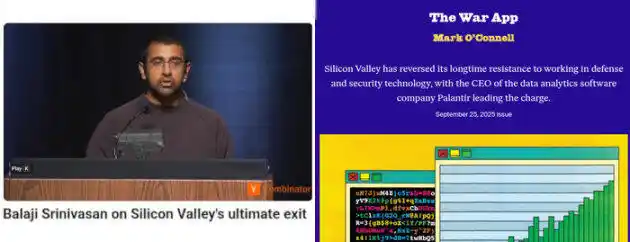
I prefer the scene on the left (2013) over the scene on the right (2025): because the left embodies a balance of power, while the right shows two powerful factions that should check each other instead merging.

The other two pairs of forces in the triangle can also form a balance of power. The Enlightenment concept of the "Fourth Estate" (the media) essentially uses civil society as a force to check government power (At the same time, even without censorship, power flows the other way: the government deeply influences educational content through funding primary, secondary schools, and universities, especially K-12 education). On the other hand, the media reports on corporate dynamics, and successful business people also fund the media. As long as there is no monopoly of power in a single direction, these mechanisms are healthy and enhance social robustness.

Balance of Power and Economies of Scale

To find an argument that explains both the rise of the United States in the 20th century and China's development in the 21st century, the answer is simple: economies of scale. This is often used by people in the US and China to criticize Europe: Europe has many small and medium-sized countries with diverse cultures, languages, and institutions, making it difficult to cultivate large pan-European companies; whereas in a large, culturally homogeneous country, companies can easily scale to hundreds of millions of users.

The impact of economies of scale is crucial. For human development, we need economies of scale—because it is by far the most effective way to drive progress. But economies of scale are a double-edged sword: if my resources are twice yours, the progress I can achieve is more than double; therefore, by next year, my resources might be 2.02 times yours. Over time, the most powerful entity will eventually control everything.
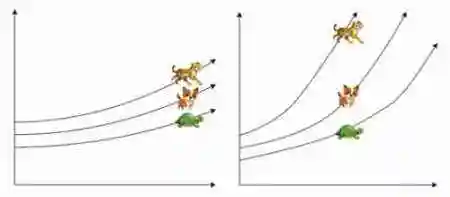
Left: Proportional growth—small initial differences remain small; Right: Growth under economies of scale—small initial differences become very large over time.

Historically, two forces have offset the effects of economies of scale, preventing power monopolies:

  • Diseconomies of scale: Large institutions are inefficient in many ways, such as internal conflicts of interest, communication costs, costs due to geographical distance, etc.
  • Diffusion effects: When moving between companies and countries, people bring their ideas and skills; less developed countries can achieve "catch-up growth" through trade with developed countries; industrial espionage is ubiquitous, and innovations are reverse-engineered; companies can use one social network to引流 (divert traffic) to another.

If the "scale leader" is compared to a cheetah and the "scale laggard" to a tortoise, then "diseconomies of scale" slow down the cheetah, and "diffusion effects" are like a rubber hand pulling the tortoise closer to the cheetah. But in recent years, several key forces are changing this balance:

  • Rapid technological progress: makes the "super-exponential growth curve" of economies of scale steeper than ever.
  • Automation: allows global tasks to be completed with few people, greatly reducing human coordination costs.
  • Proliferation of proprietary technology: Modern society can produce proprietary software and hardware products that "only grant usage rights, not modification or control rights." Historically, delivering a product to consumers (whether domestically or cross-border) necessarily meant allowing inspection and reverse engineering—but now, this rule no longer holds.

Essentially, the effects of economies of scale are strengthening: although, influenced by internet communication, the breadth of "idea diffusion" may be greater than before, the "diffusion of control" is weaker than ever.

Core dilemma: In the 21st century, how do we achieve rapid progress and build a prosperous civilization while avoiding extreme concentration of power?

Solution: Force more "diffusion."

What does "force more diffusion" mean specifically? First, let's look at a few government policy examples:

  • EU standardization mandates (e.g., the recent USB-C port standard): make it harder to build "proprietary ecosystems incompatible with other technologies."
  • China's compulsory technology transfer rules.
  • US ban on non-compete agreements: I support this policy because it forces a partial "open sourcing" of "tacit knowledge" within companies—employees can apply skills learned at one company to other areas after leaving, benefiting more people. Non-disclosure agreements limit this process, but fortunately, they are漏洞百出 (full of loopholes) in practice.
  • Copyleft licenses (e.g., GPL): require that any software developed based on Copyleft code must itself be open source and subject to Copyleft licensing.

We can propose more ideas along this direction: for example, governments could借鉴 (draw lessons from) the "EU Carbon Border Adjustment Mechanism" to design a new tax mechanism—levying corresponding taxes on domestic and foreign products based on their "degree of proprietariness" (measured by some standard); if companies share technology with society (including through open source), the tax rate could drop to zero. Another idea worth reviving is the "Intellectual Property Harberger Tax" (taxing intellectual property based on valuation, incentivizing owners to use IP efficiently).

Additionally, we should adopt a more "flexible" strategy more often: adversarial interoperability.

As Cory Doctorow (a well-known science fiction writer, blogger, and journalist) explains:

"Adversarial interoperability is developing new products/services that can interface with existing products/services without permission from the existing manufacturer. Examples include third-party printer ink, alternative app stores, or independent repair shops that use compatible parts made by competitors to repair cars, phones, or tractors."

Essentially, this strategy is "interacting with tech platforms, social media sites, companies, and countries in an unpermitted manner, while benefiting from the value they create."

Specific examples might include:

  • Alternative clients for social media platforms: Users can use these clients to view others' content, post their own content, and choose their own content filtering methods.
  • Browser extensions with similar functions: Like ad blockers, but specifically for AI-generated content on platforms like X.
  • Decentralized censorship-resistant exchanges between fiat currency and cryptocurrency: Such exchanges can mitigate the "bottleneck risk" (single point of failure) of centralized financial systems.

Overall, much of the value capture in Web2 happens at the user interface level. Therefore, if alternative interfaces can be developed that "can interoperate with the platform and other users using the existing interface," users can remain on the network while avoiding the platform's value extraction mechanisms.
Sci-Hub is a classic tool for "forced diffusion"—it has undoubtedly played an important role in enhancing fairness and open access in science.

A third strategy to enhance "diffusion effects" is to return to the concept of "plurality" proposed by Glen Weyl and Audrey Tang. They describe this concept as "collaboration across differences"—enabling people with different views and goals to communicate and cooperate better, enjoying the efficiency gains from "joining large groups" while avoiding the drawbacks of "large groups becoming single-goal-driven entities." Such ideas can help open-source communities, alliances of nations, and other non-unitary entities increase their level of "diffusion" amongst themselves, allowing them to share more of the benefits of economies of scale while still remaining competitive with internally more organized centralized giants.

It is worth noting that this line of thinking is structurally similar to Piketty's "r > g" (return on capital exceeds economic growth rate) theory and its proposal to solve wealth concentration through a global wealth tax (and strengthened public services). The core difference is: we are not focusing on "wealth" itself, but tracing upstream, focusing on the "source of unlimited wealth concentration"—what we want to diffuse is not money, but the means of production.

I believe this approach is better for two reasons: first, it more directly targets the "dangerous core" (i.e., the combination of "extreme growth" and "exclusivity"), and if executed properly, can even improve overall efficiency; second, it is not limited to targeting one type of power—a global wealth tax might prevent the concentration of power among billionaires, but it cannot constrain powerful authoritarian governments or other transnational entities, and might even leave us more defenseless against these forces. Whereas "forcing technology diffusion through global decentralized strategies"—clearly telling all parties "either grow with us, sharing core technologies and network resources at a reasonable pace; or develop in isolation, excluded by us"—can address the problem of power concentration in a more comprehensive way.

D/acc: Making a Multipolar World Safer

Pluralism faces a theoretical risk, the "fragile world hypothesis": as technology advances, more and more actors may gain the ability to "cause catastrophic harm to all humanity"; the less coordinated the world is, the higher the probability that one actor will eventually choose to inflict this harm. In response, some believe the only solution is "further concentration of power"—but this article advocates precisely "reducing power concentration."

D/acc (Defensive Accelerationism) is a complementary strategy that can make the goal of "reducing power concentration" safer to achieve. Its core is "building defensive technologies that develop in sync with offensive technologies," and these defensive technologies need to be open and inclusive, accessible to everyone—thereby reducing the demand for power concentration due to "security anxiety."
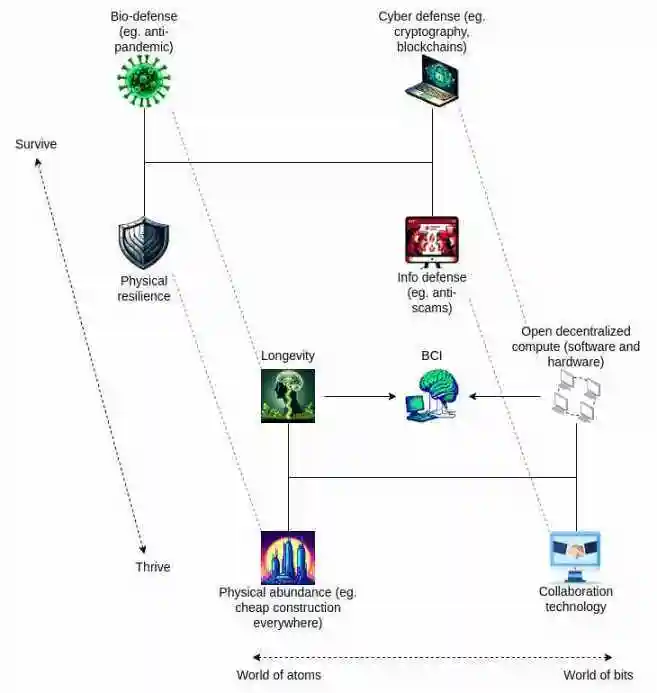
Schematic diagram of the D/acc technology cube


The Morality of Pluralism

Slave morality says: You are not allowed to become powerful.

Master morality says: You must become powerful.

A comprehensive morality centered on balance of power might say: You are not allowed to achieve hegemony, but you should strive to have a positive impact and empower others.

This view is essentially a reinterpretation of the centuries-old dichotomy between "power to enable" and "power to control."

There are two paths to achieving "having the power to enable without possessing control": first, maintain high "diffusivity" towards the external world; second, when building systems, minimize their potential to be "used as levers of power."

In the Ethereum ecosystem, the decentralized staking pool Lido is a good example. Currently, Lido manages about 24% of the total ETH staked on the network, but the level of concern about it is much lower than it would be for "any other entity controlling 24% of the stake." The reason is that Lido is not a single entity: it is an internally decentralized DAO with dozens of node operators, and it uses a "dual governance" design—ETH stakers have veto power over decisions. Lido's efforts in this direction are commendable. Of course, the Ethereum community has also been clear: even with these safeguards, Lido should not control all of Ethereum's stake—currently, it is far from this risk threshold.

In the future, more projects should explicitly consider two core questions: not only design a "business model"—how to acquire resources to support their operations; but also design a "decentralization model"—how to avoid becoming a node of concentrated power, and how to deal with the "risks that come with holding power."

Decentralization is relatively easy to achieve in some scenarios: for example, few people mind the dominance of English, and few worry about the widespread use of open protocols like TCP, IP, HTTP. But in other scenarios, decentralization is quite challenging—because some application scenarios "require entities to have clear intent and capacity for action." How to retain the "advantages of flexibility" while avoiding the "drawbacks of power concentration" will be an important long-term challenge.

Special thanks to Gabriel Alfour, Audrey Tang, and Ahmed Gatnash for their feedback and review.

Related Questions

QWhat are the three core forces that people fear according to Vitalik Buterin, and why?

AThe three core forces are Big Business, Big Government, and Big Mob. People fear Big Business due to its potential for monopolistic practices, profit-driven manipulation, and loss of soul (homogenization and lack of diversity). They fear Big Government because of its coercive power, potential for abuse, and infringement on individual freedoms. They fear Big Mob due to the risk of populist movements, mob justice, and extreme events like revolutions, which can lead to chaos and loss of rational discourse.

QHow does Vitalik propose to address the problem of power concentration in the 21st century?

AVitalik proposes enforcing more 'diffusion' to counteract power concentration. This includes policies like mandatory standardization (e.g., EU's USB-C requirement), banning non-compete agreements, copyleft licensing, and adversarial interoperability. He also suggests strategies like plurality (collaboration across differences) and D/acc (Defensive Accelerationism) to make a multipolar world safer by developing open and accessible defensive technologies.

QWhat is the concept of 'adversarial interoperability' as discussed in the article?

AAdversarial interoperability refers to creating new products or services that can interact with existing ones without the manufacturer's permission. Examples include third-party printer ink, alternative app stores, or independent repair shops using compatible parts. It allows users to benefit from the value created by platforms while avoiding their value-extraction mechanisms, such as through alternative social media clients or browser extensions.

QWhat does Vitalik mean by 'soul' in the context of Big Business, and how is it lost?

AIn this context, 'soul' refers to diversity and non-homogeneous traits among businesses. It is lost due to 'motivational commonality' (all businesses being driven primarily by profit maximization) and 'institutional commonality' (larger businesses having more power to shape their environment, leading to homogenization). This results in businesses becoming 'evil' (prioritizing profit over user/societal good) or 'lifeless' (becoming risk-averse and bland, like uniform architecture or repetitive Hollywood movies).

QHow does the D/acc (Defensive Accelerationism) strategy complement pluralism and power balance?

AD/acc complements pluralism by focusing on developing defensive technologies that are open and accessible to everyone, alongside offensive technologies. This reduces the 'security anxiety' that might lead to power concentration, as it ensures that defensive capabilities are widely distributed. By making it safer to have a less coordinated, multipolar world, D/acc supports the goal of preventing hegemony while allowing positive impact and empowerment.

Related Reads

Trading

Spot
Futures

Hot Articles

What is LINON

Linde plc Tokenized Stock (Ondo): Revolutionizing Traditional Equity Access Through Blockchain Innovation The emergence of Linde plc Tokenized Stock (Ondo), represented by the ticker $LINON, signifies a monumental shift in the fusion of traditional financial structures and decentralized finance (DeFi). This innovative financial instrument showcases the tremendous potential of blockchain technology to democratize access to traditional equity markets while ensuring the security and regulatory compliance necessary for institutional-grade financial products. Through Ondo Finance's pioneering tokenization platform, $LINON provides a seamless pathway for global investors to engage with one of the world's leading industrial gas companies, Linde plc, creating a blockchain-native representation of the underlying equity. Introduction to Linde plc Tokenized Stock The landscape of financial markets is witnessing a groundbreaking transformation through the tokenization of real-world assets. Linde plc Tokenized Stock (Ondo) epitomizes this revolutionary approach by bridging the gap between conventional stock ownership and blockchain-enabled financial infrastructure. The $LINON token allows investors to gain exposure to one of the prominent industrial companies worldwide through decentralized technology. Operating within Ondo Finance's comprehensive ecosystem, $LINON symbolizes a practical application of tokenization technology that enhances accessibility, efficiency, and global connectivity in traditional financial markets. By leveraging blockchain infrastructure, this tokenized stock enables international investors to participate in U.S. equity markets, overcoming traditional barriers associated with cross-border investing. The significance of $LINON goes beyond technological innovation; it represents a fundamental shift in asset structuring, distribution, and trading in the digital age. This tokenized stock maintains all the economic benefits associated with traditional Linde plc shares while offering improved liquidity, programmable compliance features, and seamless integration with decentralized finance protocols. The development of $LINON indicates a growing acceptance of blockchain technology as a viable means for traditional finance, exemplifying how even well-established assets like Linde plc can integrate into blockchain systems. This approach preserves the core attributes that appeal to investors while introducing advanced capabilities that enhance the overall investment proposition. Project Overview and Objectives Linde plc Tokenized Stock (Ondo) encapsulates a strategic effort to democratize access to traditional equity markets through advanced blockchain technologies. The primary objective of $LINON is to provide approved global investors seamless access to the economic exposure associated with Linde plc shares, furthering an effort to create a more inclusive financial ecosystem. Beyond the digital representation of traditional assets, $LINON endeavors to eliminate barriers of geography and time zones that limit investor participation. Its design ensures that blockchain technology can elevate traditional investment vehicles without undermining the security or compliance requirements expected by investors. Key goals of the project include enhanced liquidity provision, programmable compliance mechanisms, and interoperability with other blockchain networks. Each $LINON token is fortified by actual Linde plc securities housed at U.S.-registered broker-dealers, allowing holders to reap economic advantages akin to traditional stockholders, such as dividend reinvestment. Furthermore, $LINON aims to establish new industry standards for institutional-grade tokenized securities, paving the way for traditional assets to embrace blockchain technology while remaining compliant with regulatory frameworks. By associating itself with a company as reputable as Linde plc, the project opens avenues for exploring tokenized equities catering to both conservative institutional players and daring retail investors. Project Creator and Development Team The vision for Linde plc Tokenized Stock (Ondo) comes from Nathan Allman, founder and CEO of Ondo Finance. His background in traditional finance coupled with expertise in blockchain technology positions him uniquely to navigate the complexities of asset tokenization. Allman's academic journey began at Brown University, focusing on Economics and Biology, equipping him with valuable analytical skills. His time at Goldman Sachs in the Digital Assets division strengthened his understanding of the interplay between financial institutions and emerging technologies, laying the groundwork for his later endeavors in alternative investment strategies. Under Allman's guidance, Ondo Finance has emerged as a leader in asset tokenization, launching $LINON as a flagship example of the company's larger mission towards revolutionizing traditional financial systems using blockchain technology. His commitment to leveraging blockchain for creating institutional-grade financial products has shaped the landscape of real-world asset tokenization. Investment and Funding Structure The growth of Ondo Finance, the platform powering Linde plc Tokenized Stock (Ondo), is bolstered by robust financial backing from prestigious venture capital firms and strategic investors. This strong investment foundation underpins the development of the key infrastructure essential for compliant tokenized securities like $LINON. In August 2021, Ondo Finance secured $4 million in seed funding led by a major venture capital firm, which enabled the company to commence platform development and establish the necessary regulatory processes for tokenizing real-world assets. This early investment cemented Ondo Finance's credibility within the industry. The Series A funding round followed, garnering $20 million with participation from renowned firms committed to transformative technology companies. This backing demonstrated substantial institutional confidence in Ondo Finance's vision, allowing it to hone its approach to asset tokenization through mechanisms that ensure compliance and accessibility. Noteworthy contributors, including institutional investors and experienced partners, have added significant value to Ondo Finance’s development efforts. Their involvement underscores the confidence across sectors in Ondo Finance's approach to bridging traditional finance with blockchain innovations. Technical Infrastructure and Innovation The technical architecture that underpins Linde plc Tokenized Stock (Ondo) represents a sophisticated melding of traditional finance systems and cutting-edge blockchain technology. The architecture's foundation is built on the Ethereum network, renowned for its security and programmability—both critical for intricate financial instruments. The $LINON tokenization process comprises creating a blockchain-native representation of Linde plc shares that preserves economic benefits while augmenting investor capabilities. Each token corresponds to actual shares held at U.S.-registered broker-dealers, creating a compliant custody structure that legitimizes the asset's existence and value. Automated compliance systems are integrated into the tokenization process, managing critical components such as know-your-customer (KYC) verification and anti-money laundering (AML) protocols. This incorporation of programmable compliance empowers $LINON to uphold regulatory standards essential for institutional proliferation. Cross-chain interoperability characterizes the advanced technical features of $LINON. While initially deployed on Ethereum, the framework is designed for expansion to other networks such as Solana and BNB Chain. This adaptability enhances liquidity and accessibility, allowing investors to select their preferred blockchain ecosystems. Historical Timeline and Development Crafting the history of Linde plc Tokenized Stock (Ondo) unfolds in parallel with the evolution of Ondo Finance's tokenization platform. The timeline's inception dates back to March 2021 when Nathan Allman laid the foundations for creating institutional-grade financial products on blockchain infrastructure. The initial funding round in August 2021 provided crucial resources for developing the platform and establishing partnerships necessary for effective tokenization. By January 2023, Ondo Finance launched its tokenized treasury products, establishing mechanisms that would facilitate future tokenized equities such as $LINON. A pivotal milestone arose in February 2025 when Ondo Chain—a Layer 1 blockchain designed specifically for asset tokenization—was introduced. This infrastructure enhances capabilities vital for institutional markets, demonstrating Ondo Finance's long-term commitment to tokenization. Subsequently, the launch of Ondo Global Markets in September 2025 marked the official debut of $LINON. This milestone showcased the successful transition from development to active trading, enabling investors around the world to access American financial markets seamlessly. Ongoing development plans include a targeted expansion of available tokenized assets to over 1,000 by the end of 2025, pointing to a bright future for Ondo Finance's ecosystem and its mission to broaden tokenized equity accessibility. Regulatory Compliance and Legal Framework The legal architecture governing Linde plc Tokenized Stock (Ondo) emphasizes a sophisticated approach to regulatory compliance, allowing tokenized securities to be implemented within a blockchain-based framework. The legal structure governing $LINON spans multiple jurisdictions while maintaining a robust legal footing. Compliance systems ensure that only eligible investors can access the token, enforced through automated verification that aligns with international regulations. This innovative regulatory technology promises real-time enforcement of complex requirements, considerably enhancing efficiency in operating within the regulatory landscape. The custody framework undergirding $LINON ensures that the underlying shares are securely held at U.S.-registered broker-dealers, complying with necessary regulations while delivering blockchain-driven access to investors. The token maintains its economic equivalency and security through this carefully structured custody arrangement. KYC and AML compliance systems are embedded within the smart contract architecture, ensuring integrity and adherence to regulatory practices while fostering transparency for investors. The jurisdictional restrictions mark a commitment to navigating the evolving landscape of international securities laws. Market Impact and Industry Significance The advent of Linde plc Tokenized Stock (Ondo) holds profound implications for the broader financial landscape, symbolizing a clear shift towards blockchain-enabled markets. $LINON serves as a proof-of-concept for integrating traditional companies into blockchain ecosystems, showcasing the potential benefits such as broader accessibility and improved efficiency. The market's response to $LINON indicates a growing acceptance of tokenization among institutional investors, contributing to the emergence of an expanding sector wherein traditional assets can be interconnected with blockchain innovations. The success of $LINON further solidifies market confidence, indicating an overarching shift towards recognizing asset tokenization as a transformative force in finance. Future Development and Expansion Plans The future trajectory for Linde plc Tokenized Stock (Ondo) centers around the expansion of the tokenization ecosystem and enhanced infrastructure supporting blockchain-enabled financial services. Plans for cross-chain integration usher in new opportunities for liquidity and flexibility within the investment framework, with existing capabilities poised for continuous enhancement. With the introduction of Ondo Chain, Ondo Finance aims to transition $LINON to an optimized blockchain environment specifically designed for asset tokenization. This new infrastructure heralds exciting prospects for the development of institutional-grade financial products, ensuring ongoing compatibility with contemporary investment strategies. Further integration with decentralized finance protocols signifies a commitment to empowering $LINON holders through advanced financial strategies. The anticipated expansion of available tokenized assets promises to broaden investor access, enhancing the utility and appeal of the platform. In alignment with ambitions for regulatory expansion, ongoing efforts to secure approvals for new jurisdictions will enhance investor access, further positioning $LINON at the forefront of the burgeoning tokenization market. Conclusion Linde plc Tokenized Stock (Ondo), as represented by the $LINON token, stands at the intersection of traditional finance and blockchain innovation. It embodies a transformative milestone in how financial assets are structured, distributed, and engaged within modern investment ecosystems. The technical sophistication behind $LINON, combined with its regulatory compliance framework, illustrates that asset tokenization can improve financial infrastructure rather than simply digitizing existing products. This pioneering effort not only enhances investor access to U.S. equity markets but also signifies an evolution of how traditional financial services can integrate blockchain technology. As the asset tokenization market grows exponentially, with prospects suggesting significant valuation increases, $LINON paves the way for a future where tokenized securities become standard fixtures in the financial landscape. The trajectory of $LINON will undoubtedly influence how traditional finance adapts to a transformed, blockchain-powered world.

2.3k Total ViewsPublished 2025.12.05Updated 2025.12.05

What is LINON

What is CRMON

Salesforce Tokenized Stock (Ondo): Revolutionising Traditional Equity Access Through Blockchain Innovation The emergence of Salesforce Tokenized Stock (CRMON) marks a pivotal advancement in integrating traditional financial markets with blockchain technology. This innovative approach offers investors unprecedented access to equity exposure through tokenisation. Developed by Ondo Finance, CRMON provides tokenholders with economic exposure equivalent to holding Salesforce stock (CRM) while automatically reinvesting dividends. This effectively bridges the gap between conventional equity markets and decentralised finance (DeFi). Introduction and Comprehensive Overview of Salesforce Tokenized Stock In recent years, the financial landscape has dramatically transformed due to blockchain technology, fundamentally altering how investors access and interact with traditional assets. The development of Salesforce Tokenized Stock (CRMON) is a prime example of this evolution, representing a sophisticated fusion of conventional equity markets with cutting-edge distributed ledger technology. CRMON is a tokenised version of Salesforce stock, emerging from the innovative work of Ondo Finance, a leading platform in the real-world asset tokenisation sector that positions itself as a bridge between traditional finance and decentralised systems. Designed to provide tokenholders with economic exposure that mirrors the performance of the underlying Salesforce stock, CRMON incorporates automatic dividend reinvestment mechanisms. This eliminates many traditional barriers associated with international equity investment, such as complex brokerage relationships, currency conversion challenges, and restricted trading hours. The tokenisation process reimagines stock ownership as a blockchain-native asset while maintaining its economic equivalence with the underlying security, offering enhanced portability and integration capabilities within decentralised finance ecosystems. CRMON transcends its individual utility as an investment instrument to represent a fundamental shift in how financial markets can operate in an increasingly digital world. By maintaining full backing through U.S.-registered broker-dealers and implementing robust compliance frameworks, CRMON demonstrates that tokenised securities can achieve the regulatory standards necessary for institutional adoption while delivering the technological advantages of blockchain infrastructure. Understanding Tokenized Real-World Assets and CRMON's Strategic Position Tokenised real-world assets signify one of the most significant innovations in modern finance, fundamentally reimagining how traditional securities are represented, traded, and utilised within digital ecosystems. CRMON operates as a tokenised equity instrument correlating directly with Salesforce stock while optimising accessibility and efficiency. This aligns with Ondo Finance's broader mission to democratise access to institutional-grade financial products through innovative tokenisation strategies. The tokenisation process guarantees complete economic equivalence with the underlying Salesforce equity. Each CRMON token represents a proportional claim on Salesforce stock held by qualified custodians, with dividend payments automatically reinvested to maintain continuous exposure to total return performance. This structure simplifies dividend management and ensures that tokenholders receive the full economic benefit of their equity exposure, encompassing both capital appreciation and income generation. Ondo Finance's strategy in tokenising Salesforce stock demonstrates its expertise in creating compliant, institutional-grade products that meet traditional financial markets' stringent requirements. The platform’s focus on merging regulatory compliance with blockchain benefits positions it at the forefront of decentralised finance, captivating both institutional and retail investors seeking blockchain-native solutions. The Technology and Innovation Framework Behind CRMON The technological infrastructure supporting CRMON integrates blockchain technology with traditional financial mechanisms, delivering institutional-grade security and compliance while maintaining the operational advantages of decentralised systems. Built on the Ethereum blockchain, CRMON utilises robust smart contract capabilities to ensure transparent, secure operations. The smart contract architecture incorporates layered security and compliance mechanisms, enabling automated compliance checks and real-time asset backing verification. Integration with oracle services maintains accurate pricing and dividend information, ensuring CRMON reflects the underlying Salesforce stock's accurate performance. This architecture delivers automated dividend reinvestments and other corporate actions, eliminating manual processing requirements and directly enhancing tokenholder benefits. Ondo Finance ensures CRMON's security structure includes daily third-party verification of holdings, independent collateral agents, and a multiple-layer custody system through partnerships with established financial institutions. This framework safeguards tokenholder interests against operational risks while providing robust asset backing. The user interface enhances integration capabilities, allowing seamless interaction between CRMON and various decentralised finance protocols, as well as cryptocurrency exchanges. This interoperability enables users to leverage their tokenised equity across multiple platforms, creating sophisticated investment strategies that marry traditional equity characteristics with blockchain-native innovation. Leadership and Corporate Structure of Ondo Finance The leadership team behind CRMON and Ondo Finance blends expertise from traditional finance and blockchain technology, presenting a robust combination of skills essential for successfully bridging conventional markets with decentralised finance. Nathan Allman, the founder and CEO, emerged from a distinguished financial background before establishing Ondo Finance in 2021. Allman's experience includes notable roles at major financial institutions, including significant contributions to developing cryptocurrency market services. His insights into regulatory compliance were paramount in developing products like CRMON that successfully unify traditional securities with blockchain technology. With a team of professionals boasting substantial experience in both conventional finance and blockchain sectors, Ondo Finance's leadership comprises diverse expertise that covers every aspect of tokenised asset development. Justin Schmidt serves as President and COO, contributing unique operational expertise, while Chris Tyrell brings essential compliance knowledge. Investment Landscape and Funding History The investment landscape surrounding Ondo Finance reflects significant institutional confidence in its mission to tokenise real-world assets. The company has raised substantial funds through various investment rounds, attracting leading venture capital firms and strategic investors that recognise the transformative potential of tokenised securities like CRMON. Notably, Ondo Finance completed a successful Series A funding round in 2022, led by well-known venture capital firms. This funding success validates Ondo Finance's innovative approach to creating compliant, institutional-grade tokenised products. In total, Ondo Finance has successfully secured substantial funding, raising significant capital for product development and market expansion, including a noteworthy token sale that reinforced its governance structure through the establishment of the ONDO token. The diverse composition of investors reflects broad market confidence in Ondo Finance's business model, demonstrating support from both traditional and blockchain-native organisations. Operational Mechanics and Technical Implementation The operational framework supporting CRMON exemplifies sophisticated integration of traditional financial mechanisms with blockchain technology. The technical implementation introduces multiple layers of security, compliance, and operational efficiency to meet institutional standards while enhancing accessibility. The tokenisation process begins by acquiring actual Salesforce stock through U.S.-registered broker-dealers, ensuring each CRMON token maintains direct correlation with the underlying equity performance. Smart contracts automate operational processes, including dividend reinvestment and corporate action processing, facilitating a streamlined user experience. The Minting and redemption processes allow authorised participants to manage CRMON tokens effectively. During U.S. trading hours, institutions can mint new tokens by depositing stablecoins that are used to purchase corresponding Salesforce equity. This structure maintains a tight correlation with underlying assets, enhancing liquidity and price discovery. Additionally, the infrastructure supports twenty-four-hour token transfer capabilities, providing CRMON holders with operations outside traditional market hours. This represents a significant advantage over conventional securities ownership, thus promoting integration with decentralised finance applications. Plans for cross-chain compatibility through partnerships signal further ambitions for CRMON's market reach. By expanding to other blockchain networks, Ondo Finance aims to enhance accessibility and user engagement with tokenised equity products. Timeline and Historical Development of Tokenized Equity Innovation The timeline of CRMON's development and Ondo Finance's broader tokenised capabilities demonstrates a systematic innovation process beginning with the company's founding in 2021. 2021: Ondo Finance is founded by Nathan Allman and co-founders, launching initial products focused on structured vault offerings on the Ethereum blockchain. 2022: The company completes substantial funding rounds—both equity and token sales—totaling significant capital and launching initial tokenised U.S. Treasury products. 2023-2024: Ondo Finance experiences substantial growth, establishing partnerships with major financial institutions while expanding its product offerings beyond fixed-income securities. February 2025: Ondo Global Markets is announced, marking the transition into equity tokenisation with plans for accessing over one hundred U.S. stocks and ETFs. September 2025: The official launch of Ondo Global Markets includes CRMON alongside other tokenised equity offerings, marking a significant evolution in Ondo Finance's product ecosystem. This timeline highlights the organisation's rapid growth and its capability to adapt its technological and compliance frameworks to accommodate different asset classes effectively while maintaining security and regulatory integrity. Regulatory Framework and Compliance Approach Ondo Finance's regulatory framework showcases a sophisticated compliance strategy, essential for achieving institutional adoption in the tokenised securities market. The company's strong partnerships with U.S.-registered broker-dealers promote adherence to Securities and Exchange Commission regulations and apply robust investor protections. Acquisitions, such as Oasis Pro—a registered broker-dealer—significantly enhance Ondo Finance's compliance capabilities, ensuring thorough alignment with existing regulatory structures. The company employs independent verification procedures that foster transparency, aiming for a solid performance standards reputation. Furthermore, Ondo Finance's commitment extends to international regulatory compliance, ensuring token access remains restricted to eligible investors while adhering to pertinent cross-border securities regulations. Comprehensive attention to tax implications and reporting requirements fortifies the security and compliance landscape of CRMON, ensuring that investor obligations remain manageable. Future Prospects and Market Positioning The forward-looking landscape for CRMON and Ondo Finance illustrates substantial growth opportunities driven by institutional adoption of blockchain technology and escalating demand for efficient alternatives to conventional securities ownership. Market projections indicate the tokenised asset sector could value multiple trillion dollars by 2030. With plans to scale CRMON offerings significantly and integrate it with a dedicated blockchain infrastructure—Ondo Chain—Ondo Finance aims to elevate its institutional-grade tokenised asset operations. Additionally, the development of strategic partnerships enhances distribution capabilities while establishing the company's credibility in the financial market. Furthermore, the integration of tokenised equity with decentralised finance protocols offers new potential for innovative financial products and strategies previously impossible with traditional securities. These factors underscore CRMON's positioning to effectively capture increased market share and deliver innovative solutions for international investment exposure. Conclusion Salesforce Tokenized Stock (CRMON) symbolises a transformative development within financial markets, successfully bridging traditional equity ownership with blockchain technology to create unprecedented accessibility for global investors. Through Ondo Finance's sophisticated tokenisation framework, CRMON provides complete economic exposure to Salesforce equity performance while enhancing operational advantages that exceed traditional ownership. The launch of CRMON reflects the broader evolution of financial markets towards blockchain infrastructures that maintain regulatory compliance while delivering increased efficiency. Ondo Finance's extensive approach to regulatory adherence, institutional-grade security, and technological innovation solidifies CRMON as a model for future tokenised securities, delivering access previously unattainable in conventional brokerage structures. As the tokenised asset sector continues to develop, CRMON is well-positioned to address historical inefficiencies in capital markets while providing investors with innovative solutions for accessing traditional securities. The outlook for CRMON looks exceptionally promising, supported by ambitious expansion plans, technological innovations, and strategic partnerships, thereby representing a pioneering model of modern financial infrastructure evolving through blockchain integration.

2.4k Total ViewsPublished 2025.12.05Updated 2025.12.05

What is CRMON

What is SHOPON

Shopify Tokenized Stock (Ondo): A Comprehensive Analysis of Real-World Asset Tokenization in Web3 This article delves into the Shopify Tokenized Stock (Ondo), recognised by its ticker symbol $SHOPON, exploring its implications at the intersection of traditional finance and blockchain technology. As a part of Ondo Finance's tokenized securities platform, Shopify’s tokenized stock exemplifies advancements in democratizing access to global capital markets through innovative digital assets. Introduction and Overview of Shopify Tokenized Stock (Ondo) Shopify Tokenized Stock (Ondo), or $SHOPON, portrays a pivotal innovation in the realm of tokenized securities, allowing investors to gain economic exposure akin to directly owning shares of Shopify Inc. This token, developed under the umbrella of Ondo Finance, not only provides investors with the ability to hold digital representations of the company’s stock but also integrates features such as automatic reinvestment of dividends. This advancement represents a substantial shift in the landscape of decentralized finance (DeFi), linking conventional equity markets with blockchain solutions designed to enhance accessibility, transparency, and liquidity. By eliminating geographical barriers and enabling 24/7 trading capabilities, $SHOPON is positioned as a bridge connecting traditional financial instruments and the emerging Web3 ecosystem. What is Shopify Tokenized Stock (Ondo), $SHOPON? The $SHOPON token serves as a digital manifestation of Shopify Inc.'s shares, engineered to provide a direct correlation to the underlying asset's performance. Through the utilization of blockchain technology, the token gives holders a mechanism to participate in the economic benefits associated with equity ownership, including capital appreciation and dividend distribution. The unique aspect of $SHOPON lies in its automatic dividend reinvestment mechanism, which allows returns to compound without necessitating active management by the investor. This feature inherently enhances its attractiveness as an investment vehicle, particularly for individuals seeking passive income growth alongside exposure to high-performing equities. The tokenization process is facilitated by the custody of actual Shopify shares through regulated intermediaries, ensuring that every $SHOPON token is verifiably backed by real equity. This structure empowers investors with the dual advantages of both traditional financial characteristics and the innovative benefits tied to blockchain technology. Who is the Creator of Shopify Tokenized Stock (Ondo)? The creator of Shopify Tokenized Stock (Ondo), Nathan Allman, is an experienced figure in the finance sector, formerly associated with Goldman Sachs. His rich background includes significant expertise in digital asset development, bridging the gap between traditional finance and cryptocurrencies. Allman’s educational journey, marked by studies at Brown University, provided him with a deep understanding of economics and biology, equipping him with analytical skills that inform his strategic vision. In 2021, he founded Ondo Finance, committing to developing tokenized securities that meet institutional-grade standards while leveraging blockchain's transformative capabilities. Under Allman's leadership, Ondo Finance has focused on creating compliant and innovative financial products that empower a diverse investor base. Who are the Investors of Shopify Tokenized Stock (Ondo)? The investment landscape surrounding Shopify Tokenized Stock (Ondo) is notably robust, underpinned by significant institutional support. Primarily, Pantera Capital stands out as a strategic partner through the Ondo Catalyst initiative, a $250 million commitment aimed at accelerating the development of on-chain capital markets. This partnership not only signifies institutional confidence in the potential of tokenized assets but also reinforces Ondo Finance's operational capabilities and market positioning. The funding pathways have included earlier rounds that amassed millions in seed funding and further structural investments, solidifying relationships with both venture capital firms and private investors. Moreover, the financial framework is complemented by strategic partnerships with established financial institutions and technology companies, enhancing Ondo’s infrastructure and operational expertise. How Does Shopify Tokenized Stock (Ondo), $SHOPON Work? At the core of $SHOPON's operational framework is a sophisticated system integrating traditional finance mechanisms with blockchain technology. The custody of actual Shopify shares ensures that token holders retain authentic economic exposure, safeguarding their investments in line with recognized legal structures. The smart contracts employed in managing $SHOPON handle various functions, including automatic dividend reinvestment and ownership transfer, offering instant settlement and increased liquidity, marking a significant departure from conventional trading systems plagued by multi-day settlement delays. By providing interoperability with other decentralized finance applications, $SHOPON empowers holders with potentially lucrative opportunities for advanced investment strategies, including lending and automated market making. This complex integration presents a unique value proposition, catering to both traditional and crypto-native investors. The innovative structure of $SHOPON also allows for real-time settlements and transactions documented on the blockchain, delivering unparalleled transparency and security—a major advancement over standard equity trading practices. Timeline of Shopify Tokenized Stock (Ondo) March 2021: Nathan Allman establishes Ondo Finance, initially focusing on decentralized finance yield optimization. August 2021: Completion of a $4 million seed funding round led by Pantera Capital. January 2023: Launch of initial tokenized treasury security products, laying the groundwork for future equity tokenization. July 2025: Announcement of the Ondo Catalyst initiative, a strategic investment program valued at $250 million, aimed at propelling the development of tokenization in capital markets. September 3, 2025: Launch of Ondo Global Markets featuring over 100 tokenized U.S. stocks and ETFs, including $SHOPON. Technical Implementation and Blockchain Infrastructure Shopify Tokenized Stock (Ondo) operates on a technical architectural framework that marries blockchain protocols with traditional financial custody arrangements. The ecosystem leverages Ethereum's smart contract capabilities, providing seamless transaction management while ensuring compliance with regulatory standards through established financial custodians. Central to this architecture are security measures and transparent transaction records that affirm the legitimacy of each tokenholder's economic stake. With automated features managed by intricate smart contracts, $SHOPON not only streamlines ownership transfers but also allows for the tactical reinvestment of dividends—a hallmark of modern investment strategies. Moreover, the incorporation of LayerZero technology facilitates cross-chain interoperability, making $SHOPON accessible across multiple blockchain environments while preserving its functional robustness. This forward-thinking technical design positions $SHOPON as an adaptable asset within the larger DeFi milieu. Regulatory Framework and Compliance Architecture $SHOPON's regulatory framework is built upon the meticulous navigation of existing financial regulations that govern securities. The custody arrangements for the underlying Shopify shares are managed by U.S.-regulated broker-dealers, ensuring compliance and protection for investors. By maintaining a separation between the blockchain tokenization process and traditional custody, $SHOPON adheres to legal requirements while offering innovative functionalities that challenge conventional constraints. This dual-layered compliance approach enhances investor confidence and underscores Ondo Finance's commitment to regulatory integrity. Notably, the availability of $SHOPON is tailored to international investors from regions such as Asia-Pacific, Europe, and Africa, as regulatory parameters in the U.S. and U.K. present challenges in accessing tokenized securities. Market Access and Global Distribution Strategy The distribution strategy of $SHOPON is keenly designed to optimize global access while conforming to regulatory standards. The platform aims to establish comprehensive coverage for eligible investors across multiple regions, effectively dismantling traditional barriers through the implementation of blockchain technology. Integration with various cryptocurrency wallets and exchanges also promotes user-friendliness and accessibility, establishing a streamlined experience for investors to manage their holdings. Moreover, the 24/7 trading capabilities afforded by the tokenized model allow participants to react promptly to market shifts, fundamentally transforming how global equities are accessed and traded. Technology Integration and Cross-Chain Functionality The remarkable technological underpinnings of $SHOPON propagate its multi-chain functionality, set to expand its reach beyond Ethereum to networks such as Solana and BNB Chain. Such cross-chain capabilities allow users flexibility when navigating between blockchains, concurrently leveraging distinct network attributes to optimize their trading experience. LayerZero serves as the backbone for ensuring decentralized transfers between networks while providing the requisite security and speed, quintessential for maintaining investor trust. This comprehensive interoperability illustrates $SHOPON's commitment to being a versatile, user-centric asset in the evolving investment landscape. Ecosystem Integration and DeFi Compatibility Incorporating $SHOPON into broader DeFi protocols signifies its potential beyond traditional stock ownership. Token holders can leverage their holdings for various sophisticated strategies and applications, enhancing investment returns and liquidity management. By establishing a presence in lending protocols and automated trading systems, $SHOPON effectively democratizes access to advanced financial strategies previously limited to institutional investors. Such integration contributes to a more competitive and dynamic financial landscape, where individual investors can capitalize on tools typically reserved for larger entities. Risk Management and Security Framework Security remains paramount in the operational infrastructure of $SHOPON. The tokenization framework employs multiple layers of protection—beginning with regulated custody of the underlying Shopify shares. The operational protocols establish rigorous auditing, key management, and transaction monitoring standards, thus safeguarding against potential vulnerabilities. Moreover, meticulous adherence to evolving regulatory requirements provides an extra layer of security, fortifying investor protections and institutional compliance. Market Impact and Industry Implications The introduction of Shopify Tokenized Stock (Ondo) heralds a transformative shift in how financial markets operate, emphasizing the potential of tokenized securities to reshape traditional investment paradigms. The successful integration of $SHOPON encapsulates the efficiencies inherent in blockchain technology and opens avenues for new user demographics previously barred from extensive market participation. The impact extends beyond the immediate benefits to token holders, indicating broader trends that may challenge the status quo of investment services, particularly in addressing geographic restrictions and operational costs typically associated with traditional brokerage platforms. Undeniably, $SHOPON encapsulates the potential for traditional institutions to innovate further, leveraging the increasing demand for seamless blockchain access to complement existing financial infrastructure. Future Development Roadmap and Strategic Vision As Ondo Finance looks forward, the trajectory of $SHOPON rests on ambitious goals aimed at broadening the spectrum of available tokenized assets significantly. Over the next few years, plans are in place to expand to more than 1,000 tokenized securities, further enhancing market participation and investment options for individuals worldwide. Continued integration with traditional financial actors, development of specialized institutional products, and enhancements in automated trading capabilities will ensure that $SHOPON maintains its position at the forefront of financial innovation. Regulatory collaboration will also remain a focal point, establishing a framework that not only supports the compliance requirements but also promotes a healthy environment for tokenized asset proliferation. Conclusion and Market Significance In summary, Shopify Tokenized Stock (Ondo), represented by the ticker $SHOPON, is more than merely a tokenized equity offering; it embodies the innovation possible when traditional finance collides with modern blockchain applications. With a robust technical architecture, a commitment to compliance, and a clear strategic vision, $SHOPON exemplifies the potential for tokenized assets to enhance liquidity, accessibility, and functionality in capital markets. As the global investment landscape evolves, the transformative implications of $SHOPON extend beyond individual investors to revolutionize how financial instruments are perceived, traded, and utilized within both traditional and decentralized frameworks.

2.4k Total ViewsPublished 2025.12.05Updated 2025.12.05

What is SHOPON

Discussions

Welcome to the HTX Community. Here, you can stay informed about the latest platform developments and gain access to professional market insights. Users' opinions on the price of A (A) are presented below.

活动图片













