Vitalik Announced Selling Coins in Advance, Why Did the Market Still Panic?

比推Published on 2026-02-27Last updated on 2026-02-27

Abstract

In February 2026, amid a prolonged crypto market downturn and a six-month consecutive decline in Ethereum's price, co-founder Vitalik Buterin sold approximately 19,326 ETH through 532 transactions. This action, which exceeded his initial announcement of selling 16,384 ETH, was executed transparently via a single address and CoW Swap to minimize market impact. Vitalik had publicly disclosed his plans in late January, explaining that the proceeds would fund public goods and open-source projects, including privacy tech, security hardware, and biotech tools—areas affected by the Ethereum Foundation's budget cuts. He emphasized that the sales were not for personal gain but to support ecosystem sustainability. Despite the transparency, the larger-than-expected sell-off during a fragile market period intensified fears and selling pressure among investors, potentially exacerbating ETH's decline. The move raised concerns about market confidence, even as Vitalik maintained his commitment to ethical and open financial practices.

Author: Sanqing, Foresight News

Original Title: Vitalik Sold Nearly 20,000 ETH in a Single Month, What's Behind the Founder Leading the Sell-Off?


February 2026, the crypto market continued to slump, with Ethereum experiencing a monthly decline for six consecutive months, with a maximum intra-month drop of nearly 30%. During this period, an address associated with Ethereum co-founder Vitalik Buterin executed 532 sell operations. According to Etherscan data, the last sell operation was completed at 19:40 on February 26, with the address accumulating sales of approximately 19,326 ETH.
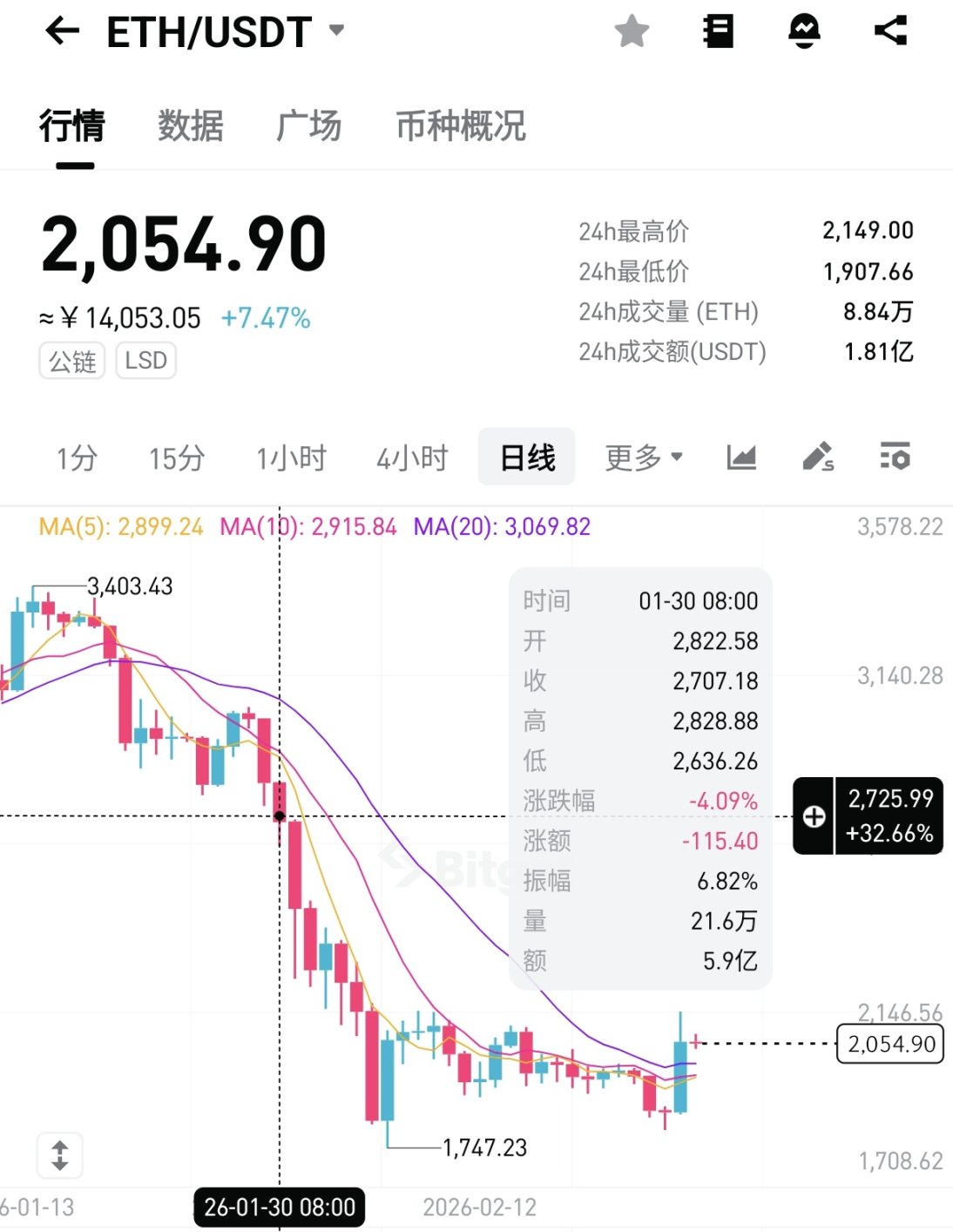
Image Source: Bitget Market

Three "Transparencies": Advance Notice, Purpose, and Public Execution

Vitalik's plan for this fund movement was announced in advance. On January 30, Vitalik published a long post via his personal X account, announcing that he would withdraw 16,384 ETH (worth approximately $44 million at the time) from his personal wallet and gradually liquidate it.
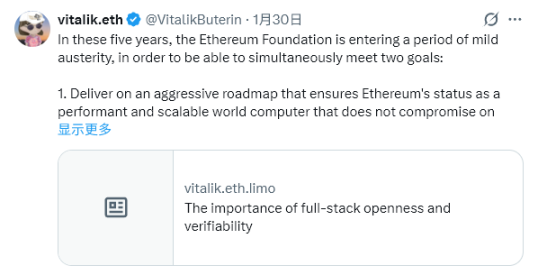
Image Source: Vitalik's Tweet

He explained that this move was his personal response to the Ethereum Foundation (EF) entering a phase of "mild austerity." The EF plans to reduce its annual spending from 15% of the treasury to 5% over 5 years, focusing more on core protocol development.

Vitalik also detailed the allocation of the funds in his post. The proceeds from this sale will be used to fund open-source projects and public goods, with a focus on privacy technologies (ZK proofs, fully homomorphic encryption FHE, differential privacy), secure hardware, verifiable computation, encrypted communication, local-first software, open-source operating systems, biotech/public health tools, and governance coordination mechanisms. These areas are mostly critical but marginalized sectors following EF's austerity. Vitalik emphasized that this was his personal decision to share the responsibility of EF's austerity.

Furthermore, the entire selling process was fully traceable through on-chain tools. Vitalik used a single address (0xfEB016D0D14AC0Fa6d69199608B0776d007203B2) and executed the sales in small batches via a single protocol (CoW Swap) to minimize market impact.

One "Unexpected": Execution Volume Slightly Higher Than Announced

Despite the high transparency, the execution result slightly differed from the initial announcement. The actual sales volume from Vitalik's address exceeded the previously announced 16,384 ETH, totaling approximately 19,326 ETH sold (an excess of about 2,942 ETH).

This sale began in the early hours of February 3, paused for about 10 days, and resumed on the 22nd, with acceleration occurring mainly in the last two days. Specifically, approximately 4,211.5 ETH were sold on February 5, about 2,283 on the 25th, and about 6,297 on the 26th.

Data Source: Etherscan & Bitget | Note: Data for the 26th is as of the time of the last sell operation

Whether the announced total was only a rough target or if unpublicized changes occurred during execution, Vitalik has not provided further explanation yet.

Vitalik has stated: "Since 2018, I have never sold ETH for personal wealth accumulation. Essentially all proceeds from sales have been used for donations, funding open-source projects, or charitable causes."

Image Source: Vitalik Farcaster Post

Moreover, compared to some project teams quietly offloading tokens, leading to post-factum crashes or trust crises, Vitalik's "open card selling" appears indeed healthier. This ETH sale plan, at least superficially, continues the path of transparency and non-personal profit.

However, objectively speaking, the founder accelerating coin sales at a rebound node during a continuous price decline may deal a blow to community and investor confidence. Market sentiment was already fragile; Vitalik's actions could amplify FUD (Fear, Uncertainty, Doubt), even compounding overall bear market pressures, pushing ETH to explore lower levels. In the short term, this may exacerbate selling by holders, affecting Ethereum's rebound trend and ecosystem stability.


Twitter:https://twitter.com/BitpushNewsCN

Bitpush TG Discussion Group:https://t.me/BitPushCommunity

Bitpush TG Subscription: https://t.me/bitpush

Original Link:https://www.bitpush.news/articles/7615139

Related Questions

QWhy did Vitalik Buterin sell nearly 20,000 ETH in February 2026?

AVitalik Buterin sold ETH as a personal response to the Ethereum Foundation's plan to reduce its annual spending from 15% to 5% of its treasury over five years, focusing more on core protocol development. The funds from the sale were intended to support open-source projects and public goods in areas like privacy technology, security hardware, and public health tools.

QHow did Vitalik's actual selling amount compare to his initial announcement?

AVitalik initially announced he would sell 16,384 ETH, but the actual amount sold was approximately 19,326 ETH, which is about 2,942 ETH more than planned. He has not provided further explanation for this discrepancy.

QWhat was the market impact of Vitalik's ETH sales during this period?

AThe sales occurred during a period of continuous decline for Ethereum, with a monthly drop of nearly 30%. Vitalik's actions, especially during a market rebound, potentially amplified FUD (Fear, Uncertainty, and Doubt), contributing to increased selling pressure and further price declines for ETH.

QHow transparent was Vitalik regarding his ETH sales?

AVitalik was highly transparent: he announced the sale plan in advance on his X account, detailed the intended use of the funds for public goods, and executed the sales through a single address and protocol (CoW Swap) in small batches to minimize market impact, with all transactions publicly traceable on the blockchain.

QWhat areas did Vitalik plan to fund with the proceeds from the ETH sale?

AThe proceeds were allocated to support open-source projects and public goods, including privacy technologies (such as ZK proofs and FHE), security hardware, verifiable computing, encrypted communication, local-first software, open-source operating systems, biotech/public health tools, and governance coordination mechanisms.

Related Reads

From Theft to Re-entry: How Was $292 Million "Laundered"?

A sophisticated crypto laundering operation was executed following the $292 million hack of Kelp DAO on April 18. The attack, attributed to the North Korean Lazarus group, began with anonymous infrastructure preparation using Tornado Cash to fund wallets untraceably. The hacker exploited a vulnerability in Kelp’s cross-chain bridge, stealing 116,500 rsETH. To avoid crashing the market, the attacker used Aave and Compound as laundering tools—depositing the stolen rsETH as collateral to borrow $190 million in clean, liquid ETH. This move triggered a bank run on Aave, causing an $8 billion drop in TVL. After consolidating funds, the attacker fragmented them across hundreds of wallets to evade detection. A major breakpoint was THORChain, where over $460 million in volume—30 times its usual activity—was processed in 24 hours, converting ETH into Bitcoin. This shift to Bitcoin’s UTXO model exponentially increased tracing complexity by shattering funds into countless untraceable fragments. The final destination was Tron-based USDT, the primary channel for illicit crypto flows. From there, funds were cashed out via OTC brokers in China and Southeast Asia, using unlicensed underground banks and UnionPay networks outside Western sanctions scope. Ultimately, the laundered money supports North Korea’s weapons programs, which rely heavily on crypto hacking for foreign currency. The incident underscores structural challenges in DeFi: its openness, composability, and lack of central control make such laundering not just possible, but inherently difficult to prevent.

marsbit1h ago

From Theft to Re-entry: How Was $292 Million "Laundered"?

marsbit1h ago

Google and Amazon Simultaneously Invest Heavily in a Competitor: The Most Absurd Business Logic of the AI Era Is Becoming Reality

In a span of four days, Amazon announced an additional $25 billion investment, and Google pledged up to $40 billion—both direct competitors pouring over $65 billion into the same AI startup, Anthropic. Rather than a typical venture capital move, this signals the latest escalation in the cloud wars. The core of the deal is not equity but compute pre-orders: Anthropic must spend the majority of these funds on AWS and Google Cloud services and chips, effectively locking in massive future compute consumption. This reflects a shift in cloud market dynamics—enterprises now choose cloud providers based on which hosts the best AI models, not just price or stability. With OpenAI deeply tied to Microsoft, Anthropic’s Claude has become the only viable strategic asset for Google and Amazon to remain competitive. Anthropic’s annualized revenue has surged to $30 billion, and it is expanding into verticals like biotech, positioning itself as a cross-industry AI infrastructure layer. However, this funding comes with constraints: Anthropic’s independence is challenged as it balances two rival investors, its safety-first narrative faces pressure from regulatory scrutiny, and its path to IPO introduces new financial pressures. Globally, this accelerates a "tri-polar" closed-loop structure in AI infrastructure, with Microsoft-OpenAI, Google-Anthropic, and Amazon-Anthropic forming exclusive model-cloud alliances. In contrast, China’s landscape differs—investments like Alibaba and Tencent backing open-source model firm DeepSeek reflect a more decoupled approach, though closed-source models from major cloud providers still dominate. The $65 billion bet is ultimately about securing a seat at the table in an AI-defined future—where missing the model layer means losing the cloud war.

marsbit7h ago

Google and Amazon Simultaneously Invest Heavily in a Competitor: The Most Absurd Business Logic of the AI Era Is Becoming Reality

marsbit7h ago

Trading

Spot
Futures

Hot Articles

Discussions

Welcome to the HTX Community. Here, you can stay informed about the latest platform developments and gain access to professional market insights. Users' opinions on the price of ETH (ETH) are presented below.

活动图片