Visa Revelation: The 50-Year Cycle of Stablecoin 'Fragmentation Dilemma'

marsbitPublished on 2026-01-15Last updated on 2026-01-15

Abstract

In the 1960s, the credit card industry was fragmented networks with limited interoperability. Visa succeeded not just through technology, but by creating a cooperative structure that unified banks under a shared network, aligning incentives, distributing ownership, and enabling compound network effects. It operated as a neutral third party, granted members profit shares and governance rights, and enforced exclusivity to consolidate growth. Today, stablecoins face a similar fragmentation issue, with over 300 stablecoins listed on Defillama, each confined to its own ecosystem, limiting network effects and liquidity. Services like Anchorage Digital and Ethena enable new issuers to create stablecoins, but this exacerbates fragmentation rather than solving it. The solution lies in adopting a Visa-like model: a neutral, cooperative structure where issuers and protocols unite under a single stablecoin standard. Members would share reserve yields and participate in governance, fostering widespread adoption and retaining value within the network instead of fragmenting liquidity. This approach could drive the mainstream integration stablecoins need.

Original Author: Nishil Jain

Original Compilation: Block unicorn

Preface

In the 1960s, the credit card industry was in chaos. Banks across the United States were trying to establish their own payment networks, but each network operated independently. If you held a Bank of America credit card, you could only use it at merchants that had a cooperation agreement with Bank of America. And when banks tried to expand their business to other banks, all credit card payments encountered the problem of inter-bank settlement.

If a merchant accepted a card issued by another bank, the transaction had to be settled through its original check settlement system. The more banks that joined, the more settlement problems arose.

Then Visa emerged. Although the technology it introduced undoubtedly played a huge role in the bank card payment revolution, the more important key to its success was its global universality and its success in getting global banks to join its network. Today, almost every bank in the world has become a member of the Visa network.

While this seems very normal today, imagine trying to convince the first thousand banks, both inside and outside the United States, that joining a cooperation agreement instead of building their own network was a wise move, and you begin to realize the scale of this endeavor.

By 1980, Visa had become the dominant payment network, processing about 60% of credit card transactions in the United States. Currently, Visa operates in more than 200 countries.

The key was not more advanced technology or more capital, but structure: a model that could coordinate incentives, decentralize ownership, and create compound network effects.

Today, stablecoins face the same fragmentation problem. And the solution may be exactly the same as what Visa did fifty years ago.

Pre-Visa Experiments

Other companies that appeared before Visa failed to develop.

American Express (AMEX) tried to expand its credit card business as an independent bank, but its scale expansion was limited to continuously adding new merchants to its bank network. On the other hand, BankAmericard was different; Bank of America owned its credit card network, and other banks only leveraged its network effects and brand value.

American Express had to approach each merchant and user individually to open their bank accounts; whereas Visa achieved scale by accepting banks itself. Every bank that joined the Visa cooperative network automatically gained thousands of new customers and hundreds of new merchants.

On the other hand, BankAmericard had infrastructure problems. They didn't know how to efficiently settle credit card transactions from one consumer bank account to another merchant bank account. There was no efficient settlement system between them.

The more banks that joined, the worse this problem became. Thus, Visa was born.

The Four Pillars of Visa's Network Effects

From the story of Visa, we learn about 2-3 important factors that led to the accumulation of its network effects:

Visa benefited from its status as an independent third party. To ensure that no bank felt threatened by competition, Visa was designed as a cooperative independent organization. Visa does not participate in competing for the distribution pie; the banks are the ones competing for the pie.

This incentivized the participating banks to strive for a larger share of the profits. Each bank is entitled to a portion of the total profits, proportional to the total transaction volume it processes.

Banks have a say in network functions. Visa's rules and changes must be voted on by all relevant banks and require 80% approval to pass.

Visa had exclusivity clauses with each bank (at least initially); anyone joining the cooperative could only use Visa cards and the network, and could not join other networks—therefore, to interact with a Visa bank, you also needed to be part of its network.

When Visa's founder, Dee Hock, lobbied banks across the United States to join the Visa network, he had to explain to each bank that joining the Visa network was more beneficial than building their own credit card network.
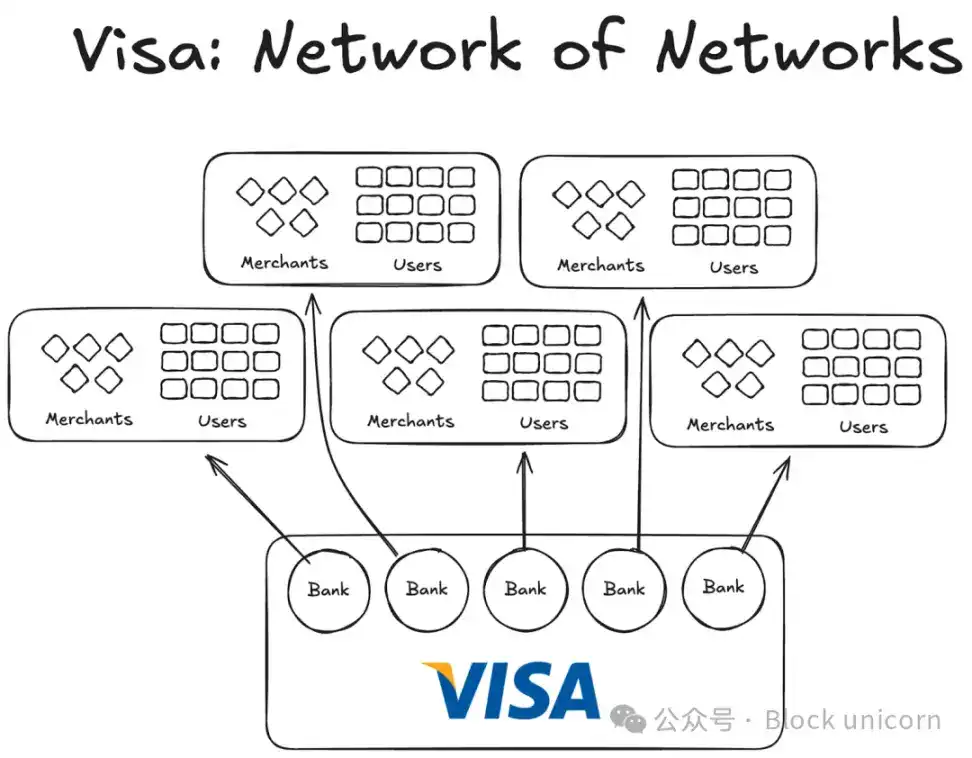
He had to explain that joining Visa meant more users and more merchants would be connected to the same network, which would facilitate more digital transactions globally and bring more benefits to all participants. He also had to explain that if they built their own credit card network, their user base would be very limited.

Implications for Stablecoins

In a sense, Anchorage Digital and other companies now offering stablecoin-as-a-service are replaying the BankAmericard story in the stablecoin space. They provide the underlying infrastructure for new issuers to build stablecoins, while liquidity continues to fragment into new tokens.

Currently, there are over 300 stablecoins listed on Defillama. Moreover, each newly created stablecoin is limited to its own ecosystem. Therefore, no single stablecoin can generate the network effects needed to go mainstream.

Since the same underlying assets back these new coins, why do we need more coins with new code?

In our Visa story, these are like BankAmericards. Ethena, Anchorage Digital, M0, or Bridge—each allows a protocol to issue its own stablecoin, but this only exacerbates industry fragmentation.

Ethena is another similar protocol that allows yield pass-through and white-label customization of its stablecoin. Just like MegaETH issuing USDm—they issued USDm through tools that support USDtb.

However, this model failed. It only fragments the ecosystem.

In the credit card case, the brand differences between banks were not important because it did not create any friction in user-to-merchant payments. The underlying issuance and payment layer was always Visa.

However, for stablecoins, this is not the case. Different token codes mean an infinite number of liquidity pools.

Merchants (or in this case, applications or protocols) will not add all stablecoins issued by M0 or Bridge to their list of accepted stablecoins. They will decide whether to accept them based on the liquidity of these stablecoins in the open market; the coins with the most holders and the strongest liquidity should be accepted, the others will not.

The Way Forward: The Visa Model for Stablecoins

We need independent third-party institutions to manage stablecoins for different asset classes. Issuers and applications supporting these assets should be able to join the cooperative and access reserve earnings. At the same time, they should also have governance rights and be able to vote on the direction of their chosen stablecoin.

From a network effects perspective, this would be a superior model. As more and more issuers and protocols join the same token, it will facilitate the widespread adoption of a token that can retain earnings internally rather than flowing into others' pockets.

Related Questions

QWhat was the main problem with the credit card industry in the 1960s that Visa solved?

AThe main problem was fragmentation, where each bank had its own payment network, leading to interoperability issues and inefficient interbank settlements. Visa created a universal network that allowed banks to cooperate, solving the settlement problems and enabling global scalability.

QHow did Visa's cooperative structure differ from competitors like American Express and BankAmericard?

AVisa acted as an independent third-party cooperative, allowing banks to join without competition fears, share profits proportionally, and have voting rights. In contrast, American Express operated as a standalone bank, and BankAmericard was owned by a single bank with infrastructure limitations.

QWhat is the 'fragmentation problem' facing stablecoins today, as described in the article?

AStablecoins face fragmentation due to the proliferation of numerous stablecoins issued by different protocols (e.g., via services like Ethena or Anchorage Digital), each with its own token code and liquidity pool, preventing network effects and universal adoption.

QHow does the article suggest applying Visa's model to solve stablecoin fragmentation?

AIt proposes an independent third-party cooperative model for stablecoins, where issuers and protocols join a shared network, earn reserve yields, and participate in governance, thereby consolidating liquidity and creating compound network effects for a universally accepted stablecoin.

QWhy did the 'stablecoin as a service' model (e.g., by Anchorage Digital) fail to achieve scalability, according to the article?

AIt failed because it perpetuated fragmentation by creating multiple stablecoins with separate liquidity pools, limiting adoption to their own networks rather than enabling universal acceptance, similar to the pre-Visa BankAmericard issue.

Related Reads

The AI Agent Era Accelerates Its Arrival: Questflow Defines a New Paradigm of Financial Intelligence with On-Chain AI Brokerage

The AI Agent era is accelerating, with the CB Insights AI 100 list highlighting global investment confidence. The focus has shifted from whether AI works to its speed of deployment and ability to manage complex workflows, with autonomous AI Agents driving this transformation. At the forefront is Questflow, a Singapore-based startup redefining financial intelligence through its on-chain AI brokerage. Unlike tools that merely provide data dashboards, Questflow deploys AI Agents that proactively scan markets, form judgments, and execute trades via a conversational interface—operating 24/7 without requiring manual confirmation for each decision. This embodies the new AI paradigm of agents capable of executing multi-step workflows autonomously. Questflow's mission is to democratize institutional-grade trading intelligence. Historically reserved for the ultra-wealthy, this capability is now accessible starting from just $1 through Questflow's "AI Clone + Copy Trade" model. The platform charges only a 1% execution fee, aligning its incentives directly with users and eliminating traditional management or performance fees. The timing is opportune, aligning with key trends identified by CB Insights: the scalable deployment of AI Agents, accelerated AI adoption in financial services, and the maturation of on-chain infrastructure. With robust liquidity on platforms like Hyperliquid and Polymarket, alongside advancements in AI reasoning and non-custodial wallet security, Questflow is positioned to merge the roles of broker, fund, and exchange into a single, accessible platform for millions.

链捕手1m ago

The AI Agent Era Accelerates Its Arrival: Questflow Defines a New Paradigm of Financial Intelligence with On-Chain AI Brokerage

链捕手1m ago

Why Pricing Social Interactions is Doomed to Fail?

Titled "Why Putting a Price on Social Interaction Is Doomed to Fail," this article critiques attempts to monetize social networks directly through SocialFi models, arguing their inevitable failure stems from a fundamental misunderstanding of media dynamics. Using Marshall McLuhan's theory of "hot" and "cold" media, the author posits that social networks are inherently "cold" media. Their value isn't contained in individual posts but is co-created through user participation, interpretation, and fragmented, ongoing interaction (e.g., replies, shares). This ambiguity and need for user involvement are core to their function. The article asserts that SocialFi projects like Friend.tech failed because introducing real-time, tradable financial pricing (a definitive "hot" signal) into this "cold" environment doesn't add a layer—it replaces the medium's essence. The unambiguous price signal overshadows and nullifies the nuanced, participatory social signal. Users become traders, not participants, and when speculative profits vanish, the underlying social ecosystem—never genuinely cultivated—collapses entirely. This principle extends beyond crypto. The author argues platforms like Twitter have gradually "heated up" through metrics (likes, retweets counts, algorithmically defined value), shifting users from participants to performers and eroding organic engagement. The solution isn't to abandon capital but to manage its entry point. Successful models like Substack, Patreon, or Bandcamp allow capital to "condense" at specific, isolated nodes (e.g., subscriptions, one-time payments) without permeating and "heating" every social interaction. They preserve the core "cold," participatory medium while enabling monetization at designated boundaries. The NFT boom and bust serves as a stark parallel: the ancient "cold" medium of collecting (valued for story, community, gradual accumulation) was rapidly destroyed by platforms that introduced real-time floor prices, rarity scores, and trading dashboards, transforming collectors into speculators and vaporizing cultural value when prices fell. The core lesson: "Liquidity equals heat." Injecting high liquidity and definitive pricing into a "cold" participatory medium doesn't optimize it; it fundamentally alters and destroys its value-creating mechanism. The future lies not in pricing every social gesture but in finding precise, non-invasive points for capital to condense without overheating the entire ecosystem.

marsbit9m ago

Why Pricing Social Interactions is Doomed to Fail?

marsbit9m ago

Jensen Huang's CMU Speech: In the AI Era, Don't Just Watch, Build

Jensen Huang, CEO of NVIDIA and a first-generation immigrant, delivered the commencement address to Carnegie Mellon University's class of 2026. He shared his personal journey from a humble background to founding NVIDIA, emphasizing resilience, learning from failure, and the responsibility that comes with leadership. Huang framed the present moment as the dawn of the AI revolution, a shift he believes is more profound than previous computing waves. He described AI as fundamentally resetting computing—moving from human-written software to machines that understand, reason, and use tools. This will create a new industry for generating intelligence and transform every sector. While acknowledging AI's potential to automate tasks and displace some jobs, Huang distinguished between the *tasks* of a job and its core *purpose*. He argued AI will augment human capability, not replace humans. The real risk, he stated, is not AI itself, but people being left behind by those who effectively use AI. He presented AI as a generational opportunity for massive infrastructure investment—in chip factories, data centers, energy grids, and advanced manufacturing—that could re-industrialize nations like the U.S. and bridge the digital divide by making computing and intelligent tools accessible to all. Huang called for a balanced approach: advancing AI safely and responsibly, establishing prudent policies, ensuring broad access, and encouraging universal participation. He urged the graduates not to fear the future but to engage with optimism and ambition, reminding them of CMU's motto, "My heart is in the work." His core message was clear: this is their moment to actively build and shape the AI-powered future, not merely observe it.

marsbit1h ago

Jensen Huang's CMU Speech: In the AI Era, Don't Just Watch, Build

marsbit1h ago

Trading

Spot
Futures
活动图片