Visa outlines stablecoin strategy during Q3 earnings call

cointelegraphPublished on 2026-07-28Last updated on 2026-07-28

Abstract

Visa's fiscal third-quarter revenue grew 14% year-over-year to $11.6 billion, supported by strong growth in payments volume, cross-border transactions, and processed transactions. During its earnings call, the company detailed its expanding stablecoin strategy, emphasizing investments across the entire stablecoin ecosystem, including blockchain infrastructure, issuance, wallets, and applications. Visa highlighted progress in issuance and application layers, and announced its participation in the OpenStandard consortium, which plans to issue the OpenUSD stablecoin for global money movement. The Visa stablecoin platform is designed to allow partners to settle with Visa using stablecoins, provide onchain wallet services, and facilitate conversions between fiat currency and stablecoins, starting with OpenUSD. The platform will also integrate with Pismo to support financial institutions' tokenized deposits, with plans to add more infrastructure providers. Visa further described stablecoins and artificial intelligence as complementary long-term growth technologies, suggesting that while stablecoins reshape the backend of commerce, AI is transforming the frontend.

Visa reported fiscal third-quarter revenue of $11.6 billion, up 14% from a year earlier, driven by double-digit growth in payments volume, cross-border volume and processed transactions.

During the company’s earnings call, Visa outlined its broader stablecoin strategy, saying it has been investing across multiple layers of the stablecoin ecosystem. The company said:

We are active in investing in each layer of the stablecoin stack, from blockchain, to issuance, wallets, infrastructure and orchestration, and applications. This quarter, we’ve made progress in both the issuance and application layers.

Visa added that it had joined the OpenStandard consortium, which plans to issue the OpenUSD stablecoin for global money movement. The company said the Visa stablecoin platform is designed to enable partners to settle with Visa in stablecoins, provide onchain wallet-as-a-service infrastructure and move money between fiat currencies and stablecoins, beginning with OpenUSD.

The platform will also integrate with Pismo to support tokenized deposits for financial institutions, with plans to add third-party tokenized deposit infrastructure providers in the future.

The company also pointed to artificial intelligence as another long-term growth area, describing stablecoins and AI as complementary technologies.

If stablecoins are reshaping the backend of commerce, we see AI is transforming the frontend. We believe agentic commerce will expand our addressable market and drive future growth for Visa.

Cross-border volume increased 13% year over year, or 12% excluding intra-Europe, while processed transactions rose 10%, according to the company’s earnings release.

Magazine: The real reason DeFi projects that survived 2022 crash are shutting down now

Related Questions

QWhat was Visa's fiscal third-quarter revenue and how does it compare to the previous year?

AVisa reported fiscal third-quarter revenue of $11.6 billion, representing a 14% increase from a year earlier.

QIn which layers of the stablecoin ecosystem has Visa been investing, according to the earnings call?

AVisa has been investing across multiple layers of the stablecoin stack, including blockchain, issuance, wallets, infrastructure and orchestration, and applications.

QWhat is the purpose of the Visa stablecoin platform as mentioned in the article?

AThe Visa stablecoin platform is designed to enable partners to settle with Visa in stablecoins, provide onchain wallet-as-a-service infrastructure, and move money between fiat currencies and stablecoins, starting with OpenUSD.

QHow does Visa view the relationship between stablecoins and artificial intelligence (AI)?

AVisa sees stablecoins and AI as complementary technologies, stating that while stablecoins are reshaping the backend of commerce, AI is transforming the frontend.

QWhat was the year-over-year growth in Visa's cross-border volume and processed transactions for the quarter?

ACross-border volume increased 13% year over year (12% excluding intra-Europe), and processed transactions rose 10%.

Related Reads

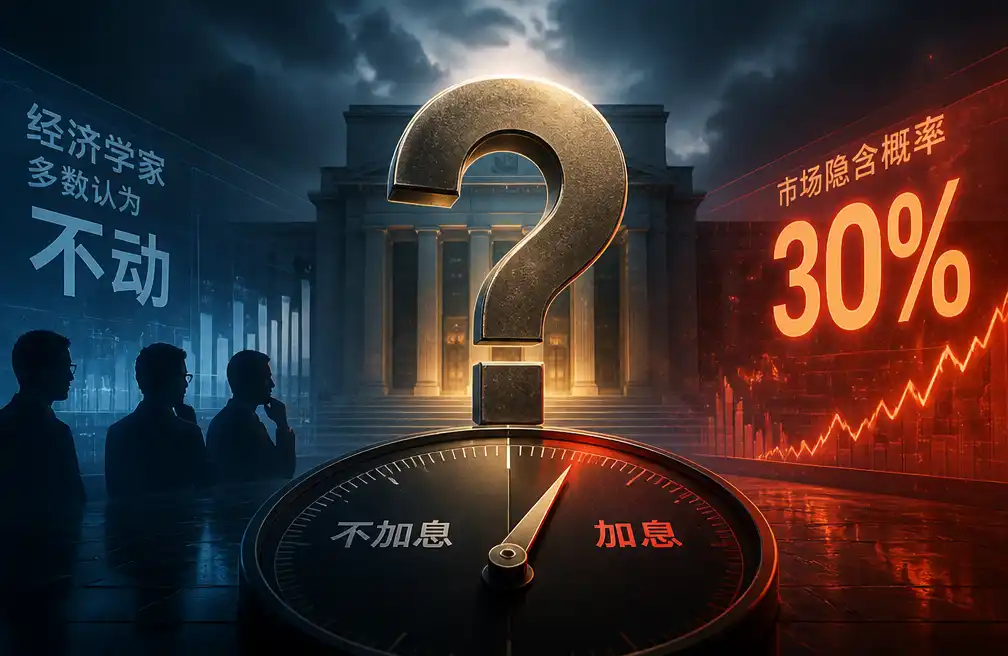
To Hike or Not Tonight: Economists Unanimous on 'No', Markets Price in a 30% Chance

Federal funds futures are repricing ahead of the July FOMC decision, as traders pay a higher premium for the risk of a surprise rate hike or more hawkish signals. This contrasts with economists, where a Reuters survey of 104 analysts unanimously expects rates to remain unchanged at 3.50%-3.75%, with 78 foreseeing no change through year-end. Yet, futures markets have priced in about a 30% probability of a 25-basis-point hike. The core debate, especially under new Fed Chair Kevin Warsh, centers on how the Fed will respond to the oil price shock from Middle East tensions. The market is not necessarily predicting a hike tonight but is hedging against two tail risks: an immediate rate increase, or a hold combined with communication that seriously opens the door for a September hike. This hedging activity has driven up open interest in Fed funds futures. Analysts are divided on how to weight the oil price surge in the Fed's reaction function. Hawkish voices (e.g., BofA) worry that completely dismissing the price pressure could challenge the Fed's inflation credibility in Warsh's first major test. Dovish views (e.g., Citi) argue the shock is primarily supply-driven and that overreacting with rate hikes could unnecessarily hurt growth, unless clear signs of secondary inflation emerge. Warsh's new tenure amplifies policy path uncertainty, as markets lack a stable baseline for his communication style. This environment forces traders to price in a wider range of outcomes, explaining the divergence between unanimous economist forecasts and market hedging. The key focus will be on Warsh's post-meeting commentary. If he downplays the oil shock and stresses anchored long-term expectations, hawkish pricing may recede. If he emphasizes the risk of broader price spillovers and prioritizes returning to 2% inflation, the market will interpret this as reopening the door for a September hike. This would sustain support for the USD, keep pressure on JPY (testing intervention thresholds), and challenge risk assets like stocks and crypto through higher discount rates and weaker sentiment. The baseline remains no action in July, but the communication will determine how far this repricing extends.

marsbit48m ago

To Hike or Not Tonight: Economists Unanimous on 'No', Markets Price in a 30% Chance

marsbit48m ago

The Semiconductor Industry's Most Obscure Chokepoint Material: It Has Multiplied in Price Unnoticed, and China Just Banned Its Export

"Helium: The Silent Choke Point in Semiconductors" Helium, despite being the universe's second most abundant element, is critically scarce on Earth. It cannot be synthesized artificially and escapes Earth's gravity once released, making it a non-renewable resource. Yet, it is indispensable for advanced semiconductor manufacturing, requiring ultra-high purity (99.9999%) for processes like wafer etching, leak detection, and thermal management in lithography tools, with no viable substitutes. This low-profile resource, whose price has doubled unnoticed, suddenly gained attention when China imposed an export ban on July 10th. The ban is a response to a severe global shortage triggered months earlier. In March, missile attacks damaged the world's largest helium production hub in Qatar's Ras Laffan, halting a third of global supply with repairs expected to take 3-5 years. Concurrently, Russia tightened export controls, and the US sold off its federal helium reserve. Approximately 200 specialized transport containers, each worth ~$1 million, were stranded with perishable cargo. Global spot prices skyrocketed, and chipmakers like TSMC warned of potential impacts. China, which imports over 84% of its helium (primarily from Qatar and Russia), faces a severe squeeze. Despite being helium-poor, China has developed domestic extraction technology over five years, processing byproduct gases from LNG plants to produce ultra-pure helium. Domestic output, while still only covering less than 20% of demand, enabled the recent export ban aimed at securing domestic supply for its own expanding chip industry. The industry now faces "Helium Shortage 5.0." With key global sources constrained for years, this invisible gas—once wasted on party balloons—has become a critical, geopolitically charged bottleneck for chips, healthcare (MRI machines), and beyond, forcing the world to finally treat it as the finite strategic resource it is.

marsbit1h ago

The Semiconductor Industry's Most Obscure Chokepoint Material: It Has Multiplied in Price Unnoticed, and China Just Banned Its Export

marsbit1h ago

Trading

Spot
活动图片