VIRTUAL surges 12% as bulls align – But downside risk still lurks

ambcryptoPublished on 2026-03-17Last updated on 2026-03-17

Abstract

VIRTUAL surged 12% in 24 hours, driven by strong bullish sentiment across both spot and futures markets. Futures activity showed a positive funding rate of 0.0022%, with $12 million inflows boosting open interest to $102.42 million, indicating dominant long positioning. Spot market demand also accelerated sharply, with net purchases rising nearly tenfold from $72,000 to $697,140 within a day, reflecting growing investor confidence. However, liquidity clusters above and below the current price suggest potential downside risk, making near-term price direction dependent on sustained momentum.

VIRTUAL continues to gain strength as market sentiment shifts decisively in its favor. The asset recorded a 12% increase over the past 24 hours, reflecting growing bullish positioning.

AMBCrypto’s analysis highlights a rare alignment between Spot and Futures markets, with participants across both segments actively accumulating the asset.

Futures market drives capital inflow

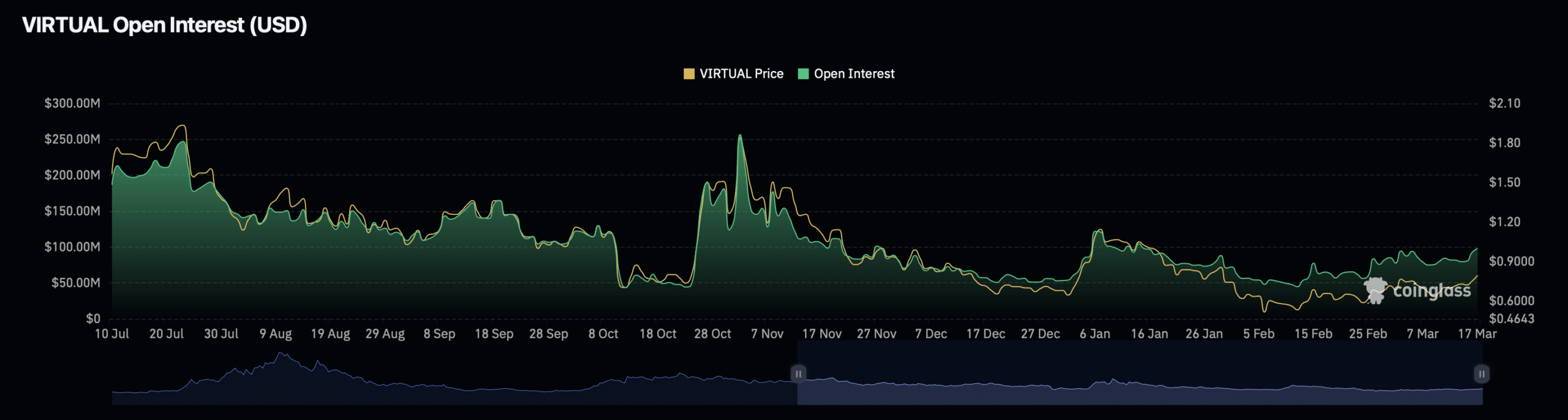
The recent surge in Virtual [VIRTUAL] has been largely fueled by bullish activity in the Futures market. This bias is reinforced by a positive Funding Rate of 0.0022%, indicating that long traders are paying a premium to maintain their positions.

In effect, long positions dominate capital flows into VIRTUAL contracts, signaling strong expectations of continued upside.
Source: CoinGlass

Within the last 24 hours, capital inflows totaled $12 million, pushing Open Interest to $102.42 million. This sharp increase reflects rising participation and conviction among derivatives traders.

With most of this capital concentrated in long positions, bullish momentum remains firmly intact—at least in the short term.

Spot demand strengthens conviction

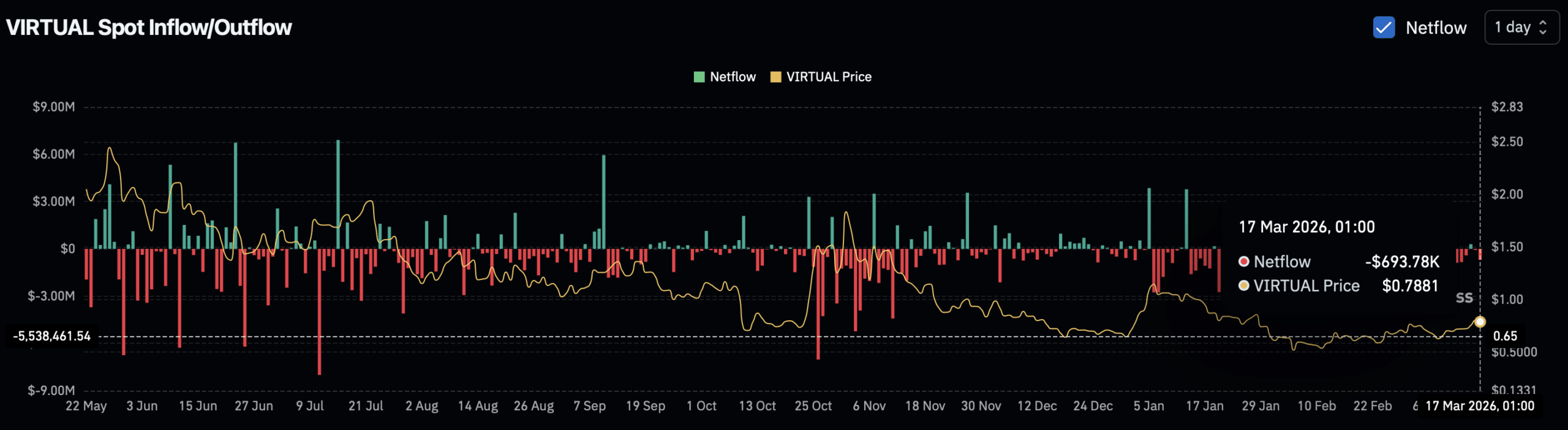
Spot market activity has also accelerated, reinforcing the broader bullish outlook. Accumulation began modestly on the 16th of March, with net inflows of just $72,000, according to CoinGlass data.

However, this quickly scaled. By the 17th of March, total purchases surged to $697,140—nearly ten times the previous day’s volume.
Source: CoinGlass

This sharp increase signals renewed investor confidence. When capital inflows expand at this pace, it typically reflects stronger conviction and a growing expectation of sustained price appreciation.

If this level of demand persists, it could provide the structural support needed to extend the rally. A slowdown, however, would weaken that foundation and expose the asset to downside pressure.

Liquidity clusters leave direction open

Despite the bullish buildup, liquidation data suggests the next move is not yet fully determined.

The heatmap shows liquidity clusters both above and below the current price. These clusters—visible as dense shaded zones—tend to attract price action.
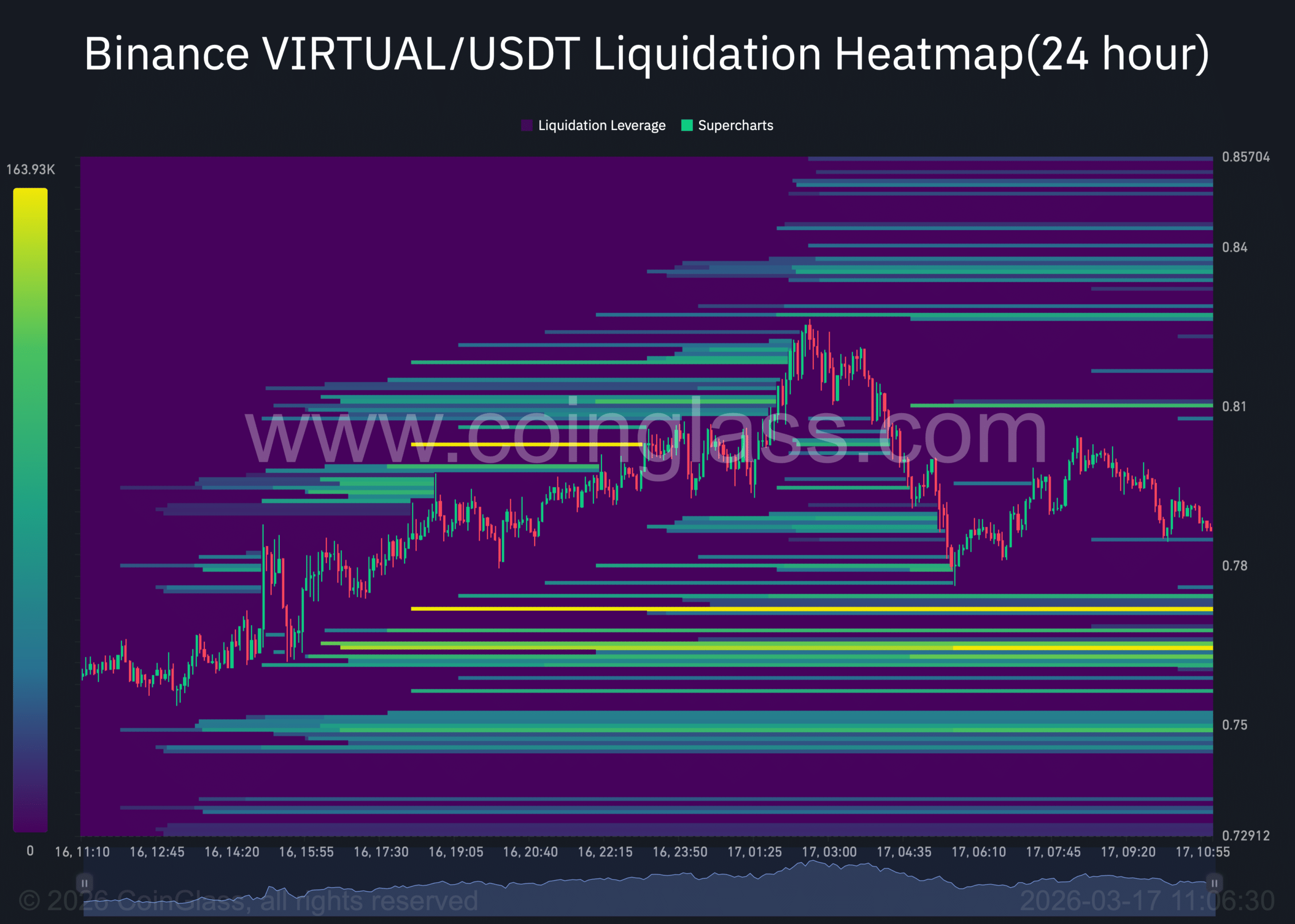
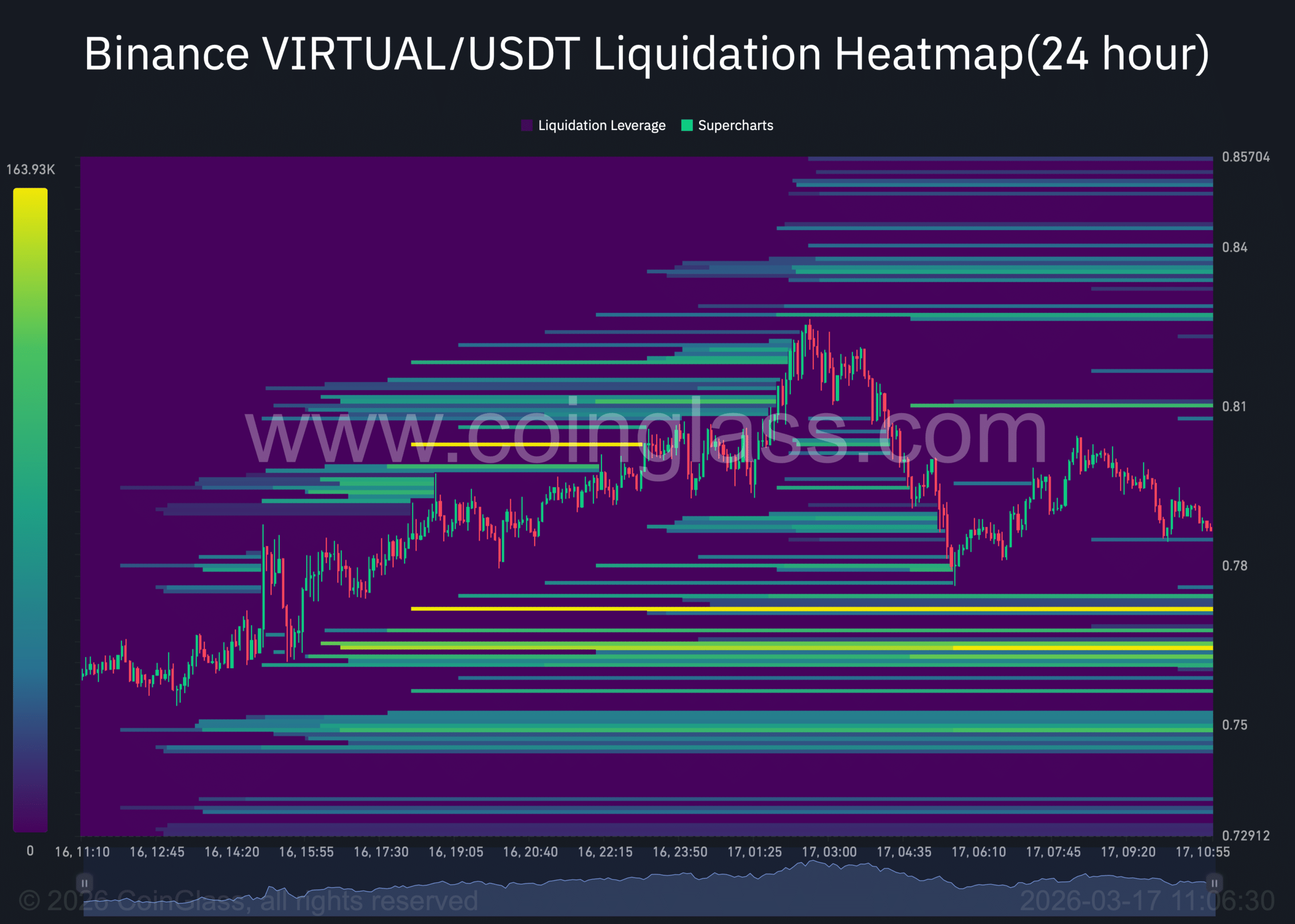
Source: CoinGlass

While liquidity remains split, the clusters below price appear more concentrated, suggesting stronger downside pull.

This creates a balanced but fragile setup. As a result, the next phase of price action will depend heavily on momentum, with VIRTUAL likely to move toward the dominant liquidity zone in the near term.


Final Summary

  • VIRTUAL’s price rally and capital inflows were driven primarily by long traders in the perpetual market.
  • Spot investors intensified accumulation, with purchases rising nearly tenfold day-over-day.

Related Reads

In Jinjiang, Fujian, a Storage Super Unicorn Lies Quiet

In Fujian's Jinjiang, a city known for sportswear, lies a quiet semiconductor giant: Fujian Jinhua Integrated Circuit Co. (JHICC). Once a promising domestic DRAM manufacturer alongside Yangtze Memory and ChangXin Memory Technologies (CXMT), its journey was derailed in 2018 when the U.S. placed it on an Entity List and filed criminal charges for alleged trade secret theft. This halted production for years. A turning point came in February 2024 when a U.S. federal court found JHICC not guilty. However, it had lost crucial time. While CXMT soared to become a top-valued A-share company in 2024, JHICC, with an estimated valuation of 80 billion RMB, was just restarting. Its current output is primarily customized DDR4 chips, not the advanced DDR5/HBM demanded for AI, but it still benefits from the broader memory chip upcycle. JHICC's story is tied to Chen Zhengkun, a veteran engineer who left Micron to lead the venture. Founded in 2016 with state-backed funding, JHICC partnered with Taiwan's UMC to develop DRAM technology. Rapid progress was cut short by the U.S. actions, which Micron initiated, partly due to its heavy reliance on the Chinese market. Post-sanctions, Chen's team worked to rebuild the production line with reduced reliance on U.S. technology. According to its records, JHICC achieved small-scale production and revenue growth under immense pressure. It now focuses on the stable "niche" DRAM market (e.g., TVs, routers) with a monthly capacity of ~40,000 wafers, aiming for 60,000 by 2026. It holds over 1,000 patents but remains on the Entity List. For Jinjiang, investing in JHICC was a bold industrial leap. The local government provided unwavering financial and logistical support during the crisis, helping the company survive. JHICC has become the anchor for a growing local semiconductor cluster. Though its scale lags behind domestic peers, JHICC's persistence symbolizes a hard-won foothold in a global market long dominated by Samsung, SK Hynix, and Micron. Having missed one boom, it seeks a place in the new AI-driven memory supercycle.

marsbit1h ago

In Jinjiang, Fujian, a Storage Super Unicorn Lies Quiet

marsbit1h ago

Trading

Spot
活动图片




