Verse8's Self-Description: How to Support Creative Expression in the AI Era

深潮Published on 2025-12-10Last updated on 2025-12-10

Abstract

Verse8 is an AI-native creation layer that transforms ideas into interactive games and stories, where every creation can be owned, remixed, and accumulate value over time. Unlike OpenAI (chat), Runway (video), or Stability (image), Verse8 focuses on interactive content as the new expressive medium, starting with games as its first vertical. The platform was built to overcome the high barriers of traditional interactive content creation—long cycles, high costs, and complex coordination across coding, art, and design. By collapsing the entire production process into a single prompt, Verse8 eliminates creative friction, automates invisible work, and enables anyone to express ideas interactively. Its core architecture consists of two layers: - **Agent8**: A multi-agent system that acts as a full production team—handling art, code, design, and testing through a single prompt. It includes an AI-native web engine with templates (FPS, RPG, etc.), automated asset generation (2D/3D optimization, animation, audio), and built-in infrastructure (Git, servers, analytics, payments). - **Verse8 Ecosystem**: A global deployment network where creators can instantly publish, share, and remix content. Integrated with Story Protocol, it enables on-chain IP ownership and programmable rights, allowing derivative works while rewarding original authors. Verse8 aims to democratize creativity—enabling everyone to create, not just consume. It supports instant world-building, prompt-based cr...

Verse8 is an AI-native creation layer that transforms your ideas into interactive games and stories. Every creation can be owned, remixed, and continuously accumulates value. Just as OpenAI started with chat, Runway rose with video, and Stability broke through with images, Verse8 begins with the most representative form: interactive content. Gaming is just the first vertical where this new medium shines. We believe creation should be for everyone, not just developers.

Why We Built Verse8
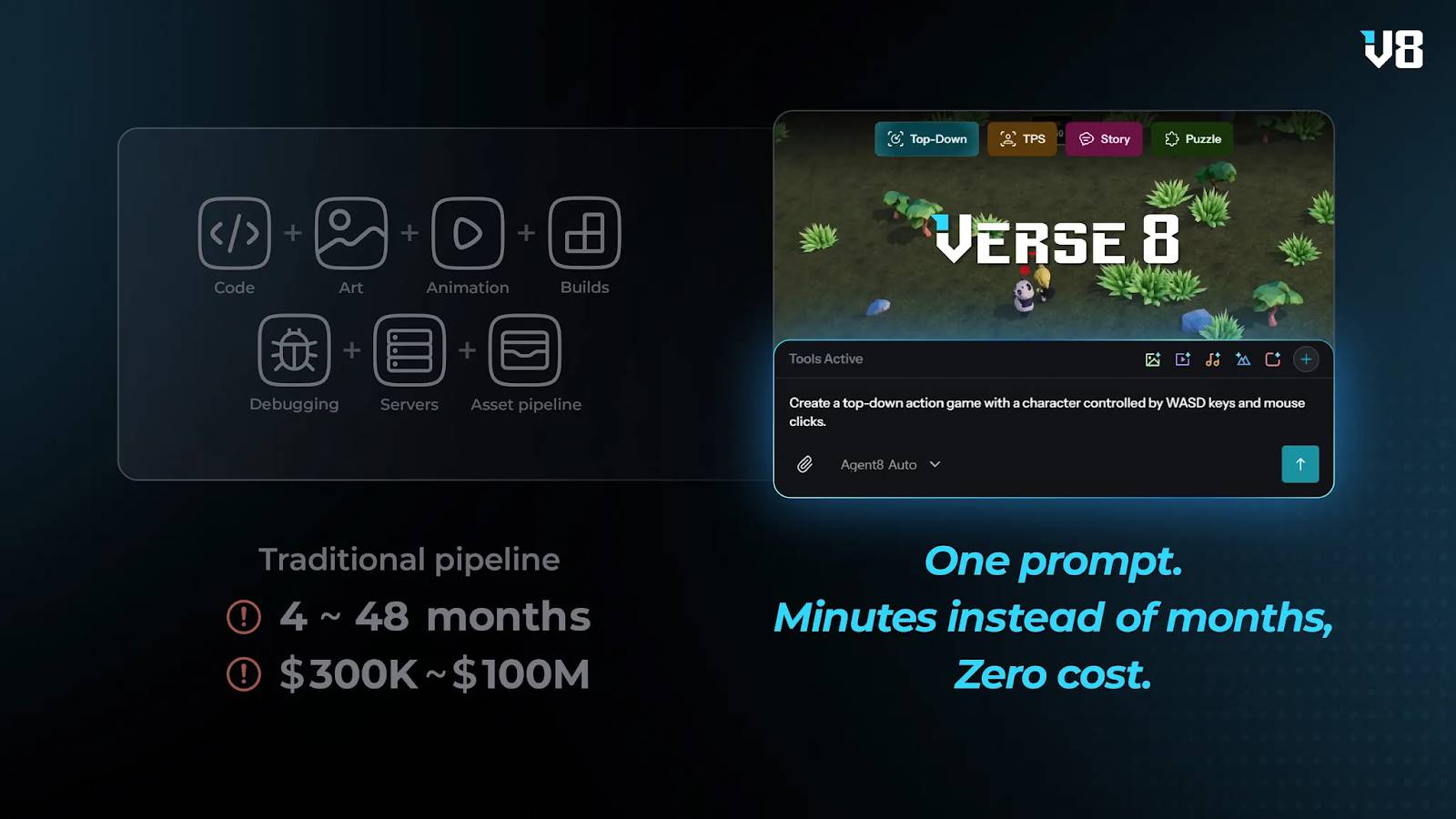
Interactive content creation has always been one of the hardest fields to enter: long production cycles, high upfront costs, and a complex workflow requiring collaboration between code, design, and art. The current system is not creator-friendly. However, creativity should not be constrained.

When we realized that the entire production pipeline could be folded into a single prompt, we knew we had to build a system:
——To eliminate creative friction,
——Automate invisible work,
——And allow anyone to express ideas interactively.

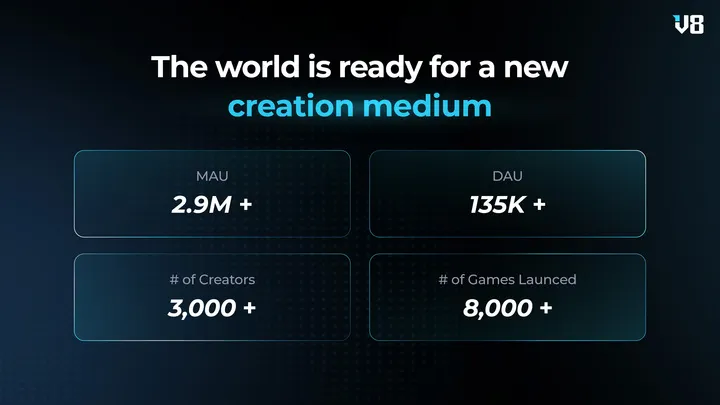
Thus, Verse8 was born. Since Verse8's stealth launch, our user and creator community has grown rapidly, confirming one thing: the world is ready for a new creative medium.
The Architecture of Verse8

Verse8 consists of two core layers.
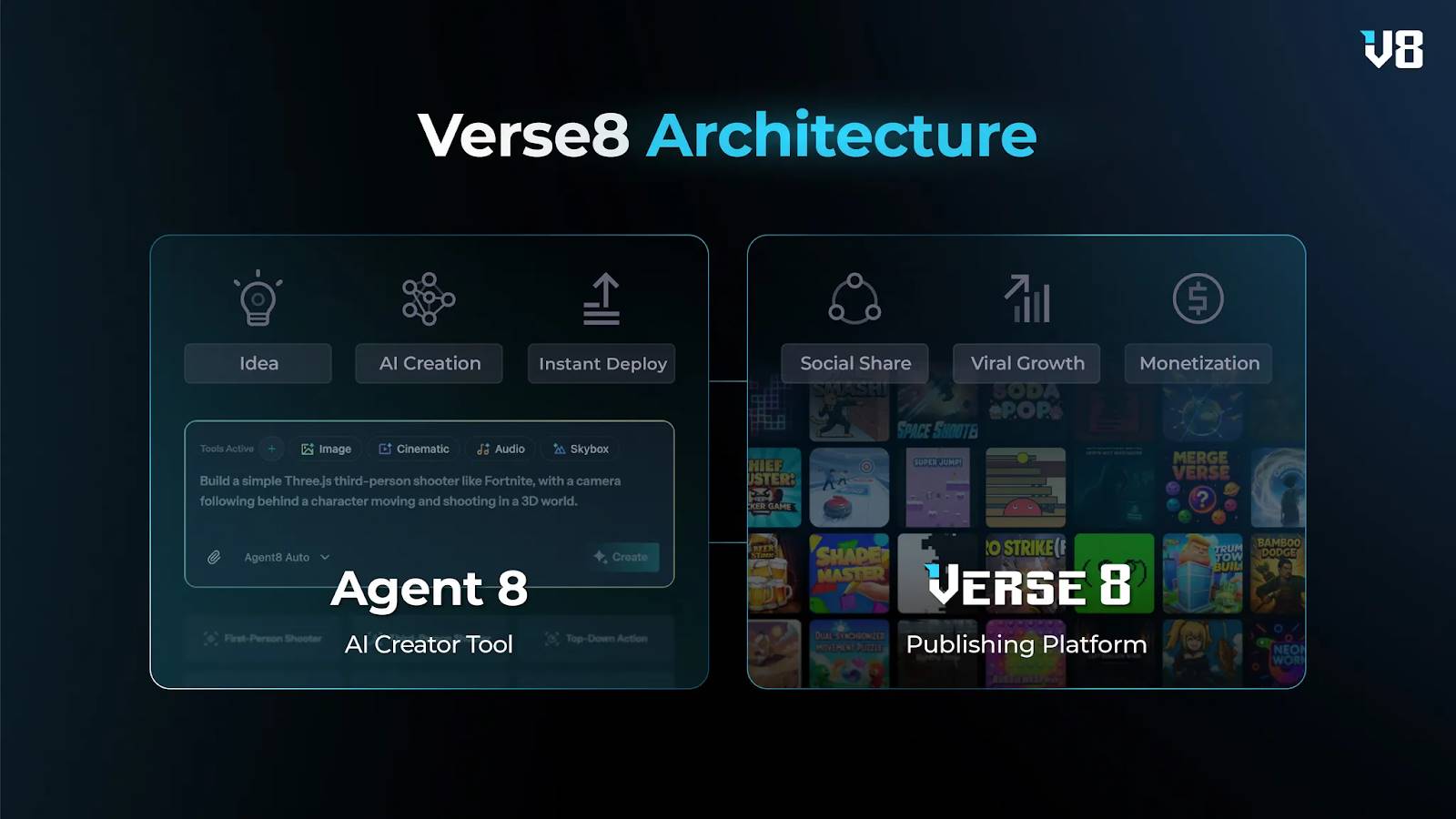
Agent8: Compressing an Entire Production Team into a Single Prompt
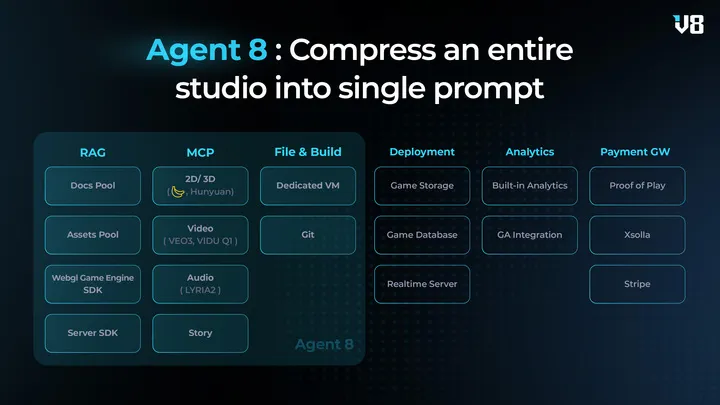
Multi-Agent Collaborative Creation System: Art, code, design, and testing agents collaborate via MCP servers, drastically reducing production costs. A single text prompt can build a complete 2D/3D multiplayer game.

AI-Native Web Content Engine: Built-in templates for various game genres (FPS, platformer, idle, RPG, etc.), integrated with React Three Fiber + WebGL engine, supports real-time publishing. Games can be deployed instantly, no build process or server hosting required.

Automated Content Asset Pipeline: Integrates top generative models. 2D assets are automatically optimized for the target platform. 3D models are automatically rigged, formatted, and optimized for WebGL, eliminating bottlenecks in modeling, animation, and audio production.

Operations and Infrastructure Automation: Built-in Git, database, real-time server, data analysis, and payment gateway. AI can autonomously operate and update live games, supporting "infinite content generation" with no additional manual cost.

Verse8: Accelerating the Creator Economy

After creation, it needs a "home"—a space to publish, access, remix, and realize value transformation. Verse8 is such an ecosystem. Creators can deploy instantly to a global content network without building their own servers, connecting with communities worldwide.

IP Ownership and Programmable IP

Verse8 integrates Story Protocol, an on-chain IP and ownership layer. Every game, asset, and derivative content is automatically registered and ownership is established. The Spin system allows anyone to copy, adapt, and extend existing IP. The more derivatives, the more the original creator benefits.

On-Chain Distribution

On-chain infrastructure unlocks capabilities impossible in Web2: global, permissionless, programmable distribution.

Encouraging Creation, Not Just Consumption

We built Verse8 to enable everyone to become a creator—not just players, not just consumers.

Verse8 empowers people to:
——Instantly create their own interactive worlds;
——Turn ideas into interactive content with a single prompt;
——Reuse and reshape the creations of others.

This is a new medium of expression, where creativity continuously appreciates in value through collaboration, remixing, and shared ownership.

- Website: https://verse8.io
- X: https://x.com/Verse_Eight
- Discord: https://discord.gg/verse8-official

Related Questions

QWhat is Verse8 and what does it aim to achieve?

AVerse8 is an AI-native creation layer that transforms ideas into interactive games and stories. It aims to make creation accessible to everyone, not just developers, by eliminating creative resistance, automating hidden work, and allowing anyone to express their ideas interactively. Every creation can be owned, remixed, and accumulate value over time.

QWhat are the two core layers of Verse8's architecture?

AVerse8's architecture consists of two core layers: Agent8, a multi-agent collaborative creation system that compresses an entire production team into a single prompt, and the Verse8 ecosystem itself, which serves as a home for creations to be published, accessed, remixed, and monetized on a global content network.

QHow does Agent8 simplify the interactive content creation process?

AAgent8 simplifies creation by using a multi-agent system (art, code, design, and testing agents) that collaborate through an MCP server. A single text prompt can build a complete 2D/3D multiplayer game. It automates asset generation, optimization, and infrastructure (like Git, databases, and servers), eliminating bottlenecks in modeling, animation, and audio production.

QHow does Verse8 handle intellectual property (IP) and ownership for creators?

AVerse8 integrates with Story Protocol, an on-chain IP and ownership layer. Every game, asset, and derivative is automatically registered and assigned ownership. Its Spin system allows anyone to copy, adapt, and extend existing IP, with the original creator benefiting more as derivatives increase.

QWhat capabilities does on-chain distribution unlock for Verse8?

AOn-chain infrastructure enables global, permissionless, and programmable distribution, which are capabilities not possible in Web2. This allows for instant global deployment and connection to communities worldwide without the need for creators to set up their own servers.

Related Reads

Central Bank Responds to Call to 'Exit the Sandbox' and Allows Stablecoins

Sberbank CEO Herman Gref expressed the bank's hope for the authorization of stablecoins for domestic transactions in Russia, stating that Sber is actively discussing this possibility with the Bank of Russia. He emphasized the need to move beyond the current regulatory "sandbox" and allow basic transactional functionality with stablecoins, primarily ruble-denominated tokens for internal use. However, the Bank of Russia maintains its position that stablecoins are a form of cryptocurrency and excludes their use for domestic payments. Kirill Pronin, head of the central bank's financial market infrastructure department, argued that Russia's digital payment ecosystem is already highly developed, making such authorization unnecessary. The article notes that Russia currently operates with Digital Financial Assets (DFAs), which are tokenized versions of real assets issued on approved blockchain platforms. Some foreign digital rights, including compliant stablecoins, can be classified as DFAs. The first such recognized asset was a Kyrgyzstani ruble stablecoin, permitted only for foreign economic activity. Pronin also mentioned that the central bank is considering allowing banks and token issuers to directly issue digital assets in public blockchains, as the current method of transferring domestically issued tokens to open networks has not gained significant traction. This shift could reduce operational costs and cybersecurity risks.

RBK-crypto3m ago

Central Bank Responds to Call to 'Exit the Sandbox' and Allows Stablecoins

RBK-crypto3m ago

17 Most Anticipated Things in the Cryptocurrency Space in 2026

17 Key Crypto Developments to Watch in 2026 Stablecoin on/off ramps will mature, connecting digital dollars to local payment systems and enabling new behaviors like real-time cross-border payments and merchant adoption without bank accounts. Stablecoins will evolve into a foundational internet settlement layer. RWA tokenization will shift toward crypto-native approaches like perpetual futures for deeper liquidity. Stablecoins will see more native issuance rather than tokenization, and on-chain native debt issuance will reduce costs and improve accessibility. Banks will leverage stablecoins to innovate without overhauling legacy systems. The internet itself will become a banking layer as value moves programmatically via smart contracts and new primitives like x402. Wealth management will become personalized and automated for everyone via tokenized assets and AI-driven portfolio management. DeFi tools and tokenized private markets will expand access. AI agents will require identity verification (KYA - Know Your Agent) and new economic models to compensate content creators as agents scrape the open web. AI will also enable new research methodologies via layered, reasoning agents. Privacy will become crypto's key moat, creating strong network effects as bridging between private and public chains risks metadata leakage. Decentralized, quantum-resistant messaging will rise, emphasizing user ownership. "Secrets-as-a-service" will emerge for programmable data access control. DeFi security will evolve from "code is law" to "specification is law" with runtime enforcement of invariants. Prediction markets will expand with more contracts, AI-powered oracles, and decentralized governance. "Staked media" will rise, where commentators back arguments with verifiable, on-chain commitments. SNARKs will become efficient enough (~10,000x overhead) for verifiable cloud computing, moving beyond blockchain. Finally, crypto market structure regulation could align legal and technical frameworks, enabling networks to operate as truly open, decentralized systems.

marsbit4m ago

17 Most Anticipated Things in the Cryptocurrency Space in 2026

marsbit4m ago

Trading

Spot
Futures
活动图片