USDC vs. USDT: $70.2T volume drives shift as Circle expands into Africa

ambcryptoPublished on 2026-03-25Last updated on 2026-03-25

Abstract

Circle partners with Sasai Fintech (Cassava Technologies) to expand USDC into Africa, aiming to revolutionize cross-border payments by making them faster, cheaper, and more reliable. This integration into Sasai's mobile platform addresses high fees (often over 7%) and slow traditional systems. The move occurs as stablecoins process $70.2T in annual volume, with USDC gaining market share against USDT, signaling a shift toward reliable, transparent systems. However, Circle faces regulatory challenges in the U.S., including concerns from the upcoming CLARITY Act, which contributed to a recent 20% stock drop. The expansion highlights a strategic focus on high-growth markets like Africa despite domestic uncertainties.

While many are currently concerned about Circle’s stock performance on the NYSE, the company’s partnership with Sasai Fintech, a business of Cassava Technologies, tells an interesting story.

This move isn’t just about expanding into Africa; it’s aimed at tackling a long‐standing challenge: cross‐border payments that remain slow, costly, and inefficient. The plan is to bring USDC into Sasai’s mobile platform, which already supports payments and remittances across multiple African countries.

USDC x Sasai’s partnership: A green flag

Currently, fees can go above 7%, so using a stablecoin like USDC can make transactions faster, cheaper, and more reliable.

By adding USDC into a mobile platform that already supports fast-moving trade, it removes the delays and high costs of traditional systems, where transactions can take days.

Additionally, the partnership is also meant to offer a stable and transparent way to make cross-border payments. This would, in turn, help businesses avoid local currency swings while staying connected to the global market.

Executives weighing in

Remarking on the same, Strive Masiyiwa, Founder and Executive Chairman at Cassava Technologies, said,

Africa’s digital economy is entering a new era, propelled by entrepreneurship, a mobile-first generation, and the acceleration of intra-regional trade.

Adding more to the sentiment, Jeremy Allaire, co-founder and CEO at Circle, noted,

Working with Cassava, we can extend the benefits of USDC and onchain infrastructure into high-growth payment corridors to deliver always-on global connectivity.

Stablecoin’s market dynamics: USDC vs. USDT

The partnership comes at an important time for stablecoins, which have handled a huge $70.2 trillion in transactions over the past year. While USDT was leading for most of 2025, things started to change in early 2026.

Even though total activity slowed a bit in March after a strong February, USDC has started catching up and even briefly matched USDT’s share.
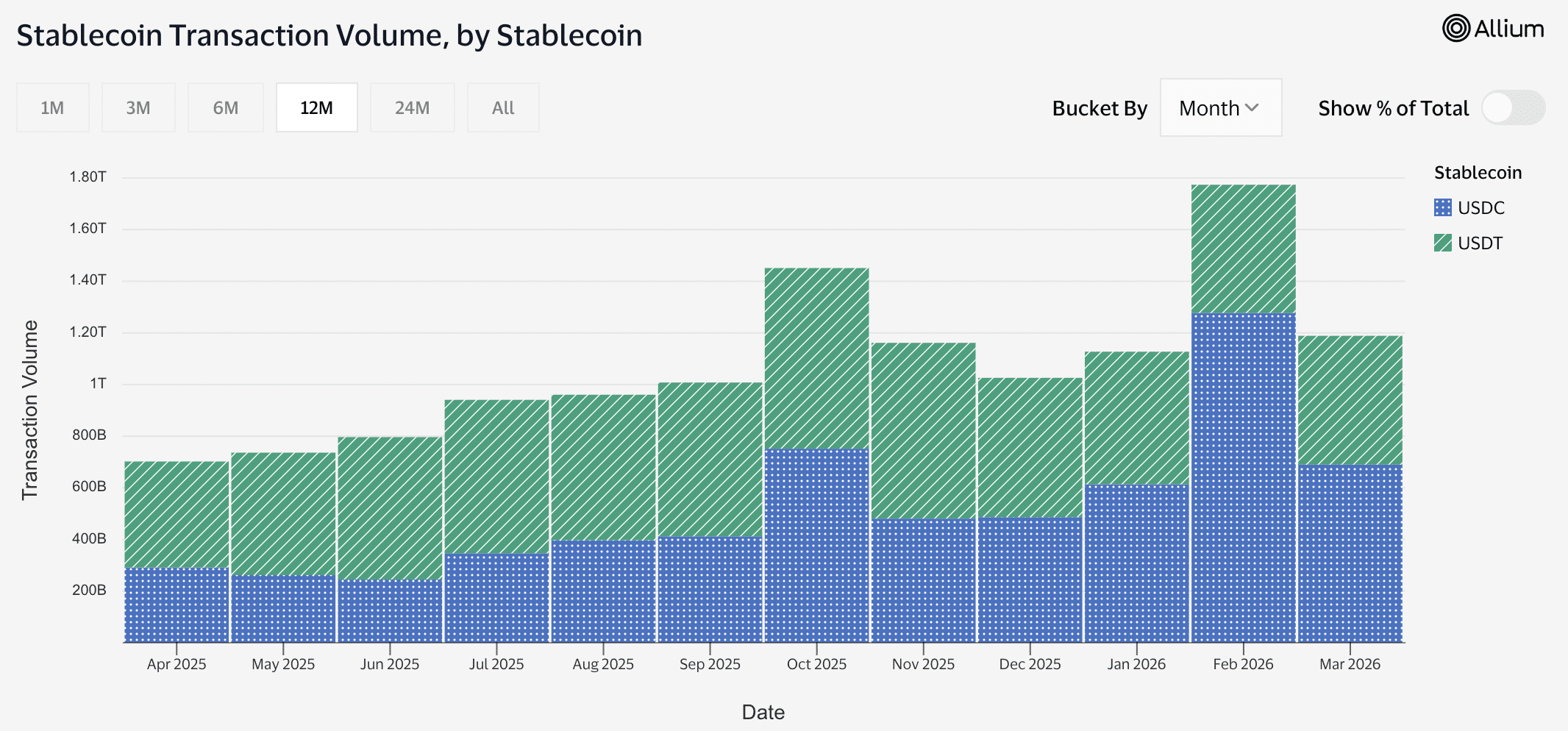
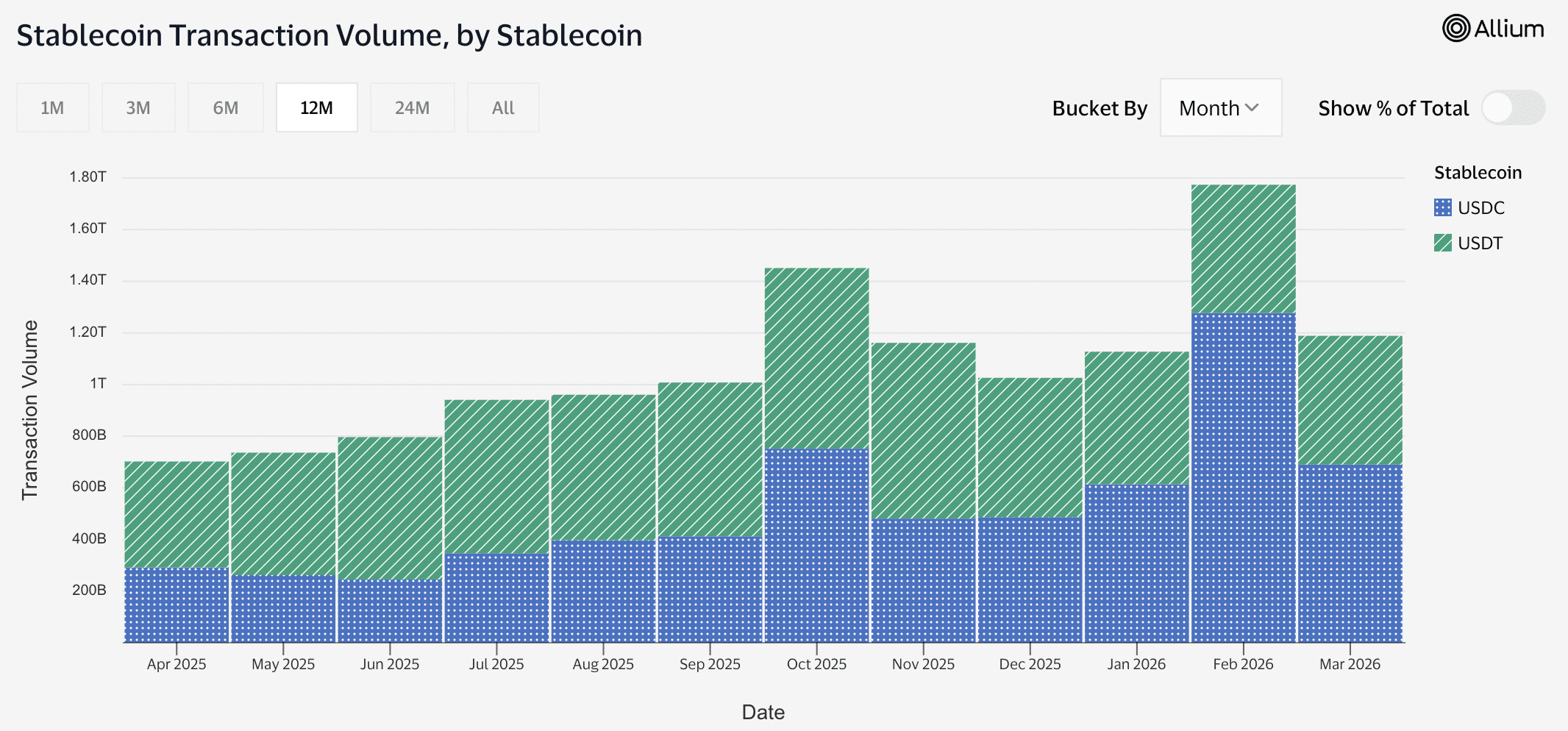
Source: Visa on-chain analytics

This rise in USDC signals a shift away from pure speculation toward more reliable systems, something Circle is now bringing to markets like Africa.

Regulatory clarity and more

While Circle expands into Africa, its position in the United States has become shaky due to new regulations.

In 2025, the GENIUS Act gave a positive direction for stablecoins by supporting dollar-backed digital assets. But now, the upcoming CLARITY Act is creating fresh concerns.

This has made investors nervous, as it could directly impact how companies like Circle generate revenue. As a result, Circle’s stock (CRCL) recently saw a sharp drop of nearly 20% on the 24th of March, closing at $101.17.

All this together shows that Circle is at a turning point, dealing with regulatory challenges in the U.S. while building a strong, usage-driven future in markets like Africa.


Final Summary

  • Integrating USDC into Sasai’s mobile network could cut remittance costs and speed up settlements.
  • The rising competition between USDC and USDT reflects demand for transparency and regulatory alignment.


Related Questions

QWhat is the primary goal of Circle's partnership with Sasai Fintech in Africa?

AThe primary goal is to tackle the challenges of slow, costly, and inefficient cross-border payments by integrating USDC into Sasai's mobile platform to make transactions faster, cheaper, and more reliable.

QAccording to the article, what significant shift in the stablecoin market does the rise of USDC signal?

AThe rise of USDC signals a shift away from pure speculation toward more reliable and transparent systems for cross-border payments and remittances.

QWhat recent U.S. regulatory development has created concerns for Circle and its investors?

AThe upcoming CLARITY Act has created fresh concerns and investor nervousness, as it could directly impact how companies like Circle generate revenue, contributing to a sharp drop in its stock price.

QHow much transaction volume have stablecoins handled over the past year, as mentioned in the article?

AStablecoins have handled a huge $70.2 trillion in transactions over the past year.

QWhich two key benefits does the article suggest the USDC integration will bring to African markets?

AThe integration is expected to cut remittance costs and speed up settlement times for cross-border payments.

Related Reads

From Code to Cognition: A Ten-Thousand-Word Guide to the Evolution of the Robot Brain

"From Code to Cognition: The Evolution of Robot Brains" The journey of robotic intelligence has shifted dramatically from manually coded systems to AI-driven brains. For decades, robots relied on layered software stacks—perception, state estimation, planning, control—each handcrafted. While predictable, they lacked adaptability. The 2010s saw deep learning revolutionize perception (e.g., object detection) and control (via reinforcement learning), but learned skills remained narrow. The arrival of Large Language Models (LLMs) marked a turning point. LLMs acted as high-level planners, interpreting natural language instructions and generating sequences of actions for traditional robotic systems to execute. However, true integration came with Visual-Language-Action (VLA) models, which fused vision, language, and motion prediction into a single network. Pioneered by models like RT-2 and open-source projects like OpenVLA, VLAs enable robots to reason and act directly from visual input and commands. The most advanced humanoid robots now employ a "dual-brain" architecture: a slow-thinking, large VLA (System 2) for reasoning and planning, and a fast-reacting, small network (System 1) for high-frequency motion control, sometimes with an even lower-level System 0 for balance. This split balances cognition with the physics of real-time movement. Computation is split between onboard hardware (e.g., NVIDIA Jetson) for safety-critical control loops and cloud/edge servers for non-critical tasks like learning and interfaces. A crucial driver is the open-source ecosystem—models like GR00T and OpenVLA allow startups to build upon pre-trained brains and fine-tune them with their own data, accelerating development. Despite progress, current systems struggle with recovery from errors, sample inefficiency, and long-horizon tasks. This has spurred the rise of **World Models**—neural networks that predict the consequences of actions. By simulating possible futures before acting (like NVIDIA Cosmos or Meta V-JEPA), robots can plan, recover, and generalize better. This represents the next frontier: shifting intelligence from learned reactions to an internal model of physics and cause-and-effect. The field is rapidly evolving. While not yet at its "ChatGPT moment," the convergence of cheaper hardware, scalable simulation, and world models points toward robots that are increasingly capable, adaptive, and useful. The question is shifting from "what can robots do?" to "what *should* they do?"

marsbit2m ago

From Code to Cognition: A Ten-Thousand-Word Guide to the Evolution of the Robot Brain

marsbit2m ago

AI Bubble Is Bursting

The AI Bubble is Bursting: A Necessary Purge on the Path to Ubiquitous Intelligence Market volatility has reignited debates about an AI bubble, with figures like Ray Dalio pointing to high valuations. However, this parallels the dot-com bubble, which, despite its crash, laid the physical infrastructure for today's internet era. The current AI investment frenzy, with tech giants planning trillions in infrastructure spending far outstripping current AI application revenues, appears similarly imbalanced. This 'bubble' is seen as an inevitable phase for a disruptive technology, paying the "innovation tax." Critically, AI inference costs have plummeted over 99.7% since 2023, making intelligence nearly free at the margin. This hasn't reduced spending but has instead unlocked massive new demand, as seen in enterprise AI cloud expenditure tripling. This follows the Jevons Paradox: efficiency gains lead to greater total consumption. The market is now entering a cleansing phase, weeding out speculative ventures lacking real moats. The deeper shift is a move from capital expenditure (CapEx) on hardware to value creation in operational expenditure (OpEx) through AI applications that solve real industry problems. While infrastructure valuations are high, rapid earnings growth from widespread AI adoption across sectors—from manufacturing and finance to law and healthcare—may digest these valuations over time. Ultimately, this creative destruction will leave behind robust infrastructure and optimized models, cheaply powering an AI-augmented future for all industries, much as the internet became indispensable after its own bubble burst. The core productive potential remains undiminished.

链捕手11m ago

AI Bubble Is Bursting

链捕手11m ago

Trading

Spot
Futures
活动图片