US Tech Sector Volatility Catalyzes a 2026 Strategy Shift Toward $LIQUID Infrastructure

bitcoinistPublished on 2026-02-09Last updated on 2026-02-09

The narrative governing global capital markets is shifting. Violently. For the past eighteen months, the ‘AI trade,’ dominated by Nvidia, Microsoft, and the overarching US tech sector, sucked the oxygen out of every room in finance. But with recent earnings volatility and fears of a capex bubble, institutional allocators are eyeing the exit. The question isn’t if a rotation is coming; it’s where the money goes next.

Data suggests the answer isn’t traditional defensive stocks. It’s ‘liquid infrastructure.’

As US tech equities face headwinds from high interest rates, smart money is looking at the plumbing of the decentralized internet. The logic is simple (and overdue): while consumer apps like meme coins are volatile, the infrastructure connecting them acts as a toll road. In crypto, that means protocols solving the industry’s most expensive headache: fragmentation.

Right now, liquidity is trapped in silos. Bitcoin holds over $1.5T; Ethereum dominates DeFi; Solana owns the retail flow. They don’t speak to each other. The rotation predicted for 2026 isn’t just about buying tokens; it’s about investing in the unification layers that let capital move without friction. Enter the Layer 3 (L3) projects fusing these disparate chains to capture the value of the next cycle. Projects like LiquidChain ($LIQUID).

The New Risks of AI Disruption

Beyond infrastructure, investors are grappling with the fact that AI is beginning to ‘disrupt the disruptors.’ There is growing concern that new AI tools, such as recent automations in legal work, could eventually automate away the need for traditional software entirely. Furthermore, while current earnings remain stable, uncertainty is mounting regarding future profit margins due to the historic levels of capital expenditure required to sustain the AI boom.

The Institutional Case for Unified Liquidity Layers

Current friction costs are unsustainable. A trader moving assets from Bitcoin to Solana currently faces a gauntlet of wrapped asset risks, bridge hacks, and slippage that can erode margins by 3-5%. Sound efficient? Hardly. This fragmentation is the primary bottleneck choking off true mass adoption.

LiquidChain has emerged as the direct response. By architecting a Layer 3 protocol specifically as a ‘Cross-Chain Liquidity Layer,’ it creates a single environment where Bitcoin, Ethereum, and Solana exist on the same plane. That matters for one reason: it shifts the value proposition from pure speculation to actual utility.
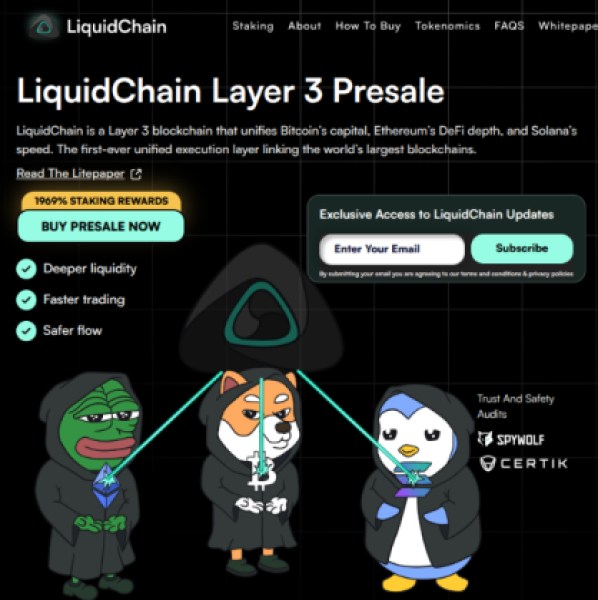
For developers, the appeal of LiquidChain’s ‘Deploy-Once Architecture’ is immediate. Instead of writing separate codebases for Rust and Solidity, builders can launch apps on LiquidChain that access users from both giants, plus Bitcoin. It effectively solves the ‘cold start’ problem for new dApps.

From a market structure perspective, this consolidation is critical. If 2024 was the year of the Layer 2 wars, 2026 is shaping up to be the era of Layer 3 aggregation. The protocol’s ability to offer ‘Single-Step Execution’ means complex strategies, previously impossible for compliance-focused institutions due to counterparty risk, finally become viable.

LEARN MORE ABOUT LIQUIDCHAIN ON ITS OFFICIAL PRESALE SITE

LiquidChain ($LIQUID) Presale Data Signals Early Infrastructure Demand

While the broader market stares at Bitcoin’s daily candles, early allocators are positioning themselves in infrastructure. The on-chain data for LiquidChain supports this rotation thesis.

$LIQUID has already raised over $532K. That number isn’t just significant for its size; it’s about timing. Raising over half a million dollars during macro uncertainty signals high-conviction capital. Investors are buying the thesis, not the hype.

At the current presale price of $0.0136, the market treats $LIQUID as a venture bet with asymmetric upside compared to established L1s. The tokenomics look designed to incentivize deep liquidity, a must for any protocol claiming to unify $BTC and $ETH. By using a Cross-Chain VM, the network uses the $LIQUID token as transaction fuel across the merged ecosystem. If usage scales, so does buy pressure.

The risk? Execution. Building a secure L3 that handles native Bitcoin assets without wrapping is technically demanding. But if the protocol succeeds in becoming the liquidity router for the 2026 cycle, that $0.0135 entry point might look like a steal relative to the value of the flows passing through the network.

BUY LIQUIDCHAIN ($LIQUID) HERE.

The content of this article is for informational purposes only and does not constitute financial advice. Cryptocurrency investments, particularly in presale stages and new infrastructure protocols, carry high risks, including total loss of capital. Always perform your own due diligence.


Related Questions

QWhat is the main investment shift discussed in the article, and why is it happening?

AThe main investment shift is from the dominant 'AI trade' and US tech stocks towards 'liquid infrastructure.' This is happening due to recent earnings volatility in the tech sector, fears of a capex bubble, and the unsustainable fragmentation of liquidity across different blockchain silos like Bitcoin, Ethereum, and Solana.

QWhat problem does LiquidChain aim to solve in the crypto ecosystem?

ALiquidChain aims to solve the problem of fragmented liquidity and high friction costs in the crypto ecosystem. It addresses issues like wrapped asset risks, bridge hacks, and slippage that occur when moving assets between different blockchains by creating a unified Layer 3 cross-chain liquidity layer.

QWhat technological feature does LiquidChain offer to attract developers?

ALiquidChain offers a 'Deploy-Once Architecture,' which allows developers to launch applications that can access users and liquidity from multiple major blockchains (like Bitcoin, Ethereum, and Solana) without needing to write separate codebases for each, effectively solving the 'cold start' problem for new dApps.

QWhat does the article cite as a new risk associated with the AI sector?

AThe article cites that AI is beginning to 'disrupt the disruptors,' with growing concerns that new AI tools could automate away the need for traditional software. There is also mounting uncertainty about future profit margins due to the historic levels of capital expenditure required to sustain the AI boom.

QWhat does the early presale data for $LIQUID indicate about investor sentiment?

AThe early presale data, which shows over $532K raised during a period of macro uncertainty, indicates that investors are making high-conviction bets on the infrastructure thesis rather than speculative hype. It signals a strategic rotation of capital into projects that solve fundamental problems like liquidity fragmentation.

Related Reads

Podcast Notes | Conversation with GSR Asset Management Head: To Determine if This Crypto Rally is Real, Just Watch the Lending Rates on Aave

Podcast Summary: Dialogue with GSR's Head of Asset Management: To Determine if This Crypto Rally is Real, Just Check Lending Rates on Aave Andy Baehr, Managing Director of Asset Management at GSR, discusses the current crypto market, characterizing it as stuck in a state of "ambivalence" with short-lived, unsustainable rallies. He outlines a simple framework: the market moves between "ambivalence" and "conviction" (sustained upward momentum). Currently, every rally resembles a single-stage rocket booster that quickly fizzles out. Baehr identifies three key signals to watch: 1) DeFi lending rates, 2) the potential passage of the CLARITY Act, and 3) the market forming a consensus on the "Fed hawkish peak." He emphasizes that the most immediate indicator for the sustainability of the recent CPI-triggered rally is the USDC borrowing rate on Aave, currently around 3.75%—close to U.S. Treasury yields. The absence of a credit spread indicates low leverage demand and a lack of market energy. He explains that a healthy, sustained rally requires layered buying pressure. Last year's rally progressed from an ETH short squeeze to crypto-native trader influx and finally to ETF inflows. Currently, this structure is missing. Other potential structural buyers like Digital Asset Treasury (DAT) companies are absent, and ETF flows have proven transient. Baehr notes that while small-cap crypto tokens outperformed large caps in Q2—a potential sign of capitation in major assets—capital is also flowing to more exciting opportunities like AI stocks and tech IPOs, leaving crypto sidelined. Regarding DeFi, he highlights that platforms like Aave provide a clear, real-time signal of leverage demand through their supply/demand-driven interest rates. A significant, sustained rate increase would signal genuine market conviction. He also observes the quiet emergence of fixed-income-like products and vaults in DeFi. On regulation, the probability of the CLARITY Act passing before the August 7th deadline has dropped linearly from 75% to below 40% on Polymarket. Baehr suggests its passage would be treated as a bullish surprise, a potent driver for price movement. However, political hurdles, including ethical clause debates and disclosures about the First Family's crypto profits, remain significant obstacles. Ultimately, the market awaits clarity on the Fed's terminal rate under Chair Warsh. Until the "Fed Solstice"—the point where the market collectively understands the peak of hawkish policy—sustained conviction will be difficult to achieve.

marsbit32m ago

Podcast Notes | Conversation with GSR Asset Management Head: To Determine if This Crypto Rally is Real, Just Watch the Lending Rates on Aave

marsbit32m ago

7 Months After the Collapse of Huiwang, Southeast Asia's Escrow Platforms Undergo a Major Reshuffle

Following the collapse of Huione Pay—dubbed the "Alipay of Southeast Asia"—seven months ago, the region's underground financial guarantee platform sector is undergoing a significant reshuffle. This power vacuum has been swiftly filled by emerging platforms such as XinBi, Tiger/Navigator, JinBei (renamed JinBo), Dali/Tiancheng, and FullyLight. These platforms, operating largely via Telegram and offering services like escrow for illicit transactions, have absorbed the vast user base and markets left behind by Huione. While positioning themselves as "trust intermediaries," their primary clientele consists of networks involved in online scams, money laundering, illegal gambling, and even human trafficking. For instance, the Tiger/Navigator platform explicitly provides "escrow" services for kidnapping-for-ransom operations ("强押车交易"). Data underscores the immense scale: Huione alone processed over $103 billion in cryptocurrency payments and facilitated over $31 billion through its escrow market before its downfall, linking it to Cambodia's notorious Prince Group. Since its collapse, competitors have seen explosive growth. For example, the XinBi platform has accumulated over $1.6 billion in total USDT revenue, while platforms like NewPay, OkPay (under Dali), and FullyLight Wallet collectively processed over $4.8 billion in USDT in a single year. This ecosystem thrives in regions like Cambodia and Myanmar, where regulatory gaps allow these platforms to act as critical financial infrastructure for sprawling cybercrime industries, from scam compounds to online casinos. The article concludes that the moniker "Southeast Asian Alipay" is a misnomer, obscuring the platforms' fundamental role in enabling serious criminal enterprises rather than representing legitimate financial innovation.

Odaily星球日报1h ago

7 Months After the Collapse of Huiwang, Southeast Asia's Escrow Platforms Undergo a Major Reshuffle

Odaily星球日报1h ago

Trading

Spot
活动图片




