US Stock Storage Fever Spreads to Crypto for the Third Time, VVV Leads 'AI Data Infrastructure' Sector Gains

marsbitPublished on 2026-05-11Last updated on 2026-05-11

Abstract

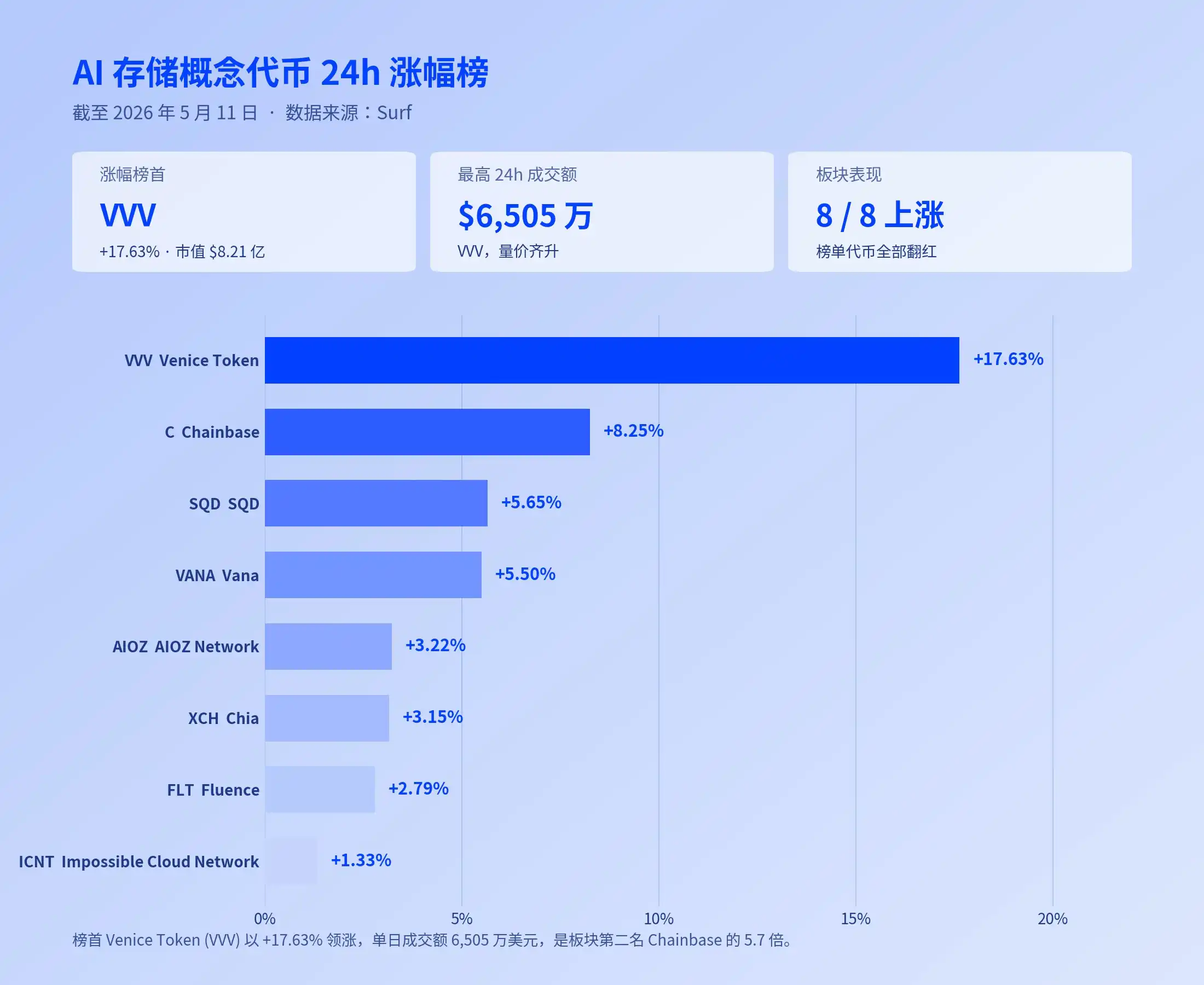
U.S. stock storage rally spreads to crypto for the third time, with VVV leading the 'AI data infrastructure' sector. On May 11, Venice Token (VVV) surged 17.63% with $65.05M volume, followed by Chainbase, SQD, and Vana, rising 5-8%. This mirrors gains in U.S. storage stocks like SanDisk and Micron. The crypto AI narrative is shifting. The initial wave (May 6-7) saw pure storage tokens like FIL, AR, and STORJ rise, driven by spillover from the U.S. storage chip boom. The second wave saw broader DePIN sector gains. The current third wave has moved beyond pure storage to broader "AI infrastructure." VVV, a decentralized AI inference platform, leads due to its own catalysts like a token burn mechanism and partnership news, alongside the broader market trend. Notably, traditional storage tokens showed minimal gains (<4%) on May 11, indicating the rally is becoming more selective, focusing on projects with specific narratives like AI data or compute. The pattern suggests the sector rally may be in a later stage, with sustainability depending on whether the U.S. storage chip boom continues.

Author: Claude, Shenchao TechFlow

Shenchao Insight: The capital spillover effect of the US stock market's storage chip "super cycle" is recurring in the crypto market with a frequency of three times a week. On May 11, the 'AI Data Infrastructure' sector token Venice Token (VVV) surged 17.63% in a single day, leading the gains with a trading volume of $65.05 million; Chainbase, SQD, and Vana followed with gains between 5% and 8%. Meanwhile, the fuel hasn't died down on the US stock end. On May 8, SanDisk skyrocketed 16.60%, Micron Technology rose 15.49%, pushing its market cap past $842.2 billion, and accumulated a nearly 38% gain for the week. From FIL breaking out of its range on May 6, to IO soaring 69% in a single day on May 7, and VVV taking the baton this Monday, the market trend has extended from single storage leaders to the entire "AI Data + Inference Compute" infrastructure sector.

The crypto AI sector is up again today, but the narrative is quietly shifting.

If the story a week ago was "the three major storage leaders FIL, AR, and STORJ rising in tandem with US stocks SanDisk and Micron," then entering this week, the main market trend has spread from pure storage to a broader "AI infrastructure": AI inference compute (VVV), on-chain data networks (Chainbase), data indexing (SQD), user data DAOs (Vana) are taking turns leading the charge. However, the driving source behind all this remains unchanged: the still-burning storage chip frenzy in US stocks.

First Wave of Transmission: May 6, FIL/AR/STORJ Triple Rise

The first instance of follow-on gains in the crypto market occurred on May 6.

According to a BanklessTimes report on May 6, Filecoin (FIL) opened at $0.975 that day, reaching an intraday high of $1.161 and closing at $1.122, marking a single-day gain of 15.08%, breaking out of a sideways consolidation range that had lasted over three months since early February. FIL's spot trading volume for the day reached $372 million, a sharp 260.22% increase from the previous day; futures trading volume hit $816 million, up 213.63% sequentially. In the same sector, Storj gained 40% and Arweave rose 20% for the day.

Chinese crypto information channel Followin that day forwarded analyst Ao Ying's viewpoint, directly attributing this round of gains to capital spillover from US stock storage trading, stating "funds from equity market storage trading are repricing FIL." The logic chain is that AI infrastructure's consumption of storage capacity has already booked capacity through 2026; this supply-demand logic first gets priced in the US stock market, then transmits to crypto tokens pegged as "on-chain storage."

Second Wave Continuation: May 7, IO Soars 69% in a Day, DePIN Sector Follows Suit and Spreads

The market movement didn't stop after a single day. According to TradingView data cited by CoinMarketCap CMC AI, FIL rose another 15.5% on May 7, breaking through the key resistance level of $1.08 that it had failed to breach since February.

The sector's diffusion was even more dramatic, with IO surging 69% and STORJ rising another 30% on the same day. The second wave of gains indicates this is no longer a localized rally of "leaders rising alone while the long tail remains calm," but rather the DePIN (Decentralized Physical Infrastructure Networks) sector being systematically repriced by the market.

However, CoinMarketCap CMC AI also cited a bearish analysis on the same day, labeling FIL a "dead asset," citing the token's cumulative decline of 99% from its all-time high. This contradiction precisely reflects the current rift in the crypto storage sector: short-term beta-driven gains from capital spillover coexist with medium-to-long-term skepticism about business models.

Third Wave Diffusion: May 11, VVV Leads 'AI Data + Inference Compute' Gains

This Monday's rally saw the main theme shift from "pure storage" to broader "AI infrastructure."

Data shows VVV's current price is $17.83, with a market cap of $821 million and a single-day trading volume of $65.05 million, 5.7 times that of the second-ranked project in the sector, Chainbase. Ranks two through four in the sector were Chainbase (C, +8.25%), SQD (+5.65%), and Vana (VANA, +5.50%), with market caps ranging between $14 million and $54 million.
However, VVV is not strictly a storage token. According to a January 2025 report by The Block and Venice's official documentation, VVV is the native token of Venice, a decentralized AI inference platform founded by Erik Voorhees, positioned to "provide private, uncensorable inference services for AI Agents." Staking VVV allows users to proportionally share in the compute power revenue from the Venice API, without needing to pay per request.

VVV's leading gains have their own fundamental catalysts. According to a Phemex analysis on April 7, Venice permanently reduced its annual token inflation by 25% on February 10, 2026 (from 80 million to 60 million). On March 2, it surged 20% in a single day after OpenClaw announced selecting Venice as its primary inference model supplier. According to Messari data, Venice officially launched a "programmatic VVV buyback and burn" mechanism on April 15, where every Venice Pro subscription triggers a $1 on-chain token buyback and burn. CMC AI data shows that as of March, approximately 33 million VVV (42% of the initial supply) had been burned.

At this point, the crypto AI sector's story can be broken into two layers: the external factor is the spillover from the US stock storage frenzy, while the internal factor is that tokens like VVV, which have real deflation mechanisms and concrete partnership developments, are catalyzing themselves. The tokens that have delivered outsized gains in this rally almost all possess both layers of logic.

Four Genuine Storage Tokens Gained Less Than 4% Today

It's worth noting that the genuine storage projects are not among the top gainers on today's Surf list. Four traditional decentralized storage projects—AIOZ Network (+3.22%), Chia (+3.15%), Fluence (+2.79%), and Impossible Cloud Network (+1.33%)—all gained less than 4%. Last week's leaders, FIL, AR, and STORJ, don't even appear on this list.

This structural difference signals that the pure "storage beta transmission" rally might have entered its second stage. The first stage (May 6-7) was the catch-up rally of storage leaders. The second stage (this week) sees tokens with their own narrative catalysts taking the baton: VVV has its buy-and-burn mechanism, Chainbase carries the "AI data" label, while SQD and Vana belong to the "data network" concept. Capital is picking "tokens with a story" within the sector, rather than indiscriminately deploying funds.

Historically, this three-phase pattern of "leader catch-up → concept diffusion → capital cherry-picking" often signifies that a sector rally has entered its latter half. Future sustainability will depend on whether the US stock storage chip frenzy can maintain momentum. Based on the current supply-demand landscape of DRAM contract prices rising 58% to 63% and HBM capacity sold out through 2026, the story, at least from a fundamental perspective, is not over yet.


Related Questions

QWhat are the three major phases of the 'storage hype' spillover from the U.S. stock market into the crypto market as described in the article?

AThe three phases are: 1) Initial spillover on May 6th with leading storage tokens like FIL, AR, and STORJ rising. 2) Continuation and diffusion on May 7th, extending to the broader DePIN/AI infrastructure sector, highlighted by IO's surge. 3) Further diffusion on May 11th, where the rally spread from pure storage to 'AI data + inference compute' infrastructure, led by VVV and followed by projects like Chainbase, SQD, and Vana.

QWhy did VVV (Venice Token) experience a significant price increase on May 11th, according to the article?

AVVV's surge was driven by a combination of external and internal factors. Externally, it benefited from the ongoing spillover effect from the U.S. stock market's storage chip rally. Internally, it had specific fundamental catalysts: a permanent 25% reduction in annual token inflation in February 2026, a partnership announcement with OpenClaw in March that boosted its price, and the launch of a 'programmatic VVV buyback and burn' mechanism on April 15th, where every Venice Pro subscription triggers a $1 token buyback and burn.

QWhat key difference does the article highlight between the market performance on May 11th and the initial rallies on May 6th-7th?

AOn May 11th, the rally shifted from purely 'storage' tokens (like FIL, AR, STORJ) to a broader 'AI infrastructure' theme, including AI inference compute (VVV), on-chain data networks (Chainbase), data indexing (SQD), and user data DAOs (Vana). In contrast, the initial rallies on May 6th-7th were more focused on traditional decentralized storage龙头 tokens. Furthermore, on May 11th, actual storage projects like AIOZ Network and Chia saw minimal gains (<4%), indicating资金 was becoming more selective, focusing on projects with stronger narratives beyond just the storage beta.

QWhat is the primary external driver identified for the rallies in the crypto AI/data infrastructure sector throughout the discussed period?

AThe primary external driver is the capital spillover from the 'super cycle' boom in U.S. stock market storage chip companies, specifically the massive gains seen in stocks like美光科技 (Micron) and闪迪 (SanDisk). The article states that the logic is that AI infrastructure's huge demand for storage capacity, which has already driven up prices and valuations in traditional markets, is now being repriced into crypto tokens that represent 'on-chain storage' and related AI data infrastructure.

QAccording to the article, what does the current market structure (with selective gains in narrative-driven tokens) suggest about the stage of the sector's rally?

AThe article suggests that the market structure, moving from 'leader catch-up' to 'concept diffusion' and then to 'capital picking specific stories,' typically indicates the sector rally is entering its later stages. The sustainability from this point forward will depend more on whether the U.S. stock market storage hype continues and on the individual fundamentals of the crypto projects, rather than on broad, indiscriminate buying across the entire sector.

Related Reads

Without Tencent, What's Left for Suiyuan?

The article centers on the crucial question posed in the title: what is Seyond Technology really worth if its dominant customer, Tencent, were to stop purchasing its AI chips? As the last of China's "Four AI Chip Dragons" to secure approval for a public listing, Seyond's IPO filing reveals a profound and controversial dependency. In 2025, 74.9% to over 80% of its revenue came from Tencent. The piece argues that this extreme customer concentration is not merely a vulnerability but a strategic outcome of China's AI industry evolution. It contrasts Seyond's path with its peers (Moore Thread, Biren Technology, and MetaX), noting that while others raced to market with ambitious stories, Seyond focused first on securing and delivering for a major client. Its explosive revenue growth—with Q1 2026 up 1474.85% year-on-year—is driven by concentrated orders from Tencent, which itself faces massive, escalating AI compute demands for products like its Yuanbao and Hunyuan models. The relationship is framed as a deliberate, symbiotic cultivation of a supply chain. As both a major shareholder (20.26%) and primary client, Tencent is actively fostering Seyond to build a controllable, stable alternative to NVIDIA, similar to how global tech giants historically nurtured key suppliers. The high switching costs—involving software stacks and deployed systems—create a deep "ecological moat" for Seyond within Tencent's ecosystem. The analysis positions the AI chip landscape in three tiers: NVIDIA as the global leader, Huawei's Ascend as the state-backed player, and commercial firms like Seyond competing for market orders. Seyond is increasingly seen as "Tencent's compute foundation," with its product roadmap closely aligned with the tech giant's needs. The conclusion is that the industry's metric for success is shifting from fundraising and technical specs to real orders, delivery capability, and ecosystem binding. Seyond's value, therefore, lies not just in its chips but in holding a massive, multi-year procurement order from China's largest internet company—a tangible asset arguably more telling than any technical whitepaper in the current climate. The core insight is that for domestic chips, the ultimate challenge isn't just catching up technologically with NVIDIA, but earning the trust, scenarios, and recurring orders from a major anchor client.

marsbit3m ago

Without Tencent, What's Left for Suiyuan?

marsbit3m ago

War Trade Unwinding | TradeXYZ Weekend Observations

Weekend markets saw a clear return of risk appetite. Major indices rose broadly, with significant gains in tech and precious metals, while energy sectors fell sharply on the "end of war" narrative. On June 14, oil prices initially rose on reports Iran had not yet finalized a memorandum of understanding. Later, YNET reported Trump might immediately lift the maritime blockade on Iran and the Strait of Hormuz. At 21:30, Trump confirmed on Truth Terminal that a deal with Iran was done, authorizing an immediate end to the US blockade and toll-free opening of the Strait. Iran's deputy foreign minister simultaneously announced an immediate and permanent halt to military actions on multiple fronts. Oil prices had already fallen to weekend boundaries, pre-pricing the news. The S&P 500 subsequently touched 7530. Markets will likely remain in a waiting period until the formal peace deal signing on June 19. At the moment of the deal announcement, gold jumped from ~4,221 to a high of 4,337, and silver from ~67.85 to 70.83, before stabilizing at higher levels. Individual stocks and ETFs like NBIS, RKLB, and LITE performed strongly. NBIS, added to the Nasdaq index, saw a target price increase due to strong AI cloud growth. RKLB, also added to the index, benefited from positive SpaceX valuation sentiment. LITE received a $1,130 target from JPMorgan. SPCX rose quickly after Musk tweeted SpaceX could potentially reach ~$1 trillion in revenue by 2030. In summary, the market shock from the multi-month war is beginning to dissipate. Israel's actions remain the key variable before the June 19 signing. Upcoming events like Fed Chair Warsh's debut and BoJ rate hike expectations will also significantly impact markets this week.

marsbit26m ago

War Trade Unwinding | TradeXYZ Weekend Observations

marsbit26m ago

Will the Next Crypto Bull Run Start with On-Chain Trading of SpaceX?

This article presents a scenario-based forecast for the crypto industry from 2026 to 2029, arguing that the next major cycle will be driven not by technological narratives but by legal access to real-world assets. The author predicts that by mid-2026, pre-IPO perpetual contracts for top private companies like SpaceX, OpenAI, and Anthropic on platforms like Hyperliquid will become the primary gateway for accessing quality assets, as most crypto-native tokens fail to capture real value. The much-hyped AI x Crypto intersection largely fails except for prediction markets, which thrive on betting on AI model supremacy. By 2027, public blockchain foundations are forced to choose between catering to retail speculation or building compliant infrastructure for institutions, with many opting for the latter. Growth in stablecoins and tokenized private credit/equity hits a "triple ceiling" due to regulatory and political uncertainty rather than market demand. The pivotal shift is forecast for 2028. A major liquidation event in pre-IPO perpetuals exposes the structural flaw of synthetic markets lacking a real underlying asset anchor. In response, regulatory changes finally allow the public solicitation of private securities resales to verified accredited investors. This creates a legitimate secondary market for real company equity, which then becomes the core asset class of the new bull market, relegating synthetic perps to a niche role. By 2029, the industry becomes "boring" but foundational. Tokens without claims on real cash flows or assets cease trading. Stablecoin growth is steady but politically capped. Crypto infrastructure fades from view as it gets absorbed into traditional finance backends. The article's central thesis is that the key bottleneck for crypto's next phase is legal and regulatory channels for real asset ownership, not technology.

marsbit1h ago

Will the Next Crypto Bull Run Start with On-Chain Trading of SpaceX?

marsbit1h ago

Trading

Spot
Futures
活动图片