Original Author: Zhao Ying
Original Source: Wall Street News
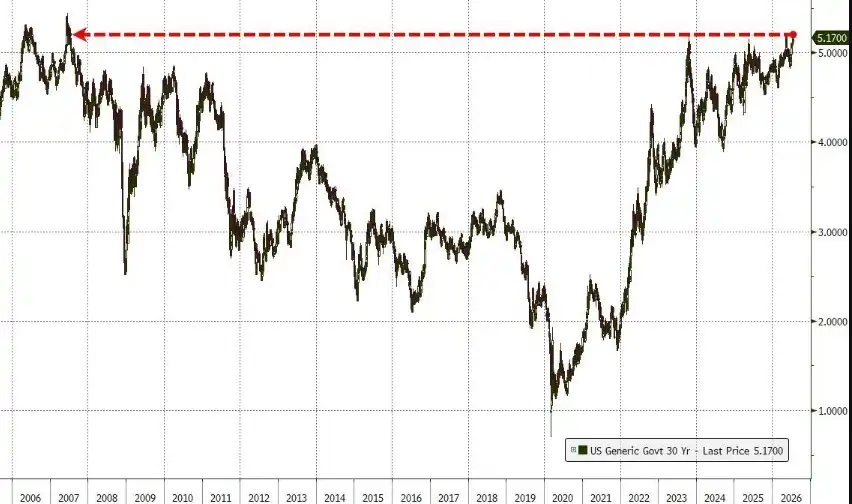
The US Treasury market is facing its most severe stress test in nearly two decades. Hit by a triple whammy of escalating Middle East tensions, oil prices breaching the $100 per barrel mark, and rekindled inflation expectations, Treasury yields have surged across the board to multi-year highs. The yield on the 30-year Treasury bond has set the longest streak of trading above 5% since 2007, forcing a sharp shift in market expectations for the Federal Reserve's policy path.
On Thursday, the yield on the 10-year US Treasury note rose 4 basis points to 4.71%, reaching its highest level since January 2025. The 30-year yield climbed to 5.19%, marking a period of consecutive closes above 5% longer than any since 2007. Concurrently, Brent crude oil futures surged 7% in a single day, breaking through $100 per barrel, as markets focused on escalating Middle East conflict and reports of attacks on oil tankers near the Saudi coast.
Rising yields are quickly translating into higher real-world borrowing costs in the US. As a key benchmark for mortgage and corporate loan pricing, the surge in the 10-year Treasury yield has pushed the average rate for a 30-year fixed-rate mortgage to 6.58% this week, a near one-year high. US stocks also faced pressure on Thursday, with the Dow Jones Industrial Average falling nearly 1%, the S&P 500 dropping 1.2%, and the Nasdaq Composite Index declining 2.15%.
Goldman Sachs' trading desk previously identified several key psychological thresholds: a 10-year Treasury yield of 4.7%, WTI crude oil at $90, a VIX index of 20 points, and the S&P 500's 50-day moving average. Currently, the 10-year yield has already touched 4.7%. Nomura analyst Charlie McElligott believes that the rates market is front-running other investors' policy expectations and expressing dissatisfaction that "hawkish hold" may no longer be sufficient.
30-Year Yield Holds Firm Above 5%, Setting Longest Streak Since 2007
The core of this round of volatility in the Treasury market is the increasing stickiness of long-end yields above 5%.
According to Dow Jones Market Data, the 30-year Treasury yield had already remained above 5% for 11 consecutive days as of Tuesday. It extended this record on Wednesday, marking the longest streak above 5% since 2007. On Thursday, the 30-year yield continued its ascent to 5.19%.
This level itself is not an automatic "red line" triggering a market crisis. Market participants generally believe 5% is more of an eye-catching round-number threshold that will not force the US to halt its public market financing immediately. Bond prices move inversely to yields. Persistently rising yields mean investors are demanding higher returns to compensate for risks such as inflation eroding returns, expanding fiscal financing, and increased long-term bond supply.
Dustin Reid, Chief Fixed Income Strategist at Mackenzie Investments, notes that for long-duration bonds, "the biggest enemy is inflation." "If inflation is going to remain elevated for a long time, investors need to be compensated for that."
Notably, unlike in 2023 and earlier this year, this time, the 30-year yield has found it difficult to retreat quickly once it hits 5%. Alexander Payne, Head of Mortgages, Agencies, and Volatility at Vanguard, stated there is no single "trigger" for this sell-off, but the market is also not seeing swift "buy-the-dip" interest. He believes that given the US's massive fiscal deficit and the historic spending expectations for AI infrastructure development, "there will be plenty of opportunities to buy long-duration debt at higher yields."
Oil Price Surge Reignites Inflation Expectations, Rate Hike Bets Heat Up Sharply
Brent crude breaking through $100 per barrel is the direct trigger for the current bond market turmoil.
Since the outbreak of the US-Iran conflict in late February this year, the energy market has remained under pressure. A ceasefire agreement reached in June led to a pullback in oil prices and cooling inflation data, but the fragile Middle East peace has quickly unraveled. Brent crude has rebounded sharply from its lows. Hamad Hussain, Climate and Commodity Economist at Capital Economics, stated, "The upside risks to oil prices remain substantial unless there is clear evidence of de-escalation in regional conflicts."
Prior to the oil price spike, institutions like Goldman Sachs and UBS anticipated the Fed would hold rates steady this year. However, the market has now begun repricing for a more hawkish policy path. According to CME FedWatch data, traders' bets on a Fed rate hike at the next policy meeting have risen to 36%. Polymarket data shows market bets for a rate hike in 2026 have climbed to 71%.
Nomura equity derivatives analyst Charlie McElligott warned in a Thursday report that the rates market is essentially trying to "front-run the front-runners" and may be staging a "mini market tantrum," signaling that a "hawkish hold is no longer enough." He further noted that the oil shock implies higher interest rate volatility, which will force central banks to reprice hawkish stances, ultimately triggering a broad-based tightening of cross-asset volatility.
The Goldman Sachs trading desk also highlighted several key psychological thresholds for the market to watch: the S&P 500's 50-day moving average (7,462 points), the 10-year yield at 4.7% (last touched in January 2025), WTI crude at $90, and the VIX volatility index at the 20-point level. McElligott also warned that the VIX's seasonal pattern is about to "take off" in August, a period characterized by thin liquidity and low risk tolerance.
Fiscal Financing and AI Bond Supply Increase Pressure on Long-End Bonds
Oil prices are not the sole reason for rising Treasury yields. Fiscal deficits, Treasury supply and demand dynamics, and increased issuance of long-term corporate debt are jointly altering the supply-demand balance for long-end bonds.
The continued deterioration of US fiscal conditions adds another layer of concern for the bond market. Secretary of Defense Pete Hegseth estimated in Congressional testimony on Tuesday that the US-Iran war has cost $37.5 billion so far, with the Trump administration requesting an additional $67 billion in supplemental funding to support the escalating conflict. Meanwhile, the total US national debt has reached $39.6 trillion, nearly five times the $8.35 trillion in 2007, with the debt-to-GDP ratio surpassing 100% this spring.
At the same time, the participation of foreign buyers in the US Treasury market has diminished compared to past decades. Brij Khurana, Fixed Income Portfolio Manager at Wellington Management, pointed out that the presence of foreign buyers in the US Treasury market has been on a declining trend for decades, even as US debt nears $40 trillion and issuance demand keeps rising. He believes a "handoff" from foreign to domestic holders needs to occur, but domestic investors "might only be willing to step in if equities sell off."
The bond market also faces structural supply pressure from the corporate sector. According to BondCliq data cited by MarketWatch, the combined outstanding bond face value for six tech giants—Microsoft, Amazon, Google parent Alphabet, Nvidia, Meta, and Oracle—has neared $500 billion in 2026. The AI capital expenditure arms race is providing bond investors with a wealth of alternatives to 30-year Treasuries, further diverting demand away from government bonds.
Furthermore, the bond market moves are compounded by market speculation about the policy orientation of the new Fed Chair, Wash. Wash has pledged to push for central bank reform, establishing a dedicated task force to review communication mechanisms, the inflation framework, and balance sheet policy. Tom Tzitzouris, Head of Fixed Income Research at Baird Strategas, said, "The biggest driver right now might just be the Wash story, and how he is going to approach being Fed chair."
Rising Rates Begin to Test Stock Valuations and Housing Financing
Rising Treasury yields are now spilling over from the bond market into US equities and the housing market.
For several weeks prior, the US stock market's reaction to rising oil prices had been relatively contained. Michael Kantrowitz, Chief Investment Strategist at Piper Sandler, believed stocks could remain resilient with the 10-year yield around 4.65% and oil around $87, partly due to low short-term realized volatility and continued upward revisions to corporate earnings expectations.
However, with oil at $100 and the 10-year yield breaking above 4.7%, this balance is under strain. Higher yields increase corporate borrowing costs and compress valuation multiples for high-priced assets. The underperformance of tech stocks on Thursday, driving the Nasdaq's decline, indicates rising market sensitivity to higher rates and capital expenditures.
The housing market faces direct impacts as well. The average rate for a 30-year fixed-rate mortgage in the US has risen to 6.58%, nearing a one-year high. Higher mortgage rates typically dampen refinancing activity and increase monthly payment burdens for homebuyers.
Mackenzie Investments' Reid warned that if the 30-year yield reaches 5.25%, the Treasury Department will start to get uneasy. "They don't want the long end of the curve to spike out of control, because that would certainly pose a risk to equities and valuations." JPMorgan Chase CEO Jamie Dimon recently stated publicly that he would not buy long-term US Treasuries at current prices and warned that the deficit problem "is going to cause trouble," at which point "bond vigilantes" will re-emerge.






