Author: Bu Shuqing, Wall Street News
US consumer demand cooled significantly in July, with retail sales data falling far short of expectations, leading the market to adopt a more cautious stance on consumption resilience in the second half of the year.
Data released by the US Census Bureau on Friday showed that the monthly retail sales volume in July fell by 0.6%, marking the largest single-month decline since May 2025 and significantly below the market expectation of a 0.1% increase. Reduced car purchases and a pullback in online retail were the main drags.
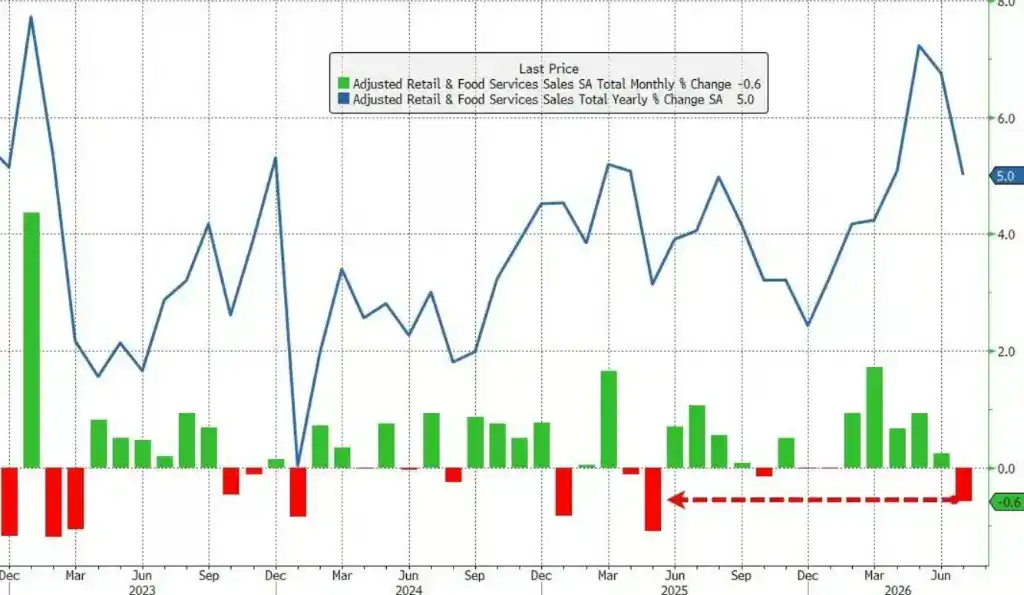
Excluding automobiles and gasoline, July retail sales fell 0.2% month-over-month, compared to an expected increase of 0.3%.
The core retail sales (the "control group" measure), which is directly related to GDP calculations and seen as a "bellwether" for consumer spending, also fell by 0.4% month-over-month, significantly missing the expected 0.3% gain.
Following the release of this data, market concerns about the outlook for US consumer spending have intensified. Economists widely pointed out that the one-time boost from excess tax refunds in the first half of 2026 has gradually faded, and with the personal savings rate falling to a four-year low in June, the sustained momentum on the consumer side is uncertain.
Analysts believe that the unusual weakness in July's data is partly due to the concentrated release of short-term disruptive factors.
As Bank of America analysts previously predicted, the timing of this year's Prime Day and related promotional events shifted forward from July to June, causing a significant forward shift in online (non-store) retail consumption, which consequently led to a notable decline in online sales for July.
Looking at the breakdown, clothing, gasoline (affected by falling oil prices), and furniture sales all recorded month-over-month declines. Furthermore, the heatwave around the US Independence Day on July 4th and the waning consumer enthusiasm after the end of the World Cup were also considered to have exerted some drag on retail activity for the month.
On a year-over-year basis, July retail sales still grew by 5.0%, with the absolute level remaining relatively robust, but the growth rate has slowed compared to previous periods.
Among all the sub-indicators, the performance of the "control group" sales data is the most closely watched by the market. This measure excludes automobiles, gasoline, building materials, and food services, and is directly used to calculate Personal Consumption Expenditures (PCE), which is then incorporated into GDP calculations, making it a key indicator for gauging the underlying momentum of consumption.
The 0.4% month-over-month decline in control group sales in July, compared to the market expectation of a 0.3% increase, represents a deviation of 0.7 percentage points. This significant miss may put downward pressure on Q3 GDP growth forecasts.
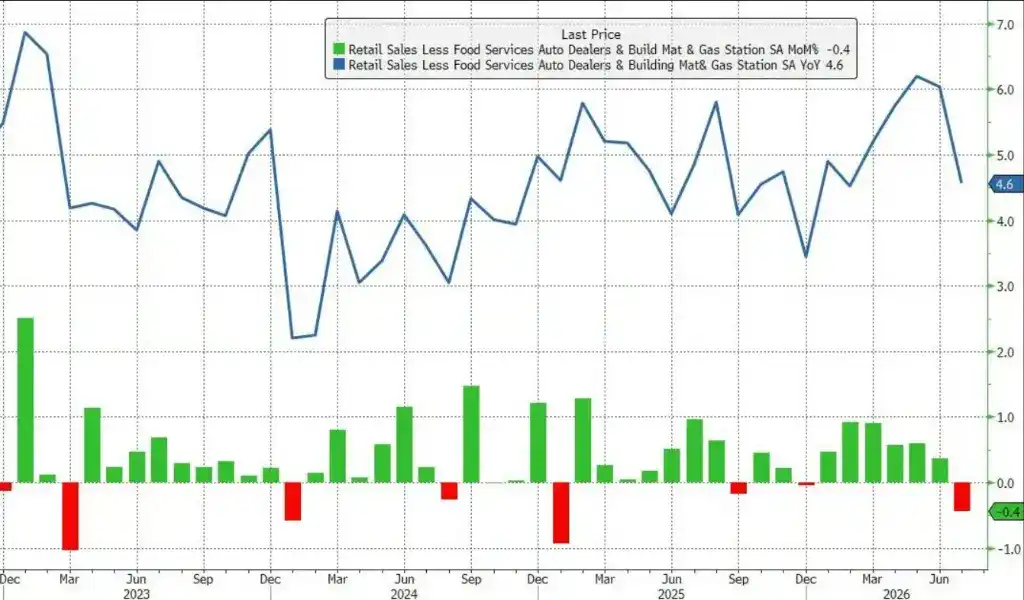
Bank of America data shows that core retail sales excluding automobiles and gasoline fell 0.2% month-over-month, also worse than the expected decline of 0.2%—in summary, all core indicators showed a significantly weaker-than-expected trend.
It's worth noting that this round of consumption cooling is not evenly distributed across income groups, reflecting subtle changes in consumption structure.
The latest Bank of America credit card spending data shows that in the four consecutive weeks ending August 1st, the year-over-year spending growth rate for low-income households has consistently been higher than that for high-income households. This marks a significant reversal from the persistent K-shaped divergence seen in recent years—where high-income group consumption was strong while low-income groups were relatively pressured.
Even within discretionary spending categories, this trend holds true and is not solely driven by gasoline price changes. Low-income groups show robust discretionary spending, while high-income groups show modest cooling. Bank of America believes this indicates that the K-shaped economic pattern is gradually converging towards a "C-shape," meaning consumption trends across income tiers are becoming more aligned.
For the market, this implies that some retail sectors that previously relied on consumption by high-income groups may face some growth pressure.