The weakness in U.S. indexes seen on Monday continued into the next day: Tuesday's main blow hit the technology sector amid a reassessment of the urgency of assets. The S&P 500 index lost about 0.6-0.7%, ending the day around 7,690-7,700 points, while the Nasdaq Composite fell by more than 1.2%. The Dow Jones Industrial Average remained relatively stable, declining approximately 0.15-0.22% to a level in the middle of the 53,300-point range.
Semiconductor Stock Sell-Off Hits Tech Shares
The closely watched PHLX Semiconductor index slumped about 5%, with shares of several well-known memory and chipmakers falling 7-9%. This is what happens when the market stops viewing investments in artificial intelligence (AI) as a one-way trade and starts asking what those future cash flows are worth at a much higher rate.
Long-term bond yields aren't just making financial statements look worse. They force investors to reconsider the premium being paid for companies whose payback is years down the road. Market saturation with AI-related deals is turning this reassessment into a forced sell-off.
The correction followed a powerful rally in 2026. The S&P 500 is still up more than 13% for the year, but it has fallen about 0.7-1% below its mid-August record high, close to the 7,799 mark. The energy sector held up thanks to high oil prices. The technology, communication services, and consumer staples sectors did not receive such support this week.
Long-Term Treasury Yields Call Valuations into Question
Warning signals continued to flash in the bond market on Tuesday, with seasoned traders watching them intensify for weeks. The yield on the 10-year Treasury note fluctuated in a range from 4.70% to 4.74%, approaching multi-month highs. The yield on the 30-year bond briefly reached around 5.32-5.33%—its highest level since 2007—before retreating to 5.28-5.30% by the close.
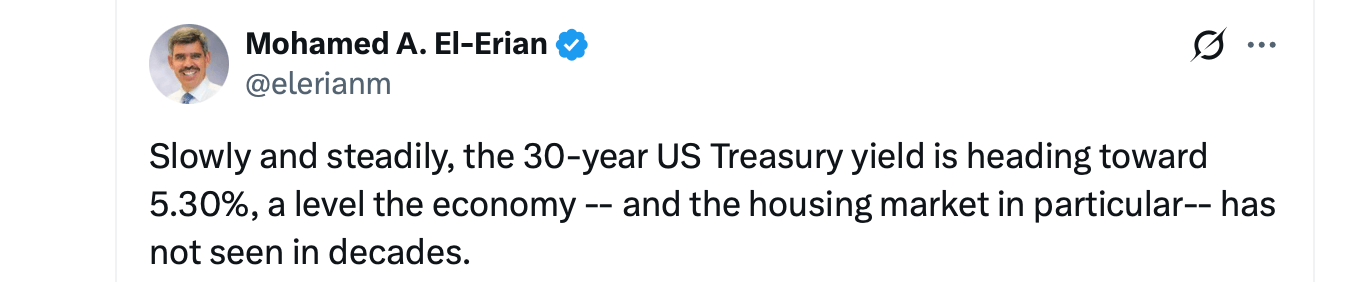
And this isn't just a technical detail. Treasury yields are the price investors demand for lending to Washington, and the long end of the curve drives mortgage rates, corporate financing, and asset valuations. When that price rises, borrowers ultimately feel it, and stocks and other assets are forced to compete with a bond market offering higher yields.
Traders are weighing the same complex mix of factors: high energy costs, significant federal deficits, and a constantly growing debt burden. A significant July budget deficit adds pressure on longer-dated bonds. Short-term bond yields, which are more closely tied to Federal Reserve expectations, remained in a range from the low to mid-4% mark and fluctuated much less.
Straits of Hormuz Disruptions Keep Oil Market on Edge
Oil remains in the spotlight this week as shipping through the Straits of Hormuz remains far from normal. West Texas Intermediate (WTI) crude traded in the $84-85 per barrel range, while Brent crude continued to hold above $90. About 20% of the world's traded oil typically passes through this narrow waterway, so any shipping disruption quickly becomes a global inflationary headache.
A 60-day U.S.-Iran memorandum of understanding aimed at restoring freer navigation expired without a long-term agreement. Shipping remained sharply curtailed at times, with new incidents sustaining a geopolitical premium in oil prices. The market is pricing not a theoretical narrowing of passage but the barrels that might not arrive when buyers need them. Furthermore, the U.S. diesel crack spread reached a record high, exceeding $102 per barrel.
"Diesel is more visible than WTI or Brent in showing the physical tightness in the global energy system," wrote the Endgame Macro account on X this week. "Benchmark crude prices are restrained by weak global demand, hopes for eventual normalization, alternative export routes from Gulf states, and ongoing strategic petroleum reserve releases."
The account added:
"Diesel has fewer 'pressure relief valves.' It must be refined from suitable crude at operating refineries, shipped along disrupted sea lanes, and delivered to trucking, agricultural, manufacturing, and heating markets. That 'pinch point' is showing up sharply right now."
This pressure extends far beyond fuel pumps. Rising oil costs push up transportation and raw material expenses, which then feed into the prices households and businesses pay. It also leaves the Federal Reserve less room to ease policy, even if other parts of the economy are slowing. This is why energy stocks found buyers while much of the market was neglected.
UAE Severs Key Trade Link with Iran
The UAE then ratcheted up tensions, announcing it had suspended all trade, commercial exchanges, and financial transactions with Iran until further notice. Afra Al-Hameli of the UAE Ministry of Foreign Affairs linked the move to escalating regional tensions threatening peace and security.
This is more than just diplomatic news. Closing this channel could make it harder for Iran to obtain hard currency, imports, and access to overseas trade networks at a time when sanctions and conflict continue to bite.
The UAE clarified that it remains committed to dialogue, regional cooperation, and the integrity of the international financial system. However, the suspension much more sharply delineates the boundaries of commercial risk and shows Gulf states are recalculating the costs of doing business amid prolonged confrontation.
Gold and Cryptocurrencies Fail 'Stress Test'
Gold and silver did not live up to the hopes of many investors who looked to them as a 'safe haven' during market panic. Spot gold fluctuated around the mid-$4,300 per ounce mark, while silver traded near $63-64. Rising Treasury yields increased the opportunity cost of holding precious metals, and that pressure from rates outweighed some protective demand.
Bitcoin traded in the $64,200 to $65,000 range, with Ethereum around $1,900. Cryptocurrencies showed mixed or modestly positive momentum by some measures but remained largely range-bound. Bitcoin failed to stage a sustained rally as a 'geopolitical haven' and remains significantly below its October 2025 record high, just above $126,000. Nevertheless, Bitcoin and cryptocurrencies have sharply diverged from the trend in stocks—an unusual decoupling that has prevented normal market correlations from holding.
Markets Brace for the Next Test
The next move largely depends on whether negotiations over the Straits of Hormuz can reach a sustainable agreement. The UAE-Iran rift adds another variable: increased pressure on Tehran and a faster splintering of trade and finance along geopolitical lines. The 'cheap money' narrative has given way to a more complex question: who bears the cost when rates, oil prices, and regional risks all rise at once?
end-content