Two Paths, One Destination

marsbitPublished on 2026-02-24Last updated on 2026-02-24

Abstract

Coinbase and Robinhood, despite recent earnings misses, are undergoing significant transformations that diverge from simplistic narratives tied to crypto performance. Both are systematically diversifying their revenue streams to reduce cyclical dependency. Coinbase’s subscription and service revenue reached $2.8B in 2025, 5.5x its 2021 peak. It now holds 12% of global crypto assets and is expanding into derivatives (via the Deribit acquisition), prediction markets, and institutional services, partnering with major banks and asset managers like BlackRock. Its long-term goal is to become a foundational settlement layer for on-chain finance. Robinhood’s growth is highlighted by a 27% YoY increase in ARPU to $191, driven largely by its prediction markets—its fastest-growing product line, generating $300M in annualized revenue. Other key drivers include options trading and subscription services. The company is also expanding into banking and private market access through Robinhood Ventures, aiming to capture a share of generational wealth transfer. Though they started from opposite ends—Coinbase in crypto, Robinhood in traditional equities—both are converging toward the same vision: a financial super-app for retail users. They are now competing directly in emerging areas like prediction markets, tokenization, and private market access, with the goal of deepening user financial integration and becoming indispensable platforms.

Written by: Prathik Desai

Compiled by: Block unicorn
Preface

Happy Year of the Horse, everyone. Last week, two highly anticipated emerging financial companies released their earnings reports within 48 hours. Both companies' revenues fell short of expectations. They were immediately framed within the same narrative: the cryptocurrency market is sluggish, trading volumes are weak, and the good days are over.

But this perspective completely misses the point.

While Coinbase and Robinhood's stock prices may be closely correlated with the price of Bitcoin (BTC), their future trajectories are not determined by BTC's performance in the fourth quarter. They are gradually moving away from the narrow definition of "company fate being tightly linked to the cryptocurrency cycle."

Both companies are undergoing significant transformations—you can see it in their financial data if you know where to look—but these changes could be completely overlooked if you only focus on the complex data from the last quarter.

But it's actually not that ambiguous. Just look at the data from the past few quarters and compare it with the series of product announcements both companies have made over the past 12 months, and it becomes clear.

The long-term trends of both companies tell us their respective directions, their bets on the future of finance, and, crucially, when their paths will begin to converge.

In today's analysis, I will dissect their stories separately before explaining their commonalities and what this reveals about the broader competitive landscape they operate in.

Part 1: Coinbase - The Infrastructure Bet

Coinbase's net loss of $667 million in Q4 2025 might make it seem like a terrible quarter. But numbers need context. The quarter also saw $718 million in unrealized losses on Coinbase's cryptocurrency holdings and a $395 million impairment loss on its investment in Circle. Excluding these non-cash paper losses, Coinbase maintained adjusted profitability for the 12th consecutive quarter.
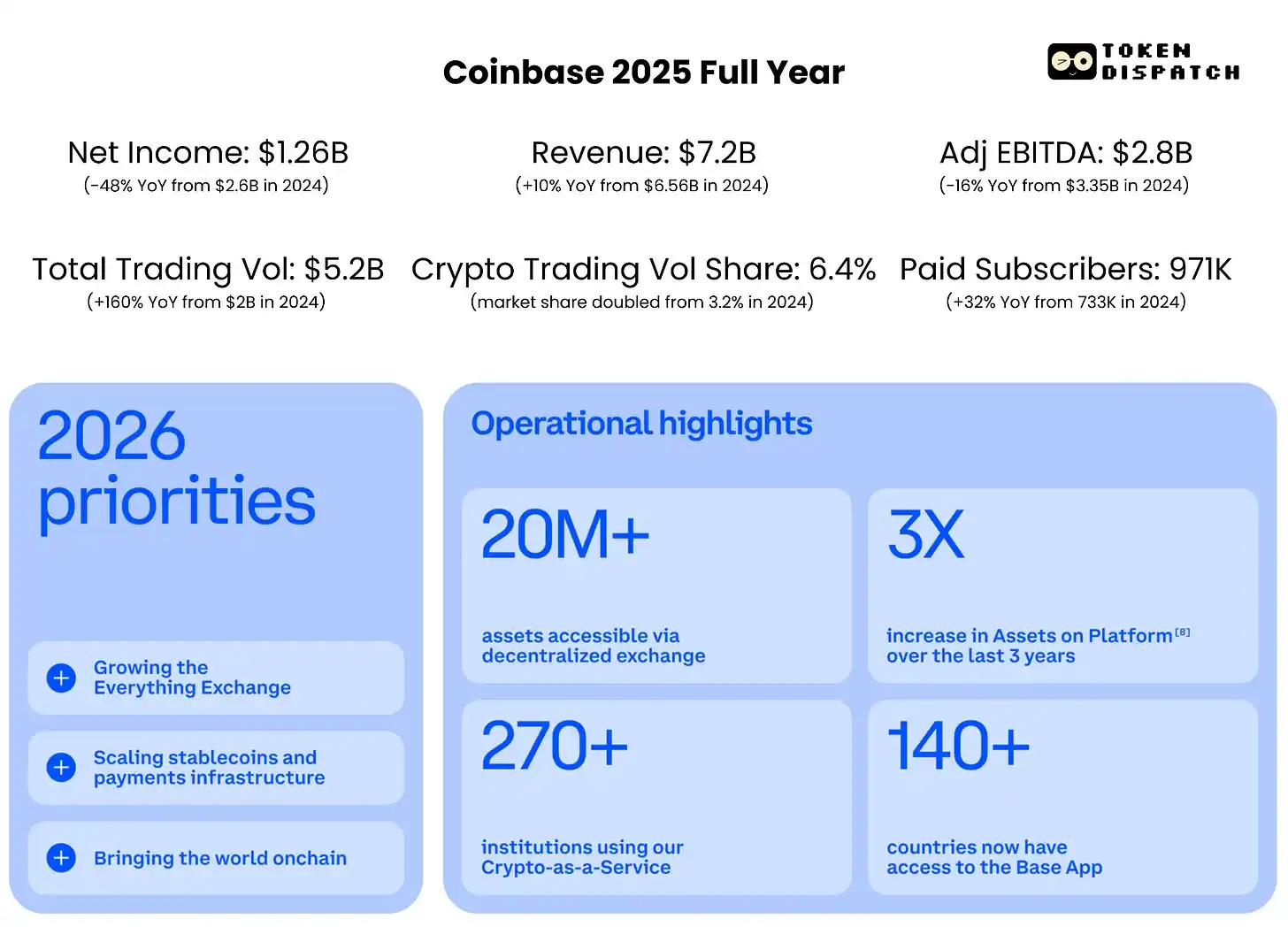
The report showed adjusted earnings of $178 million and adjusted EBITDA of $566 million.

While this might be reassuring, there's one thing I find even more noteworthy.

Coinbase's Subscription & Services (S&S) revenue reached $2.8 billion in 2025, a 5.5x increase from the cycle peak in 2021 and double that of 2023. This indicates Coinbase's revenue base is broadening, encompassing areas like stablecoins, custody, and blockchain rewards. In Q4, the value of USDC held in Coinbase products hit a record high of $17.8 billion, up 18% quarter-over-quarter. Currently, Coinbase holds more cryptocurrency than any other company globally, accounting for 12% of the world's crypto holdings.
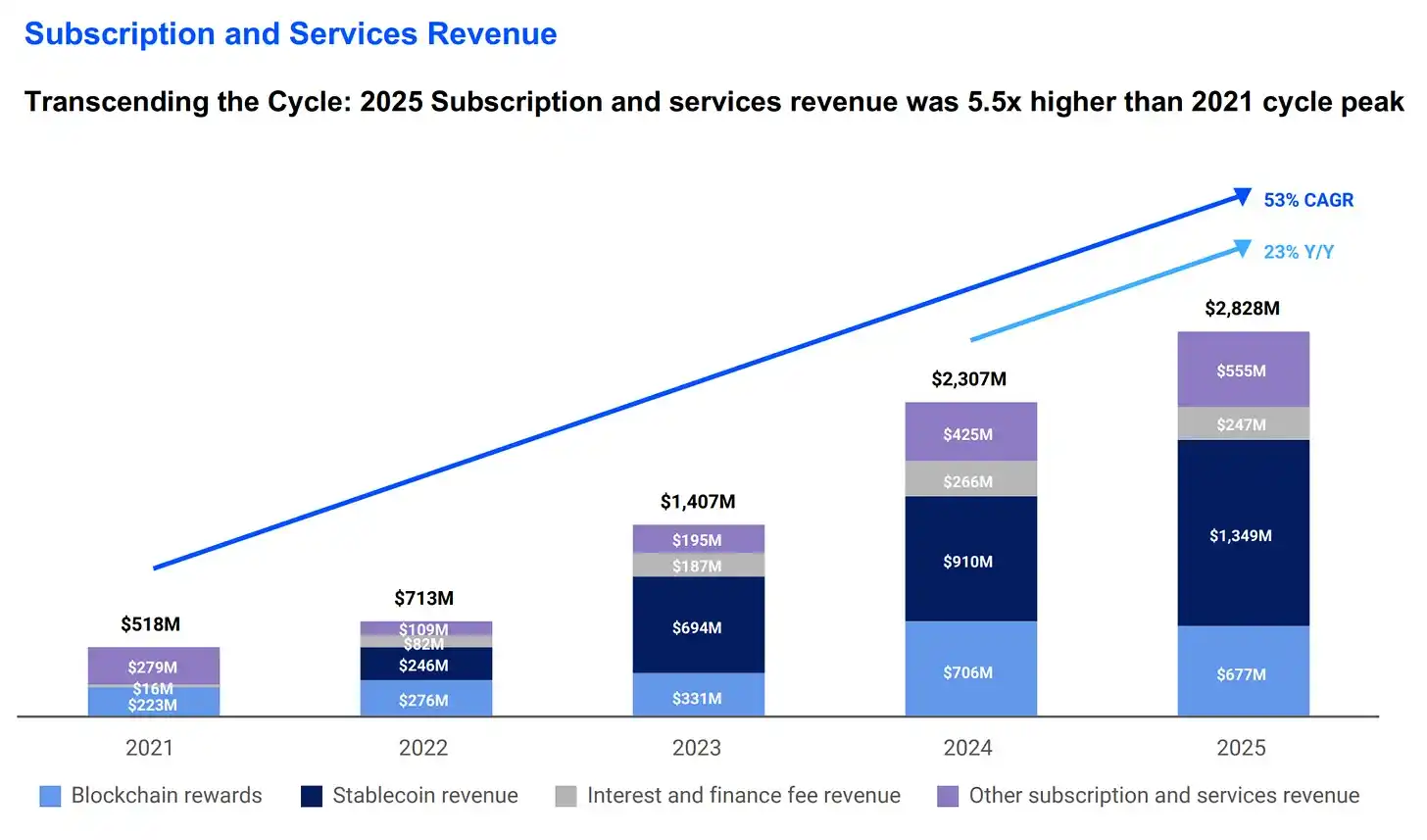
However, this revenue is highly sensitive to interest rate changes. When interest rates and crypto prices fall, stablecoin yields, staking rewards, and interest income on custody balances all decrease. This is evident in the company's Q1 2026 guidance, which expects revenue from stablecoins and custody to drop to between $550 million and $630 million from $727 million in Q4.

Coinbase's systematic diversification across multiple business areas, reducing its dependence on the crypto cycle, should boost investor confidence. Currently, Coinbase has 12 business units with annual revenue exceeding $100 million, 6 units over $250 million, and 2 units over $1 billion.
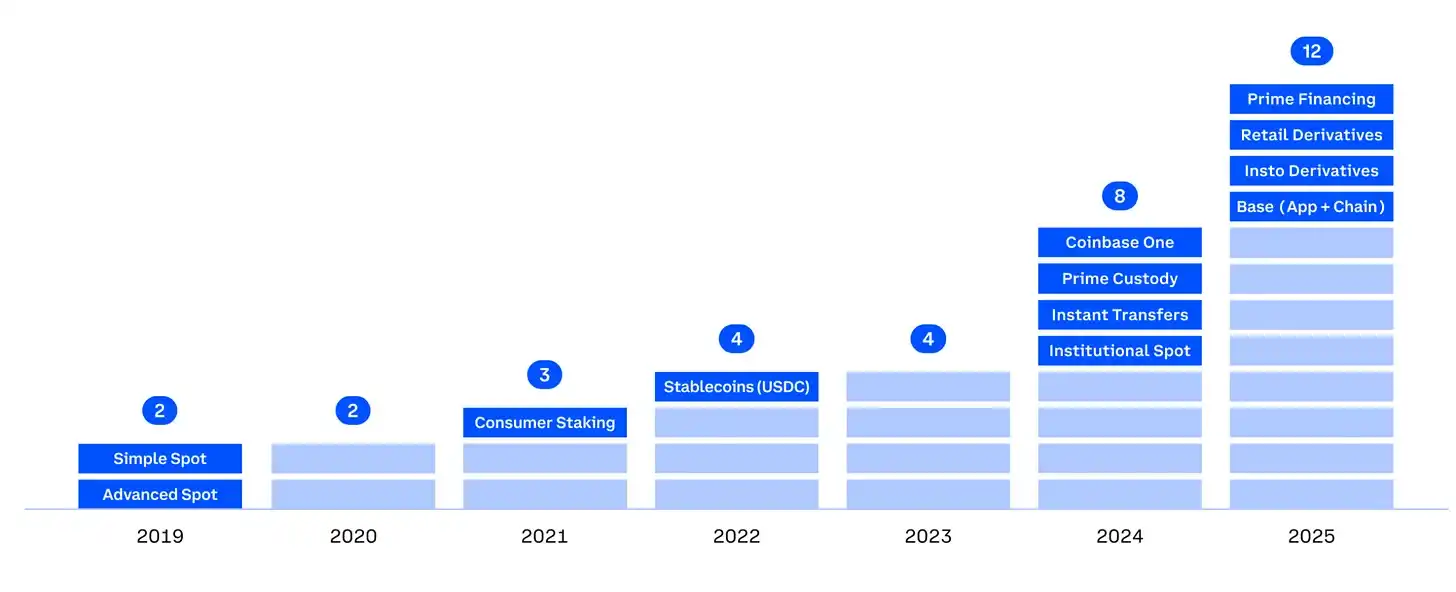
Coinbase's acquisition of Deribit, the largest crypto transaction ever, allows the company to capture the high-volume derivatives trading, especially during times of high spot market volatility.

Coinbase's "Everything Exchange" vision is beginning to manifest beyond just traditional finance. Earlier this week, Armstrong revealed on Twitter that five of the world's largest Global Systemically Important Banks (G-SIBs) are collaborating with Coinbase.

J.P. Morgan has signed an agreement allowing clients to link bank accounts directly to Coinbase. BlackRock's Bitcoin ETF custody also runs on Coinbase's infrastructure. These trials indicate Coinbase's long-term goal is to become the settlement layer large institutions can plug into as finance moves on-chain.

Coinbase's recent launch of prediction markets follows the same pattern for retail customers. Launched two weeks ago, prediction markets further expand Coinbase's "everything is tradable" vision by introducing event-based trading. This creates a whole new asset class, providing Coinbase with a new revenue stream and giving customers more reason to keep assets on Coinbase rather than transfer them elsewhere.

While the short-term performance of this new business line may be modest, the strategic intent is clear. How do I know? Prediction markets have become Robinhood's fastest-growing business line, which is proof enough.

So let's look at the other side...

Part 2: Robinhood - The Consumer Deep Play

Robinhood's Q4 performance was actually quite good but was punished for the wrong reasons. Revenue missed expectations due to lower crypto trading volumes and the end of the football season, but to me, these are not the main points.
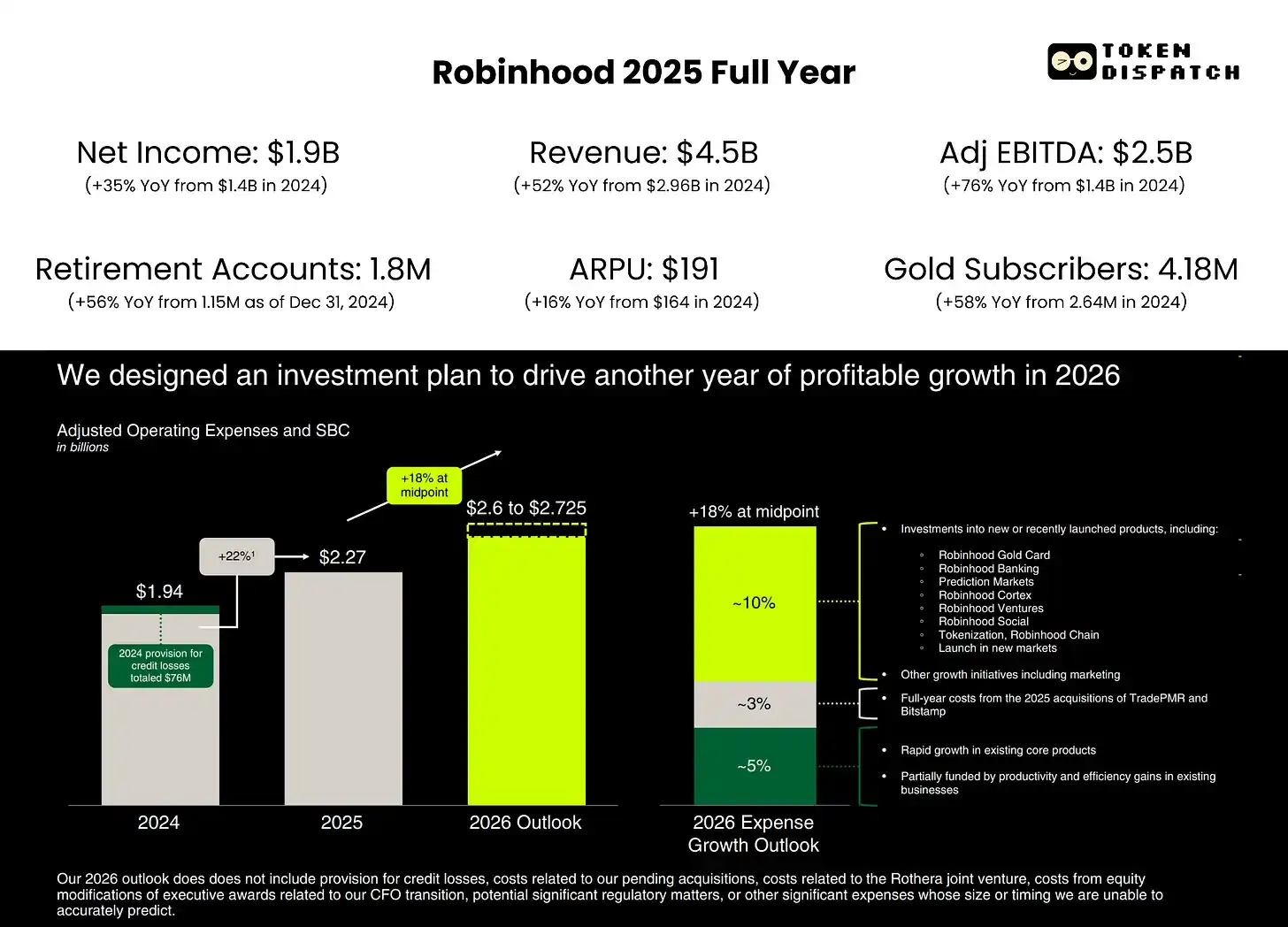
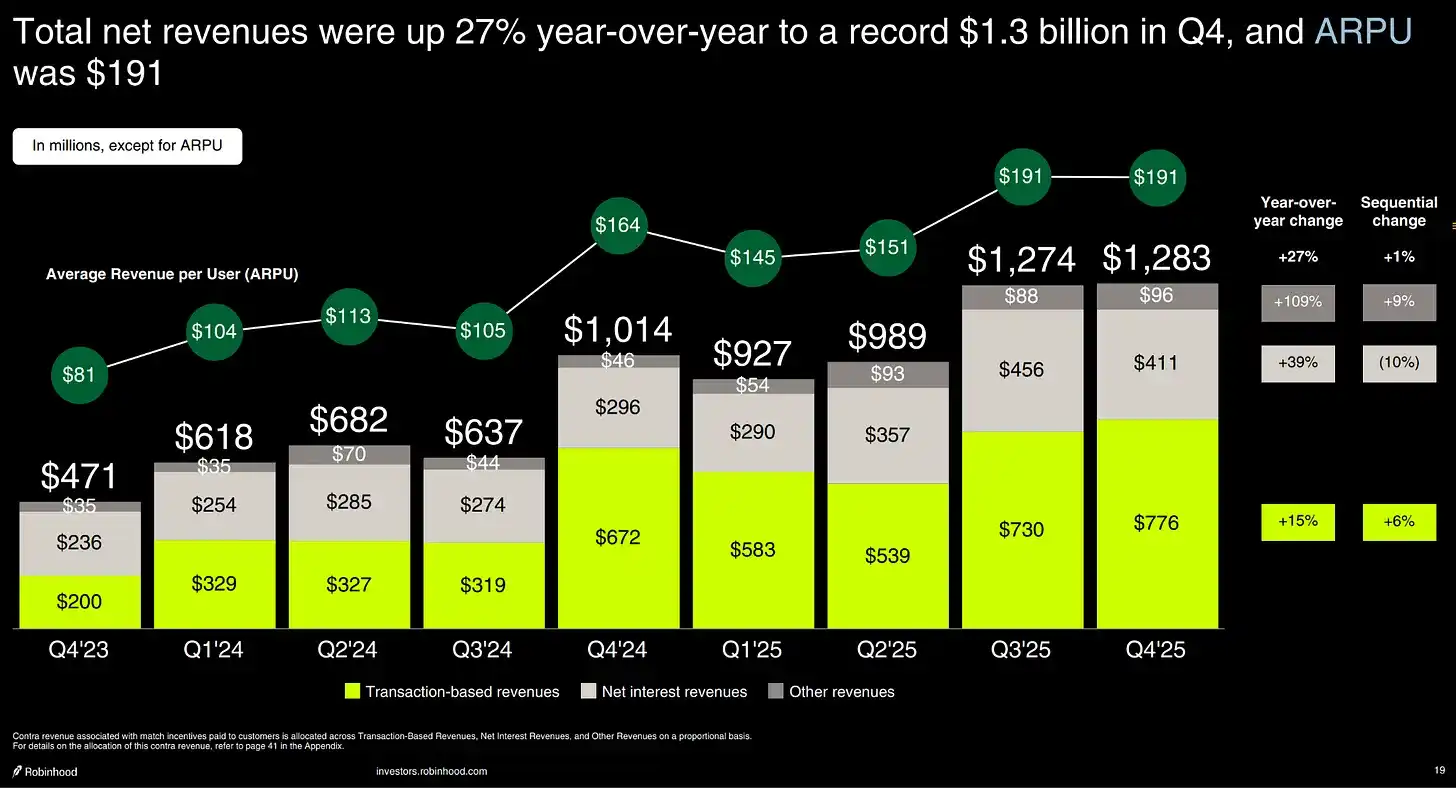
Most striking is its Average Revenue Per User (ARPU), which grew 27% year-over-year to $191, while the number of funded users grew only 7%. This indicates Robinhood is making more money from each customer without rapidly expanding its user base. This is a more diversified business model compared to its model at the time of its IPO in 2021.

Where is the ARPU growth coming from? Partly from the fastest-growing "Other Transaction Revenue," which grew 300% year-over-year to $147 million, primarily driven by prediction markets. Part of the growth also comes from options, which grew 41% to $314 million. Growth in net interest income and Gold subscriptions also contributed.

Although transaction-based crypto revenue grew over 40% year-over-year in 2025, $8 out of every $10 in Robinhood's revenue still comes from non-crypto businesses. This ensures the company is less dependent on the crypto cycle.
The $300 Million Business

The biggest indicator of Robinhood's future trajectory lies in the performance of its prediction markets. CEO Vladimir Tenev called this product line, launched less than a year ago, the fastest-growing business in Robinhood's history, which speaks volumes about its importance. The product line achieved $300 million in annualized revenue and $12 billion in contract volume in its first year. Such rapid growth clearly signals future prospects.

Robinhood is also doubled down on prediction markets by forming a joint venture with Susquehanna, Rothera LLC. Rothera LLC acquired MIAXdx in January 2026. This deal gives Robinhood its own CFTC-licensed exchange and clearinghouse. This layer helps Robinhood build the infrastructure for prediction markets, allowing it to control the pricing, contract selection, and economic models of these markets.

Although the NFL season has ended, some short-term tailwinds make Robinhood's prediction markets more resilient. In January, NBA contract volume on the platform surpassed NFL contracts. A government shutdown also caused a significant spike in volume the same week the NFL season ended. Furthermore, the FIFA World Cup is this summer, following the ongoing Winter Olympics. Beyond this, Robinhood is building out a whole new non-sports category.

The Diversification Puzzle

Beyond prediction markets and Robinhood's current profit engines (options, margin, and Gold subscriptions), other factors will boost investor confidence. $HOOD is also building the next layer of distribution through private markets, family investing, and banking.

Robinhood Banking officially launched a few months ago, rolling out to its first customers. As of the end of January, it had 25,000 paying customers with total deposits of $400 million. Over half of these customers have enabled direct deposit, which Tenev sees as the most encouraging signal. This means these customers are moving their financial lives into the Robinhood ecosystem, not just experimenting. But $400 million in deposits is still a drop in the bucket for a platform with a market cap of $32.4 billion. Banking is a long game, and Robinhood must be prepared for the challenge.

While the world is busy building prediction markets, I believe private markets could be Robinhood's ace in the sleeve, an area few competitors are tackling. Tenev also believes private markets could "grow larger than prediction markets." Robinhood Ventures, a registered fund under Robinhood aimed at giving retail investors access to invest in private companies, has not officially launched yet. But last year, European users got a taste through the controversial gift of stock tokens for OpenAI and SpaceX. Robinhood Ventures will launch in the US in 2026, and the total addressable market is huge. Tenev has repeatedly mentioned the ongoing $100 trillion intergenerational wealth transfer. If Robinhood can capture even a fraction of this as private assets shift from institutional to retail investors, it would dramatically alter its revenue mix.

The bigger challenge will be managing customer expectations by clearly delineating the lines between tokenized equity and traditional equity.

Private markets as a revenue source may start in 2026 but will likely play out over a much longer horizon.

Same Destination, Different Timelines

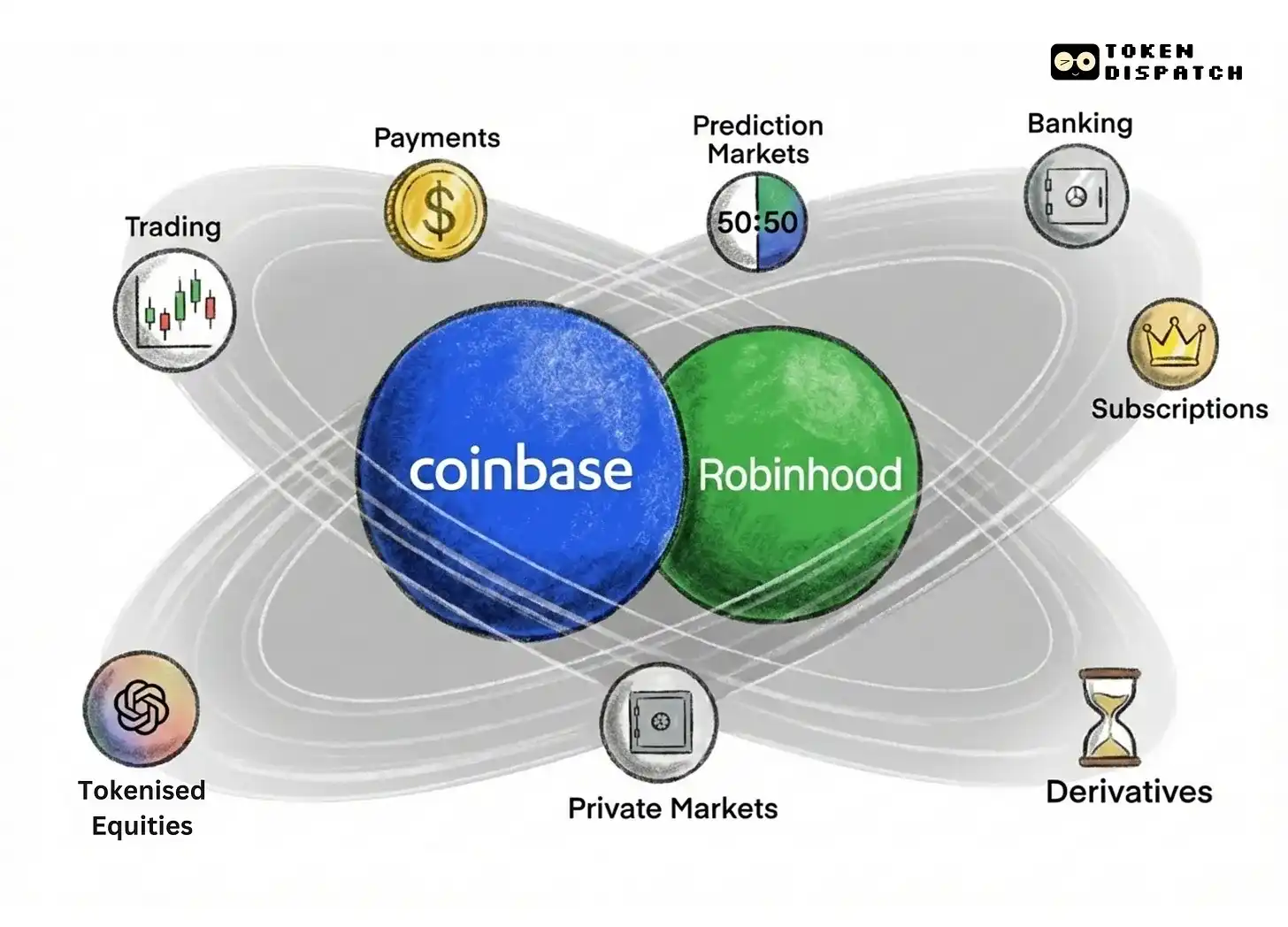
At first glance, Coinbase and Robinhood's paths seem截然不同 (jiéránbùtóng - completely different). Indeed, they started from two opposite ends of the finance spectrum. However, they are now converging towards the same vision: becoming a financial super app. Their recent histories confirm this.

Robinhood entered finance the traditional way: offering commission-free stock trading designed for a user base that found traditional brokers too expensive and complex. For five years, it has been building crypto-native infrastructure on top of traditional finance (TradFi). Today, it offers margin accounts, Gold subscriptions, credit cards, banking products, a derivatives exchange, prediction markets, and tokenized strategies.

Coinbase was born in crypto, providing the most trusted way to buy, store, and trade digital assets at a time when most of Wall Street shunned cryptocurrency. Over the past five years, Coinbase has expanded from its crypto-native core into consumer products already existing in traditional finance, such as stocks, subscriptions, credit cards, and now prediction markets.

Both are rapidly converging towards the middle from opposite directions, where the battle for retail finance will be fought over the next decade.

Prediction markets are currently the clearest stage for their head-to-head competition. Robinhood is ahead here, having a head start over Coinbase, which launched just two weeks ago. $HOOD also has its own exchange and clearinghouse, while $COIN is partnering with Kalshi but not exclusively.

Tokenization will be another, more complex area of competition. Coinbase sees it as an infrastructure problem, issuing tokenized stock internally and building regulatory relationships for on-chain trading of bonds and securities. Meanwhile, Robinhood sees it as a consumer access problem, enabling trading by opening up stock tokens for non-public companies. They are taking different paths to solve different aspects of the same problem.

Private markets could be a third area where these two companies meet. Coinbase enables on-chain capital formation through its acquisition of Echo, while Robinhood is taking its first steps with its Ventures arm to bring private company investing to retail users.

Both companies know the broader market will trust the one that builds the deepest financial relationship and meets the growing demand from investors. Financial services are often one of the hardest areas to gain market acceptance. People don't easily switch banks, brokers, and custodians. If one platform allows a user to manage their retirement account, card details, prediction market positions, and eventually their private equity portfolio, it becomes very difficult for another platform to take that customer away from a competitor.


Related Questions

QWhat was the main reason for Coinbase's net loss in Q4 2025, and what does the adjusted profit reveal about its underlying performance?

ACoinbase's net loss of $667 million in Q4 2025 was primarily due to $718 million in unrealized losses on its crypto holdings and a $395 million impairment loss on its investment in Circle. However, when these non-cash, mark-to-market losses are excluded, the company posted an adjusted profit of $178 million, marking its 12th consecutive quarter of adjusted profitability.

QHow is Coinbase diversifying its revenue streams to become less dependent on crypto market cycles?

ACoinbase is diversifying by significantly growing its Subscription & Services (S&S) revenue, which reached $2.8 billion in 2025. This includes income from stablecoins, custody, and blockchain rewards. The company now has 12 business units generating over $100 million in annual revenue. Its acquisition of Deribit expands it into derivatives, and partnerships with major traditional banks position it as a settlement layer for institutional on-chain finance.

QWhat key metric from Robinhood's Q4 report indicates a successful shift towards a more diversified business model, and what drove this growth?

AThe key metric is Average Revenue Per User (ARPU), which grew 27% year-over-year to $191. This growth was driven by a 300% increase in 'Other transaction revenue' (primarily from prediction markets), a 41% rise in options revenue, and growth in net interest income and Gold subscriptions. This shows Robinhood is earning more from each customer without solely relying on rapid user base expansion or crypto trading volumes.

QAccording to the article, how are Coinbase and Robinhood's long-term strategies converging?

ABoth companies are converging on the vision of becoming a financial super-app for retail customers. They are moving from opposite starting points: Robinhood from traditional finance (TradFi) into crypto-native products, and Coinbase from a crypto-native base into traditional financial products. Their paths are now crossing in areas like prediction markets, tokenization of assets, and eventually, private market access, making them direct competitors in the future of retail finance.

QWhy does the article suggest that prediction markets are a critical new battleground for both companies?

APrediction markets are a critical battleground because they represent a fast-growing, new asset class that drives user engagement and revenue. Robinhood's prediction market business is its fastest-growing product line ever, achieving $300 million in annualized revenue in its first year. Coinbase's recent entry into this space with its own prediction market product shows it is a strategic priority for both firms to capture this new revenue stream and deepen financial relationships with users.

Related Reads

North Korean Hackers Loot $500 Million in a Single Month, Becoming the Top Threat to Crypto Security

North Korean hackers, particularly the notorious Lazarus Group and its subgroup TraderTraitor, have stolen over $500 million from cryptocurrency DeFi platforms in less than three weeks, bringing their total theft for the year to over $700 million. Recent major attacks on Drift Protocol and KelpDAO, resulting in losses of approximately $286 million and $290 million respectively, highlight a strategic shift: instead of targeting core smart contracts, attackers are now exploiting vulnerabilities in peripheral infrastructure. For instance, the KelpDAO attack involved compromising downstream RPC infrastructure used by LayerZero's decentralized validation network (DVN), allowing manipulation without breaching core cryptography. This sophisticated approach mirrors advanced corporate cyber-espionage. Additionally, North Korea has systematically infiltrated the global crypto workforce, with an estimated 100 operatives using fake identities to gain employment at blockchain companies, enabling long-term access to sensitive systems and facilitating large-scale thefts. According to Chainalysis, North Korean-linked hackers stole a record $2 billion in 2025, accounting for 60% of all global crypto theft that year. Their total historical crypto theft has reached $6.75 billion. Post-theft, they employ specialized money laundering methods, heavily relying on Chinese OTC brokers and cross-chain mixing services rather than standard decentralized exchanges. Security experts, while acknowledging the increased sophistication, emphasize that many attacks still exploit fundamental weaknesses like poor access controls and centralized operational risks. Strengthening private key management, limiting privileged access, and enhancing coordination among exchanges, analysts, and law enforcement immediately after an attack are critical to improving defense and fund recovery chances. The industry's challenge now extends beyond secure smart contracts to safeguarding operational security at the infrastructure level.

marsbit34m ago

North Korean Hackers Loot $500 Million in a Single Month, Becoming the Top Threat to Crypto Security

marsbit34m ago

Circle CEO's Seoul Visit: No Korean Won Stablecoin Issuance, But Met All Major Korean Banks

Circle CEO Jeremy Allaire's recent activities in Seoul indicate a strategic shift for the company, moving away from issuing a Korean won-backed stablecoin and instead focusing on embedding itself as a key infrastructure provider within Korea’s financial and crypto ecosystem. Despite Korea accounting for nearly 30% of global crypto trading volume—with a market characterized by high retail participation and altcoin dominance—Circle has chosen not to compete for the role of stablecoin issuer. Instead, Allaire met with major Korean banks (including Shinhan, KB, and Woori), financial groups, leading exchanges (Upbit, Bithumb, Coinone), and tech firms like Kakao. This approach reflects a broader industry transition: the core of stablecoin competition is shifting from issuance rights to systemic positioning. With Korean regulators still debating whether banks or tech companies should issue stablecoins, Circle is avoiding regulatory uncertainty by strengthening its role as a service and technology partner. The company is deepening integration with trading platforms, building connections, and promoting stablecoin infrastructure. This positions Circle to benefit regardless of which entity eventually issues a won stablecoin. Allaire also noted the potential for a Chinese yuan stablecoin in the next 3–5 years, underscoring a regional trend of stablecoins becoming more regulated and integrated with traditional finance. Ultimately, Circle’s strategy highlights that future influence in the stablecoin market will belong not necessarily to the issuers, but to the foundational infrastructure layers that enable cross-system transactions.

marsbit1h ago

Circle CEO's Seoul Visit: No Korean Won Stablecoin Issuance, But Met All Major Korean Banks

marsbit1h ago

SpaceX Ties Up with Cursor: A High-Stakes AI Gambit of 'Lock First, Acquire Later'

SpaceX has secured an option to acquire AI programming company Cursor for $60 billion, with an alternative clause requiring a $10 billion collaboration fee if the acquisition does not proceed. This structure is not merely a potential acquisition but a strategic move to control core access points in the AI era. The deal is designed as a flexible, dual-path arrangement, allowing SpaceX to either fully acquire Cursor or maintain a binding partnership through high-cost collaboration. This "option-style" approach minimizes immediate regulatory and integration risks while ensuring long-term alignment between the two companies. At its core, the transaction exchanges critical AI-era resources: SpaceX provides its Colossus supercomputing cluster—one of the world’s most powerful AI training infrastructures—while Cursor contributes its AI-native developer environment and strong product adoption. This synergy connects compute power, models, and application layers, forming a closed-loop AI capability stack. Cursor, founded in 2022, has achieved rapid growth with over $1 billion in annual revenue and widespread enterprise adoption. Its value lies in transforming software development through AI agents capable of coding, debugging, and system design—positioning it as a gateway to future software production. For SpaceX, this move is part of a broader strategy to evolve from a aerospace company into an AI infrastructure empire, integrating xAI, supercomputing, and chip manufacturing. Controlling Cursor fills a gap in its developer tooling layer, strengthening its AI narrative ahead of a potential IPO. The deal reflects a shift in AI competition from model superiority to ecosystem and entry-point control. With programming tools as a key battleground, securing developer loyalty becomes crucial for dominating the software production landscape. Risks include questions around Cursor’s valuation, technical integration challenges, and potential regulatory scrutiny. Nevertheless, the deal underscores a strategic bet: controlling both compute and software development access may redefine power dynamics in the AI-driven future.

marsbit1h ago

SpaceX Ties Up with Cursor: A High-Stakes AI Gambit of 'Lock First, Acquire Later'

marsbit1h ago

Trading

Spot
Futures

Hot Articles

How to Buy ONE

Welcome to HTX.com! We've made purchasing Harmony (ONE) simple and convenient. Follow our step-by-step guide to embark on your crypto journey.Step 1: Create Your HTX AccountUse your email or phone number to sign up for a free account on HTX. Experience a hassle-free registration journey and unlock all features.Get My AccountStep 2: Go to Buy Crypto and Choose Your Payment MethodCredit/Debit Card: Use your Visa or Mastercard to buy Harmony (ONE) instantly.Balance: Use funds from your HTX account balance to trade seamlessly.Third Parties: We've added popular payment methods such as Google Pay and Apple Pay to enhance convenience.P2P: Trade directly with other users on HTX.Over-the-Counter (OTC): We offer tailor-made services and competitive exchange rates for traders.Step 3: Store Your Harmony (ONE)After purchasing your Harmony (ONE), store it in your HTX account. Alternatively, you can send it elsewhere via blockchain transfer or use it to trade other cryptocurrencies.Step 4: Trade Harmony (ONE)Easily trade Harmony (ONE) on HTX's spot market. Simply access your account, select your trading pair, execute your trades, and monitor in real-time. We offer a user-friendly experience for both beginners and seasoned traders.

3.3k Total ViewsPublished 2024.03.29Updated 2025.06.04

How to Buy ONE

Discussions

Welcome to the HTX Community. Here, you can stay informed about the latest platform developments and gain access to professional market insights. Users' opinions on the price of ONE (ONE) are presented below.

活动图片