Turning Point Approaching: The "Net Long vs. Net Short" Structure Presents a Historically Rare State

Odaily星球日报Published on 2026-03-09Last updated on 2026-03-09

Abstract

Kyle Soska analyzes the perpetual futures market structure using Ethena's transparency dashboard to gauge crypto market risk sentiment. Ethena's deployed capital has fallen to a multi-year low, just 71% of its 2025 minimum, indicating a sharp decline in excess long demand. Historically, directional longs significantly outnumber directional shorts, but the current market shows an almost 1:1 balance—a rare and typically unsustainable structure. This equilibrium is likely driven by increased directional shorting and hedging demand from VCs, projects, and crypto firms locking in prices or managing exposures, rather than a lack of leveraged long interest. While this balance could become the new normal, similar structures in other asset classes rarely persist long-term, suggesting a potential market turning point may be near.

This article is from: Kyle Soska

Compiled by | Odaily Planet Daily (@OdailyChina); Translator | Azuma (@azuma_eth)

Editor's Note: The market has been oscillating at low levels for a sustained period. Will the future direction be up or down? Ramiel Capital Chief Investment Officer Kyle Soska, in his latest article, analyzes the long-short structure of the perpetual futures market and attempts to provide an answer by examining changes in market risk appetite.

The highlight of Kyle's analytical method lies in incorporating data disclosures from Ethena, which excludes basis positions and hedging positions that have some noise impact on the price direction, focusing only on net long and net short positions that more directly determine the market's direction. His final point is that the current market's net long vs. net short structure is in a historically rare state. While it's possible this could become the new normal, observing other asset markets reveals that such a trend is generally extremely difficult to sustain long-term. In other words, a turning point may be imminent.

Below is the original content by Kyle Soska, compiled by Odaily Planet Daily.

The cryptocurrency market has been in a risk-off state for several consecutive months. I have been sifting through various forms of market data, hoping to find signs of a potential market turnaround. This article will delve into the market structure of perpetual futures and, combined with data from the Ethena transparency dashboard, explore changes in market risk appetite.

Ethena's currently deployed capital has fallen to its lowest level in years, only 71% of the low point in 2025. This is not a criticism of Ethena, but rather a reflection of the current market state. Directional shorts have almost reached parity with directional longs — an extremely rare structure in the crypto market and one that has historically been difficult to sustain long-term.

The cryptocurrency market has long been characterized by extremely high asset volatility and the widespread use of high leverage by traders. Since the BitMEX era, perpetual futures have become the highest volume product, with trading volumes typically 5 to 20 times that of the spot market. As the core hub providing leverage to retail traders in the market, observing the perpetual futures market can provide a good reflection of the overall risk appetite of the crypto market.

And Ethena provides us with a unique window into the crypto derivatives market. As shown in the figure below, Ethena's strategy essentially executes a carry trade in cryptocurrency, and its logic is very simple — when a trader goes long on a crypto asset, Ethena acts as the counterparty and goes short. Simultaneously, Ethena will buy an equivalent amount of the asset in the spot market to hedge its short position.
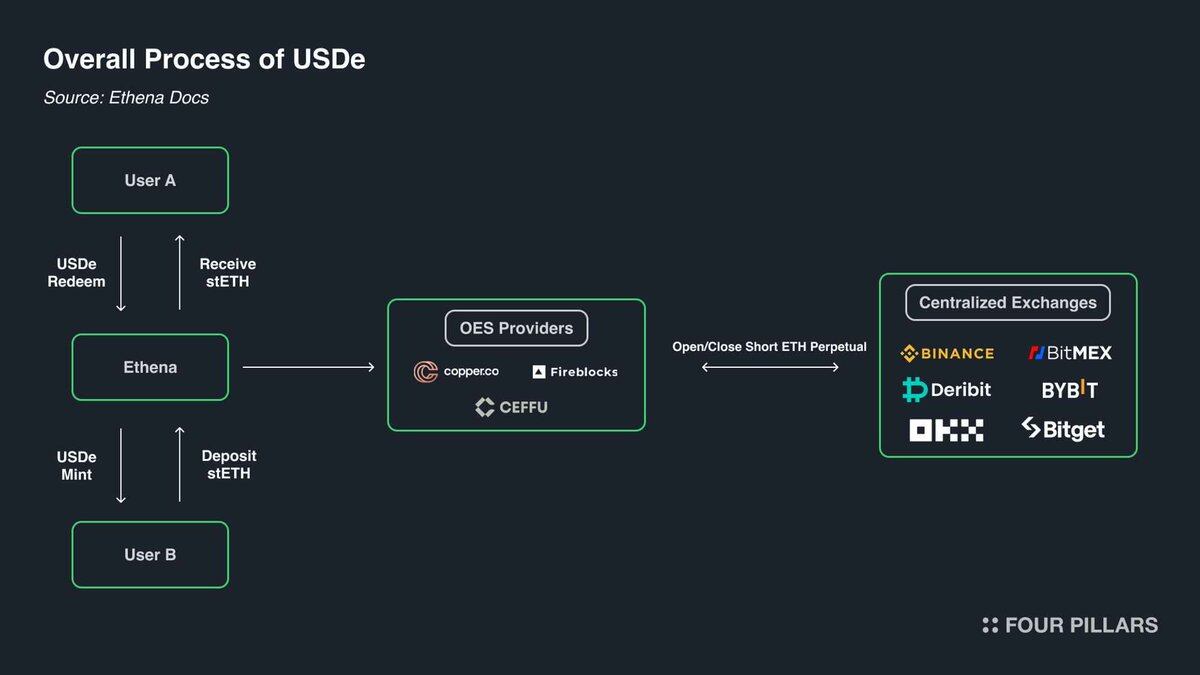
In a sense, Ethena provides "Leverage-as-a-Service":

  • Traders want exposure to rising crypto assets but lack sufficient capital;
  • Ethena has capital but has a lower risk appetite;
  • Therefore, traders borrow capital from Ethena via perpetual futures, and their cost is the "basis" + "perpetual funding rate".

According to the structure of perpetual futures, every long position is matched by a short position; they are always 1:1. Each open interest represents a cash flow agreement between two parties. The exchange's role is to match these contracts, ensuring that every contract always has a sufficiently funded long and short holder. The matrix below shows the four possible outcomes when an exchange matches contracts.
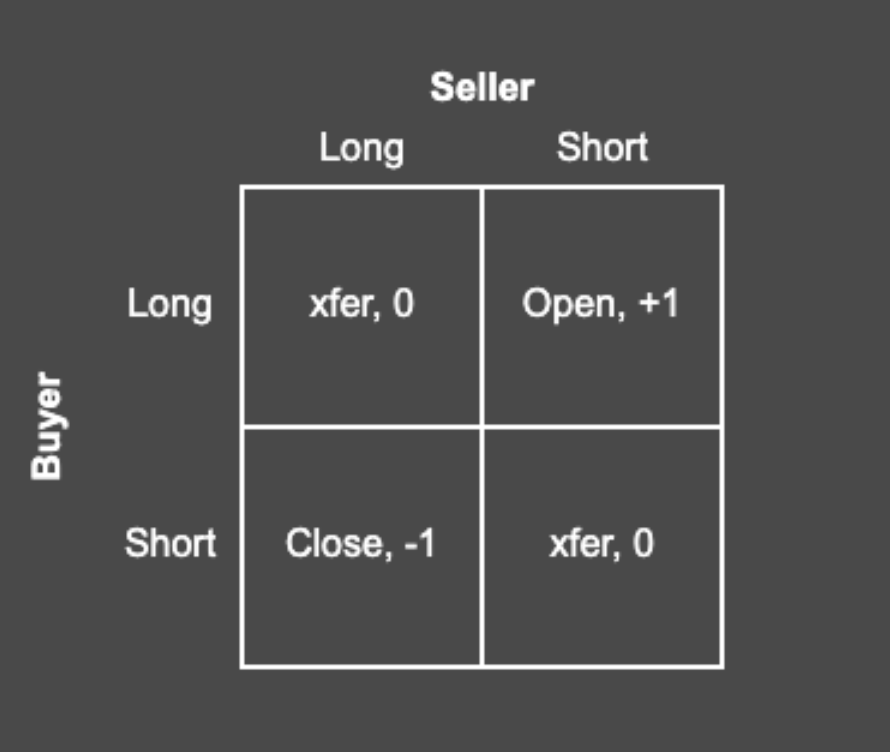
Every trade has a buyer and a seller. When the buyer and seller of a contract are both long or both short, the exchange only needs to transfer the contract ownership between the two parties. This transfer does not create or destroy any contracts. When the buyer is long and the seller is short, a new contract must be created: the buyer gets the long position, the seller gets the short position, thereby increasing the open interest by 1. Conversely, if the seller is long and the buyer is short, the exchange can unbind both parties from a specific contract and delete that contract, thereby reducing the open interest by 1.

So who actually holds these contracts in a typical market? Essentially, there are four types of contract holders:

  • Directional longs want exposure to price increases. They are risk-seeking participants, and their risk demand depends on the strength of market risk appetite.
  • Directional shorts comprise two types of participants: those who want exposure to asset price declines, and those who wish to hedge their held assets in a more tax-efficient manner. For example, VCs and company employees who receive compensation in tokens often want to hedge future unlockable tokens to lock in the current price. For many altcoins, market liquidity is often too thin to support effective direct hedging, or relevant markets may not even exist. In such cases, companies like Cumberland, Wintermute, FalconX, Flowdesk, Amber, etc., can construct a dynamically managed synthetic position: by shorting several highly liquid and correlated assets (like Bitcoin and Ethereum) to hedge an exposure to a less liquid asset (e.g., Monad). This category also includes projects like Neutrl, which use this hedging structure as a yield strategy.
  • Basis traders are opportunistic shorts. They are not concerned with price direction but voluntarily match the excess demand from directional longs when market imbalances occur. In most market environments, long demand tends to exceed short demand, and their role is to fill this gap. Their scale is usually highly elastic and can expand or shrink rapidly.
  • Perp-Perp arbitrageurs simultaneously hold both long and short positions in perpetual futures. Their role is to connect prices between different perpetual futures markets and eliminate any slight price differences after deducting trading fees. Their longs and shorts are perfectly matched at any given moment.

According to the structure of perpetual futures, every contract must be 1:1 long-short matched, so we know that "Directional longs + Arbitrage longs = Directional shorts + Basis shorts + Arbitrage shorts"; furthermore, due to the arbitrage structure, we also know that "Arbitrage longs = Arbitrage shorts"; canceling this relationship out from the first equation yields "Directional longs = Directional shorts + Basis shorts".

Ethena provides us with a proxy metric for all basis shorts, thereby helping us observe the structural comparison between directional longs and directional shorts.

The chart below shows the balance sheet disclosed by Ethena, which divides assets into cash and deployed capital, for the period from December 27, 2024, to March 7, 2026.
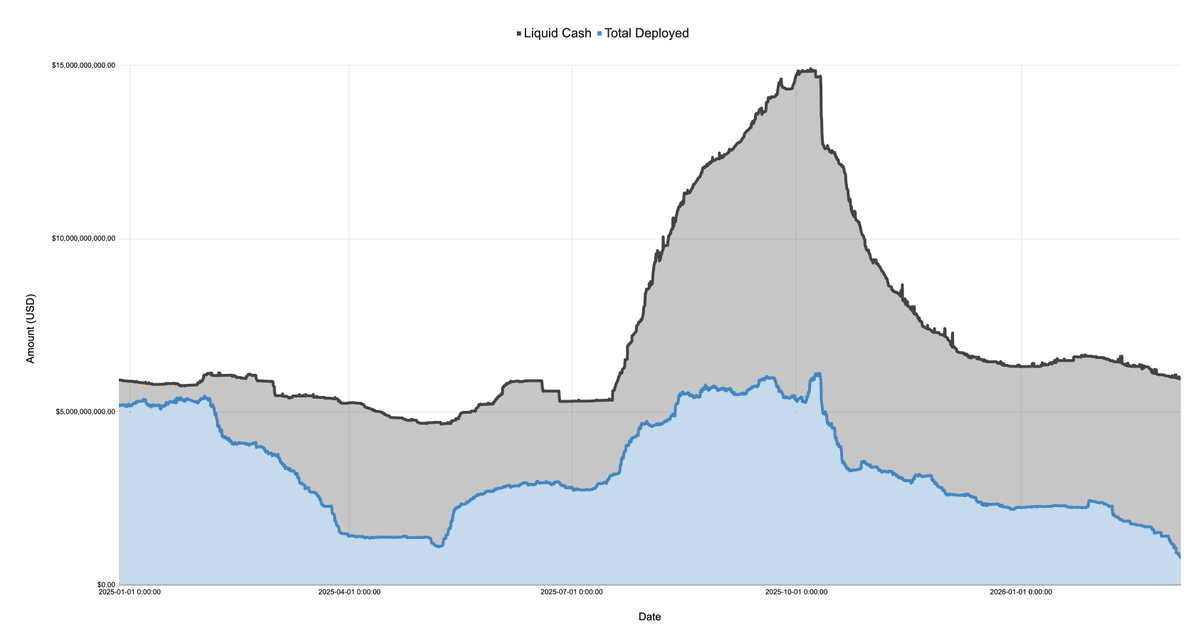
In 2025, following the launch of the TRUMP token in January, the market quickly entered a risk-off state, continuing to decline during the initial tariff discussions and the "Liberation Day" event in April. During this period, Ethena's deployed capital plummeted from over $5 billion to about $1.1 billion, a drop of more than 75%.

Remember, Ethena's deployed capital can be seen as a proxy for excess long demand in the market. Although Ethena is not the only institution executing this trade, its scale is very large (at times accounting for about 25% of the total size on Binance and Bybit). As long as Ethena has excess cash, it would theoretically expand its positions to fill the unmet long demand in the market. This means that while overall long demand may not have fallen by 75%, the excess long demand not absorbed by directional shorts did indeed decrease by that much.

The chart below shows the change in deployed capital in Ethena's balance sheet relative to its total size, the 2025 low, and the 2025 high.
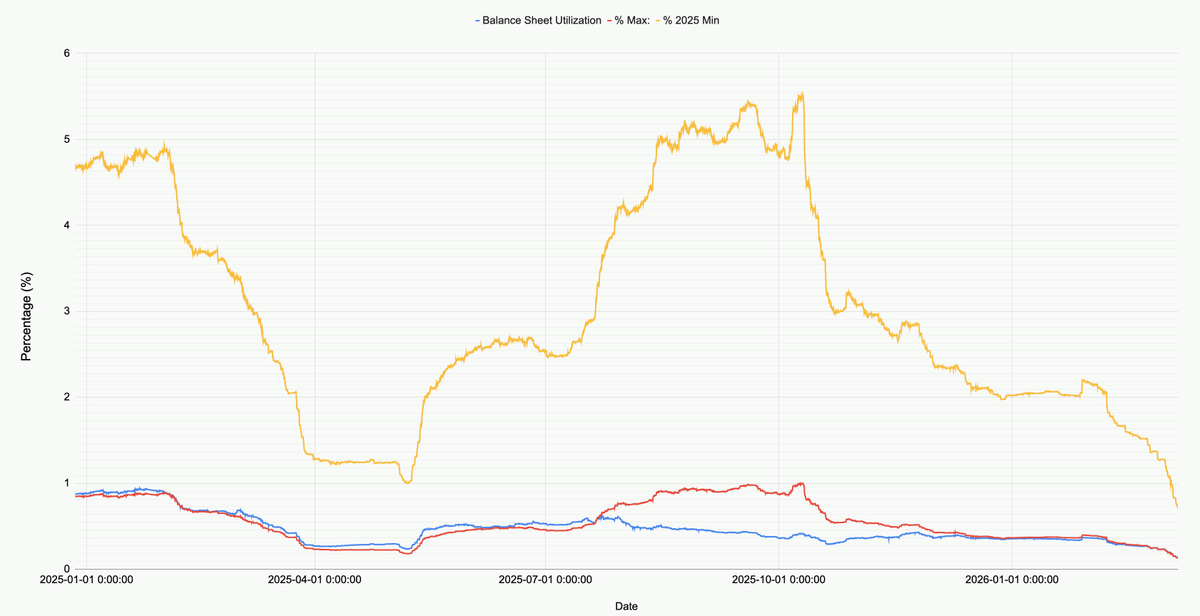
Observing the current market, Ethena's deployed capital across all markets (BTC, ETH, SOL, BNB, XRP, HYPE) is $790 million. This value is only 71% of the 2025 low and 12.9% of the pre-October 10th high. This number is not a criticism of Ethena but a reflection of the overall market state — net long demand in the current market is at a historically low level.

It is worth noting that during the market crash when Bitcoin fell to $60,000, Ethena still deployed over $2 billion in capital. Yet, just one month later, after February 8, 2026, deployed capital plummeted by 60%.

The chart below zooms in on Ethena's deployed capital and Bitcoin's price movement since January of this year.
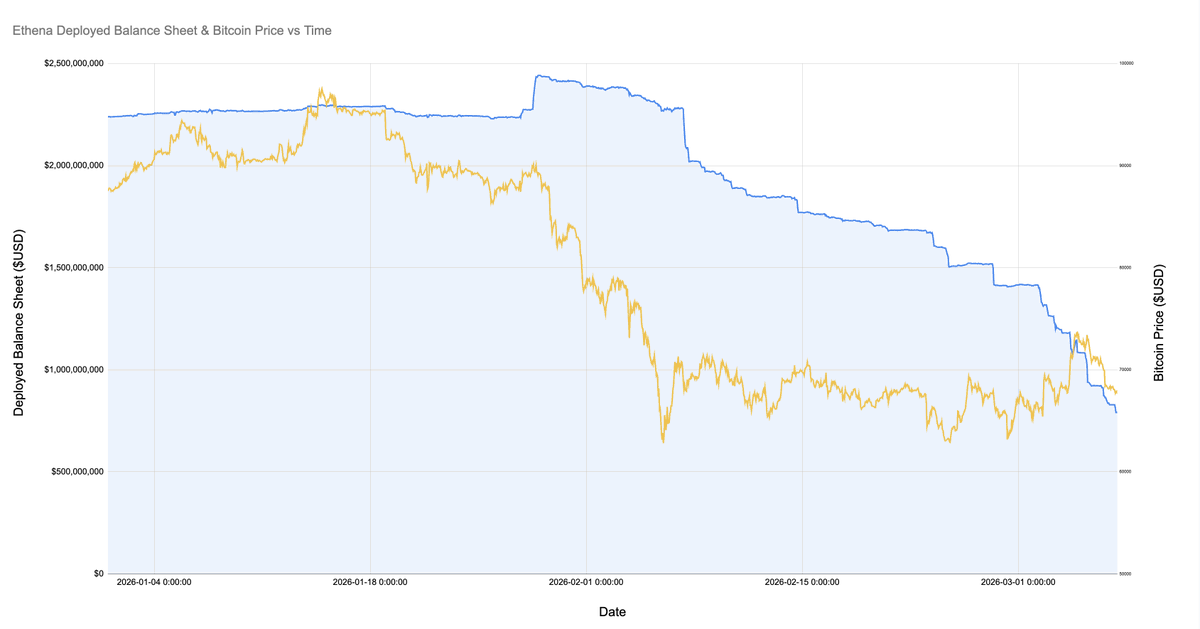
Since BTC fell to $60,000, Ethena's basis positions have shrunk from over $2 billion to less than $800 million. This change is quite intriguing because the overall market price has been relatively stable during this period. There are three possible explanations for this situation:

  • Basis trades from the February crash are gradually closing. These trades were profitable but unsustainable (the basis became more negative, but the funding rate was also negative);
  • Directional short and hedging demand increased, squeezing out opportunistic basis traders;
  • Insufficient demand for leveraged long exposure.
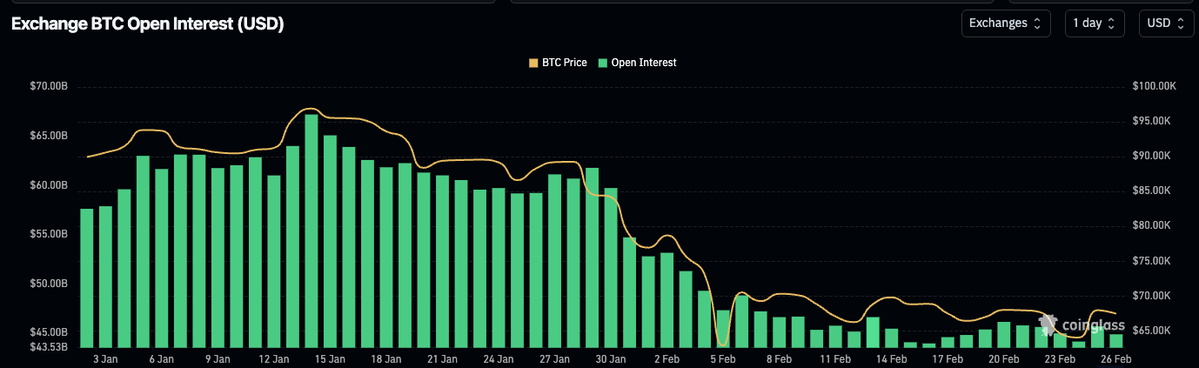
In my opinion, the reality is mainly a combination of the first two possibilities, with the third possibility having a smaller impact. As shown in the figure above, during the period when Ethena was gradually closing its positions, the open interest of Bitcoin and other major assets remained generally stable. At the same time, funding rates were negative for a considerable period, and coins like SOL had cumulative negative funding rates on multiple exchanges. This indicates that market demand for directional shorting or hedging exposure is rising.

If I had to guess, I think many small and medium-sized crypto companies and VCs are going through a crisis. Think of those small-cap projects (like Eigen, Grass, Monad, etc.). There could be hundreds of such tokens, and each project corresponds to multiple VCs, a project team, a company treasury, and a large number of employees. VCs need to limit losses and lock in profits to meet fund investment requirements, and project companies need to protect their operational capital reserves and employee size. This creates a situation where all participants must squeeze as much yield as possible from limited resources, and the solution is often a "crowded trade" — actively managed structured products that short a basket of correlated assets.

We can see some signs of these structured products in some short-term spikes in ETH, as these rallies often trigger short covering and drive synchronous increases in many small and mid-cap crypto assets. Another piece of evidence is the noticeable crowding out of opportunistic basis trading (e.g., Ethena) from the market.

Whatever the reason, we can ascertain that for almost the first time in crypto market history, directional longs and directional shorts have reached almost complete parity.

Theoretically, there is no reason why this state cannot become the new normal, or that this structure necessarily needs to change. But if we look at markets in other asset classes, we find that such a trend is very rare to sustain long-term.


Related Questions

QWhat is the current state of the net long vs. net short structure in the perpetual futures market according to the article?

AThe net long vs. net short structure is in a historically rare state where directional shorts have almost reached parity with directional longs, a situation that is extremely difficult to sustain long-term in crypto markets.

QHow does Ethena's deployed capital serve as an indicator for the market's risk appetite?

AEthena's deployed capital acts as a proxy for the market's excess long demand that is not absorbed by directional shorts. Its current sharp decline to multi-year lows reflects a historically low level of net long demand and a significant risk-off sentiment in the market.

QWhat are the four types of contract holders in the perpetual futures market as described in the article?

AThe four types are: 1. Directional longs (speculating on price increases), 2. Directional shorts (speculating on price decreases or hedging existing holdings), 3. Basis traders (opportunistic shorts filling excess long demand), and 4. Perp-Perp arbitrageurs (holding matched long and short positions to profit from price differences between markets).

QWhat does the sharp decrease in Ethena's deployed capital since February 8th, 2026, suggest about the market dynamics?

AThe 60% decrease in deployed capital, while prices remained relatively stable, suggests a combination of profitable but unsustainable basis trades from the February crash being unwound and a significant increase in directional shorting or hedging demand, which has crowded out opportunistic basis traders.

QWhy does the author believe a major market shift (变盘) is imminent?

AThe author believes a shift is imminent because the current equilibrium, where directional longs and shorts are nearly equal, is a historically rare and unstable structure in crypto markets. Observing other asset classes shows that such a trend is extremely difficult to maintain for a long period, implying a reversion or a breakout is likely.

Related Reads

Crypto is dead, Perps are forever

The crypto industry is shifting from a focus on creating native assets (like altcoins and protocol tokens) to becoming a "global asset pipeline." Native cryptocurrencies, except for Bitcoin, are seen as failing in their value storage and utility promises, with demand driven largely by speculation. Attention and liquidity are now moving toward real-world assets (RWAs) like U.S. stocks, bonds, gold, and oil traded on-chain via perpetual contracts (Perps). Stablecoins like USDT and USDC set the precedent, proving blockchain's core strength is efficient global settlement and transfer, not inventing new monetary systems. Meanwhile, assets like Ethereum and many DeFi tokens struggle as their narratives weaken against tangible traditional assets and the rapid real-world progress of AI. Perpetual contracts have emerged as a pivotal innovation. They simplify trading by offering pure price exposure to any asset, bypassing complexities of ownership, custody, and traditional market hours. Projects like Hyperliquid gained traction by combining CEX-like efficiency with on-chain transparency, capitalizing on post-FTX distrust, macroeconomic volatility, and the surge in demand for 24/7 stock trading. In conclusion, while the era of speculative native "crypto assets" may be over, perpetual contracts persist as the industry's most potent financial instrument—transforming all assets into globally accessible, constantly tradable instruments centered on price speculation.

marsbit7m ago

Crypto is dead, Perps are forever

marsbit7m ago

Tencent, Alibaba, ByteDance in a Battle for the Skill Store

Skill is becoming a key concept in the AI field, essentially serving as a structured "instruction manual" for AI Agents that specifies tool calls, decision logic, and output standards. This allows Agents to execute predefined tasks. As the number of Skills grows, distribution platforms have emerged. Major tech companies are swiftly entering this space. In March, Tencent, Alibaba, and ByteDance launched Skill stores within their respective Agent platforms. Subsequently, players like Zhipu AI, Meituan, and Xiaohongshu joined the fray. This competition for the "Skill store" is fundamentally a battle for the AI-era user entry point; whoever controls distribution controls the users. While ByteDance's Coze has experimented with paid Skills, most platforms offer them for free. The real value lies not in the stores themselves but in using them to attract and retain users within an ecosystem, driving revenue from services like cloud computing, model calls, or advertising. The landscape features three main player types: 1) **Internet giants** (e.g., Alibaba, ByteDance, Tencent, Meituan), leveraging Skills to drive traffic and monetize through their broader ecosystems (cloud services, transactions, ads). 2) **Large model companies** (e.g., Zhipu AI, Moonshot AI), using Skill stores to increase user engagement and monetize model API calls. 3) **Content platforms** (e.g., Xiaohongshu), treating Skills as a new content format to generate traffic and ad revenue. However, transforming Skill stores into a sustainable business faces significant hurdles. Key challenges include: the **difficulty in pricing Skills** due to inconsistent outputs across different models and contexts; **lack of cost transparency** (varying token consumption); **security risks** like Skill poisoning; and the **absence of standardized protocols** for development and evaluation. Unlike standardized mobile apps, Skills are often personalized workflows resistant to uniformity, which hinders the establishment of a reliable review and monetization system akin to the App Store. While there is genuine user demand for paid Skills—particularly in enterprise (e.g., contract review) and certain personal productivity scenarios—current platforms offer developers limited and unpredictable distribution. The future of Skill stores depends on overcoming these standardization, evaluation, and safety challenges to make acquiring a Skill as straightforward as downloading an app. For now, the stores function more as display shelves than robust marketplaces.

marsbit7m ago

Tencent, Alibaba, ByteDance in a Battle for the Skill Store

marsbit7m ago

The Crypto Scene Is Dead, Perpetual Swaps Are Eternal

The crypto industry is undergoing a fundamental shift. The era defined by minting novel, native digital assets (altcoins) is fading. These assets, lacking real-world cash flows or clear value, are losing relevance as attention and capital flow elsewhere. Two powerful external forces are reshaping the space. First, traditional assets like U.S. stocks, bonds, gold, and oil are being tokenized and traded on-chain. Second, the explosive growth of AI, with its tangible products, has overshadowed crypto's once-dominant "future narrative." This marks a critical pivot: crypto is transitioning from being a "factory for new assets" to becoming a "global conduit for existing assets." Its validated utility is not complex financial reinvention but efficient global settlement, transfer, and trading—the original promise of blockchain. Stablecoins like USDT and USDC exemplify this, offering faster dollar movement rather than replacing it. Consequently, native ecosystems like Ethereum face profound challenges. While still crucial infrastructure, ETH struggles to capture value as users interact with Layer 2s or trade traditional assets without needing to hold it. DeFi's grand narrative of rebuilding finance has narrowed to core needs like cheap transfers and deep liquidity. The true breakout innovation is the perpetual contract (Perp). It brilliantly bypasses the complexities of direct asset ownership (custody, compliance, dividends) by creating pure price exposure. Users can speculate on the price movement of *any* asset—NVIDIA, gold, oil—24/7, globally, and with leverage. This "price casino" model, while risky and ethically fraught, delivers unmatched liquidity and accessibility. Projects like Hyperliquid succeeded not by inventing new mechanics but by perfecting the timing and execution of this model. Key drivers included making on-chain Perps feel like centralized exchanges, post-FTX trust migration towards transparency, and rising demand to trade macro assets and equities round-the-clock. In conclusion, the crypto world's most enduring successes are the dollar (via stablecoins), Bitcoin, and trading. Its new frontier is not creating alternative assets but providing a seamless, perpetual trading layer—a new API—for the world's existing financial system. The age of native altcoins is over; the age of perpetual synthetic exposure has begun.

Odaily星球日报16m ago

The Crypto Scene Is Dead, Perpetual Swaps Are Eternal

Odaily星球日报16m ago

After Marvell's 32% Surge, the Chinese Chip Family Behind It Emerges

The stock price of Marvell Technology surged 32.5% on June 2nd, driven by NVIDIA CEO Jensen Huang highlighting its custom ASICs and optical interconnects as core to AI data center architecture. This event brought attention to the Chinese semiconductor family behind Marvell: the Dai siblings. The story centers on three siblings, all UC Berkeley graduates, whose three-decade entrepreneurial journey aligns with major semiconductor industry shifts. In 1995, youngest sister Dai Wei Li co-founded Marvell with her husband Sehat Sutardja and his brother, focusing on storage controllers. Eldest brother Dai Wei Min founded EDA company Ultima, later sold to Cadence, and later founded VeriSilicon (芯原) in China, becoming a leading semiconductor IP provider. Second brother Dai Wei Jin co-founded EDA firm Silicon Perspective (sold to Cadence) and GPU IP company Vivante, later acquired by VeriSilicon. The combined "Dai-Sutardja" family network extends beyond Marvell. Their ventures and investments form a comprehensive ecosystem for the post-Moore's Law, chiplet era. Key holdings include: Dream Big Semiconductor (AI SuperNICs, acquired by Arm), Alphawave (high-speed SerDes IP, acquired by Qualcomm), and Silicon Box (a chiplet advanced packaging foundry). VeriSilicon itself thrives on the AI ASIC and IP boom in China. Collectively, the family's AI infrastructure-related portfolio is estimated at over $22 billion. Their strategy represents a distinct path: building critical components for open standards and key manufacturing capacity in the chiplet era, rather than pursuing standalone AI chip dominance. While this path may not create the next NVIDIA, it has enabled repeated successful exits and sustained influence within the global semiconductor industry.

marsbit1h ago

After Marvell's 32% Surge, the Chinese Chip Family Behind It Emerges

marsbit1h ago

Trading

Spot
Futures
活动图片