Turning 200,000 into Nearly 100 Million: DeFi Stablecoin Attacked Again

marsbitPublished on 2026-03-22Last updated on 2026-03-22

Abstract

DeFi stablecoin protocol Resolv Labs was exploited, resulting in a hacker minting 80 million USR tokens using only 200,000 USDC. The attacker’s address (starting with 0x04A2) first created 50 million USR with 100,000 USDC, and later minted another 30 million with an additional 100,000 USDC. This caused USR to depeg, dropping to around $0.25 before partially recovering to approximately $0.80. The incident also impacted related lending markets on Morpho and Lista DAO, which paused new borrowing requests. Additionally, RLP token holders, including Stream Finance—which holds over 13 million RLP tokens—face significant exposure, with estimated losses around $17 million. Initial analysis by DeFi community YAM suggests the exploit occurred because the protocol’s SERVICE_ROLE, which provides minting parameters, was compromised. The system fully trusted this role’s input without on-chain verification or minting limits, allowing the attacker to manipulate the mint amount. The project’s emergency response was also slow, taking nearly three hours to pause the protocol due to multi-signature delays. This attack highlights critical vulnerabilities in off-chain role trust and emergency mechanisms within DeFi protocols.

Written by: Eric, Foresight News

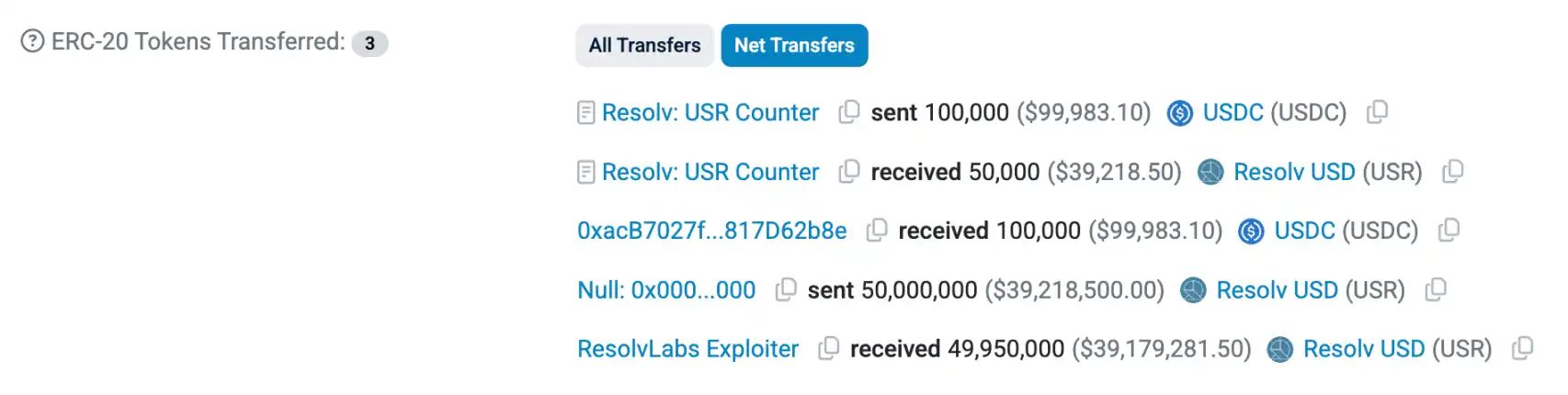
At approximately 10:21 Beijing time today, Resolv Labs, which issues the stablecoin USR using a Delta neutral strategy, was hacked. An address starting with 0x04A2 used 100,000 USDC to mint 50 million USR from the Resolv Labs protocol.
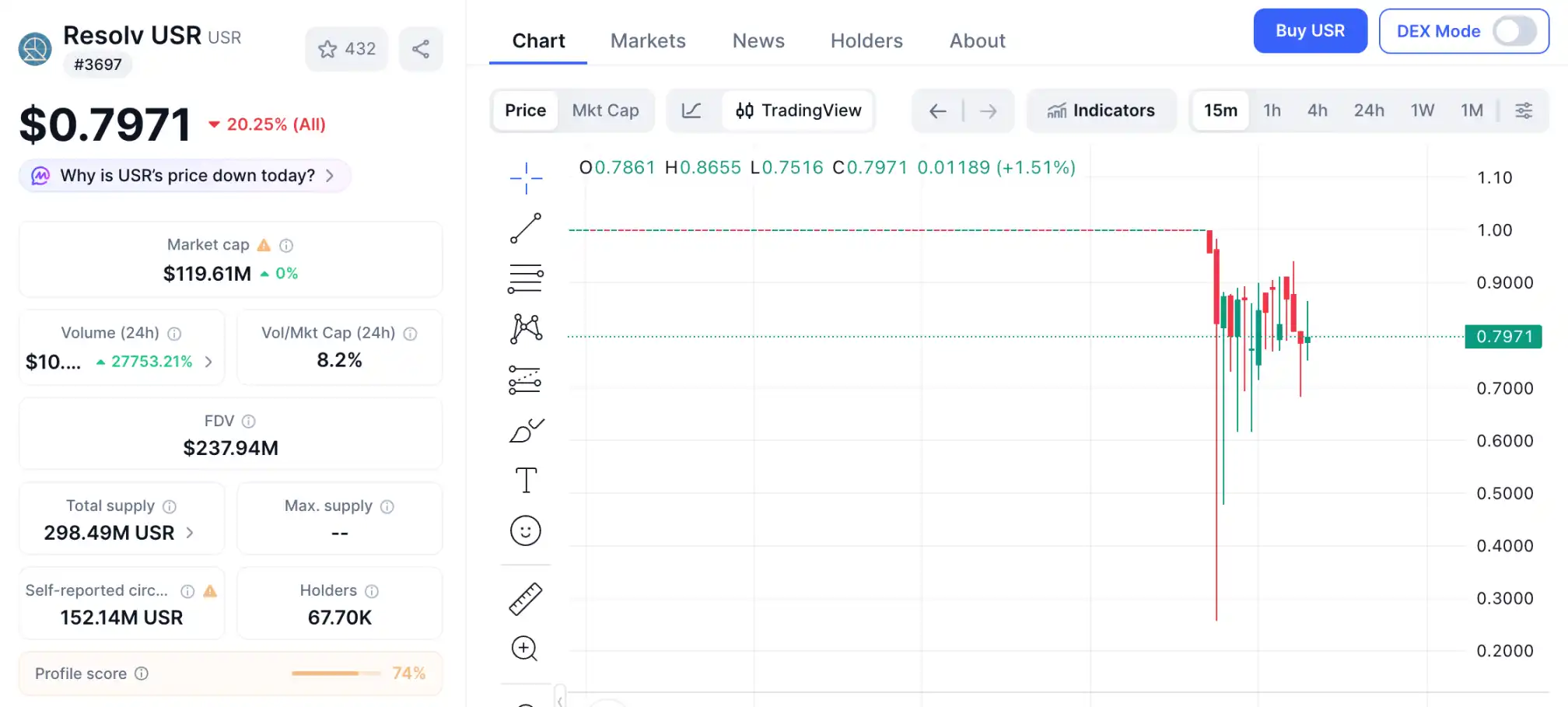
As the incident was exposed, USR plummeted to around $0.25, and as of writing, it has recovered to approximately $0.80. The price of the RESOLV token also saw a short-term drop of nearly 10%.
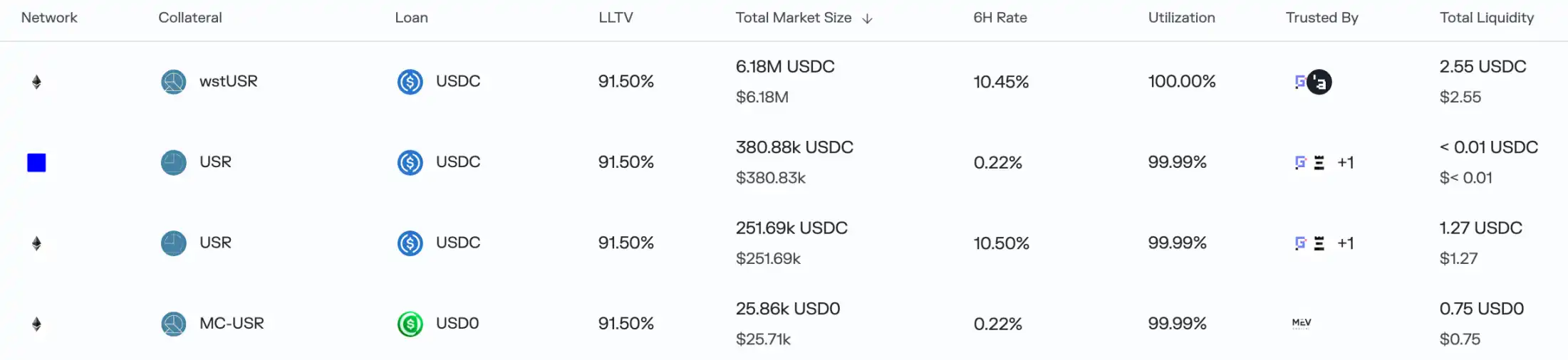
Subsequently, the hacker repeated the same method, using another 100,000 USDC to mint 30 million USR. As USR significantly depegged, arbitrage traders quickly took action. Many lending markets on Morpho that supported USR, wstUSR, and others as collateral were almost drained, and Lista DAO on BNB Chain also suspended new borrowing requests.
The impact was not limited to these lending protocols. In the Resolv Labs protocol design, users can also mint an RLP token, which has greater price volatility and higher returns but requires bearing compensation liability when the protocol incurs losses. Currently, the circulating supply of RLP tokens is nearly 30 million, with the largest holder, Stream Finance, holding over 13 million RLP, representing a net risk exposure of approximately $17 million.

Yes, Stream Finance, which was previously hit by the xUSD incident, may be hit again.

As of writing, the hacker has converted USR into USDC and USDT and continues to buy Ethereum, having purchased over 10,000 ETH so far. Using 200,000 USDC, the hacker extracted over $20 million in assets, finding their "hundred-fold coin" during the bear market.

Another Exploit Due to "Lack of Rigor"

The sharp drop on October 11 last year caused collateral losses for many stablecoins issued using Delta neutral strategies due to ADL (Auto-Deleveraging). Projects using altcoins as assets for strategy execution suffered even more severe losses, with some even directly absconding.

The attacked Resolv Labs also uses a similar mechanism to issue USR. The project announced in April 2025 that it had completed a $10 million seed round led by Cyber.Fund and Maven11, with participation from Coinbase Ventures, and launched the RESOLV token at the end of May/early June.

However, the reason for the attack on Resolv Labs was not extreme market conditions but rather a "lack of rigor" in the design of the USR minting mechanism.

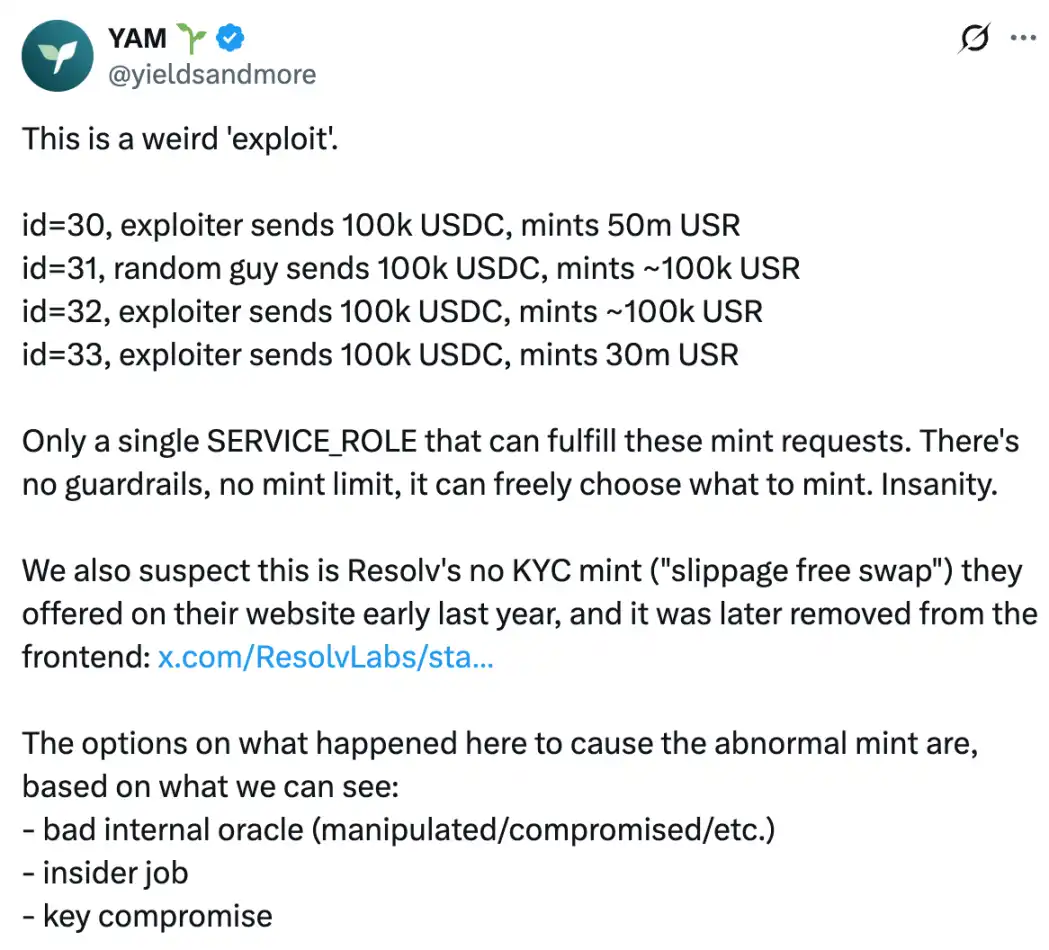
No security firm or official has yet analyzed the cause of this hack. The DeFi community YAM preliminarily concluded through analysis that the attack was likely caused by the SERVICE_ROLE, used by the protocol's backend to provide parameters to the minting contract, being compromised by the hacker.
According to Grok's analysis, when a user mints USR, they initiate a request on-chain and call the contract's requestMint function, with parameters including:

_depositTokenAddress: the address of the deposited token;

_amount: the amount deposited;

_minMintAmount: the minimum expected amount of USR to receive (slippage protection).

Subsequently, the user deposits USDC or USDT into the contract. The project's backend SERVICE_ROLE monitors the request, uses the Pyth oracle to check the value of the deposited assets, and then calls the completeMint or completeSwap function to determine the actual amount of USR to mint.

The problem lies in the fact that the minting contract fully trusts the _mintAmount provided by the SERVICE_ROLE, assuming this number was verified off-chain by Pyth. Therefore, it did not set an upper limit restriction, nor did it perform on-chain oracle verification, and directly executed mint(_mintAmount).

Based on this, YAM suspects that the hacker gained control of the SERVICE_ROLE, which should have been controlled by the project team (possibly due to internal oracle failure, insider theft, or key compromise), and directly set the _mintAmount to 50 million during the minting process, achieving the attack of minting 50 million USR with 100,000 USDC.

In conclusion, Grok's assessment is that Resolv did not consider the possibility that the address (or contract) receiving user minting requests could be compromised by hackers when designing the protocol. When the USR minting request was submitted to the final USR minting contract, no maximum minting amount was set, nor did the minting contract perform secondary verification using an on-chain oracle; it simply trusted all parameters provided by the SERVICE_ROLE.

Inadequate Prevention

In addition to speculating on the cause of the hack, YAM also pointed out the project's lack of preparedness in crisis response.

YAM stated on X that Resolv Labs only paused the protocol 3 hours after the hacker's first attack was completed, with about 1 hour of delay coming from collecting the 4 signatures required for the multisig transaction. YAM believes that an emergency pause should require only one signature, and the authority should be assigned to team members as much as possible, or to trusted external operators, to increase attention to on-chain anomalies, improve the possibility of quick pauses, and better cover different time zones.

Although the suggestion of requiring only a single signature to pause the protocol is somewhat radical,确实 requiring multiple signatures across different time zones to pause the protocol can indeed cause significant delays when emergencies occur. Introducing trusted third parties who continuously monitor on-chain behavior, or using monitoring tools with emergency protocol pause permissions, are lessons learned from this incident.

Hacker attacks on DeFi protocols have long gone beyond contract vulnerabilities. The Resolv Labs incident serves as a warning to project teams: the assumption in protocol security should be to trust no single link; all parameter-related links must undergo at least secondary verification, even if it's the project's own operational backend.


Related Questions

QWhat was the main reason behind the Resolv Labs hack according to the DeFi community YAM's analysis?

AThe hack was likely due to the SERVICE_ROLE, which provides parameters to the minting contract, being controlled by the hacker. The minting contract fully trusted the _mintAmount parameter provided by SERVICE_ROLE without setting a maximum limit or performing a secondary on-chain oracle verification.

QHow much initial capital did the hacker use, and what was the approximate value of the assets they obtained?

AThe hacker used 200,000 USDC to mint a large amount of USR and subsequently obtained assets worth over 20 million US dollars.

QWhich protocols or platforms were affected beyond Resolv Labs itself due to this attack?

AMorpho's lending markets that accepted USR and wstUSR as collateral were almost drained, and Lista DAO on BNB Chain paused new borrowing requests. Additionally, RLP token holders, like Stream Finance, faced significant risk exposure.

QWhat specific flaw in the protocol's design allowed the hacker to mint an excessive amount of USR?

AThe protocol's design did not consider the possibility that the address (or contract) receiving user minting requests could be compromised. The minting contract lacked a maximum mint amount limit and did not use an on-chain oracle for secondary verification, blindly trusting all parameters from the SERVICE_ROLE.

QWhat criticism did YAM level against Resolv Labs' emergency response measures?

AYAM criticized that it took Resolv Labs 3 hours to pause the protocol after the first attack, with about an hour of that delay attributed to collecting 4 signatures required for the multisig transaction. They suggested emergency pauses should require only one signature and be assigned to team members or trusted external operators for faster response.

Related Reads

Cerebras IPO: A $48.8 Billion Valuation—Is the 'Nvidia Challenger' a Bubble or a New King?

Cerebras Systems, positioning itself as an NVIDIA challenger, is going public with a $48.8 billion valuation despite several underlying paradoxes revealed in its S-1 filing. While 2025 revenue grew 76% to $510M and GAAP net income was $237.8M, this profitability relies heavily on a one-time, non-cash accounting gain. Adjusting for this, the company's non-GAAP net loss actually widened to $75.7M. Furthermore, customer concentration remains extreme: 86% of 2025 revenue came from two Abu Dhabi-based entities, MBZUAI (62%) and G42 (24%). Its landmark deal with OpenAI, valued at over $20 billion, creates a complex, nested relationship where OpenAI is simultaneously a major customer, lender, warrant holder, and strategic partner with exclusivity clauses. Cerebras's technical edge in latency-sensitive AI inference is real, with its wafer-scale chip outperforming competitors in benchmarks. However, this advantage is confined to a specific niche, not the broader AI training market dominated by NVIDIA's CUDA ecosystem. With a 95x price-to-sales ratio, the valuation demands flawless execution of the OpenAI contract and massive future revenue growth. Key long-term risks include intense competition from giants like NVIDIA and AMD, a dual-class share structure granting insiders near-total voting control, and ongoing geopolitical uncertainties regarding export controls. The IPO is a pivotal capital markets event for AI infrastructure. As an investment, it represents a high-risk, high-reward bet on the "inference-first" narrative and Cerebras's ability to dominate its specialized segment, underpinned by a valuation that highlights the current fervor in the sector.

marsbit23m ago

Cerebras IPO: A $48.8 Billion Valuation—Is the 'Nvidia Challenger' a Bubble or a New King?

marsbit23m ago

What Happens to Ethereum Developer Tools After the Grants Run Out?

On February 27th, the Ethereum Foundation (EF) announced Project Odin, a structured sustainability support program designed for a select group of strategic, previously grant-funded teams. Unlike a standard grant, Odin offers a long-term advisory mechanism focused on helping these teams establish credible, sustainable paths within a two-year framework, thereby reducing long-term dependence on single funding sources. The program addresses a critical post-grant challenge: how essential public goods, especially major developer tools, can achieve financial sustainability beyond initial funding. While grants from EF and programs like Gitcoin or RetroPGF remain vital for startups and research, they often fall short for mature, widely-used infrastructure. Tools like compilers, languages, and network stacks are deeply embedded but struggle with monetization, trapped between being too foundational to lose and too public to generate natural revenue. Project Odin provides teams with a dedicated Strategic Advisor to guide them through a three-phase process: 1) analyzing current funding and realistic options, 2) validating potential paths with stakeholders, and 3) executing plans, which may include crafting support contracts, service agreements, or other recurring revenue models. The first pilot participant is Vyper, a critical smart contract language for the EVM, highlighting the need for sustainable models for core infrastructure. The initiative reframes the public goods conversation from "who should be funded" to "how do already-proven teams avoid perpetual funding crises?" It encourages ecosystem participants—protocols and projects that depend on these tools—to view sustainable support not just as charity, but as essential risk management for their own operational supply chains.

marsbit52m ago

What Happens to Ethereum Developer Tools After the Grants Run Out?

marsbit52m ago

MARA Reports Q1 Revenue Below Expectations, Net Loss of $1.3 Billion, Stock Plunges After Hours

Bitcoin mining firm MARA Holdings reported disappointing Q1 2024 results, causing its stock to erase all daily gains and fall 3.44% in after-hours trading. Revenue dropped 18% year-over-year to $174.6 million, missing Wall Street estimates of $192.7 million. The company posted a net loss of $1.3 billion, a significant increase from a $533.4 million loss a year ago, primarily driven by unrealized losses on its holdings of 38,689 Bitcoin, which depreciated in value during the quarter. MARA also sold over 15,100 BTC in late March to repurchase debt at a discount. The broader mining environment remains challenging due to a 35% decline in Bitcoin's price from its all-time high and a nearly 30% increase in mining difficulty over the past year. MARA's market cap ranking among U.S. miners has slipped to seventh. Critically, the company announced a strategic pivot away from Bitcoin mining expansion. It stated it has no plans to purchase new mining equipment and is fully transitioning toward AI data centers. Its strategy involves retrofitting existing mining sites for AI and high-performance computing (HPC) and leveraging its recent $1.5 billion acquisition of Long Ridge Energy & Power, a gas-fired power plant and data center. This infrastructure could eventually support 600 MW of AI compute capacity, allowing MARA to redeploy up to 90% of its non-custodial mining power for AI and IT workloads.

marsbit53m ago

MARA Reports Q1 Revenue Below Expectations, Net Loss of $1.3 Billion, Stock Plunges After Hours

marsbit53m ago

Trading

Spot
Futures
活动图片




