Trust Wallet taps Revolut for crypto purchases in Europe

cointelegraphPublished on 2025-12-11Last updated on 2025-12-11

Abstract

Trust Wallet, owned by Binance co-founder Changpeng Zhao, has partnered with Revolut to enable direct crypto purchases for users in Europe. The integration allows buying Bitcoin, Ether, and Solana with a minimum purchase of €10 and a daily cap of €23,000. While stablecoins like USDC are not yet supported, the feature supports multiple fiat currencies with zero transaction fees. However, funding a Revolut account may incur charges. The move follows Revolut’s recent regulatory approval under MiCA and its $75 billion valuation.

Trust Wallet, the self-custodial crypto wallet owned by Binance co-founder Changpeng “CZ” Zhao, has partnered with European fintech unicorn and digital banking giant Revolut to introduce a new way to purchase crypto assets on its platform.

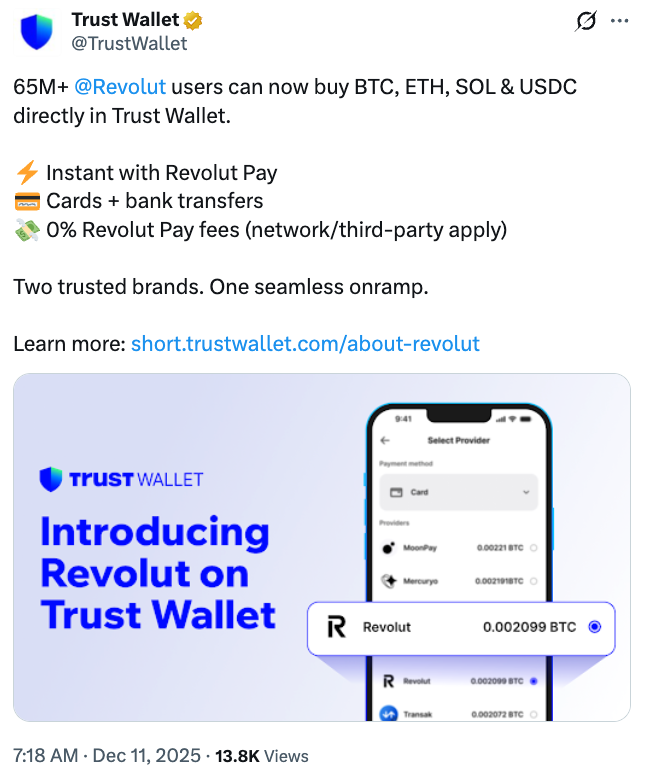
Trust Wallet users can now buy Bitcoin (BTC), Ether (ETH) and Solana (SOL) with Revolut through a direct integration, the company announced on Thursday.

With a minimum purchase starting at 10 euros ($12) and capped at 23,000 euros ($26,950) daily and per transaction, Trust Wallet’s new buy option is expected to provide a faster and easier way to access crypto from Europe.

In October, Revolut scored regulatory approval from the Cyprus Securities and Exchange Commission to offer crypto services across 30 European Economic Area markets in compliance with the European Union’s Markets in Crypto-Assets Regulation (MiCA) framework.

Stablecoins like USDC not supported, for now

The integration will initially support only three crypto assets, but the companies said they expect to add stablecoins such as Circle’s USDC (USDC) at a later stage.

The feature enables zero-fee crypto purchases using multiple fiat currencies supported by Revolut, including the euro, the British pound, as well as the Czech koruna, Danish Krone, Polish Złoty and others.
Source: Trust Wallet

While Revolut–Trust Wallet crypto purchases are offered with zero fees, adding money to a Revolut account is not free of charge in many cases, including via bank transfers, card top-ups and cash deposits. Cash deposits are subject to a 1.5% fee and are limited to $3,000 per calendar month, according to Revolut’s FAQs.

Related: Crypto self-custody is a fundamental right, says SEC’s Hester Peirce

The integration came shortly after Revolut secured a $75 billion company valuation after completing a private share sale in late November. “This makes us Europe’s most valuable private company and in the top 10 of the world’s most valuable private companies,” Revolut said in a post on X.

CZ-backed Trust Wallet has been actively tapping into trending market sectors, including prediction markets and real-world asset tokenization, expanding access to these offerings for self-custody users.

Cointelegraph contacted Revolut and Trust Wallet for comment on the integration, but had not received a response by publication.

Related Reads

"AI Burning Books" Is Actually a Misunderstanding

"AI Book-Burning" Is Actually a Misunderstanding Recent reports about AI companies purchasing used books, scanning them, and then destroying the physical copies have sparked widespread outrage. Terms like "AI is devouring human knowledge" have become common, fueled by dramatic visuals of books being cut and shredded. However, the actual facts reveal a more nuanced story. While companies like Anthropic have indeed spent millions to buy and "destructively scan" several million books for AI training, this volume is a small fraction of the global second-hand book market. The core act—digitizing content and then discarding the physical object—is the opposite of historical book-burning, which aimed to erase knowledge. A key point of contention is the purchase of rare or out-of-print books. Yet, if these books were legally for sale on the open market, the buyer (whether an AI firm or an individual) has the right to do with them as they wish. The real question is whether society has adequate systems to protect books of genuine cultural heritage *before* they are sold. Expecting profit-driven companies to self-regulate on this is unreliable; the solution lies in establishing public rules, such as protected lists for rare editions or granting libraries priority purchase rights. Much of the intense public reaction stems not from the scale of actual harm, but from the powerful symbolism. The image of books being fed into machines taps into deeper anxieties about AI: fears of job displacement, mistrust of tech giants, and the unsettling feeling that humanity is feeding its own cultural past to the systems that might replace it. The outrage over "AI book-burning" is thus less about the physical books and more a proxy for broader societal tensions surrounding artificial intelligence.

marsbitJust now

"AI Burning Books" Is Actually a Misunderstanding

marsbitJust now

Robinhood CEO named three benefits of tokenized stocks for American investors

Robinhood CEO Vlad Tenev advocates for the U.S. to allow trading of tokenized stocks domestically. He argues this model could modernize the financial system through three key benefits: **faster, near real-time settlements** reducing counterparty risk and broker capital requirements; **24/7 trading** enabling reaction to market events anytime; and **greater asset portability**, allowing tokens to be moved between platforms and held in self-custody wallets, increasing competition among services. Tenev emphasized tokenization is about rebuilding asset ownership infrastructure for freer movement, similar to information online. He highlighted potential integration with DeFi, where tokenized stocks could be used for lending or as collateral. Currently, Robinhood's stock tokens are not direct ownership of the underlying securities but are backed by them and provide access to economic value like dividends; their structure may evolve with future regulations. Tenev identified outdated securities laws and market infrastructure, developed over a century, as the main U.S. obstacle, urging regulators to adapt rules for blockchain while preserving investor protections. He warned it would be strange if the rest of the world could build the future of ownership around U.S. assets while Americans are left behind, suggesting tokenization could later expand to private company shares and other illiquid assets.

cryptonews.ru21m ago

Robinhood CEO named three benefits of tokenized stocks for American investors

cryptonews.ru21m ago

Trading

Spot
活动图片